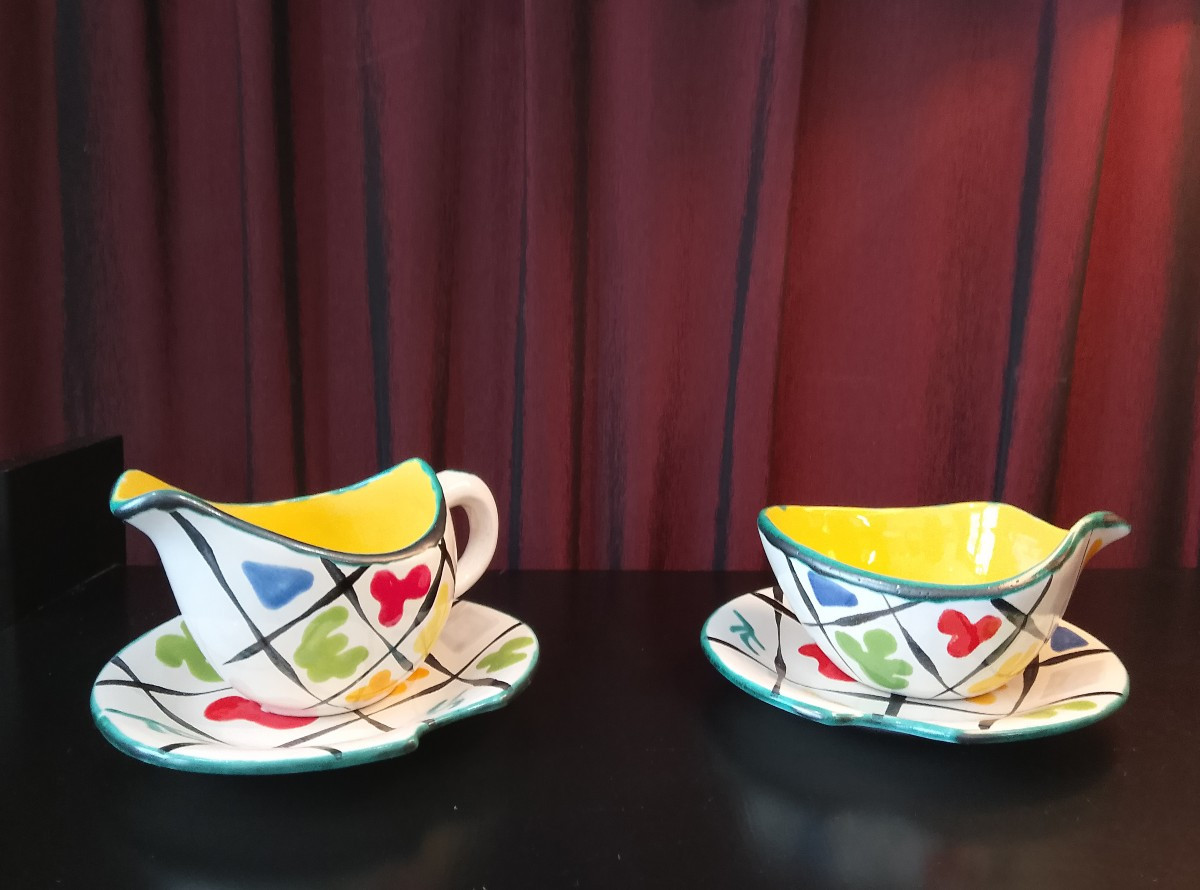
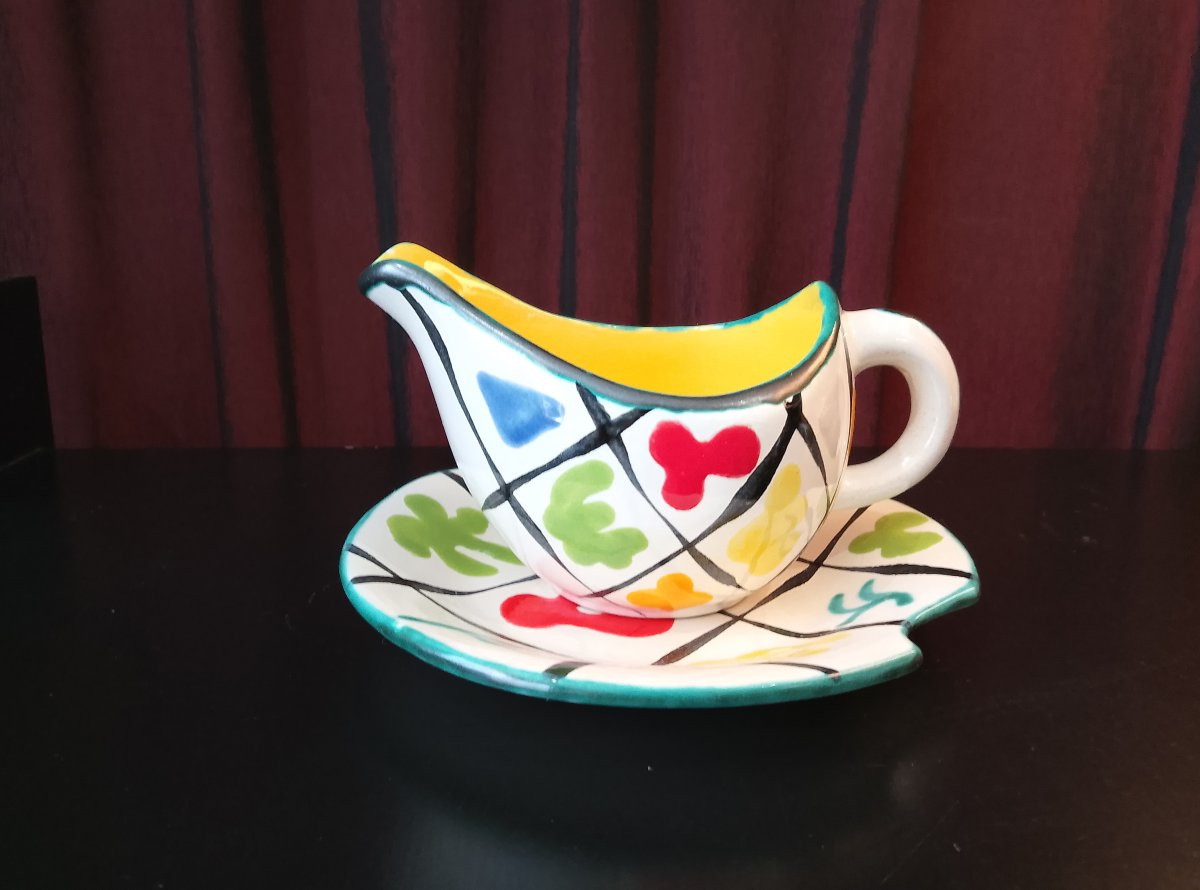
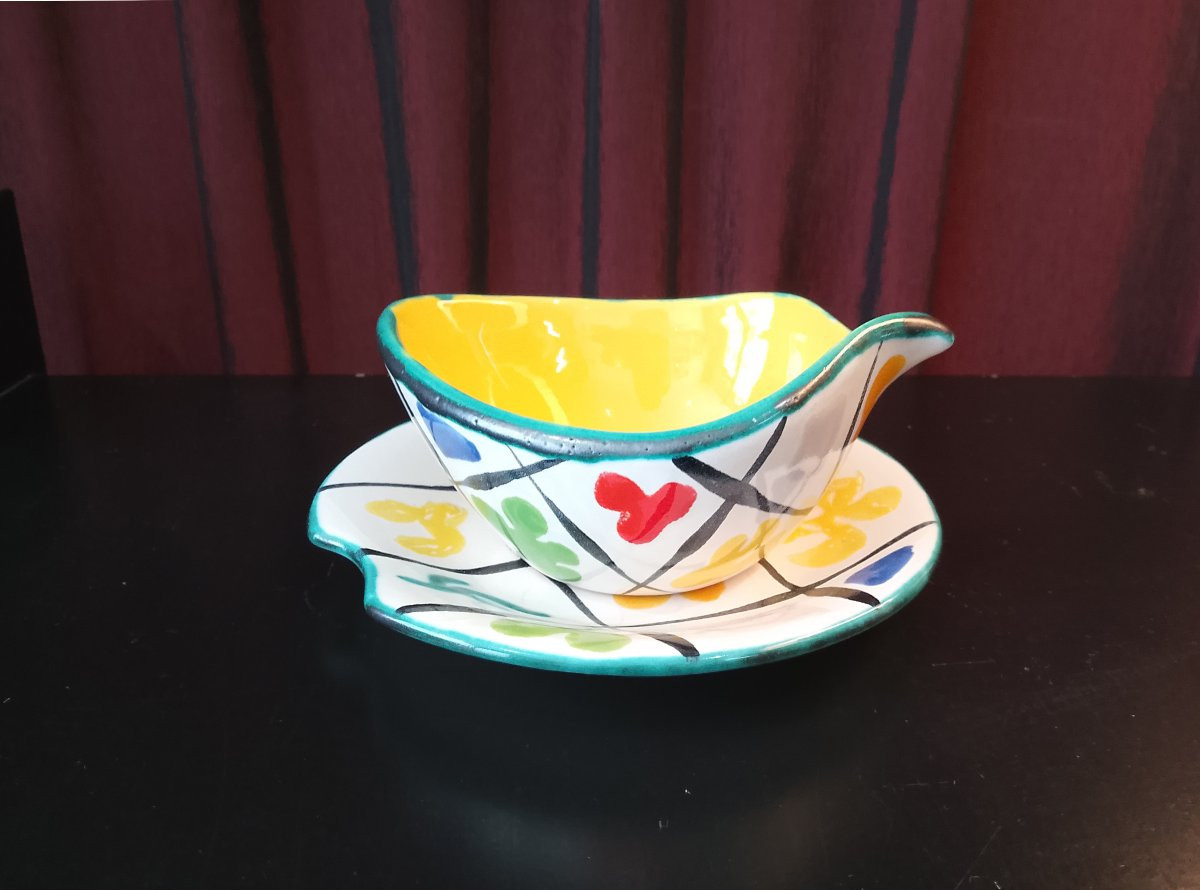
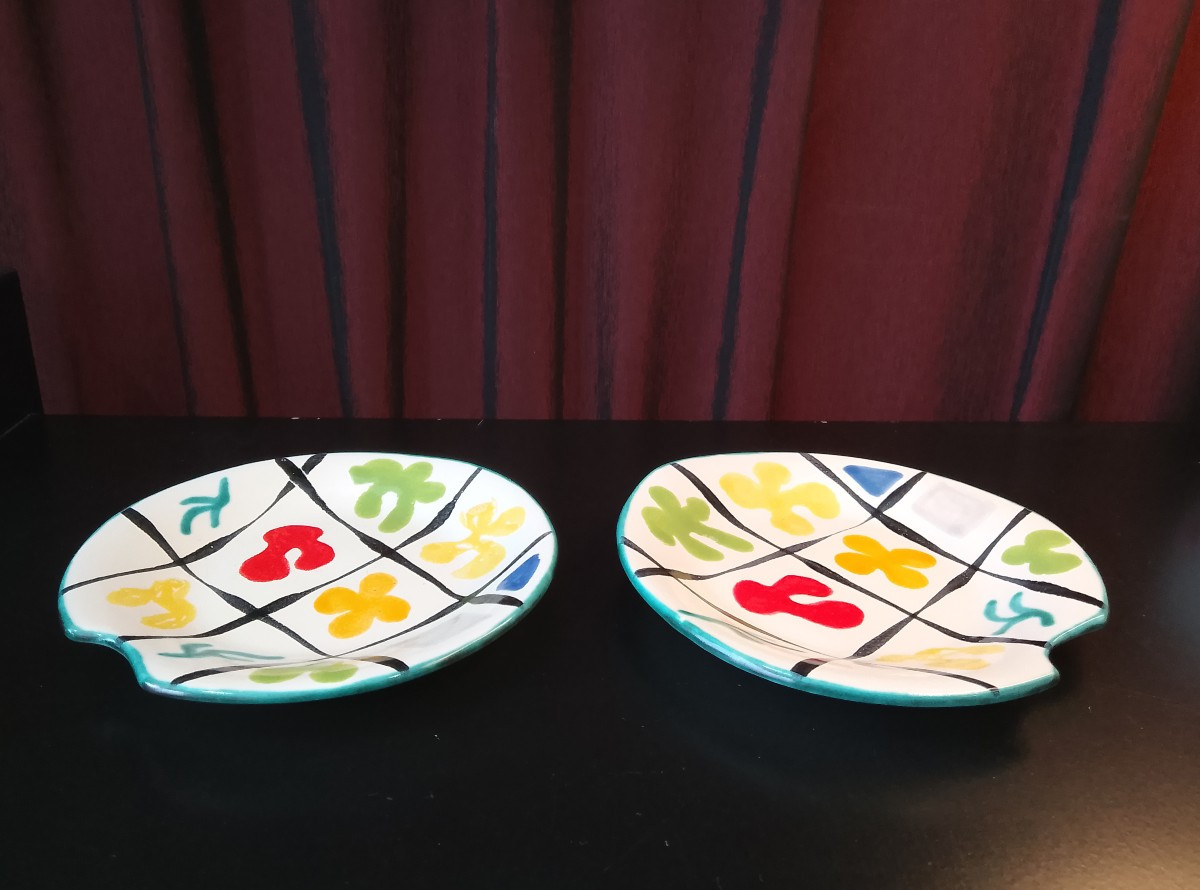

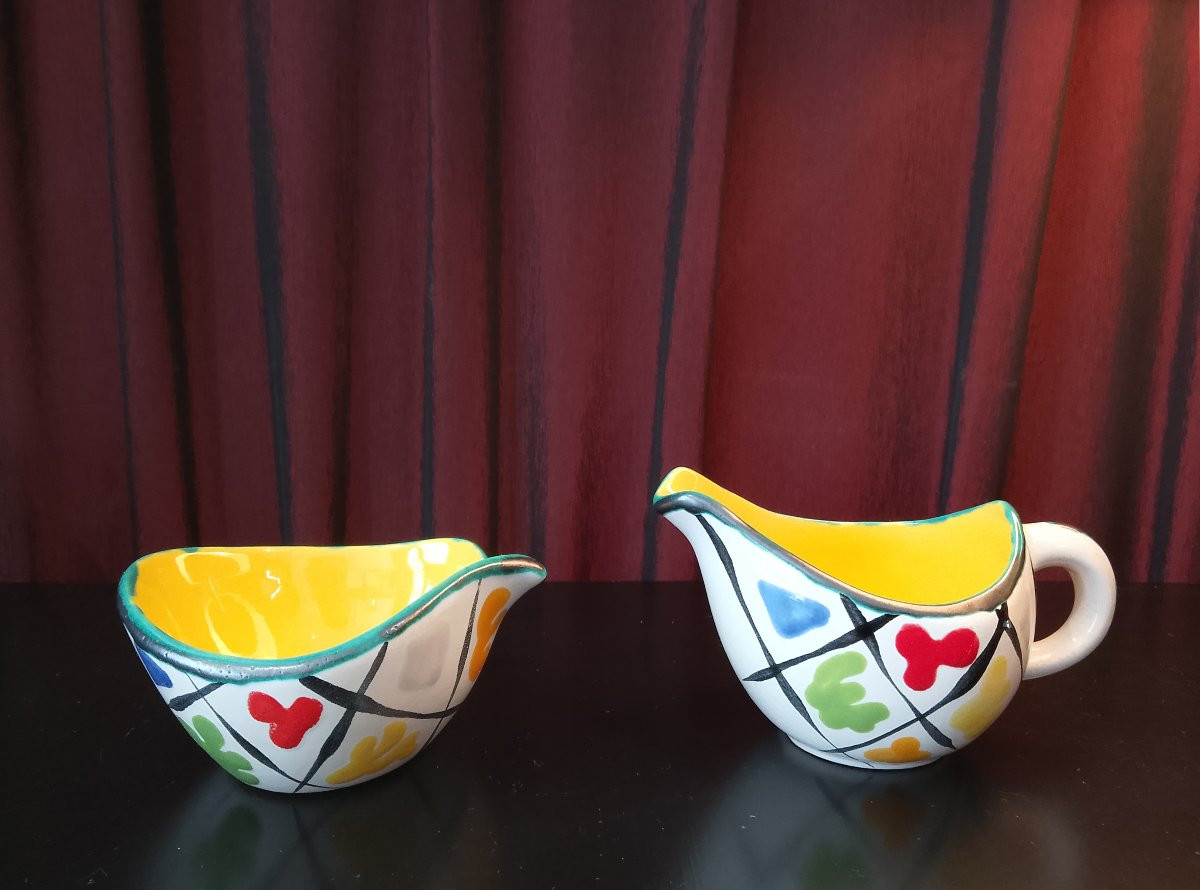
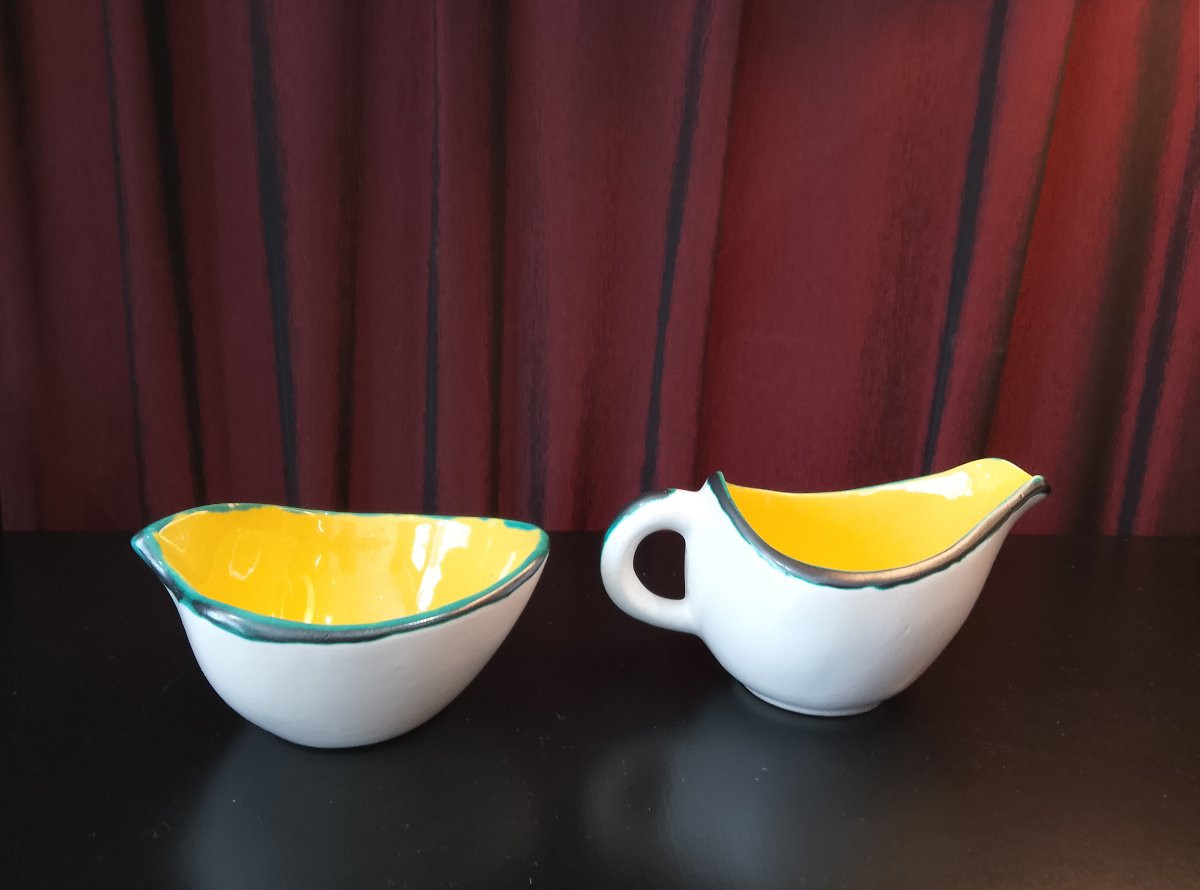
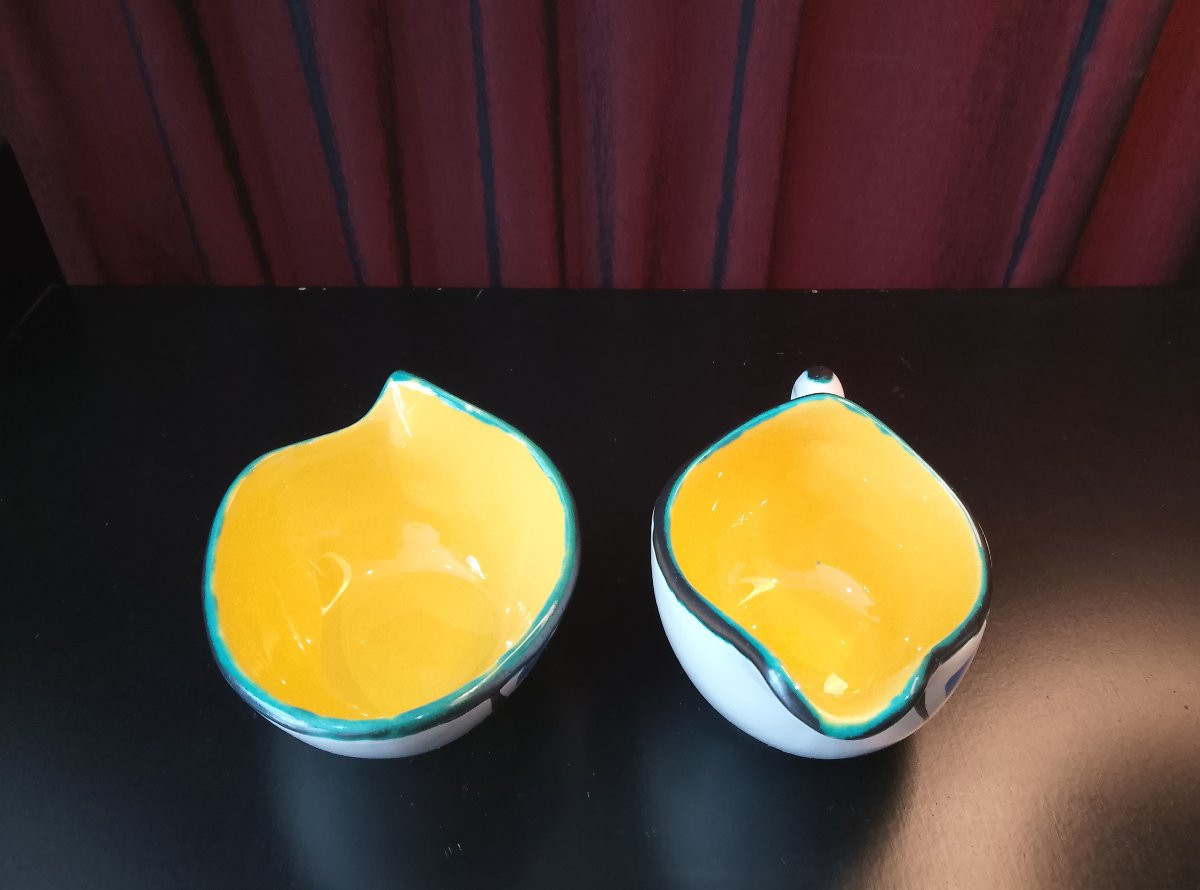
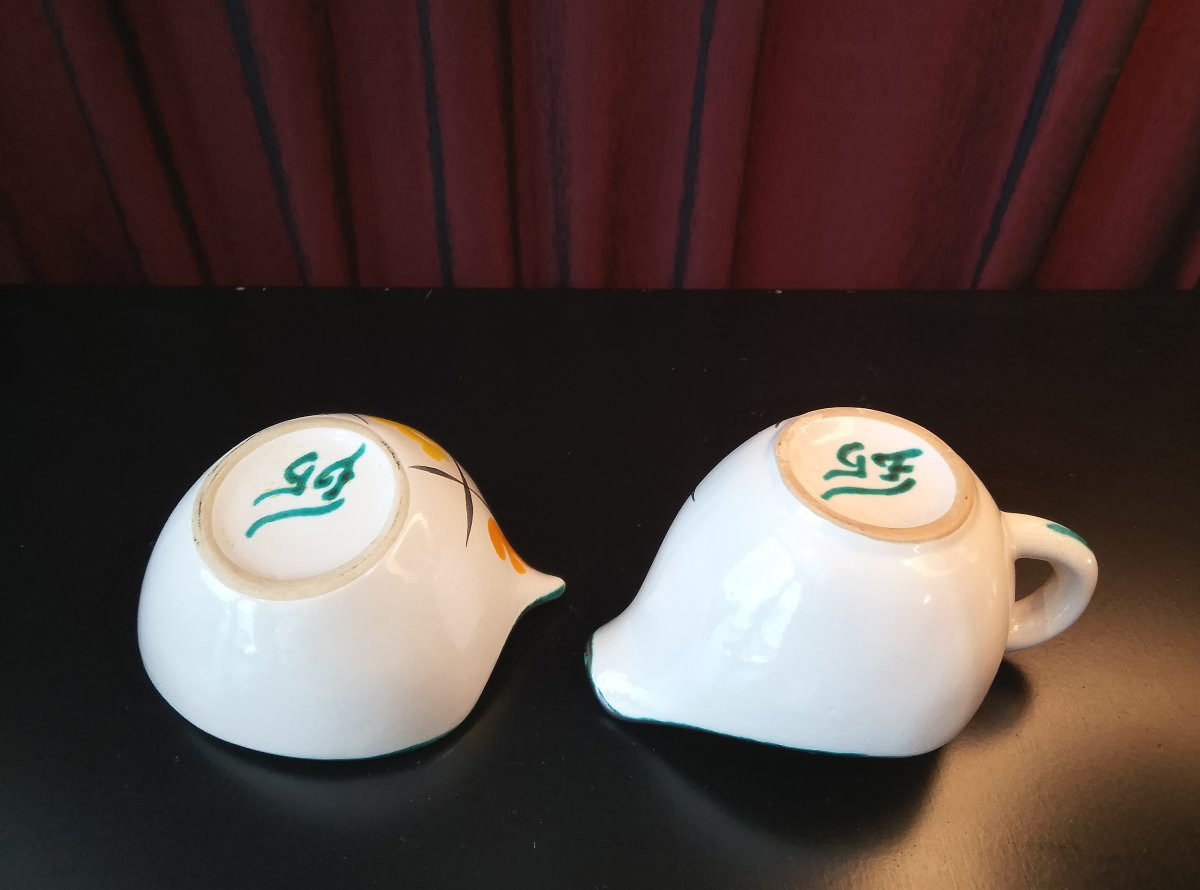


"Ceramics By Gabriel Fourmaintraux."
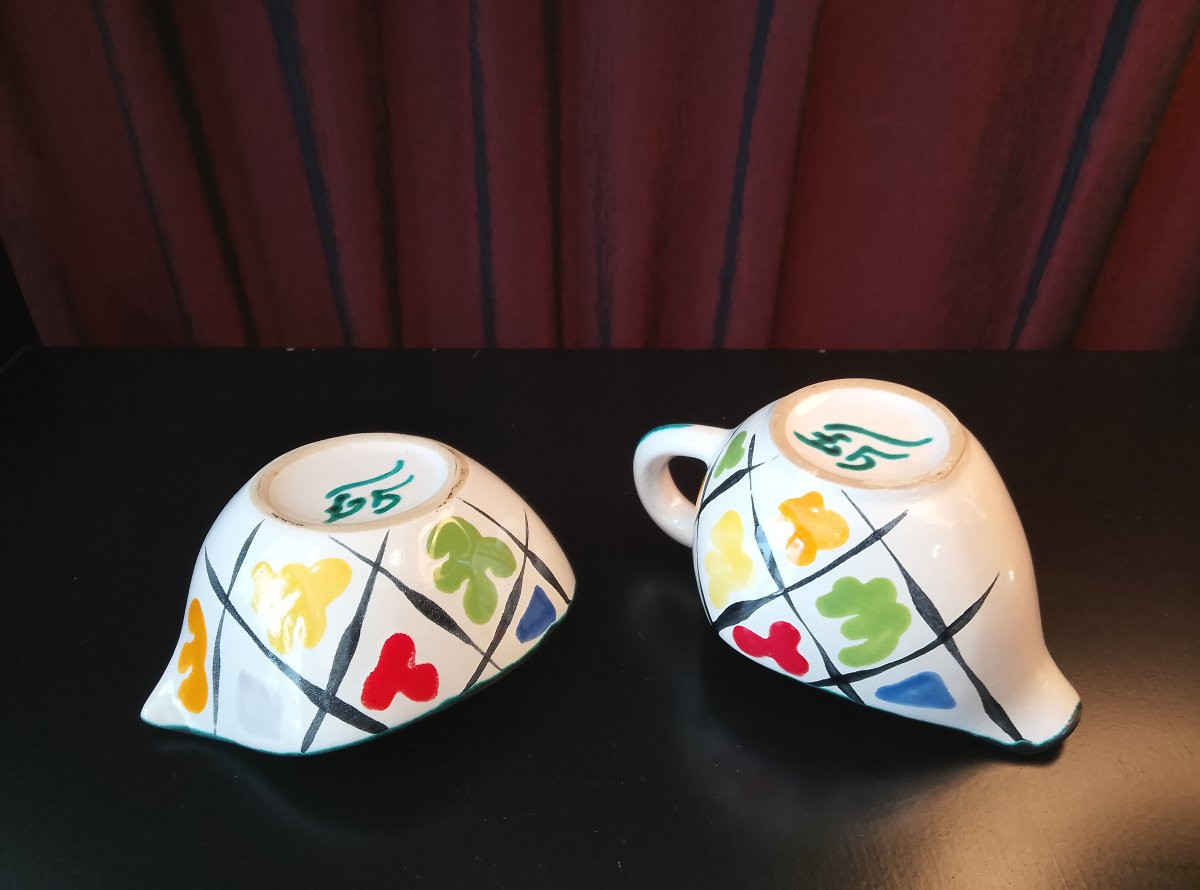
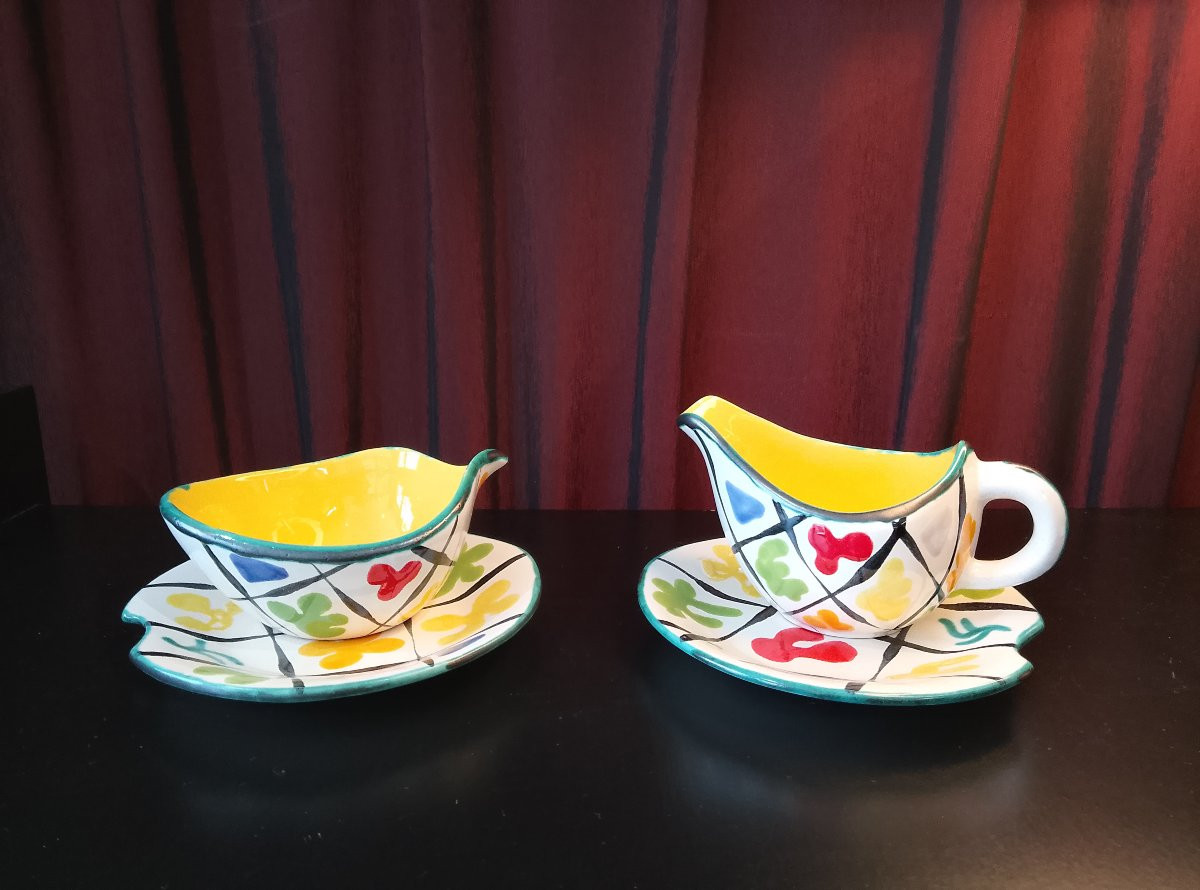
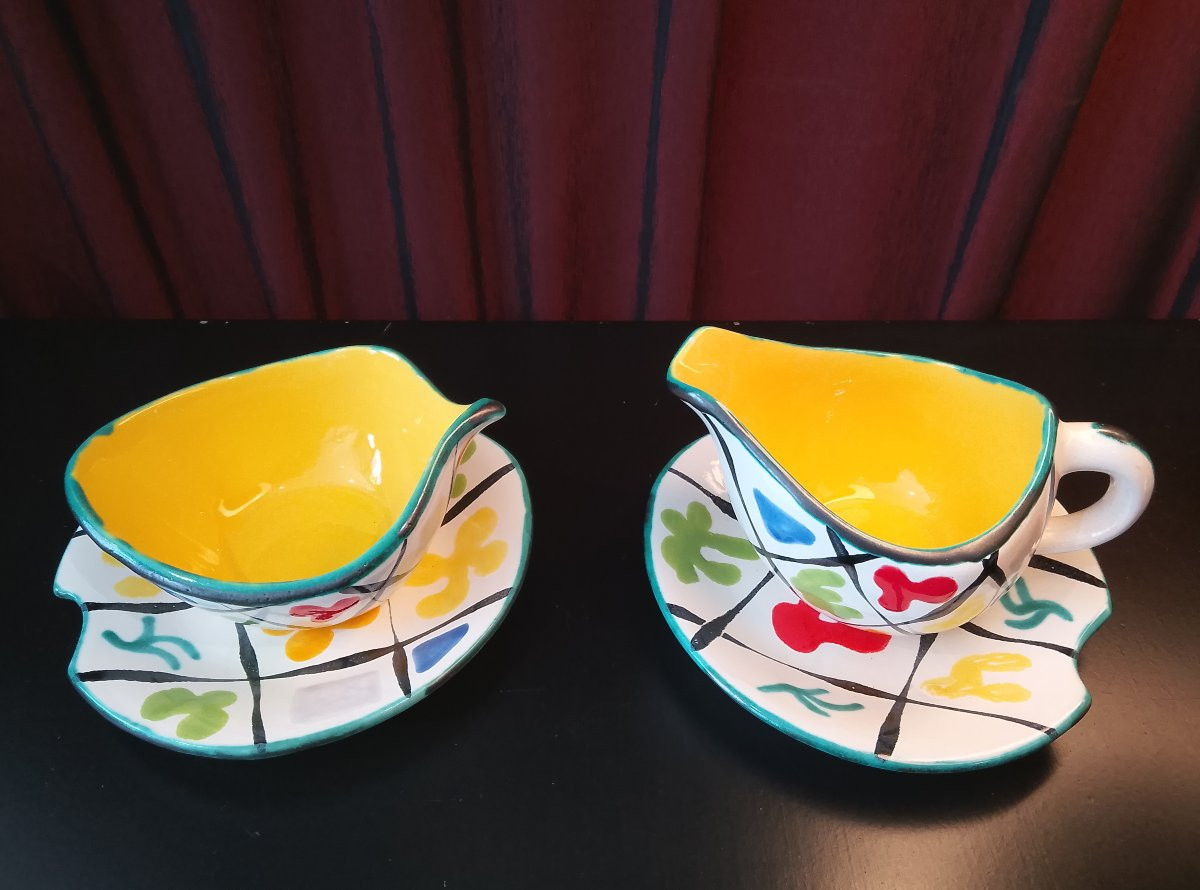
A milk jug, cup, and two saucers in glazed ceramic. The pieces are decorated with various stylized motifs in yellow, green, blue, pink, orange, red, and gray within black lozenge-shaped cartouches. The base of the milk jug and cup is bright yellow. Made by the ceramist Gabriel Fourmaintraux during his collaboration with Fernand Léger in Biot, who encouraged him to create pieces with more original and colorful shapes than those he had previously produced. The saucers have a pointed, leaf-like shape with a notch, typical of Fourmaintraux's work at the time. 1960s. Signed with the monogram "GF" on all bases. Height: 8 cm - Length: 15 cm - Width: 9.5 cm (for the milk jug). Height: 6 cm - Length: 13 cm - Width: 10.5 cm (for the cup). Length: 15.5 cm - Width: 15 cm (for the saucers). Gabriel Fourmaintraux (1886-1984) was a French ceramicist who contributed to the development and renown of Desvres faience. He belonged to an old and prestigious family of French ceramicists. Indeed, the Fourmaintraux family's ceramic activity dates back to 1804 when François-Joseph Fourmaintraux founded his own factory. Gabriel Fourmaintraux studied at the Sèvres School of Ceramics, graduating with distinction in 1907 and beginning to work in the family factory alongside his father. During this golden age of Desvres faience, they produced small porcelain objects (vases, ashtrays, lamps, decorative trinkets, etc.) that were meticulously decorated. This porcelain production ceased around 1925-1930. Gabriel Fourmaintraux took over the management of the factory in 1930 and created new designs and decorations (crackleware, cartoon characters, advertising pieces, figures, bowls, vases, plates, and decorative objects, etc.), as well as his own original themes such as African and Art Deco designs, while continuing to produce copies of well-known designs from renowned traditional potteries (Rouen, Quimper, Delft, Moustiers, Marseille, Meillonas, Montpellier, Nevers, Strasbourg, etc.). This resulted in a very significant production. Gabriel Fourmaintraux also collaborated with the painter Fernand Léger, who lived in Biot in the south of France. This association encouraged him to work with primary colors (reds, whites, and yellows on a black or white background). It also led him to produce objects with original shapes. Gabriel Fourmaintraux worked there until his retirement in 1982. The factory closed in 1997. 










 Le Magazine de PROANTIC
 TRÉSORS Magazine
 Rivista Artiquariato