


Revival Brooch In Gold And Micromosaic, With Lapis Lazuli And Secret Compartment — Rome, C. 1800
Gold with 'bollo camerale' (Papal States / Vatican hallmark, Rome)
Central stone: Lapis lazuli cabochon in box setting with hinged compartment
Decoration: Polychrome micromosaic (pasta vitrea)
Diameter: 4 cm — Gross weight: 25.81 g
Origin: Rome, Italy, circa 1880
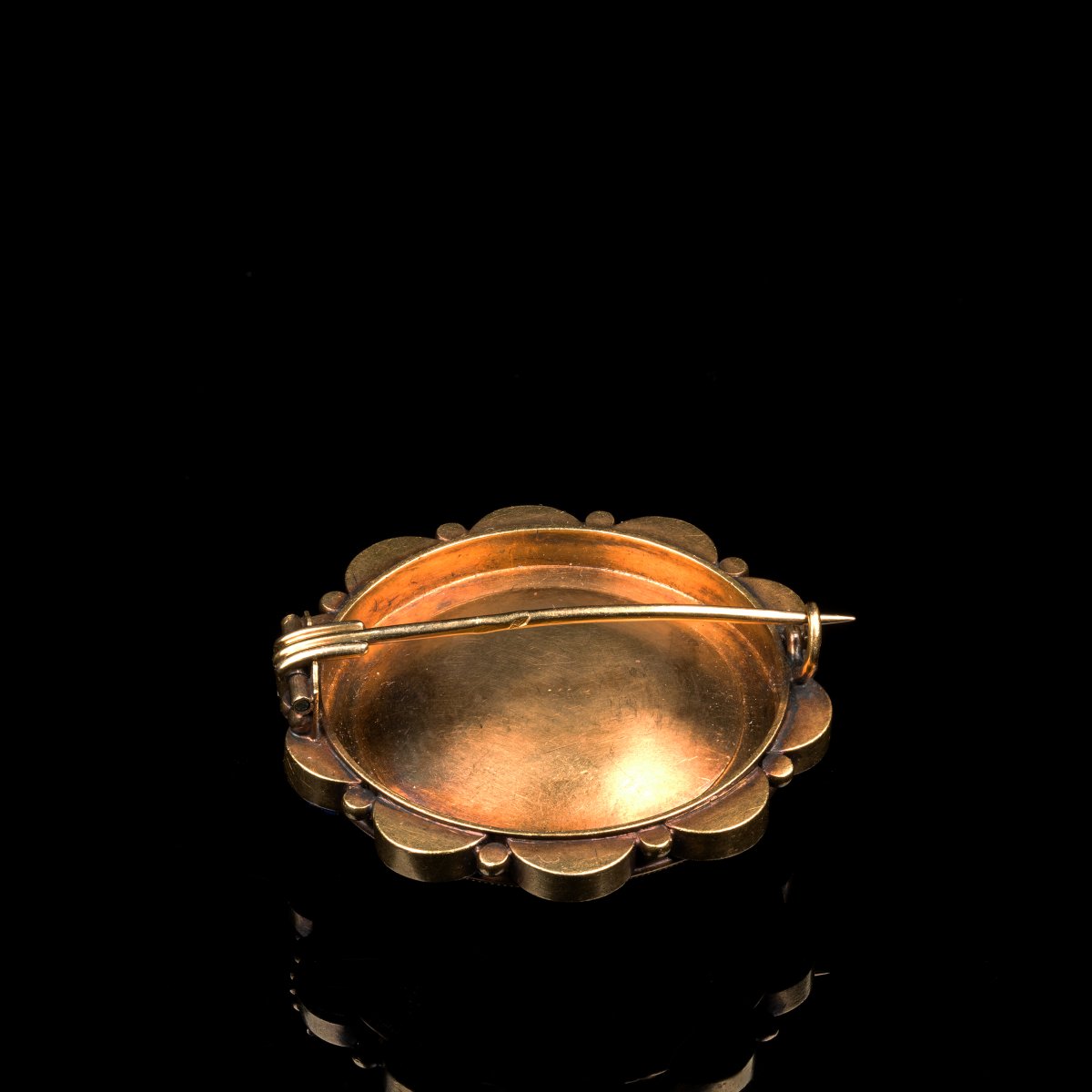
A superb gold brooch in the Archaeological Revival taste, crafted in Rome circa 1880 and bearing the poinçon camerale — the official hallmark of the Papal States guaranteeing the fineness of precious metals under Vatican authority.
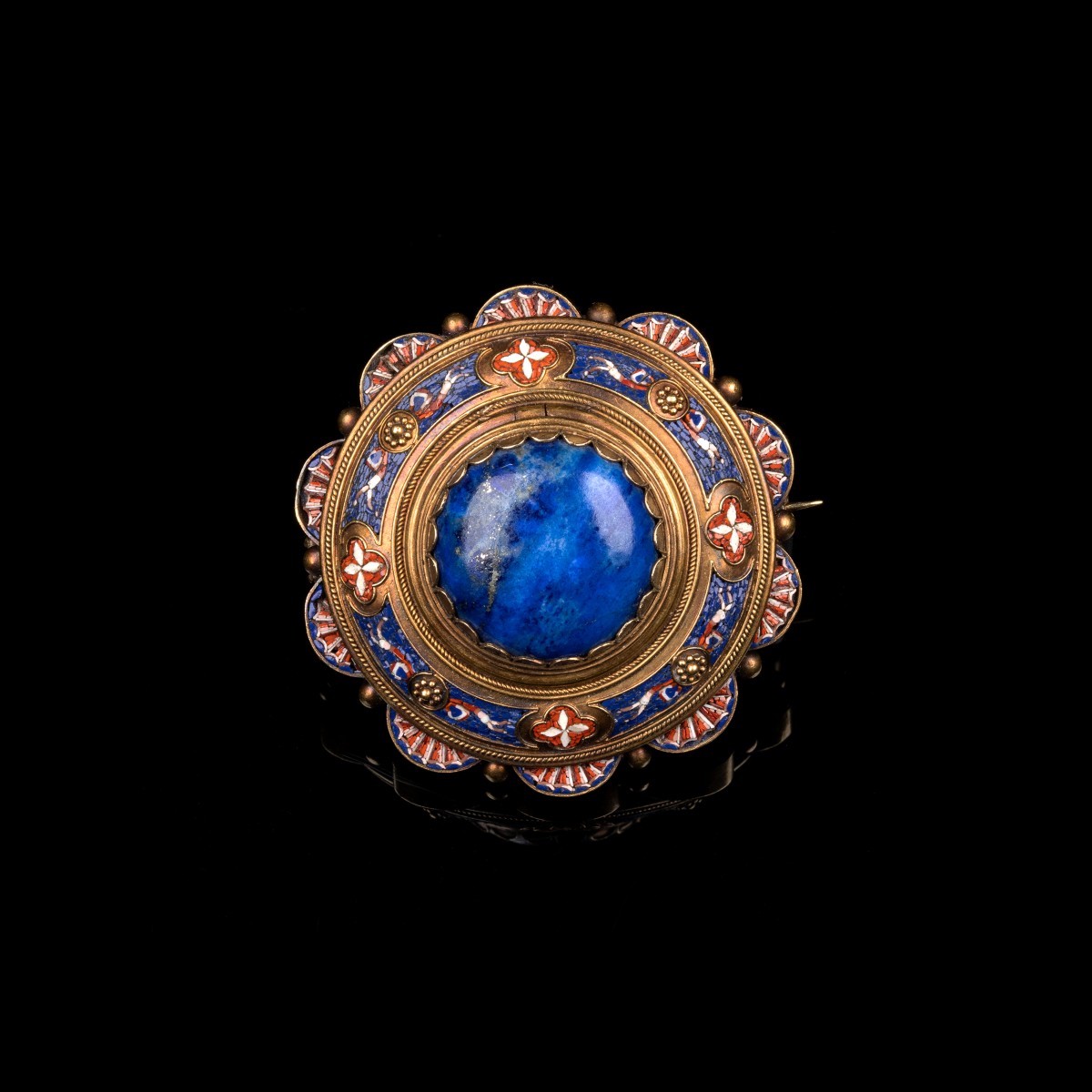
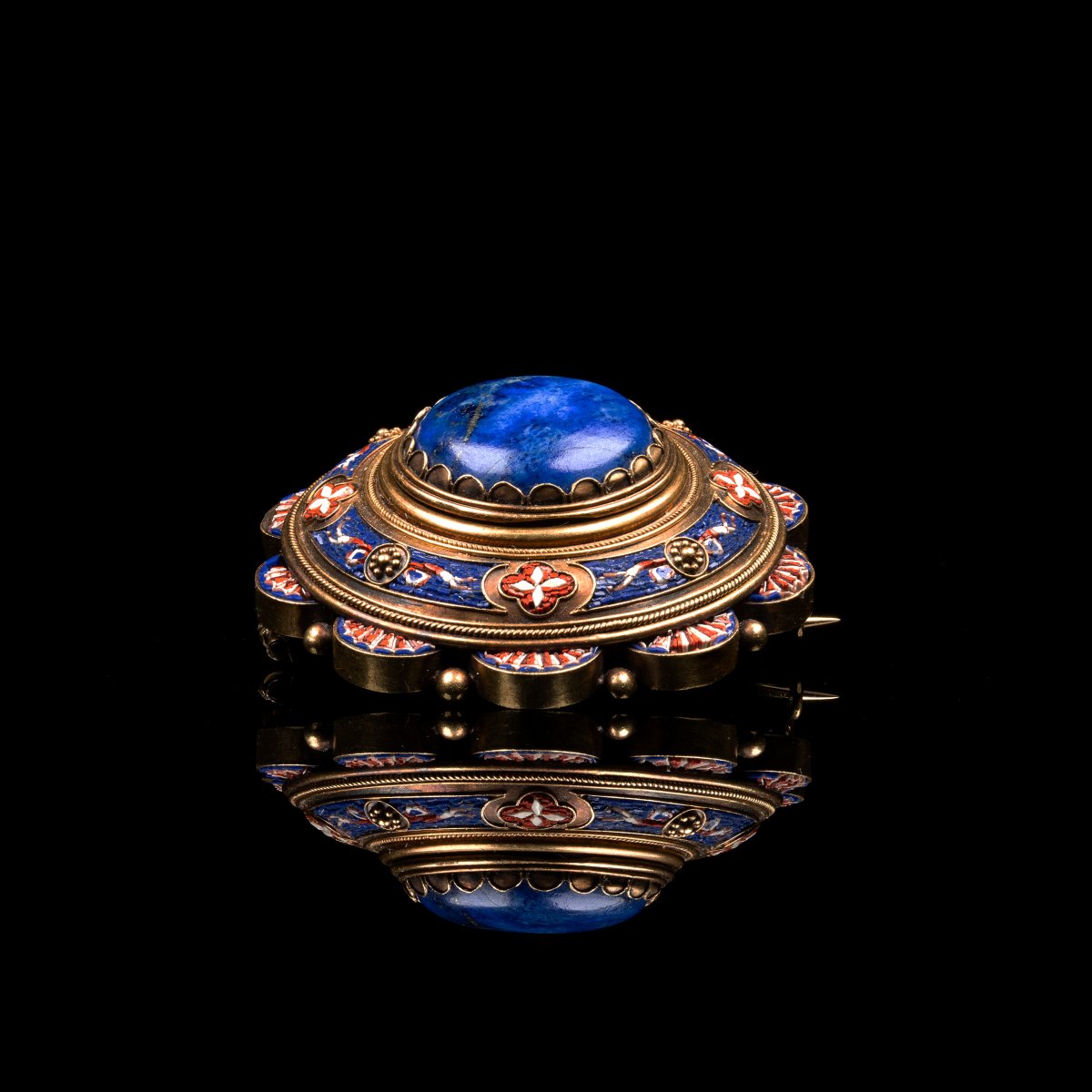
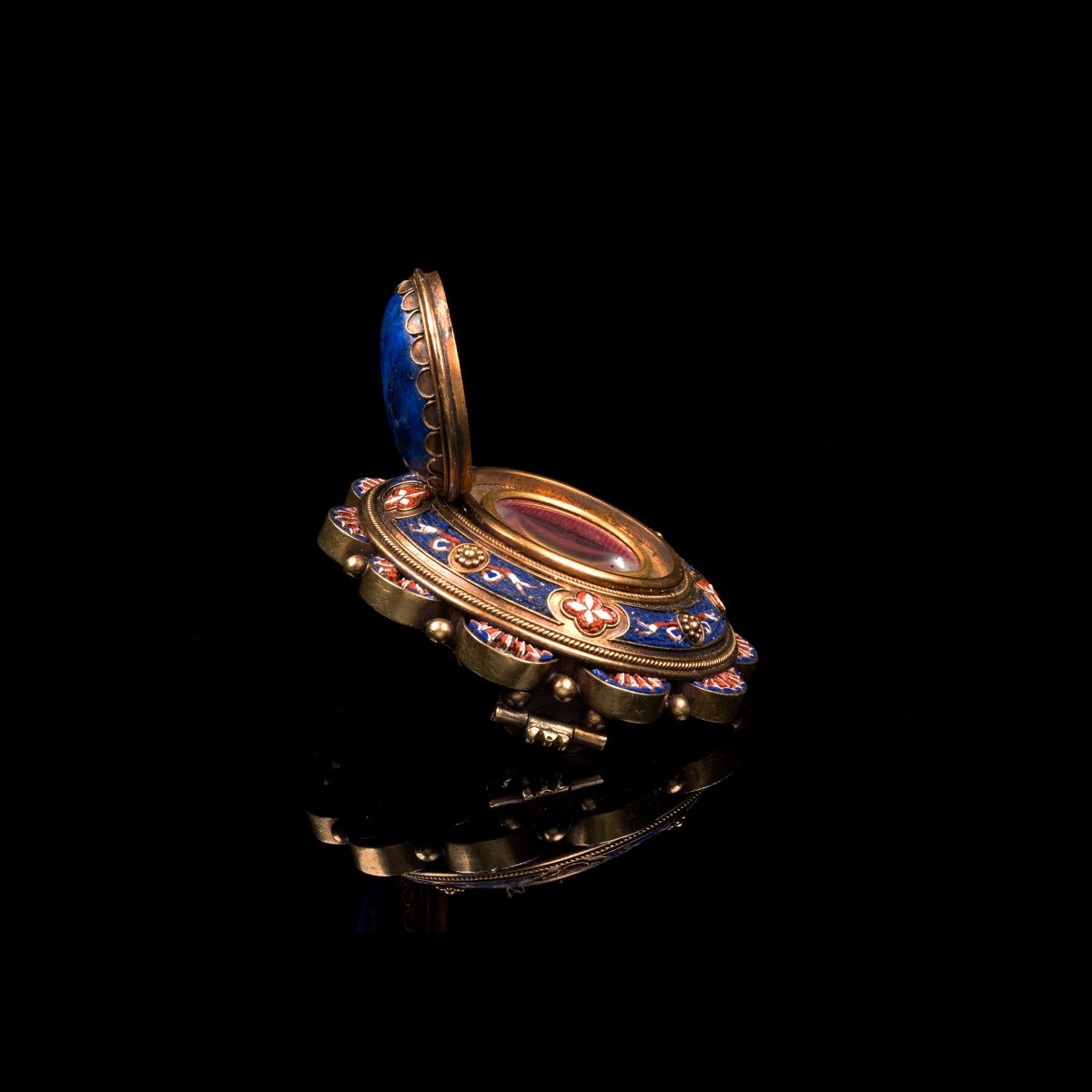
The brooch centres upon a fine cabochon of lapis lazuli — the celestial stone prized since antiquity for its deep blue hue scattered with golden pyrite inclusions. The stone is mounted in a box setting concealing a hidden locket compartment: the bezel opens on a hinge to reveal a circular compartment protected under glass, designed to hold a lock of hair, a miniature portrait, or other precious keepsake. This intimate feature transforms the brooch into a piece of sentimental jewellery, uniting decorative splendour with personal meaning.
The cabochon is framed by concentric gold borders adorned with delicate rope-twist wire, a technique revived from ancient Etruscan goldsmithing. The surrounding band displays exquisite polychrome micromosaic decoration in glass paste (pasta vitrea), featuring an alternating pattern of ribbons and rosettes in coral red, cobalt blue, and white. The outer polylobed frame, shaped as stylised petals, is enriched with fan-shaped micromosaic motifs, radiating outward in harmonious symmetry. Small gold rosettes punctuate each petal, lending rhythm and refinement to the composition.
The Papal Hallmark — Poinçon Camerale:
The bollo camerale or poinçon camerale was the official guarantee mark used in Rome and the Papal States to certify the fineness of gold and silver wares. This system, reorganised after the Napoleonic period and codified by the Bando Generale of 1815, remained in force until the annexation of Rome to the Kingdom of Italy in 1870. The presence of this hallmark attests to the Roman origin of the piece and its manufacture within the goldsmithing tradition flourishing under Papal patronage — a tradition that produced some of the finest Archaeological Revival jewellery of the 19th century, including the celebrated creations of the Castellani workshop and their followers.
A rare and poetic jewel combining Roman micromosaic artistry, ancient-inspired goldwork, and the tender intimacy of a secret locket — a treasure for the collector of 19th-century sentimental and archaeological jewellery.
Condition: Very good. Micromosaic intact (slight misisng on the edge) with crisp tesserae, lapis lazuli cabochon secure, locket mechanism functional, gold mount with soft patina consistent with age.
Central stone: Lapis lazuli cabochon in box setting with hinged compartment
Decoration: Polychrome micromosaic (pasta vitrea)
Diameter: 4 cm — Gross weight: 25.81 g
Origin: Rome, Italy, circa 1880
A superb gold brooch in the Archaeological Revival taste, crafted in Rome circa 1880 and bearing the poinçon camerale — the official hallmark of the Papal States guaranteeing the fineness of precious metals under Vatican authority.
The brooch centres upon a fine cabochon of lapis lazuli — the celestial stone prized since antiquity for its deep blue hue scattered with golden pyrite inclusions. The stone is mounted in a box setting concealing a hidden locket compartment: the bezel opens on a hinge to reveal a circular compartment protected under glass, designed to hold a lock of hair, a miniature portrait, or other precious keepsake. This intimate feature transforms the brooch into a piece of sentimental jewellery, uniting decorative splendour with personal meaning.
The cabochon is framed by concentric gold borders adorned with delicate rope-twist wire, a technique revived from ancient Etruscan goldsmithing. The surrounding band displays exquisite polychrome micromosaic decoration in glass paste (pasta vitrea), featuring an alternating pattern of ribbons and rosettes in coral red, cobalt blue, and white. The outer polylobed frame, shaped as stylised petals, is enriched with fan-shaped micromosaic motifs, radiating outward in harmonious symmetry. Small gold rosettes punctuate each petal, lending rhythm and refinement to the composition.
The Papal Hallmark — Poinçon Camerale:
The bollo camerale or poinçon camerale was the official guarantee mark used in Rome and the Papal States to certify the fineness of gold and silver wares. This system, reorganised after the Napoleonic period and codified by the Bando Generale of 1815, remained in force until the annexation of Rome to the Kingdom of Italy in 1870. The presence of this hallmark attests to the Roman origin of the piece and its manufacture within the goldsmithing tradition flourishing under Papal patronage — a tradition that produced some of the finest Archaeological Revival jewellery of the 19th century, including the celebrated creations of the Castellani workshop and their followers.
A rare and poetic jewel combining Roman micromosaic artistry, ancient-inspired goldwork, and the tender intimacy of a secret locket — a treasure for the collector of 19th-century sentimental and archaeological jewellery.
Condition: Very good. Micromosaic intact (slight misisng on the edge) with crisp tesserae, lapis lazuli cabochon secure, locket mechanism functional, gold mount with soft patina consistent with age.
2 850 €
Period: 19th century
Style: Rome and Antic Greece
Condition: Good condition
Material: Gold
Reference (ID): 1704247
Availability: In stock
Print