


Us A2 Jacket Of A Pilot Who Participated In The Preparatory Bombs Of D-day
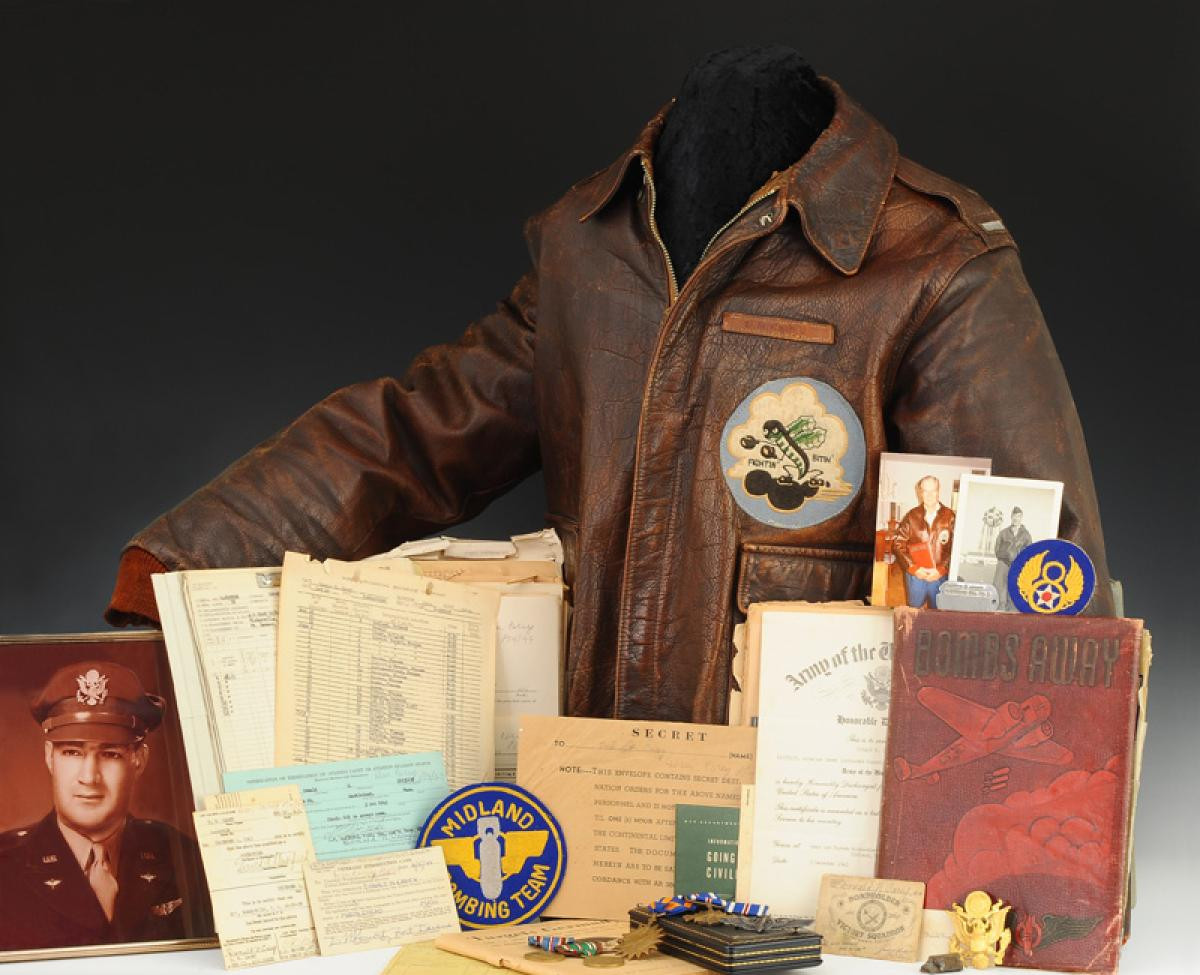
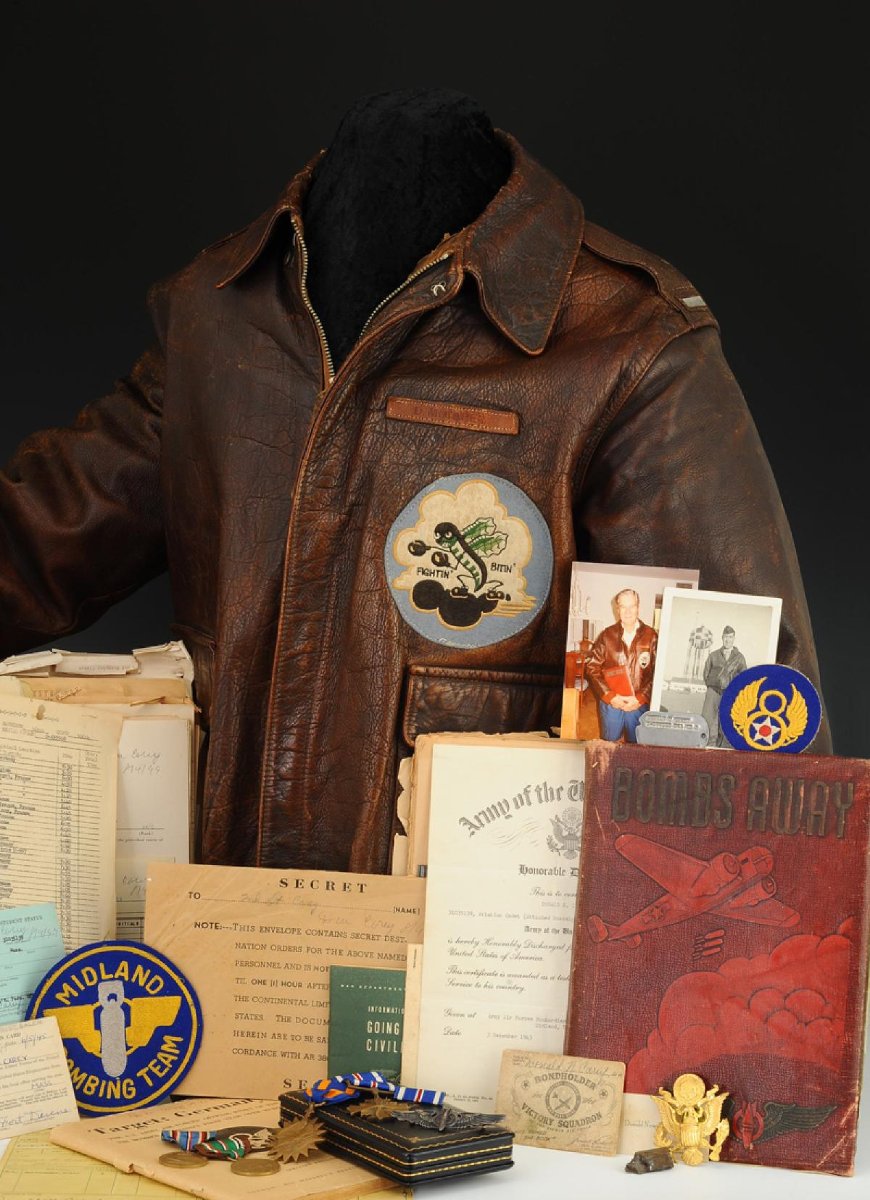
FLYING JACKET "A2" AND IMPORTANT COLLECTION OF DOCUMENTS AND DECORATIONS OF THE PILOT OFFICER, LIEUTENANT D.M. CAREY OF THE 8th AIR FORCE, 306th BOMBER GROUP, 369th SQUADRON WHO PARTICIPATED IN THE PREPARATORY BOMBINGS OF D-DAY ON JUNE 6, 1944, AND BOMBED NANTES ON JUNE 15, 1944. Grouping Lt. Carey's A2 flying Jacket. World War II. 22332
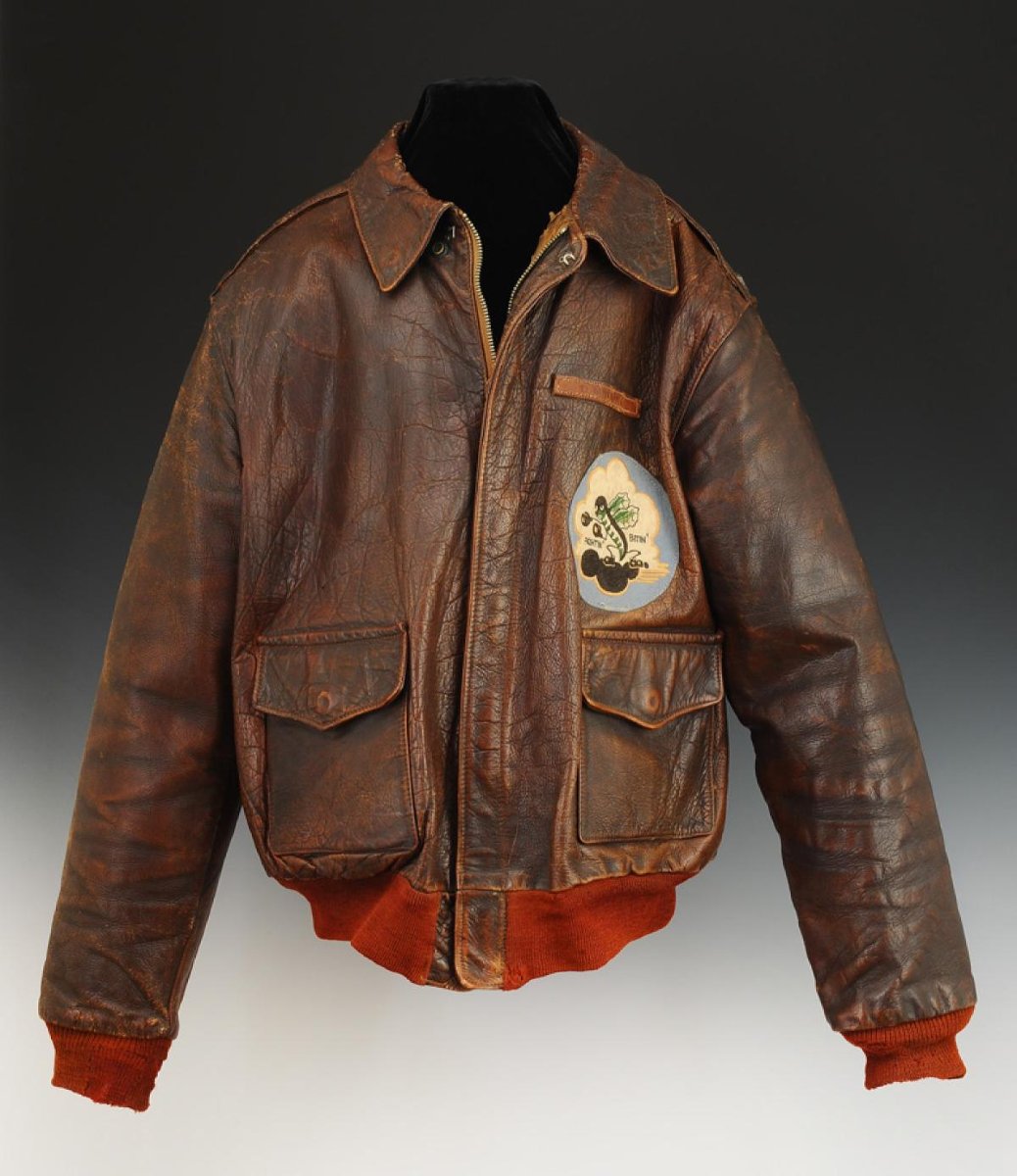
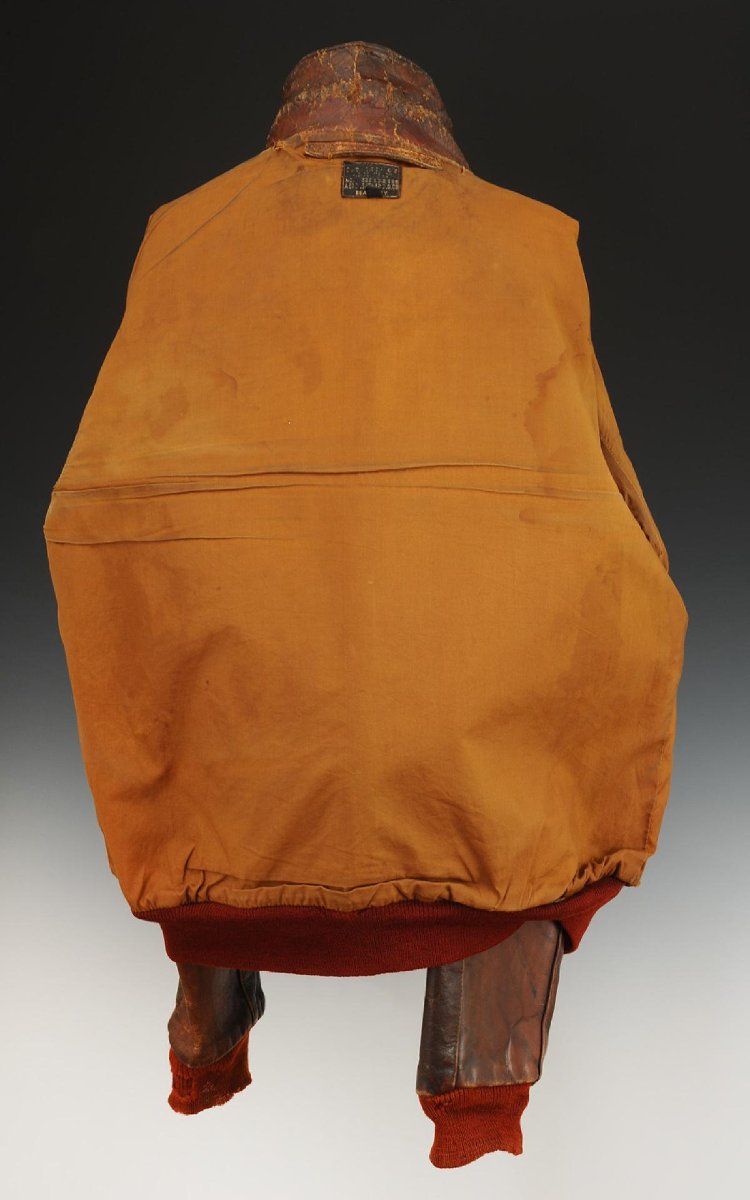
Flying jacket designated as "Flight Jackets, type A-2," made of cowhide leather approved on July 17, 1940, from contract Aero W535-AC-16160, this particular example corresponds to contract number "W535 ac-21996," contracted on October 14, 1941, and produced in 25,000 copies by the manufacturer "Aero Leather Clothing Co."
Chrome-tanned leather in chocolate color, wool knit pieces in elastic chocolate color at cuffs and waist.
Stand-up collar, snaps holding down the collar flaps, metal clip at its base. Closes straight with a zipper from the brand "Talon - Conmar," flap pockets with pointed flaps, closing with hidden snap buttons.
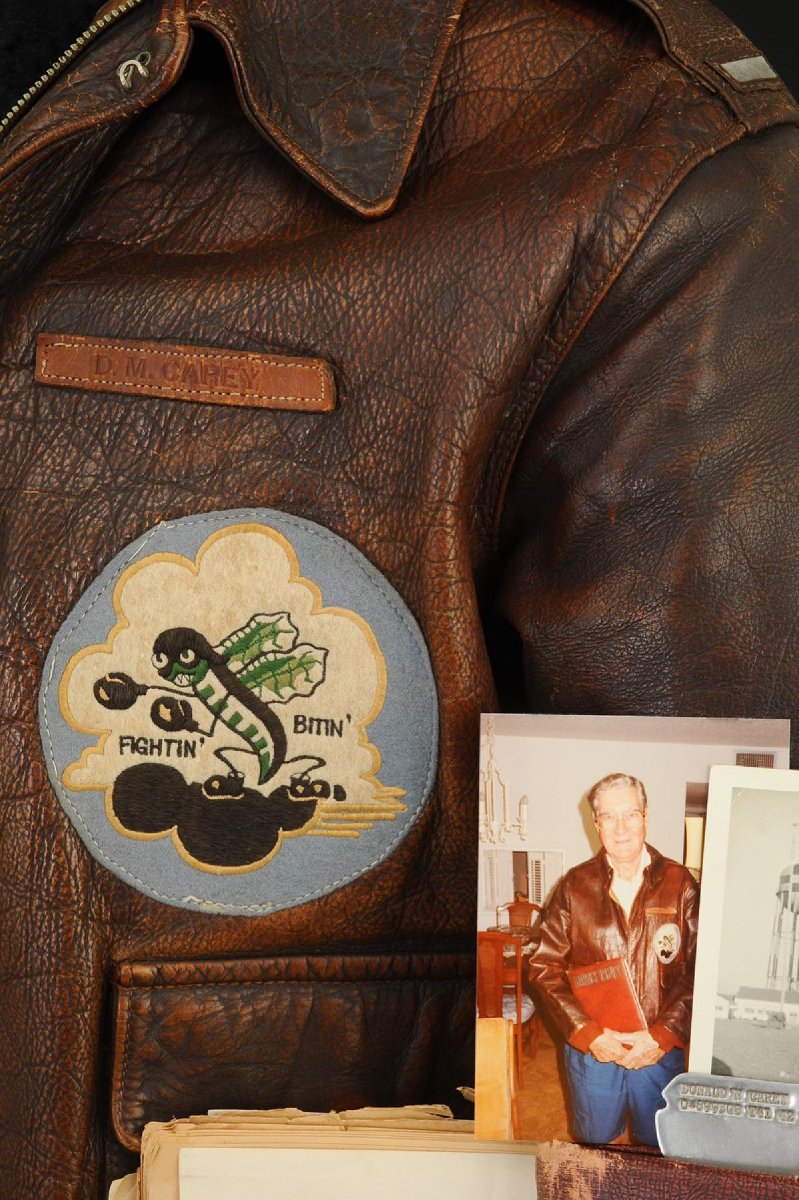
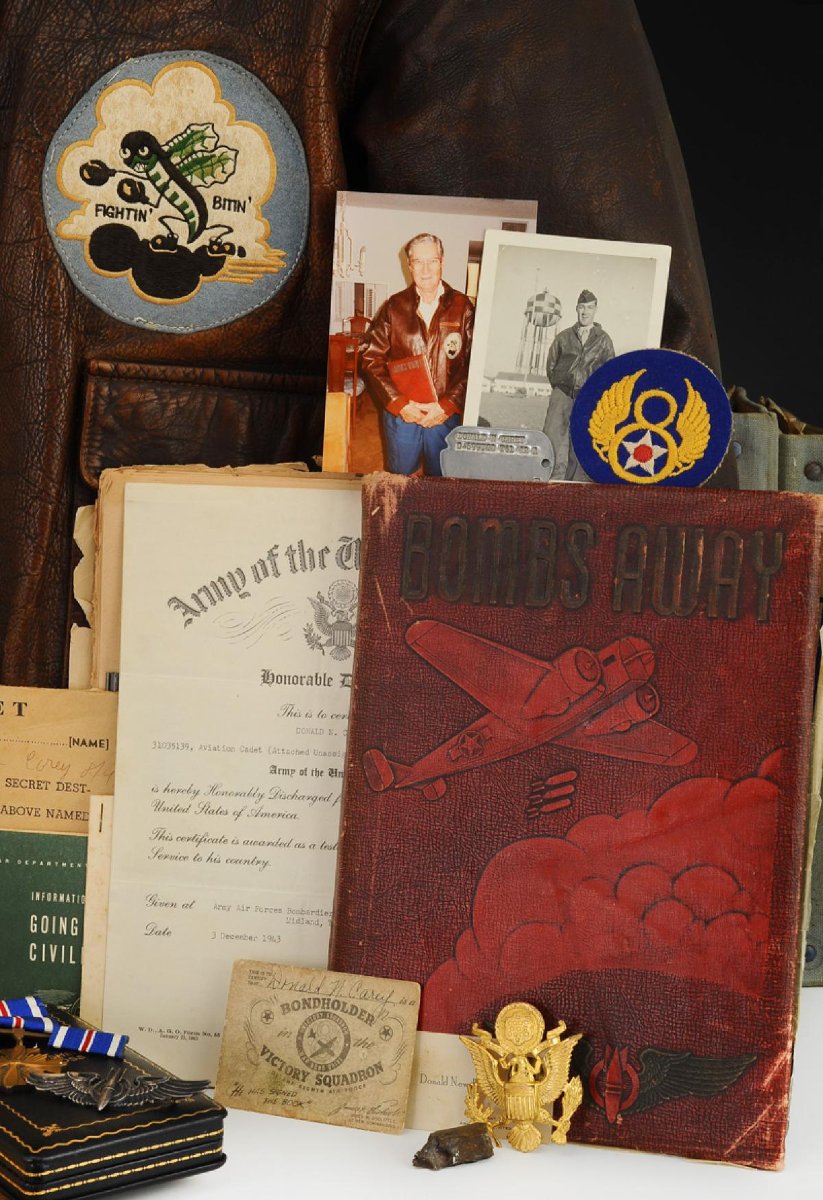
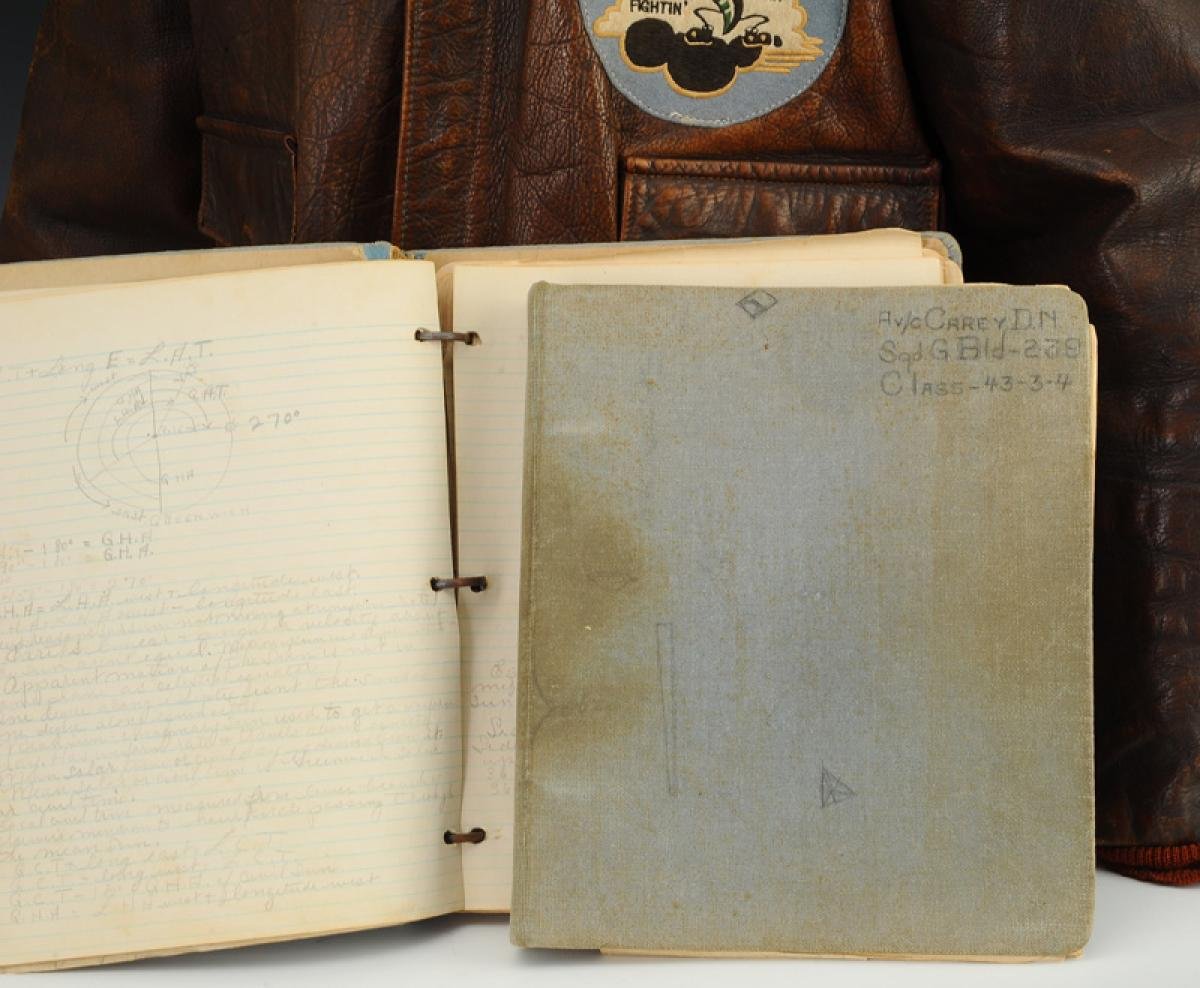
Leather pieces representing sewn shoulder loops at the ends. At the armpits, a small piece of silver-colored painted leather corresponding to the rank of first lieutenant. At the left chest level, an added rectangular leather piece sewn with the officer's name "D.M. CAREY" in relief, and a British-made felt patch representing the squadron emblem of the 369th squadron, depicting a flying bomb personified (white flying insect with green wings and belly), topped with a black helmet, visible teeth (the "bitin"), wearing boxing gloves (the "fightin") and black shoes, emerging from a black cloud, symbolizing heavy bombing with the legend "FIGHTIN' BITIN'" which translates to "I fight and I bite." Diameter 12.5 cm. This patch is official and specific to the 368th BS approved on August 10, 1944. Light brown rayon lining, woven label of the manufacturer and size "44".
Officer's identification tag, made of aluminum.
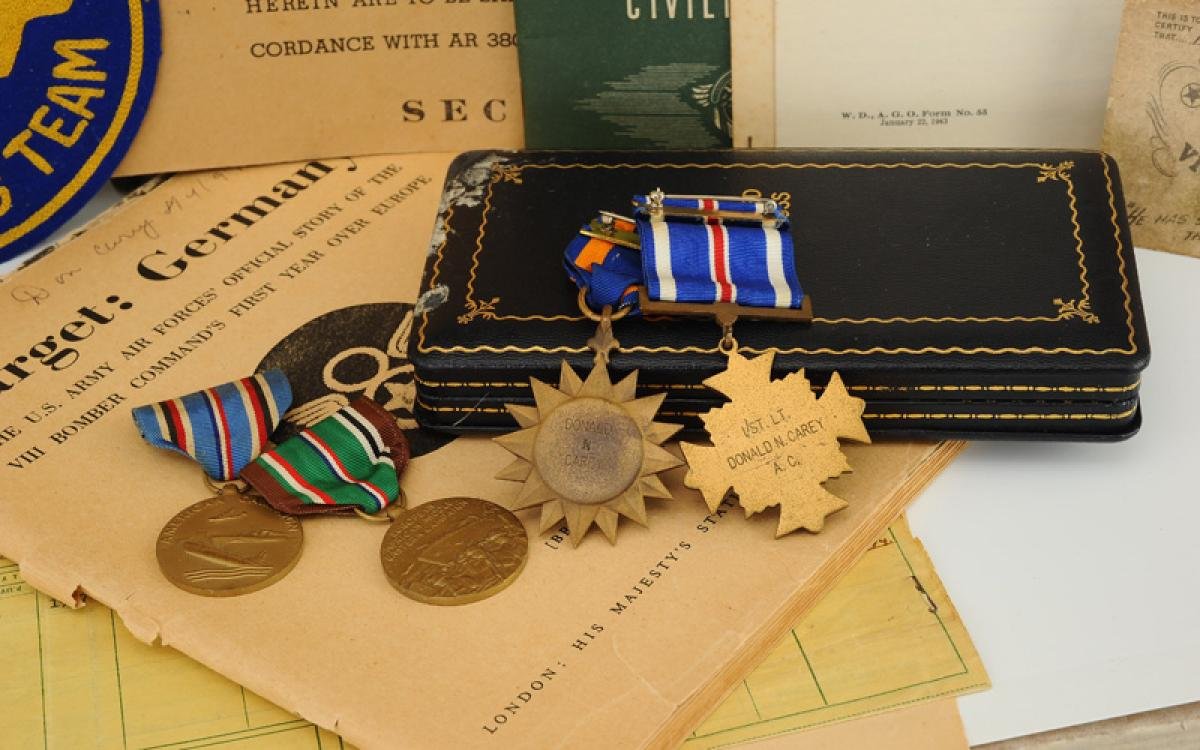
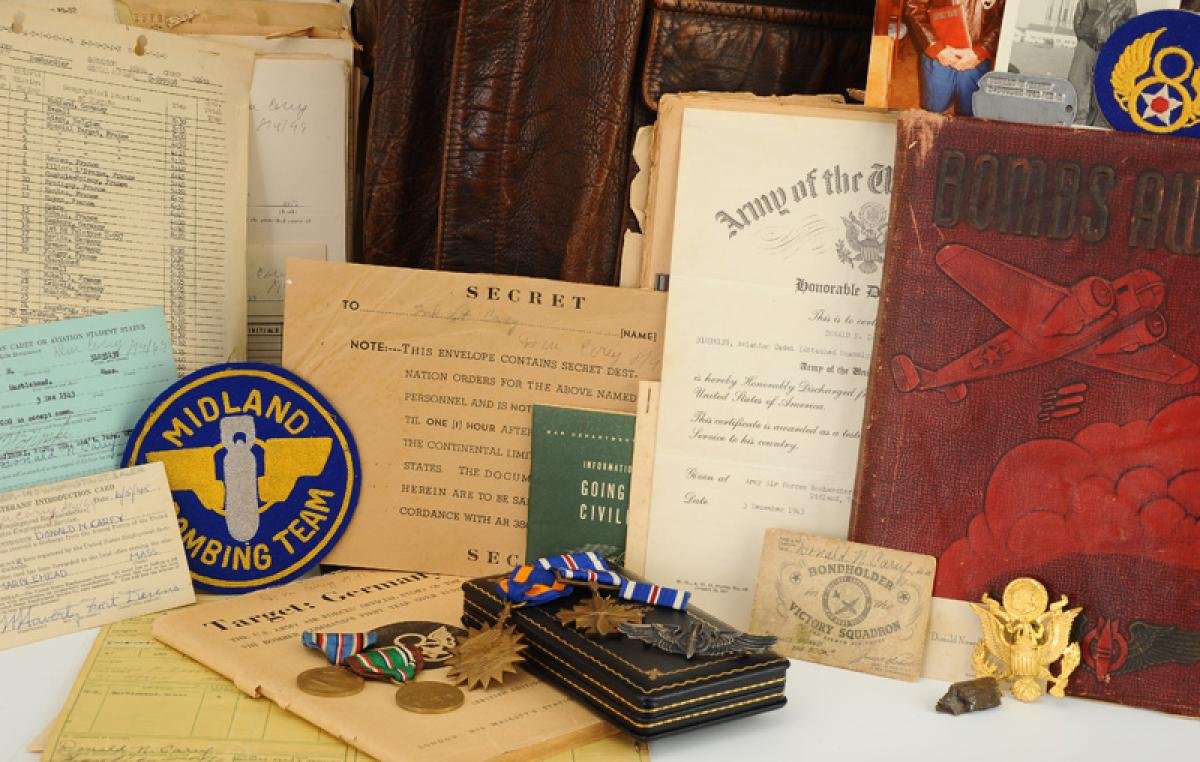
Gold-plated brass cap attribute, woven sleeve patch of the 8th Air Force, officer pilot bomber wings, in stamped silver with "Balfour Sterling" on the reverse, distinguished flying cross with name (distinguished flying cross) with service ribbon, air medal for meritorious action during a flying mission with oak leaf clusters, European campaign medal, American campaign medals between 1941 and 1945.
Piece of steel shrapnel, likely from a German AAA shell.
Two binders and a small notebook containing his handwritten course notes, with drawings and diagrams.
Envelope intended for the officer, containing "secret destination orders," to be opened only one hour before departure.
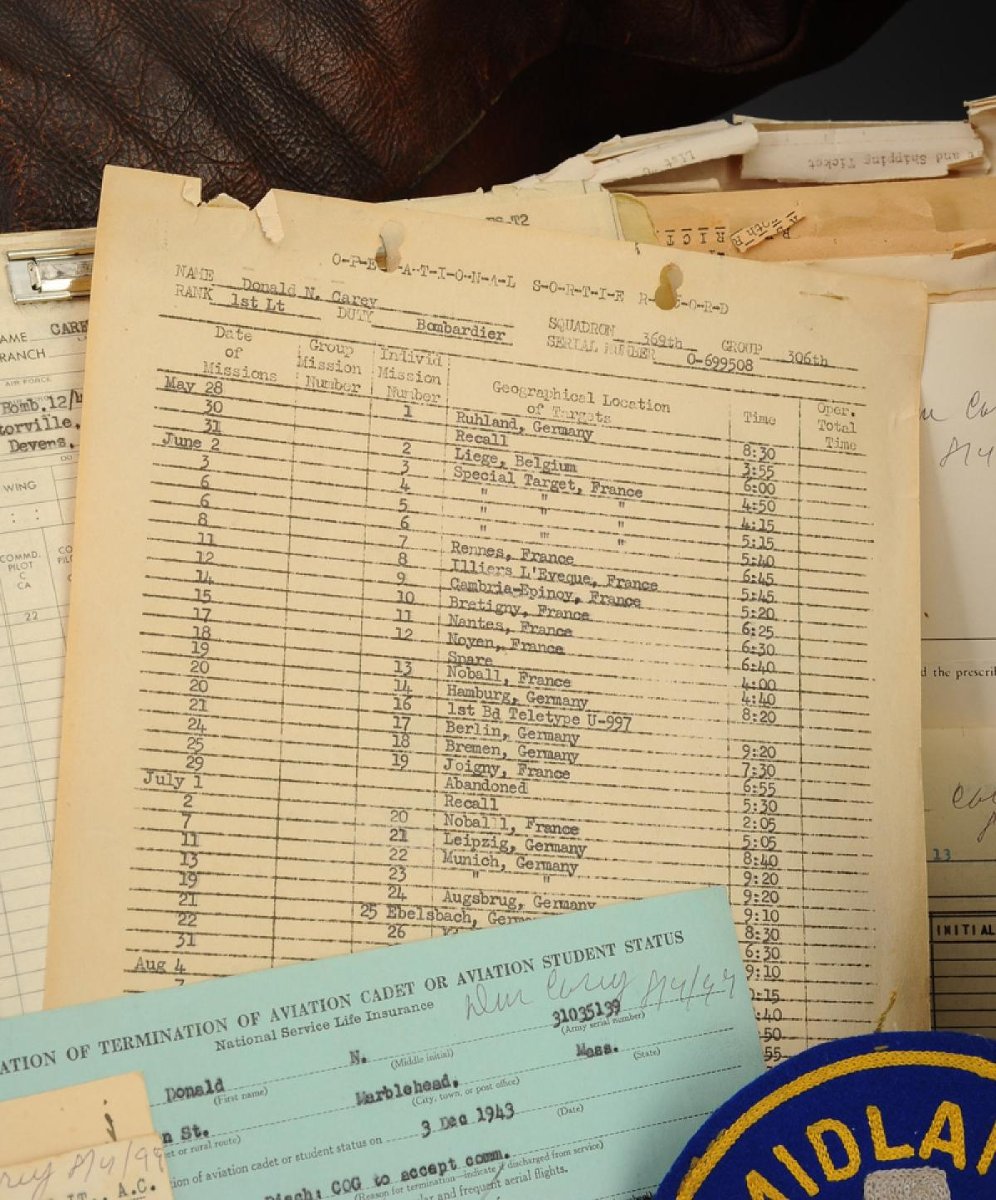
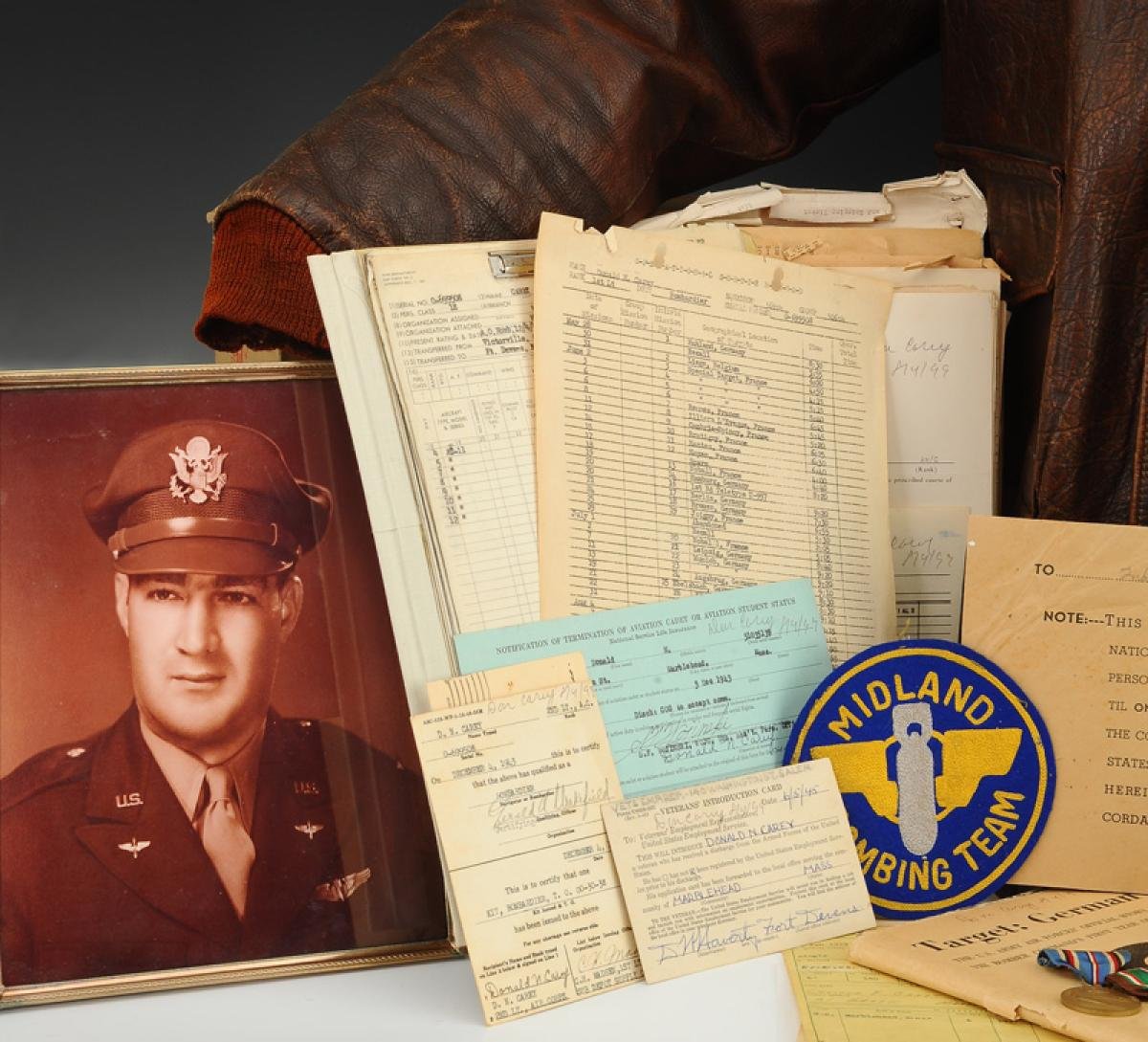
Typed page of mission orders covering May to August 1944, addressed to Donald N. Carey, including date and location of targeted objectives, as well as operation time. Note that for the days of June 3, 4, 5, and 6, only a special target in France, "special target France," is mentioned without further location details. Mention of a bombing on Nantes on June 15, 1944.
Folders with his mission sheets and various documents, and maps.
Typed page, signed by his colonel, dated August 31, 1944, attesting to Carey's service records, 236.5 flight hours, 31 combat missions, destroyed an enemy plane, and acknowledging the presentation of his decorations.
Significant collection of mainly typed documents on the items received by the officer, technical sheets, and diplomas.
Officer's career document dated May 1944, detailing his various assignments since his training in 1941, and the start of his active service on December 4, 1943.
1944 American aerial leaflet for German troops.
Photograph of the crew members of Carey's flying fortress, with names on the back.
Important sheet from 1944 and 1945 on the directives to follow for training.
Patch of the "Midland Bombing Team," chain stitch embroidery, diameter 12 cm.
Small album with a vintage photo of the officer, his business card, attestation of his belonging to the 8th bombing group with signatures of different officers.
Several vintage photo reprints and a picture of the officer taken in March 1991, wearing his jacket and holding the squadron's souvenir book.
Squadron souvenir book "Bombs away," with photographic portraits of all unit members.
Framed photo, reprint of his portrait in dress uniform. Vintage book on the various bombing missions over Germany undertaken by the 8th bombing group.
Booklet published in 1944, containing information for the return to civilian life.
United States.
World War II.
Very good conservation condition, evident signs of wear, wear at the collar. Zipper and snaps in good working order.
Jacket featured in the book "Art of the Flight Jacket - classic leather jackets of World War II" by Jon Maguire & John Conway. Pages 27/28.
Collection presented by Bertrand Malvaux: [YouTube link].
NOTE ON THE BOMBING OF JUNE 15, 1944, IN NANTES:
The history of Nantes during World War II experienced 28 bombings and 442 air alerts, although it is often reduced to the devastating raids of September 16 and 23, 1943.
However, the shadow of the conflict continued to loom over the city, striking heavily on June 15, 1944. On that day, tragedy struck at the heart of the cathedral: under the rubble of the pulverized sacristy and the south chapels torn open, several parishioners and their archpriest perished.
Between the end of May and July 1944, Nantes endured a series of particularly harrowing air raids. On Pentecost Sunday, May 28, bombs hit the Dalby and Malakoff areas head-on. The toll was heavy: 86 victims whose bodies were gathered at the Fine Arts Museum, improvised as a mortuary chapel for the occasion. To limit risks related to gatherings, the religious ceremony had to be solemnly held on the square of the Saint-Clément church.
Just as the Normandy Landings had begun, the violence of war struck Saint-Sébastien on June 7 and 8, 1944. These raids claimed the lives of 34 people, including the vicar Raimbert and his employee, buried under the ruins of the rectory, while the church suffered significant destruction. In this chaotic atmosphere, the people of Nantes faced an informational dilemma: on one side, the collaborationist press like Le Phare de la Loire relayed German propaganda about alleged Allied failures; on the other, clandestine BBC listeners tried to discern the truth from the false, aware that liberation was near but still ignorant of the true extent of operations.
In early June 1944, the Nantes diocese united around the passage of one of the statues of Our Lady of Boulogne, nicknamed "Our Lady of the Great Return". This national procession aimed to pray for peace and the repatriation of prisoners. Its journey through the Loire region began in Ancenis on June 4, where a huge crowd, led by Monsignor Villepelet and Archpriest Léon Poupard, welcomed it with devotion. After crossing the diocese, the statue was sheltered at the church of Notre-Dame de Lourdes in Nantes on June 25, the very place where priestly ordinations took place on the morning of June 29.
Despite the arrival of this statue, which traveled throughout the diocese, the atmosphere was very heavy. Corpus Christi was celebrated without any fanfare on June 11. Early on the morning of June 15, the sirens wailed once again. Everyone headed towards shelters... Monsignor Villepelet, the Bishop of Nantes, was preparing to celebrate Mass in his chapel at the bishop's residence.
"I take the Holy Ciborium and go down into the cellar with the two nuns of the bishop's residence. Without delay the bombs begin to fall. Their shrill whistling makes it seem like they are all around us. At one point I even believe that the bishop's residence has been hit: sound of broken windows, shaking, black dust. Once the calm comes, I go back up and see that if the bombs didn't fall on the house, it was very close. [...] Then I see smoke in the direction of the cathedral sacristy. I immediately learn in the street that it is hit, the sacristy is on fire, and Canon Poupard, the archpriest, killed under the rubble. What an emotion!"
As Canon Léon Poupard was about to officiate at the cathedral, the sky blazed under the fire of German AAA responding to the Allied bombers. Taking refuge in the rectory, the archpriest eventually attempted to reach the shelter of the building. Out of a sinister presentiment or mere chance, he abandoned the usual crypt for the cellars of the sacristy, accompanied by his curates. It was there that a bomb struck head-on. While one of the curates miraculously survived despite the force of the blast, Canon Poupard was killed on the spot. Outside, death also struck three parishioners — Marie and Jean Rivard along with Michel Schwarz — who had come to attend the service. The monument itself bore the scars of the explosion: devastated sacristy, collapsed vaults, and shattered stained glass windows, leaving only a rare 15th-century window unscathed.
The neighborhood of the cathedral, particularly Aguesseau Street, paid a heavy toll with nineteen recorded victims. On June 15, it was at the Saint-Similien church — the last major sanctuary in the center of Nantes spared by the bombs — that the city gathered for a final farewell. Fourteen coffins occupied the nave, while other bodies were still awaiting extraction from the rubble or had joined their respective parishes. While the Nantes clergy turned out in force, the absence of rural priests underscored the city's isolation: without means of transport and facing constant dangers, the countryside was cut off from the wounded city.
HISTORY OF THE 306th BOMB GROUP:
The 306th Bombardment Group was activated in March 1942 and, after training in the United States, deployed to England around August-September 1942, stationed at RAF Thurleigh. It participated in the strategic bombing campaign of the Eighth Air Force until the end of the war in Europe.
The 368th Bomb Squadron — sometimes nicknamed "The Eager Beavers" in certain internal histories — was one of the four squadrons of the 306th BG. Its missions reflect the major operations of the group:
1. Early strategic bombing missions (late 1942 - early 1943).
October 9, 1942: First bombing missions in Europe — attack on a locomotive factory in Lille, France.
January 27, 1943: Historic raid on the U-boat yards in Wilhelmshaven, the first penetration into Germany by heavy bombers of the Eighth Air Force (the 306th was in the lead).
The entire formation, including the 368th, participated in this pioneering offensive. These missions marked the beginning of the strategic bombing campaign deep into enemy territory, targeting rail junctions, factories, and naval facilities.
2. Mass attacks on the German industry (1943–1944).
The 368th took part in missions where the 306th BG was engaged in major raids, including:
Raids against aircraft factories and strategic installations: ball-bearing factories in Schweinfurt, aircraft factories in Leipzig, oil installations in Merseburg.
January 11, 1944: Highly contested attack on an aircraft factory in central Germany. The whole group received a Distinguished Unit Citation for this raid despite heavy losses.
Big Week (February 20-25, 1944): Intensive campaign against the German aviation industry; despite difficult weather conditions for fighter escort, the formation reached its targets.
The 368th was heavily involved in these operations, bombing these key industrial targets and facing the counter-attacks of fighters and AAA.
3. Support for ground operations (1944–1945).
In addition to purely strategic missions, the 368th (like the other squadrons of the 306th) participated in tactical operations:
Preparation for the Normandy Landings: bombing bridges, rail lines, and coastal batteries.
June 6, 1944 (D-Day): Direct support to Allied forces by removing enemy positions threatening the beaches.
July 1944: Attack on enemy positions ahead of the Allied advance (Saint-Lô).
Operation Market Garden (September 1944): Aerial support for airborne forces in the Netherlands.
Battle of the Bulge (December 1944 - January 1945): Targeting airfields and supply centers to halt the German offensive.
Operation Varsity (March 1945): Support for Allied forces during the Rhine crossing.
These missions, although less "strategic" than deep raids, were crucial for the advancement of Allied ground forces.
After the German surrender on May 8, 1945 (V-E Day), the 368th carried out a final phase of missions in the form of aerial photographic surveys (photographic mapping) across Europe and North Africa as part of Project Casey Jones before being inactivated at the end of 1946.
HISTORY OF THE 369th SQUADRON:
In early 1943, the 369th bombardment squadron of the 306th bombardment group, nicknamed "Fightin' Bitin'", achieved a phenomenal record: forty-two consecutive missions without any losses. This almost unbelievable feat began during the first raid on Wilhelmshaven ("First Over Germany," January 27) and was finally beaten on July 29, during the bombing mission on the Kiel shipyards in Germany. The record stood until after D-Day when, of course, several squadrons from different groups surpassed it. Nevertheless, the 369th accomplished this remarkable feat when the Luftwaffe was at its peak. ~ Shared on behalf of Steve Snyder, a member of the 8th AFHS board and president of the 306th BG.
Flying jacket designated as "Flight Jackets, type A-2," made of cowhide leather approved on July 17, 1940, from contract Aero W535-AC-16160, this particular example corresponds to contract number "W535 ac-21996," contracted on October 14, 1941, and produced in 25,000 copies by the manufacturer "Aero Leather Clothing Co."
Chrome-tanned leather in chocolate color, wool knit pieces in elastic chocolate color at cuffs and waist.
Stand-up collar, snaps holding down the collar flaps, metal clip at its base. Closes straight with a zipper from the brand "Talon - Conmar," flap pockets with pointed flaps, closing with hidden snap buttons.
Leather pieces representing sewn shoulder loops at the ends. At the armpits, a small piece of silver-colored painted leather corresponding to the rank of first lieutenant. At the left chest level, an added rectangular leather piece sewn with the officer's name "D.M. CAREY" in relief, and a British-made felt patch representing the squadron emblem of the 369th squadron, depicting a flying bomb personified (white flying insect with green wings and belly), topped with a black helmet, visible teeth (the "bitin"), wearing boxing gloves (the "fightin") and black shoes, emerging from a black cloud, symbolizing heavy bombing with the legend "FIGHTIN' BITIN'" which translates to "I fight and I bite." Diameter 12.5 cm. This patch is official and specific to the 368th BS approved on August 10, 1944. Light brown rayon lining, woven label of the manufacturer and size "44".
Officer's identification tag, made of aluminum.
Gold-plated brass cap attribute, woven sleeve patch of the 8th Air Force, officer pilot bomber wings, in stamped silver with "Balfour Sterling" on the reverse, distinguished flying cross with name (distinguished flying cross) with service ribbon, air medal for meritorious action during a flying mission with oak leaf clusters, European campaign medal, American campaign medals between 1941 and 1945.
Piece of steel shrapnel, likely from a German AAA shell.
Two binders and a small notebook containing his handwritten course notes, with drawings and diagrams.
Envelope intended for the officer, containing "secret destination orders," to be opened only one hour before departure.
Typed page of mission orders covering May to August 1944, addressed to Donald N. Carey, including date and location of targeted objectives, as well as operation time. Note that for the days of June 3, 4, 5, and 6, only a special target in France, "special target France," is mentioned without further location details. Mention of a bombing on Nantes on June 15, 1944.
Folders with his mission sheets and various documents, and maps.
Typed page, signed by his colonel, dated August 31, 1944, attesting to Carey's service records, 236.5 flight hours, 31 combat missions, destroyed an enemy plane, and acknowledging the presentation of his decorations.
Significant collection of mainly typed documents on the items received by the officer, technical sheets, and diplomas.
Officer's career document dated May 1944, detailing his various assignments since his training in 1941, and the start of his active service on December 4, 1943.
1944 American aerial leaflet for German troops.
Photograph of the crew members of Carey's flying fortress, with names on the back.
Important sheet from 1944 and 1945 on the directives to follow for training.
Patch of the "Midland Bombing Team," chain stitch embroidery, diameter 12 cm.
Small album with a vintage photo of the officer, his business card, attestation of his belonging to the 8th bombing group with signatures of different officers.
Several vintage photo reprints and a picture of the officer taken in March 1991, wearing his jacket and holding the squadron's souvenir book.
Squadron souvenir book "Bombs away," with photographic portraits of all unit members.
Framed photo, reprint of his portrait in dress uniform. Vintage book on the various bombing missions over Germany undertaken by the 8th bombing group.
Booklet published in 1944, containing information for the return to civilian life.
United States.
World War II.
Very good conservation condition, evident signs of wear, wear at the collar. Zipper and snaps in good working order.
Jacket featured in the book "Art of the Flight Jacket - classic leather jackets of World War II" by Jon Maguire & John Conway. Pages 27/28.
Collection presented by Bertrand Malvaux: [YouTube link].
NOTE ON THE BOMBING OF JUNE 15, 1944, IN NANTES:
The history of Nantes during World War II experienced 28 bombings and 442 air alerts, although it is often reduced to the devastating raids of September 16 and 23, 1943.
However, the shadow of the conflict continued to loom over the city, striking heavily on June 15, 1944. On that day, tragedy struck at the heart of the cathedral: under the rubble of the pulverized sacristy and the south chapels torn open, several parishioners and their archpriest perished.
Between the end of May and July 1944, Nantes endured a series of particularly harrowing air raids. On Pentecost Sunday, May 28, bombs hit the Dalby and Malakoff areas head-on. The toll was heavy: 86 victims whose bodies were gathered at the Fine Arts Museum, improvised as a mortuary chapel for the occasion. To limit risks related to gatherings, the religious ceremony had to be solemnly held on the square of the Saint-Clément church.
Just as the Normandy Landings had begun, the violence of war struck Saint-Sébastien on June 7 and 8, 1944. These raids claimed the lives of 34 people, including the vicar Raimbert and his employee, buried under the ruins of the rectory, while the church suffered significant destruction. In this chaotic atmosphere, the people of Nantes faced an informational dilemma: on one side, the collaborationist press like Le Phare de la Loire relayed German propaganda about alleged Allied failures; on the other, clandestine BBC listeners tried to discern the truth from the false, aware that liberation was near but still ignorant of the true extent of operations.
In early June 1944, the Nantes diocese united around the passage of one of the statues of Our Lady of Boulogne, nicknamed "Our Lady of the Great Return". This national procession aimed to pray for peace and the repatriation of prisoners. Its journey through the Loire region began in Ancenis on June 4, where a huge crowd, led by Monsignor Villepelet and Archpriest Léon Poupard, welcomed it with devotion. After crossing the diocese, the statue was sheltered at the church of Notre-Dame de Lourdes in Nantes on June 25, the very place where priestly ordinations took place on the morning of June 29.
Despite the arrival of this statue, which traveled throughout the diocese, the atmosphere was very heavy. Corpus Christi was celebrated without any fanfare on June 11. Early on the morning of June 15, the sirens wailed once again. Everyone headed towards shelters... Monsignor Villepelet, the Bishop of Nantes, was preparing to celebrate Mass in his chapel at the bishop's residence.
"I take the Holy Ciborium and go down into the cellar with the two nuns of the bishop's residence. Without delay the bombs begin to fall. Their shrill whistling makes it seem like they are all around us. At one point I even believe that the bishop's residence has been hit: sound of broken windows, shaking, black dust. Once the calm comes, I go back up and see that if the bombs didn't fall on the house, it was very close. [...] Then I see smoke in the direction of the cathedral sacristy. I immediately learn in the street that it is hit, the sacristy is on fire, and Canon Poupard, the archpriest, killed under the rubble. What an emotion!"
As Canon Léon Poupard was about to officiate at the cathedral, the sky blazed under the fire of German AAA responding to the Allied bombers. Taking refuge in the rectory, the archpriest eventually attempted to reach the shelter of the building. Out of a sinister presentiment or mere chance, he abandoned the usual crypt for the cellars of the sacristy, accompanied by his curates. It was there that a bomb struck head-on. While one of the curates miraculously survived despite the force of the blast, Canon Poupard was killed on the spot. Outside, death also struck three parishioners — Marie and Jean Rivard along with Michel Schwarz — who had come to attend the service. The monument itself bore the scars of the explosion: devastated sacristy, collapsed vaults, and shattered stained glass windows, leaving only a rare 15th-century window unscathed.
The neighborhood of the cathedral, particularly Aguesseau Street, paid a heavy toll with nineteen recorded victims. On June 15, it was at the Saint-Similien church — the last major sanctuary in the center of Nantes spared by the bombs — that the city gathered for a final farewell. Fourteen coffins occupied the nave, while other bodies were still awaiting extraction from the rubble or had joined their respective parishes. While the Nantes clergy turned out in force, the absence of rural priests underscored the city's isolation: without means of transport and facing constant dangers, the countryside was cut off from the wounded city.
HISTORY OF THE 306th BOMB GROUP:
The 306th Bombardment Group was activated in March 1942 and, after training in the United States, deployed to England around August-September 1942, stationed at RAF Thurleigh. It participated in the strategic bombing campaign of the Eighth Air Force until the end of the war in Europe.
The 368th Bomb Squadron — sometimes nicknamed "The Eager Beavers" in certain internal histories — was one of the four squadrons of the 306th BG. Its missions reflect the major operations of the group:
1. Early strategic bombing missions (late 1942 - early 1943).
October 9, 1942: First bombing missions in Europe — attack on a locomotive factory in Lille, France.
January 27, 1943: Historic raid on the U-boat yards in Wilhelmshaven, the first penetration into Germany by heavy bombers of the Eighth Air Force (the 306th was in the lead).
The entire formation, including the 368th, participated in this pioneering offensive. These missions marked the beginning of the strategic bombing campaign deep into enemy territory, targeting rail junctions, factories, and naval facilities.
2. Mass attacks on the German industry (1943–1944).
The 368th took part in missions where the 306th BG was engaged in major raids, including:
Raids against aircraft factories and strategic installations: ball-bearing factories in Schweinfurt, aircraft factories in Leipzig, oil installations in Merseburg.
January 11, 1944: Highly contested attack on an aircraft factory in central Germany. The whole group received a Distinguished Unit Citation for this raid despite heavy losses.
Big Week (February 20-25, 1944): Intensive campaign against the German aviation industry; despite difficult weather conditions for fighter escort, the formation reached its targets.
The 368th was heavily involved in these operations, bombing these key industrial targets and facing the counter-attacks of fighters and AAA.
3. Support for ground operations (1944–1945).
In addition to purely strategic missions, the 368th (like the other squadrons of the 306th) participated in tactical operations:
Preparation for the Normandy Landings: bombing bridges, rail lines, and coastal batteries.
June 6, 1944 (D-Day): Direct support to Allied forces by removing enemy positions threatening the beaches.
July 1944: Attack on enemy positions ahead of the Allied advance (Saint-Lô).
Operation Market Garden (September 1944): Aerial support for airborne forces in the Netherlands.
Battle of the Bulge (December 1944 - January 1945): Targeting airfields and supply centers to halt the German offensive.
Operation Varsity (March 1945): Support for Allied forces during the Rhine crossing.
These missions, although less "strategic" than deep raids, were crucial for the advancement of Allied ground forces.
After the German surrender on May 8, 1945 (V-E Day), the 368th carried out a final phase of missions in the form of aerial photographic surveys (photographic mapping) across Europe and North Africa as part of Project Casey Jones before being inactivated at the end of 1946.
HISTORY OF THE 369th SQUADRON:
In early 1943, the 369th bombardment squadron of the 306th bombardment group, nicknamed "Fightin' Bitin'", achieved a phenomenal record: forty-two consecutive missions without any losses. This almost unbelievable feat began during the first raid on Wilhelmshaven ("First Over Germany," January 27) and was finally beaten on July 29, during the bombing mission on the Kiel shipyards in Germany. The record stood until after D-Day when, of course, several squadrons from different groups surpassed it. Nevertheless, the 369th accomplished this remarkable feat when the Luftwaffe was at its peak. ~ Shared on behalf of Steve Snyder, a member of the 8th AFHS board and president of the 306th BG.
11 000 €
Period: 20th century
Style: Other Style
Condition: Excellent condition
Reference (ID): 1703927
Availability: In stock
Print