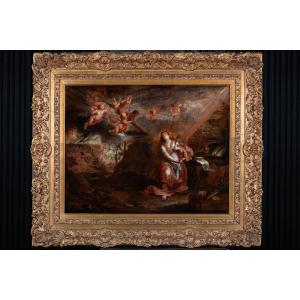


Simon de Vos (1603–1676) – Penitent Mary Magdalene
Oil painting – Hand-signed
Artist: Simon de Vos (1603–1676) (attributed)
Title: Penitent Mary Magdalene
Medium: Oil on canvas
Dimensions: 59 × 75.5 cm (with gilt Baroque frame: 85 × 100.5 cm)
Style: Baroque (Flemish Baroque)
Signature: “SV” monogram at lower center
Condition: Paint loss, craquelure, chromatic alteration/darkening; historic retouching visible under UV light
Provenance: From a high-quality Dutch private art collection
At once restrained and intensely dramatic, this painting presents Mary Magdalene in her role as the penitent saint—one of the most beloved devotional subjects in the seventeenth-century Southern Netherlandish Baroque. The work combines an intimate moment of contemplation with an emphatic celestial vision, characteristic of Counter-Reformation visual culture, in which repentance, inner conversion, and divine grace are made tangible through image-making.
Subject and IconographyMary Magdalene is depicted in a rocky landscape, withdrawn from the world. Her loose hair refers to her traditional iconography and heightens the personal, almost corporeal dimension of penitence. Around her are classical vanitas attributes: a skull (memento mori), books, and an unfurled scroll (meditation, sacred reading, contemplation). On the table stands a glass vessel containing red liquid, convincingly aligned with Magdalene iconography as a symbol of balm, devotion, and offering.
Above the earthly scene, the heavens open: putti carry a large cross through the air, while a powerful beam of light cuts diagonally across the composition from the upper right. This diagonal light is not merely atmospheric; it signifies the irruption of grace—the spiritual breakthrough received in prayer.
Composition and LightThe composition is structured around two poles of tension. On the left, movement and turbulence are generated by the flying putti and the oblique cross; on the right, this dynamism is counterbalanced by the kneeling Magdalene, who responds to the heavenly sign with a measured gesture and uplifted gaze. The light beam functions as a structural axis: it links heaven and earth and directs the eye toward the face and hands, where emotion and intention converge. The deliberately warm, earthy palette—ochres, deep reds, and subdued whites—gives the scene a hushed, almost vesperal atmosphere.
Technique and Painterly HandlingThe paint handling is characteristically Baroque: broad, transparent-looking dark passages build tonal depth against which lighter accents (flesh tones, the white garment, highlights in the drapery) emerge with greater force. The textiles display a supple interplay of folds and sheen, a key stylistic device for suggesting materiality, refinement, and emotional charge—even within a penitential subject. The background is treated more freely and sketch-like, allowing the principal figure and beam of light to dominate.
Artist and Historical ContextActive in Antwerp, Simon de Vos developed from cabinet scenes and genre subjects toward larger-scale religious and history paintings. Trained by the Antwerp portraitist Cornelis de Vos, he became a master in the Guild of Saint Luke at an early age—an indicator of rapid professional recognition.
In maturity, his work fully participates in the rhetorical language of Flemish Baroque, where theatrical lighting, affective intensity, and material presence combine into a devotional theatre. His artistic horizon is tied to the leading Antwerp milieu shaped by Peter Paul Rubens and Anthony van Dyck, two major poles in the visual language of seventeenth-century history painting. De Vos also collaborated with specialists such as Daniel Seghers and Frans Snyders (notably in devotional and garland works), confirming his place within the Antwerp workshop ecosystem.
Stylistic comparanda (national and international): Jacob Jordaens, Frans Francken the Younger, David Teniers the Younger, Gerard Seghers, Caravaggio, Guido Reni.
Conservation, Signature, and FrameThe painting shows age characteristics consistent with a seventeenth-century canvas: craquelure, localized paint loss, and overall darkening/chromatic alteration. Historic retouching is visible under UV, indicating earlier conservation interventions. An “SV” monogram appears at lower center (notably visible in the overexposed detail image). The composition is further enhanced by an important gilt Baroque wooden frame with gesso ornament (overall dimensions: 85 × 100.5 cm), reinforcing the theatrical chiaroscuro effect.
ConclusionPenitent Mary Magdalene is a compelling Baroque meditation on mortality and redemption. The combination of celestial vision (putti and cross), vanitas symbolism, and the saint’s emotionally charged pose makes this a strong collector’s work within the Flemish Baroque tradition.
Presented in a gilt wooden frame with gesso ornament.
Overall dimensions: 85 × 100.5 cm
Canvas dimensions: 59 × 75.5 cm





 Le Magazine de PROANTIC
 TRÉSORS Magazine
 Rivista Artiquariato