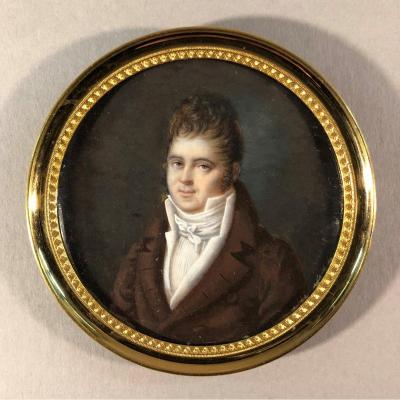


Miniature Enamel On Copper Signed Denis Brownell Murphy 1806
Artist: Denis Brownell Murphy (dublin 1772– Londres 1824)
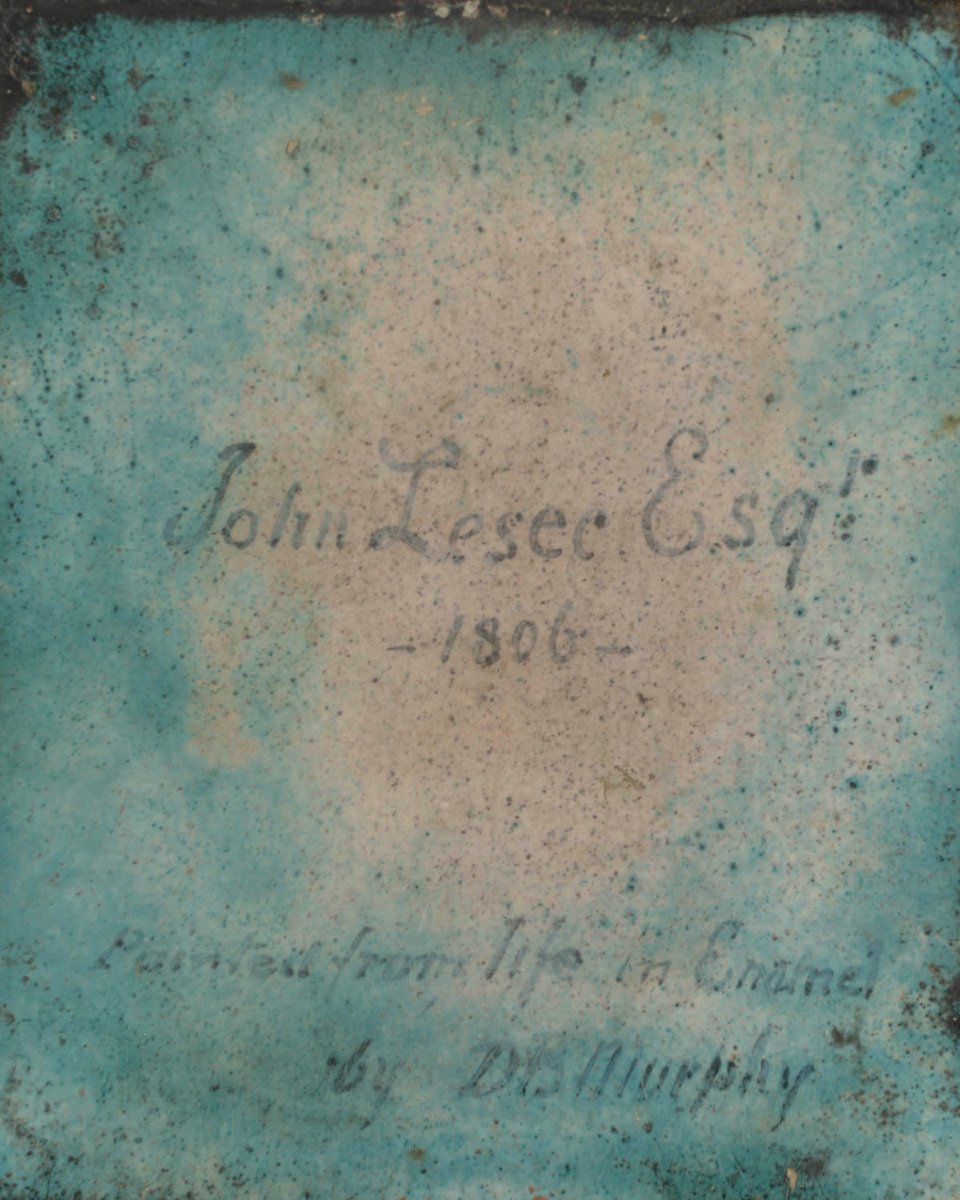
An exceptional enamel miniature on copper, signed Denis Brownell Murphy (Dublin 1772–London 1824), depicting a man in three-quarter view, wearing a dark blue double-breasted coat and a white tie. The reverse bears the handwritten inscription "John Lesec Esq 1806" as well as the words "Painted from Life in Enamel by DBMurphy." Technique and Support: The enamel on copper technique involves applying successive layers of vitrifiable pigments to a copper plate, each layer being fixed by firing. This technique, rarer and more demanding than watercolor on ivory (more common for British miniatures), allows for great finesse in modeling and excellent color preservation. Dating: The date 1806, inscribed on the reverse, corresponds perfectly to Murphy's London period; he settled in London in 1803 and exhibited regularly at the Royal Academy. The style of dress (wide-collared coat, high cravat) is comparable to the early 19th century, during the reign of George III. Subject: The inscription identifies the sitter as "John Lesec Esq." The designation "Esq" (Esquire) indicates respectable social status, generally a gentleman landowner or member of the liberal professions. The exact identity remains to be confirmed by archival research (London registers, directories, Royal Academy exhibition records). Frame: The gilt-bronze frame adorned with a floral garland is typical of early 19th-century framing for miniatures. Dimensions: 13 × 11 cm: these dimensions correspond to a cabinet miniature rather than a pocket medallion. This reinforces the idea of a commissioned portrait intended for domestic display. Significance of the artist: Denis Brownell Murphy (1772–1824) was an Irish miniaturist born in Dublin, where he received his artistic training before making a name for himself as a portraitist. He specialized in miniature painting, particularly in enamel on copper, a demanding technique requiring great mastery of drawing and firing vitreous pigments. Around 1803, he moved to London to expand his clientele and establish his career within the British artistic context. He exhibited regularly at the Royal Academy between 1800 and 1827, demonstrating lasting professional recognition. His work is rooted in the late 18th- and early 19th-century portrait tradition, characterized by meticulous attention to the features and dignity of the sitter. He was also the father of Anna Jameson (1794–1860), an influential writer and art critic in Victorian England.
2 480 €
Period: 19th century
Style: Consulat, Empire
Condition: Perfect condition
Material: Enamel
Width: 13 cm
Height: 11 cm
Reference (ID): 1695768
Availability: In stock
Print