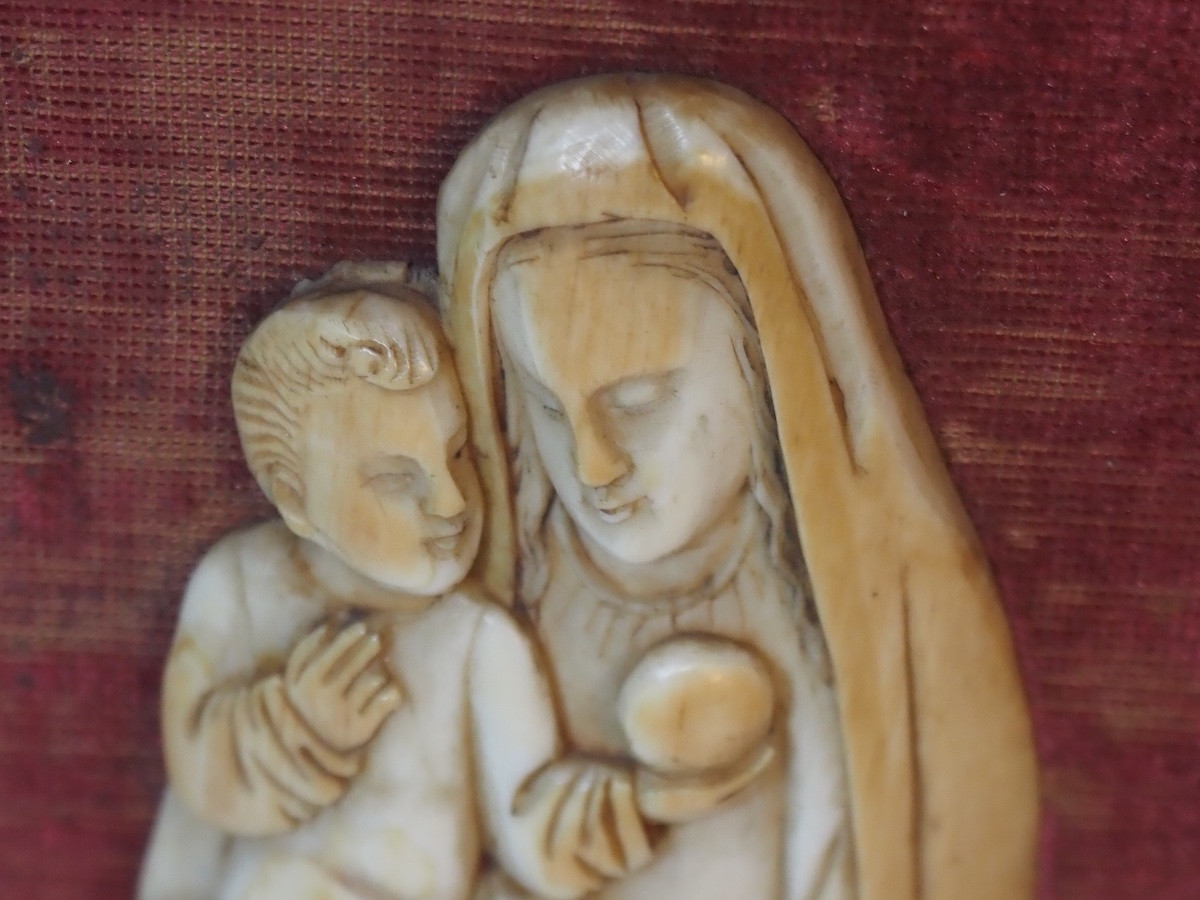


Ivory Relief Of The Virgin And Child Jesus, Probably Macau (china), Circa 1700-1750
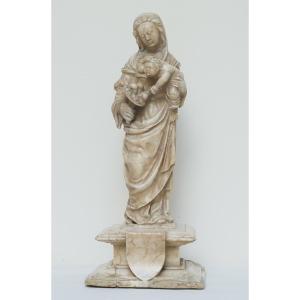
This small ivory carving depicts the Virgin Mary with the Christ Child in a vertically oriented composition, set against a velvet background. The figures are carved in low relief, with Mary supporting the seated Child with both hands. The Christ Child holds a globe in his left hand, a symbol of his universal kingship, and raises his right hand in a gesture of blessing. The two faces are turned toward one another in a tender and intimate gesture, with Christ resting his cheek against Mary’s veil.
The oval, smoothly finished facial features of both figures are striking and point to an Asian origin. At the same time, it is clear that the maker was thoroughly familiar with Western Catholic iconography. This is evident in the precise rendering of familiar elements such as the globe and the blessing gesture of Christ, both of which appear frequently in European Baroque sculpture.
It is highly likely that this carving was produced in one of the southern Chinese port cities where European missionaries, particularly Jesuits and Franciscans, had been active since the 16th century. Macau, which served as an important center of Catholic missionary activity in the 17th and 18th centuries, is the most plausible place of origin in this regard. The treatment of the drapery shows faint reminiscences of late Gothic European sculpture, possibly derived from models or prints that circulated locally.
Such ivory carvings were popular as objects of personal devotion, both among local converts and Western missionaries. In their compact size and intercultural style, these works demonstrate the global dissemination of Christian visual language and the adaptive power of missionary art in contact zones between Europe and Asia.
Dimensions: 15.4 × 4.5 cm.
Period: 18th century
Style: Other Style
Condition: Good condition
Material: Ivory
Width: 4.5 cm.
Height: 15.4 cm.
Reference (ID): 1693820
Availability: In stock