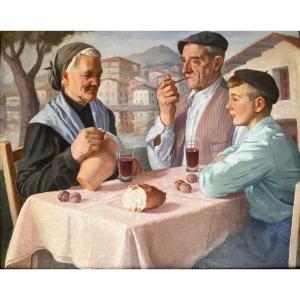
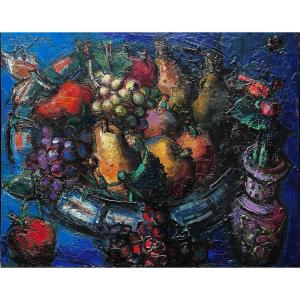
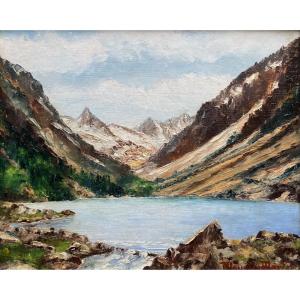
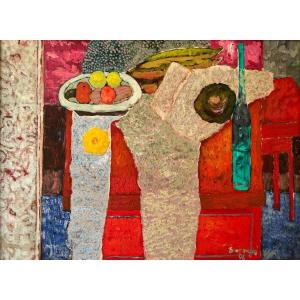
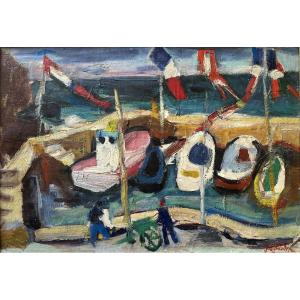
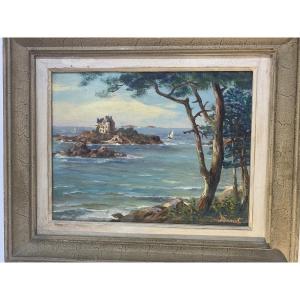
Hélène Elizaga (1898–1981) Boats In Front Of The Ravel Quay In Ciboure, Basque Country, Oil On Canvas, 27 X 35 Cm
Hélène ELIZAGA (1898 Bagnères-de-Bigorre – 1981 Saint-Jean-de-Luz) “Boats in front of the Quai Ravel in Ciboure” Oil on panel, signed lower right. On the reverse, a sketch depicting a Basque landscape with La Rhune mountain. H: 27 cm x W: 35 cm (39 x 47 cm with frame). Hélène Elizaga (or simply Elizaga), born Marie Lucie Hélène Elissague in Bagnères-de-Bigorre on March 3, 1896, and died in Saint-Jean-de-Luz on September 25, 1981, was a French Basque painter originally from Sare. Her work is primarily known for its treatment of perspective and themes related to the Basque Country. The daughter of a pharmacist, she began painting at the age of 13. At the age of 21, she studied in Paris at the Académie Julian, then at the Grande Chaumière, and finally at the Sacred Art Workshops of Maurice Denis and Georges Desvallières. In Paris, she also took classes with the portrait painter Henry du Sorbiers de La Tourasse, whom she married in 1918. She then returned with him to the Basque Country, the couple settling first in Urrugne and then in Saint-Jean-de-Luz (Pyrénées-Atlantiques). There, they established a painting restoration workshop together and began to associate with many Basque artists, including Ramiro Arrue and other painters of the "Group of Nine." At Arrue's urging, she joined the Basque Artists' Association in 1932 and exhibited her works alongside other artists from the region such as Arrue, Colin, Labrouche, Masson, Ribera, and Veyrin. She died on September 25, 1981, in Saint-Jean-de-Luz and was buried in Urrugne. Hélène Elizaga primarily worked in her paintings and portraits on themes related to Basque identity and culture. Her best-known works are "Partie de pelote" (Pelota Match) and "Portrait des frères Arrayet, champions de pelote" (Portrait of the Arrayet Brothers, Pelota Champions), both of which are on permanent display at the Basque Museum and the History Museum of Bayonne, which owns most of her works. Previously, her works were also exhibited in Bayonne in 1930, 1932 and 1935, in Pau and at the Universal Exhibition in Paris in 1937, and finally in Saint-Jean-de-Luz in 1950. Other exhibitions of her works have also taken place posthumously, notably in Saint-Jean-de-Luz in 1994, in Ciboure in 2009 (as part of an exhibition called "Women painters and women painted in the Basque Country"), and in Cap d'Ail in 2017. A fresco by Elizaga can be seen in the Notre-Dame-de-l'Aubépine chapel in Ainhoa.
6 000 €
Period: 20th century
Style: Modern Art
Condition: Perfect condition
Material: Oil painting on wood
Width: 35
Height: 27
Reference (ID): 1686204
Availability: In stock
Print