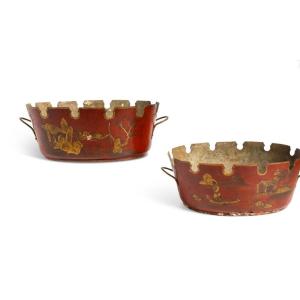


Pair Of Lacquered Painted Sheet Metal Stained-glass Windows, Louis XV Period, Circa 1760.
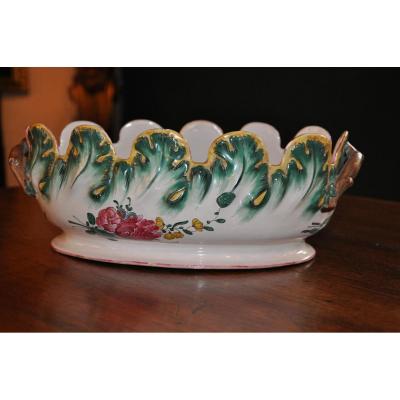
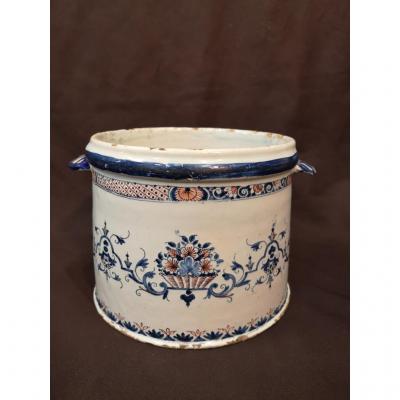
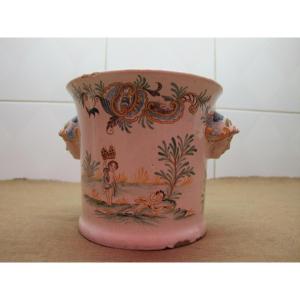
Pair of oval lacquered sheet metal window frames, fitted with side handles decorated with animated landscapes in gold on a red background. Louis XV period, circa 1760. Good overall condition, some wear.
H x W x D = 11 x 30 x 21 cm
What is painted or lacquered sheet metal?
It is a sheet of rolled tinplate covered with a thin layer of tin. The sheet was then cut, shaped, and soldered. The next step is essential, as it transforms a simple piece of sheet metal into a varnished sheet metal work of art. Abbé Jaubert, in the "Dictionary of Arts and Crafts" published in 1793, gives us the recipe for varnishing sheet metal: "Before applying the first coat of varnish, the metal must be cleaned, smoothed with pumice stone, and above all, ensured to be completely dry; After drying this first coat in the sun or over a moderate fire, the second coat must be applied while still hot. The varnish can be darkened with the smoke of a resin torch, the heat of which helps to smooth and even it out… This treatment could be repeated up to four times, and it was on the final, carefully polished layer that the decoration was applied. Indeed, without varnish, there can be no decoration. Under Louis XIV, objects covered with lacquer or Oriental varnish fascinated collectors, and numerous researchers sought the secret of these varnishes throughout Europe. But it was only around 1740, after Bonami's discovery of "amber varnish" in Italy, that experiments multiplied, culminating in 1768 in France with the creation of the first factory for painted sheet metal under the name "La Petite Pologne" (Little Poland). A few years later, a second factory, "Au Petit Dunkerque" (At Little Dunkirk), run by Granchez, opened.
A little history…
In the 18th century, painted sheet metal frequently followed the shape of Sèvres or Oriental porcelain pieces. The same was true for the decoration. Many items were found on glass or bottle coolers, glass-fronted cabinets, cachepots, inkwells, planters, and perfume burners. The decorations were often set within reserves, as at Sèvres, and depicted pastoral scenes, fishermen, bouquets of flowers, or Chinese figures. The backgrounds were generally plain. The most remarkable pieces were painted across the entire surface and were sometimes adorned with chased and gilded bronze mounts.
H x W x D = 11 x 30 x 21 cm
What is painted or lacquered sheet metal?
It is a sheet of rolled tinplate covered with a thin layer of tin. The sheet was then cut, shaped, and soldered. The next step is essential, as it transforms a simple piece of sheet metal into a varnished sheet metal work of art. Abbé Jaubert, in the "Dictionary of Arts and Crafts" published in 1793, gives us the recipe for varnishing sheet metal: "Before applying the first coat of varnish, the metal must be cleaned, smoothed with pumice stone, and above all, ensured to be completely dry; After drying this first coat in the sun or over a moderate fire, the second coat must be applied while still hot. The varnish can be darkened with the smoke of a resin torch, the heat of which helps to smooth and even it out… This treatment could be repeated up to four times, and it was on the final, carefully polished layer that the decoration was applied. Indeed, without varnish, there can be no decoration. Under Louis XIV, objects covered with lacquer or Oriental varnish fascinated collectors, and numerous researchers sought the secret of these varnishes throughout Europe. But it was only around 1740, after Bonami's discovery of "amber varnish" in Italy, that experiments multiplied, culminating in 1768 in France with the creation of the first factory for painted sheet metal under the name "La Petite Pologne" (Little Poland). A few years later, a second factory, "Au Petit Dunkerque" (At Little Dunkirk), run by Granchez, opened.
A little history…
In the 18th century, painted sheet metal frequently followed the shape of Sèvres or Oriental porcelain pieces. The same was true for the decoration. Many items were found on glass or bottle coolers, glass-fronted cabinets, cachepots, inkwells, planters, and perfume burners. The decorations were often set within reserves, as at Sèvres, and depicted pastoral scenes, fishermen, bouquets of flowers, or Chinese figures. The backgrounds were generally plain. The most remarkable pieces were painted across the entire surface and were sometimes adorned with chased and gilded bronze mounts.
800 €
Period: 18th century
Style: Louis 15th - Transition
Condition: Good condition
Material: Painted metal
Width: 30
Height: 11
Depth: 21
Reference (ID): 1673786
Availability: In stock
Print