THIS OBJECT WAS SOLD
Bronze Age Globular Jar With Twin Handles – Certificate Of Authenticity

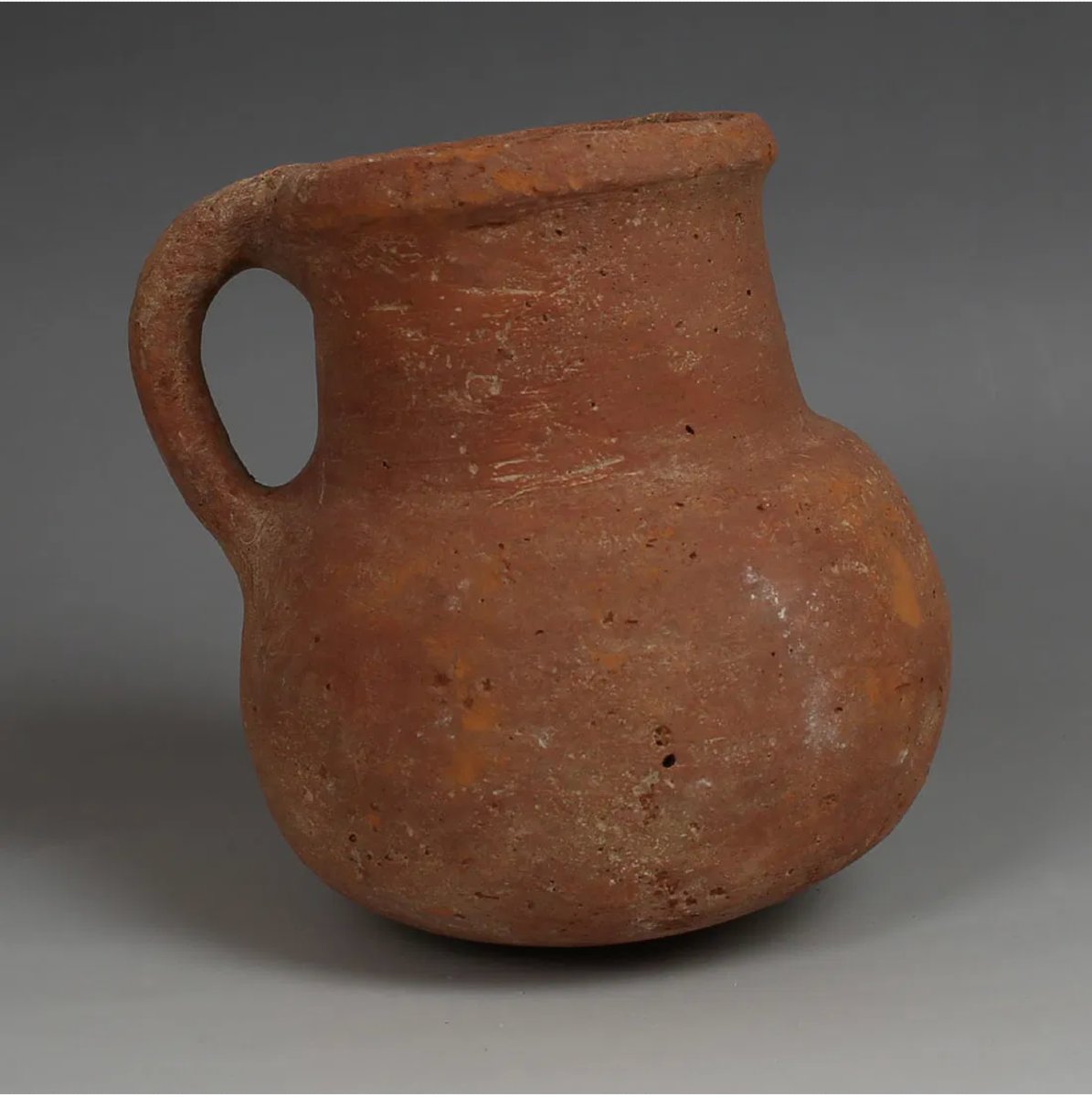
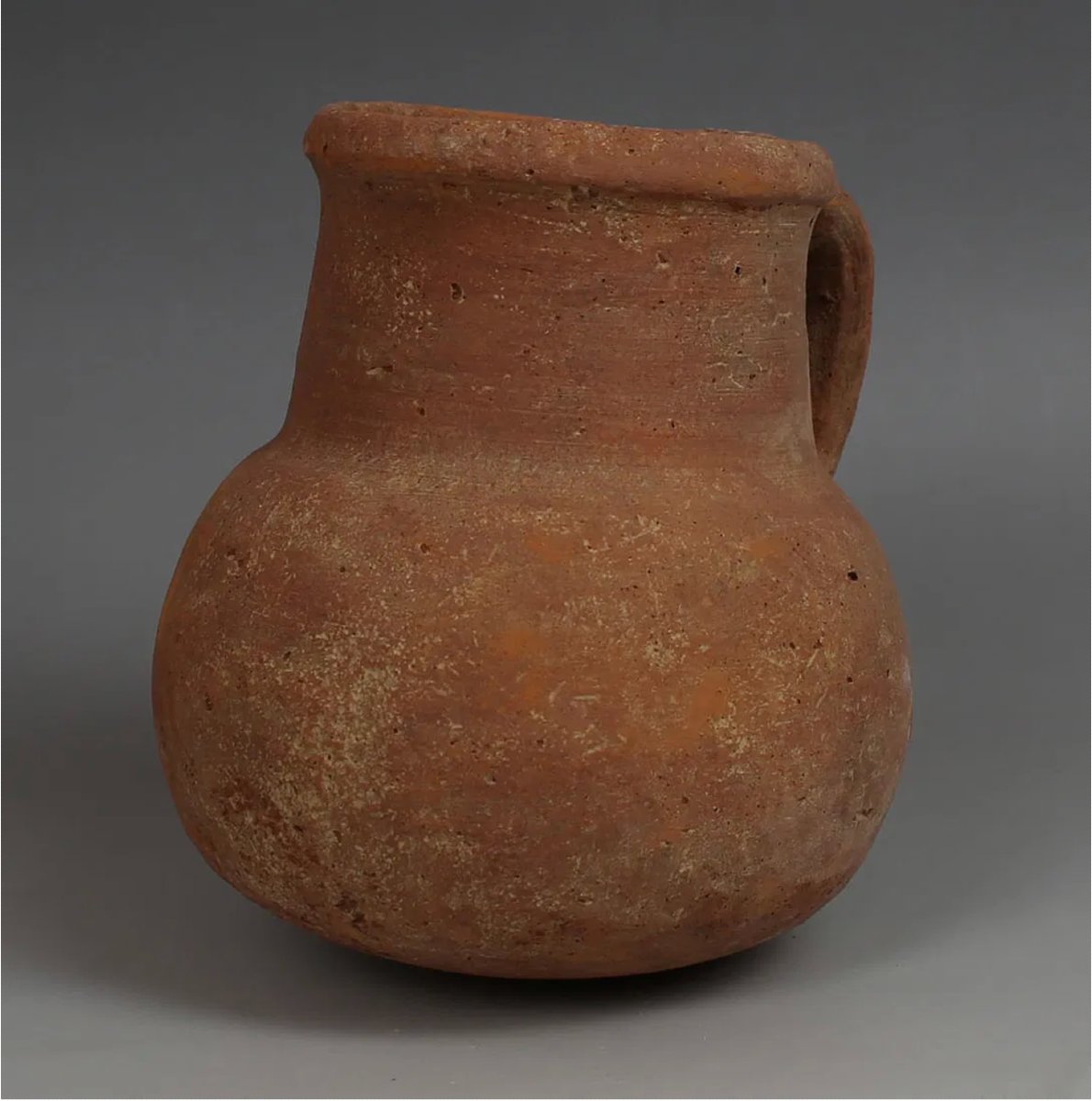
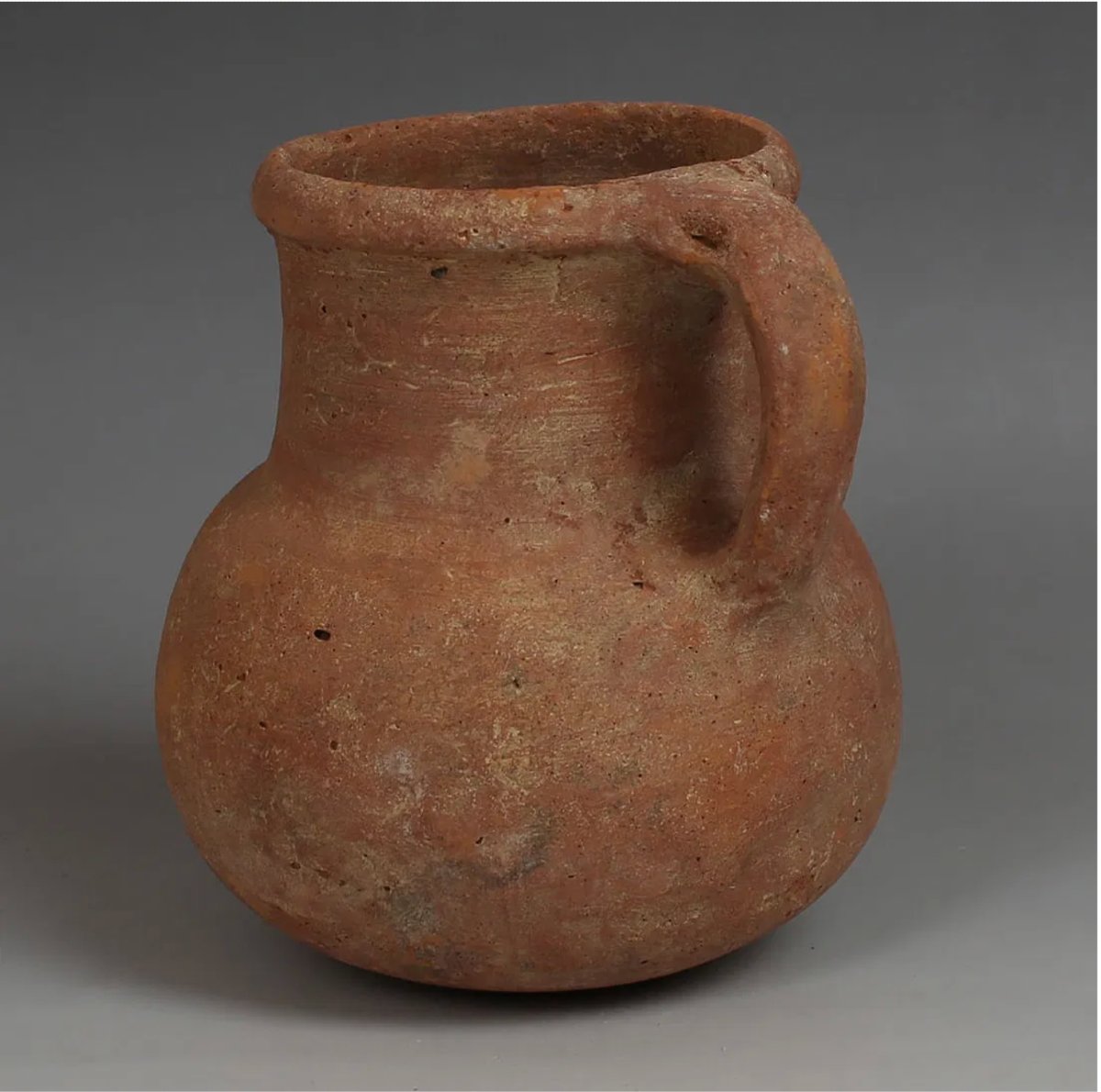


This globular vessel from the Bronze Age is distinguished by a "squat" and powerful architecture, designed for stability and durable conservation. The object asserts its presence through a raw, honest materiality: a coarse-grained terracotta that catches the light and bears witness to a vigorous shaping technique, predating the industrialization of ceramics. The piece is marked by a complex archaeological patina, blending the ochre-pink hues of firing with the grayish deposits of burial. The perforation visible on the body should not be read as an alteration, but as a "scar of time": its eroded edges guarantee the integrity of the ancient material, untouched and unmasked by modern restorations, offering the viewer the naked truth of an artifact several millennia old.
Characteristics
Object: Globular storage vessel with two handles (Cooking Pot or Storage Jar).
Culture: Bronze Age (Levant / Canaan).
Period: 3rd – 2nd Millennium BC.
Material: Coarse ware, visible mineral inclusions.
Dimensions: Height: 122 mm | Diameter: 120 mm.
Condition: Good general condition; presence of an ancient perforation on the body (stable) and surface erosion attesting to antiquity.
Provenance: Ex-private Jerusalem collection, formed between 1975 and 1990.
Documentation: Sold with Certificate of Authenticity.
Historical Context In the societies of the Levant and the Eastern Mediterranean during the Bronze Age, this type of vessel played a central role in the domestic economy. Its bulbous shape and wide neck made it suitable for storing dry goods (grains, legumes) or for culinary preparation. The presence of handles suggests versatility: it could be suspended to protect contents from pests or transported using ropes. These ceramics, produced locally for community use, are silent markers of sedentarization and the organization of ancient households.
Formal and Material Analysis
Morphology: The vessel presents a slightly flattened spherical body, ensuring optimal capacity within a compact volume. The neck, short and flared, allows easy access. The determining typological element is the presence of two small vertical handles (lug handles) attached to the shoulder, hand-modeled and forcefully welded to the wall.
Material and Texture: Surface examination reveals an unrefined fabric, rich in inclusions (quartz, sand, or grog used as temper), characteristic of utilitarian ceramics designed to withstand thermal or mechanical shock. The texture is rough, retaining the memory of manual modeling or slow-wheel shaping.
Patina and Condition: The surface offers a chromatic variety, ranging from warm beige to ashen gray, resulting from firing in a primitive kiln with a variable atmosphere. Whitish calcareous concretions, lodged in the interstices of the granular material, attest to a long underground stay. The perforation on the body, with its eroded and non-sharp edges, confirms that this is an ancient, stabilized accident, not a recent break.
Cultural and Aesthetic Value This jar is an archetype of Bronze Age pottery: robust, necessary, and technically mastered. It does not seek to seduce through superfluous decoration but commands respect through its millenary functionality. For the collector, it offers the absolute authenticity of a piece found "as is" ("dans son jus"), whose imperfections tell the story of its survival through the ages without the artifices of restoration.
Expertise Report The analysis confirms the cultural and chronological attribution:
Typology: The globular form with lug handles is characteristic of the Early to Middle Bronze Age in the Levant.
Materiality: The coarse fabric with heavy inclusions is consistent with utilitarian productions of this period.
Condition: The patina and the wear on the perforation (soft edges) validate the antiquity of the object and its signs of use.
Traceability: The provenance (Jerusalem, 1975–1990) is documented.
Explore similar pieces and discover your ideal find:
archeology