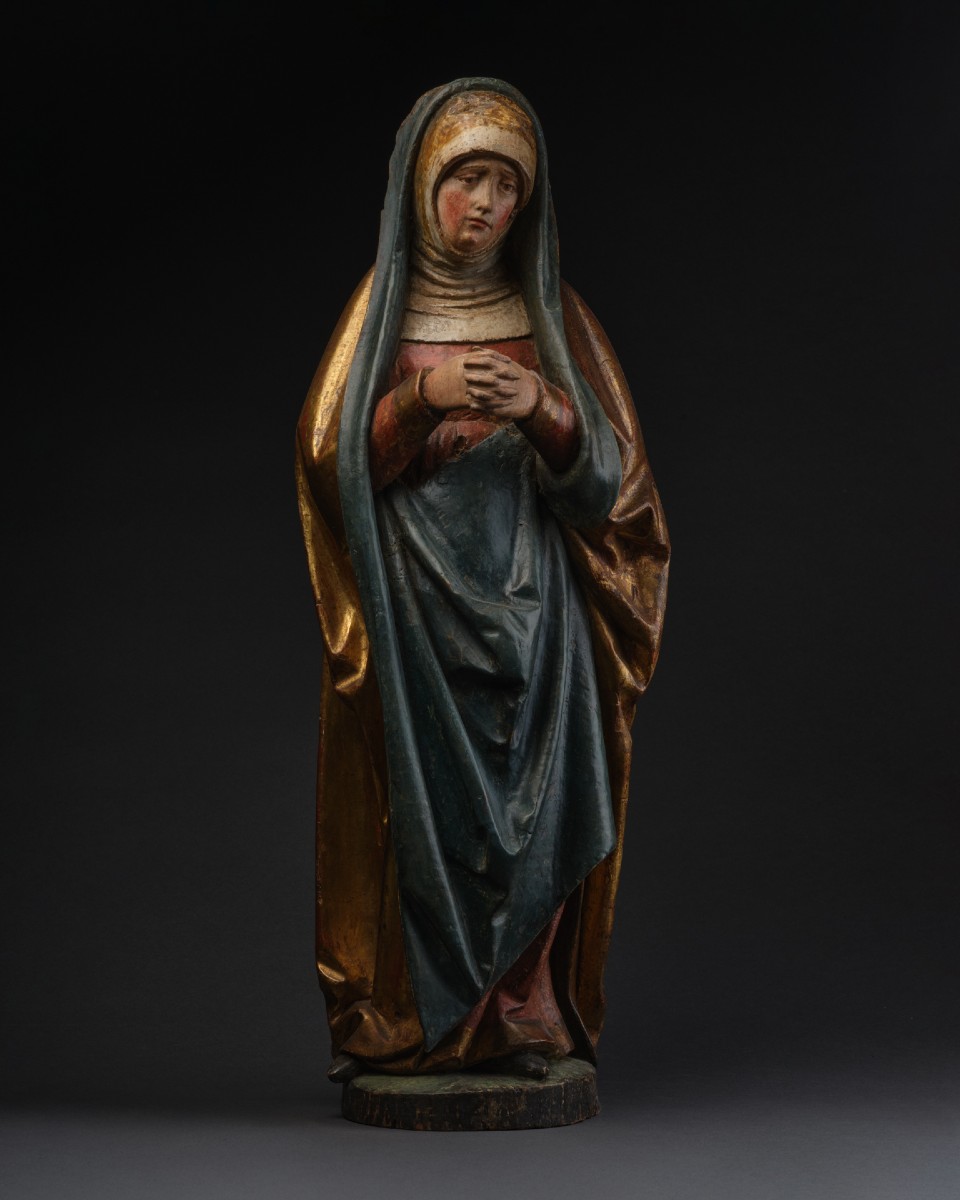
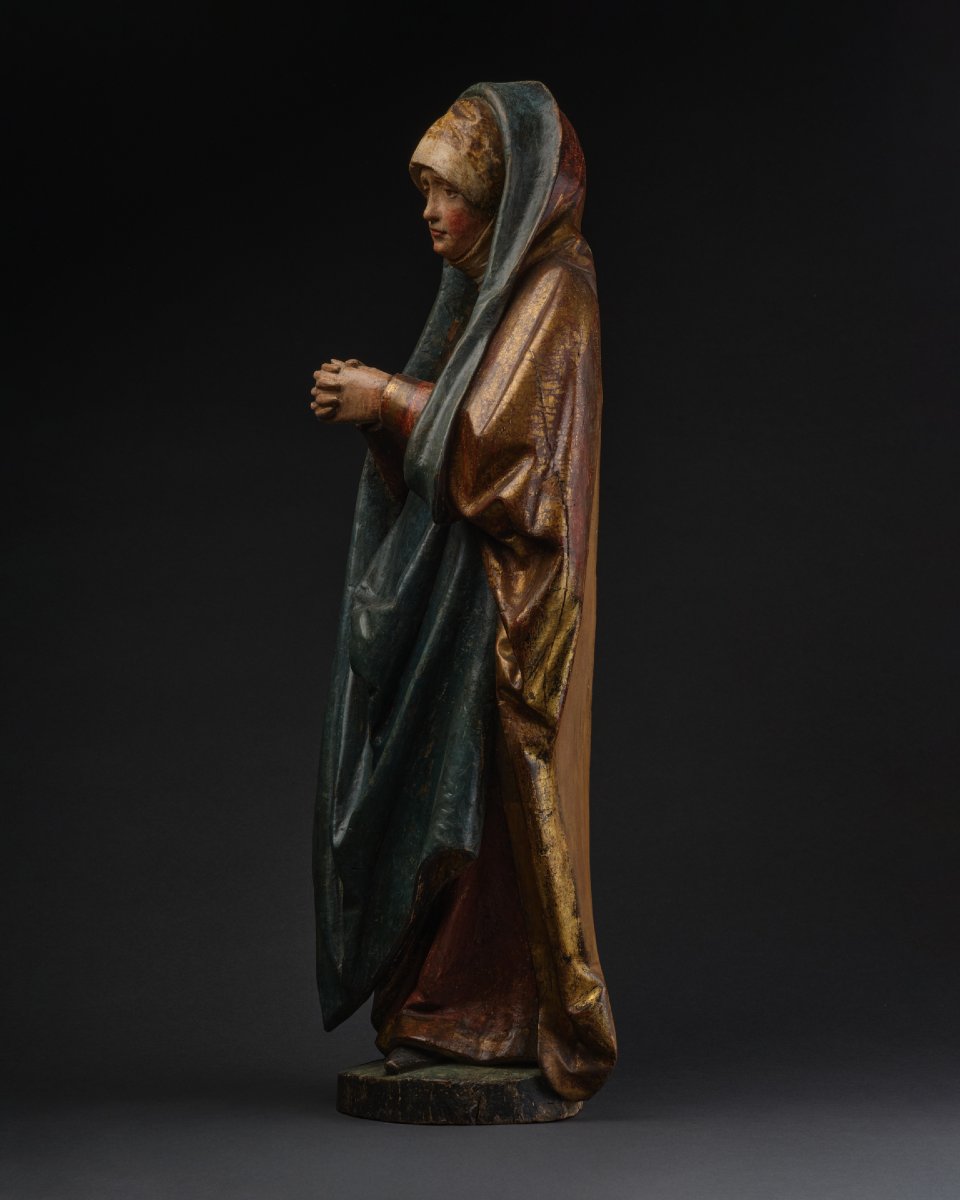

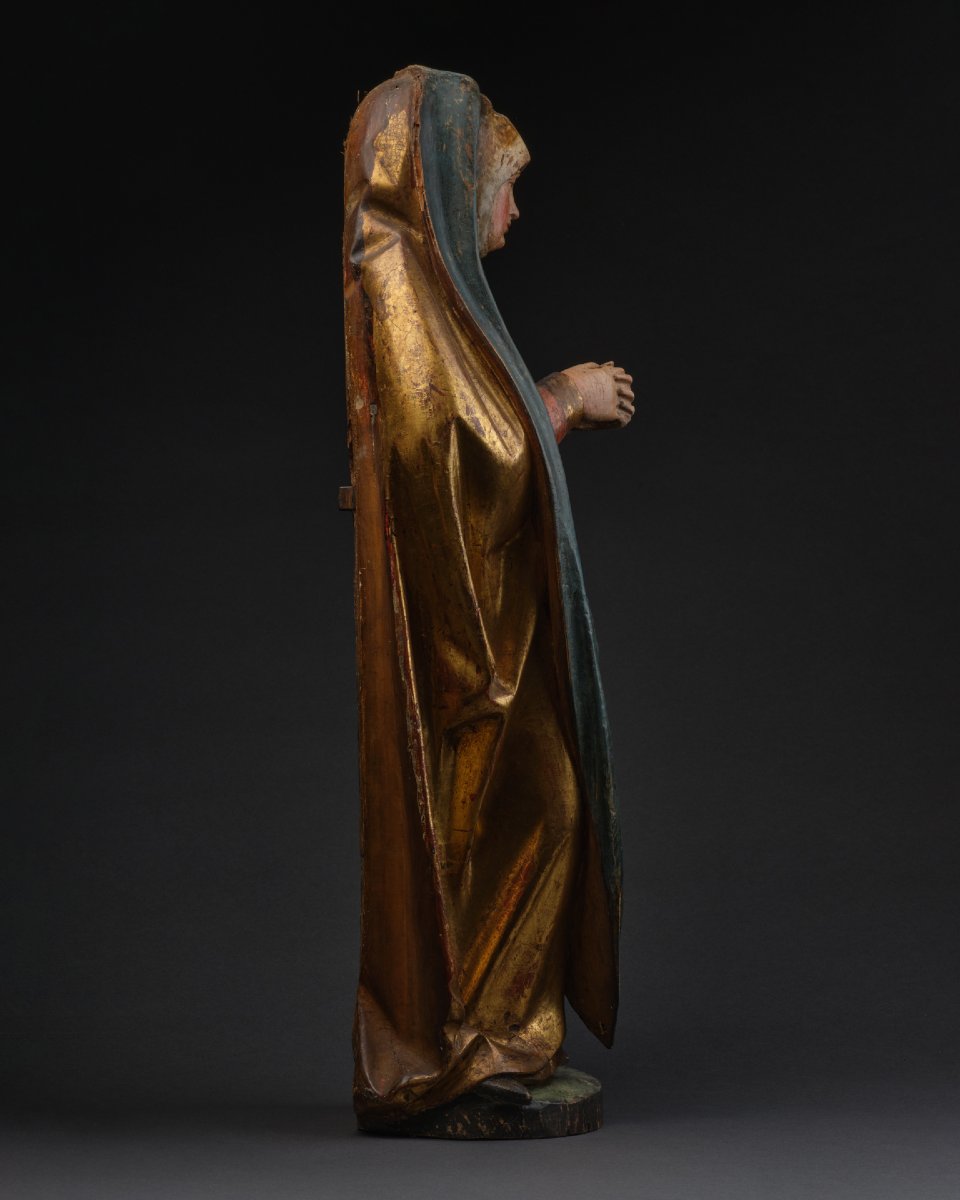
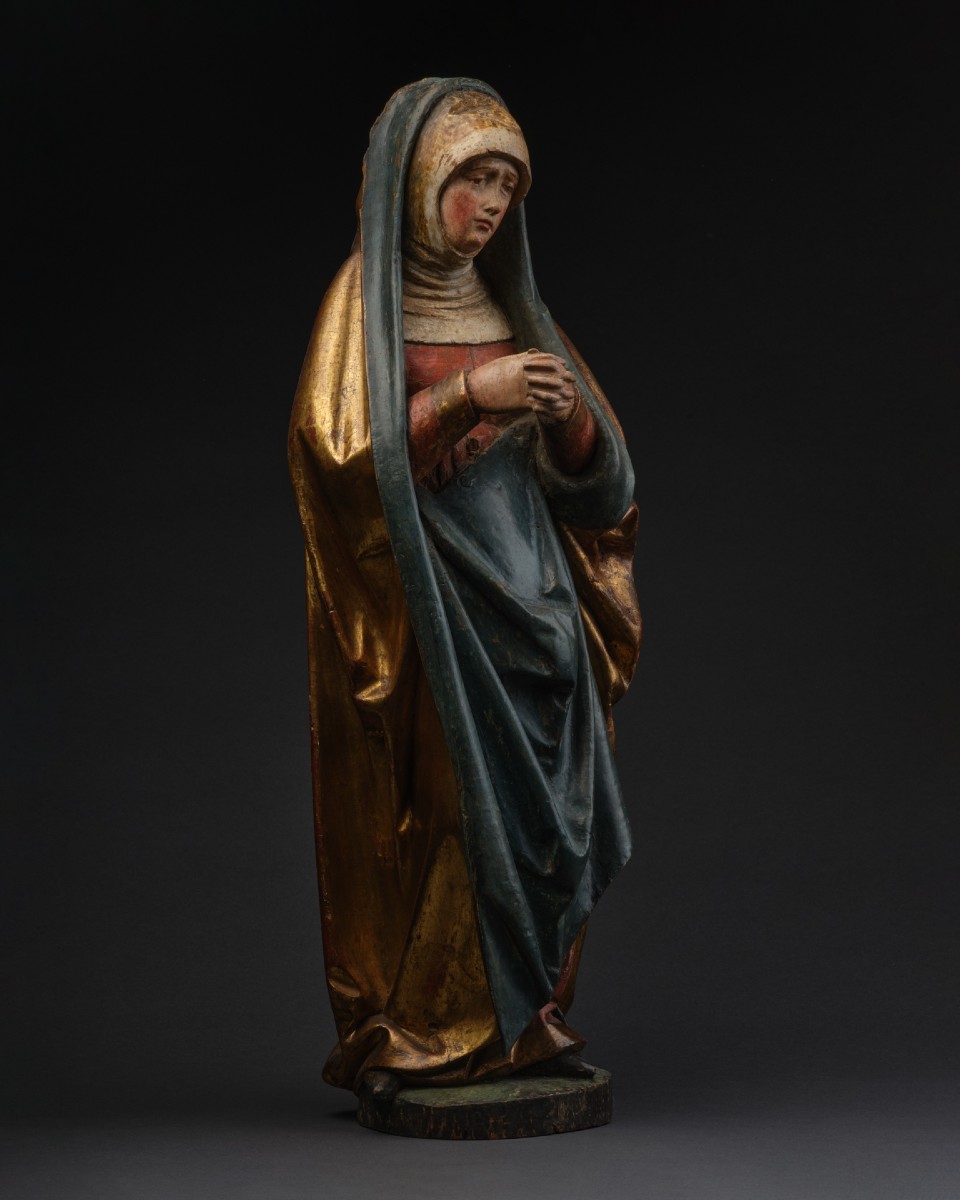
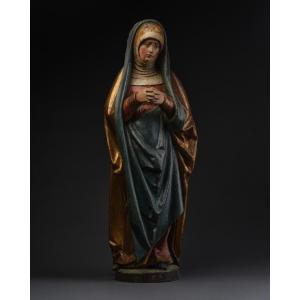


"Virgin Of Calvary – Polychrome And Gilt Wood, Swabia, Early 16th Century"
Since the nineteenth century, and even more so in recent years during their rare appearances on the art market, the delicate and expressive creations of Swabia have captivated the hearts of enthusiasts and collectors of early sculpture. Between 1490 and 1520, in the many autonomous urban centers of this vast historical region of southern Germany, and in an economic climate highly favorable to artistic production, a multitude of sculpture workshops flourished, each led by a master assisted by several journeymen. Combining strength and sensitivity in their handling of wood as nowhere else in Europe, these workshops fulfilled a large number of commissions for altarpieces, one of the most significant sculptural productions in late medieval Germany.The work presented here fits fully within this flourishing artistic context. Carved in the round from carefully selected wood, this Virgin retains a beautiful early polychromy, whose deep blues, softened reds, and delicately patinated golds lend the figure a presence that is at once vibrant and subtle. The ample drapery, animated by soft, fluid folds, envelops the figure with a grace characteristic of early sixteenth-century Swabian sculpture and attests to the high level of mastery achieved by these workshops.
Depicted with her hands clasped, the Virgin adopts a moving attitude of contemplation. The gentle inclination of her head, the shadowed gaze, and the closed mouth with delicately down-turned corners express restrained emotion, a modest yet deeply felt sorrow. This characteristic detail marks her face with profound sadness and identifies her as a Virgo Dolorosa, a Virgin of Calvary. Exquisitely carved, her face embodies the particular sensibility of the Swabian workshops, which knew how to infuse their figures with a profound and immediately affecting humanity. She was originally intended to stand at the foot of a Calvary, paired with the figure of Saint John, thus completing a sculptural group devoted to the Crucifixion.
Although it cannot be attributed with certainty to a specific workshop, this Virgin nevertheless shows notable affinities with a fine Virgin of Calvary preserved in the Musée de Cluny and originating from Upper Swabia (Cl. 15397). Both share the same type of garment, an enveloping mantle and close-fitting wimple, a similarly elongated silhouette, and, above all, faces marked by a poignant gentleness in which tenderness blends with sorrow. This closeness in expression, attitude, and sensibility endows these sculptures with the same emotional intensity and profoundly human presence, fully revealing the genius of late medieval Swabian art.















 Le Magazine de PROANTIC
 TRÉSORS Magazine
 Rivista Artiquariato