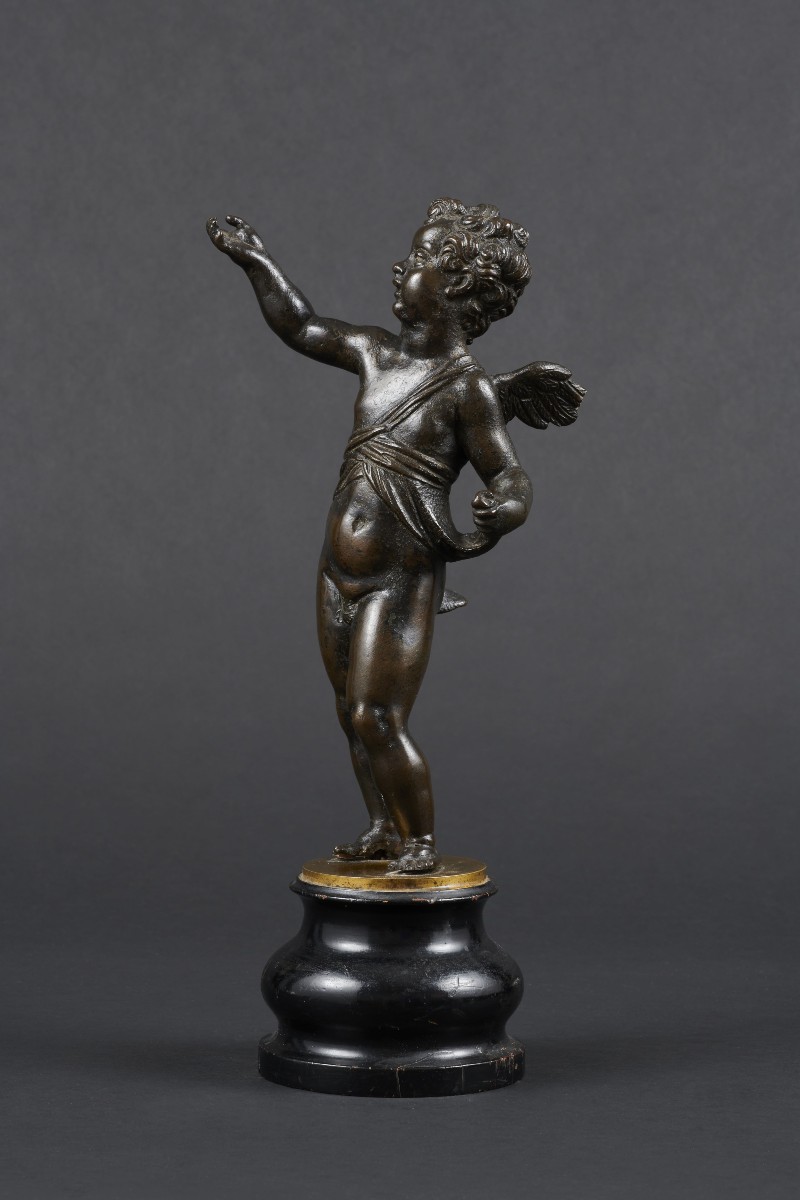


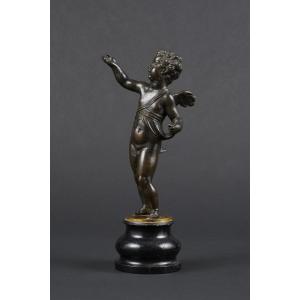


Workshop Of Niccolò Roccatagliata, Winged Putto, Bronze, Venice, Early 17th Century
This beautiful bronze putto is emblematic of the work of the Italian sculptor Niccolò Roccatagliata, identified by the renowned art historian Leo Planiscig as the "Master of the Putto" due to his abundant production of charming, childlike figures in various poses and settings, which brought glory to Venice during the first quarter of the 17th century. Born in Genoa but working primarily in Venice, Niccolò Roccatagliata (1593-1636) is famous for his prolific bronze work. Depicting religious, allegorical, and mythological subjects, he fulfilled numerous commissions for private clients as well as for the churches of the City of the Doges. Upon his death, his son Sebastiano Nicolini inherited his workshop and continued to produce bronzes in the master's style. The thick, tightly curled hair of our putto, his heavy eyelids, and his plump thighs are all distinctive features that characterize the naturalistic and sensual style of Roccatagliata and his workshop. These features are also found in the Putto with a Drum and the Putto Playing the Flute in the Kunsthistorisches Museum in Vienna, both attributed to the Master. The firmer treatment of the flesh in our figure, as well as the more careful and precise rendering of his gaze, brings him even closer to a Musician Putto and a Torchbearer Putto from the former Barzanti collection, both made at the end of the 16th century in Roccatagliata's circle. The rounded bellies of these cherubs are delicately emphasized by a few folds of flesh, similar to those observed in our work. The Barzanti cherubs are enveloped in a fine fabric that wraps like a scarf around their chubby bodies, echoing the one worn by our putto, a corner of which he holds in his left hand in a gesture comparable to that of a handsome Cupid similar to the Master's work, now in the Bargello Museum in Florence. This fine tunic, more elaborate than the band of fabric on the Barzanti putti, can be compared to that worn by two other cherubs attributed to Roccataliagata, in the Kunsthistorisches Museum in Vienna and the Ashmolean Museum in Oxford. On these examples, the fabric opens like a curtain, just as on our cast, beneath the child's chest, revealing his rounded belly. The firm treatment of the flesh on the Vienna putto, the precise rendering of his gaze, and the similar arrangement of his hair make it the closest equivalent to our work. The almost identical format of the two bronzes, relatively important within the production gathered around the Master, could designate them, like the example in the Bargello, as figures of andirons, a flagship production of the Venetian bronze workshops which made the fame of Roccatagliata, and his followers until the end of the 17th century.
8 600 €
Period: 17th century
Style: Renaissance, Louis 13th
Condition: Good condition
Material: Bronze
Height: 26 cm
Reference (ID): 1654311
Availability: In stock
Print