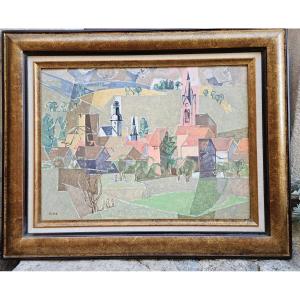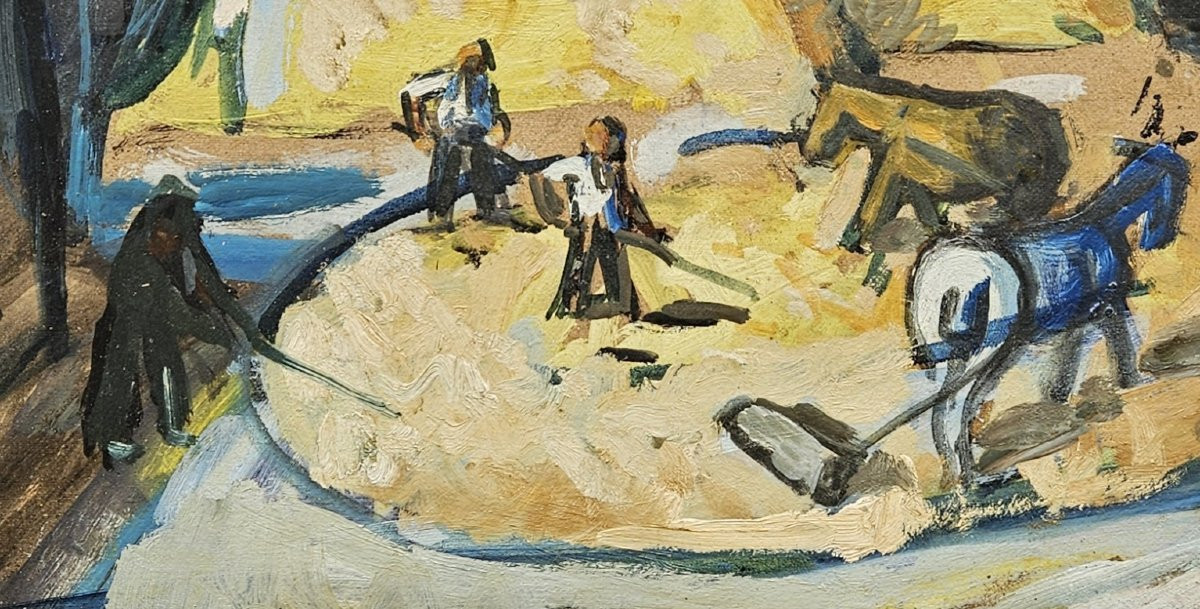
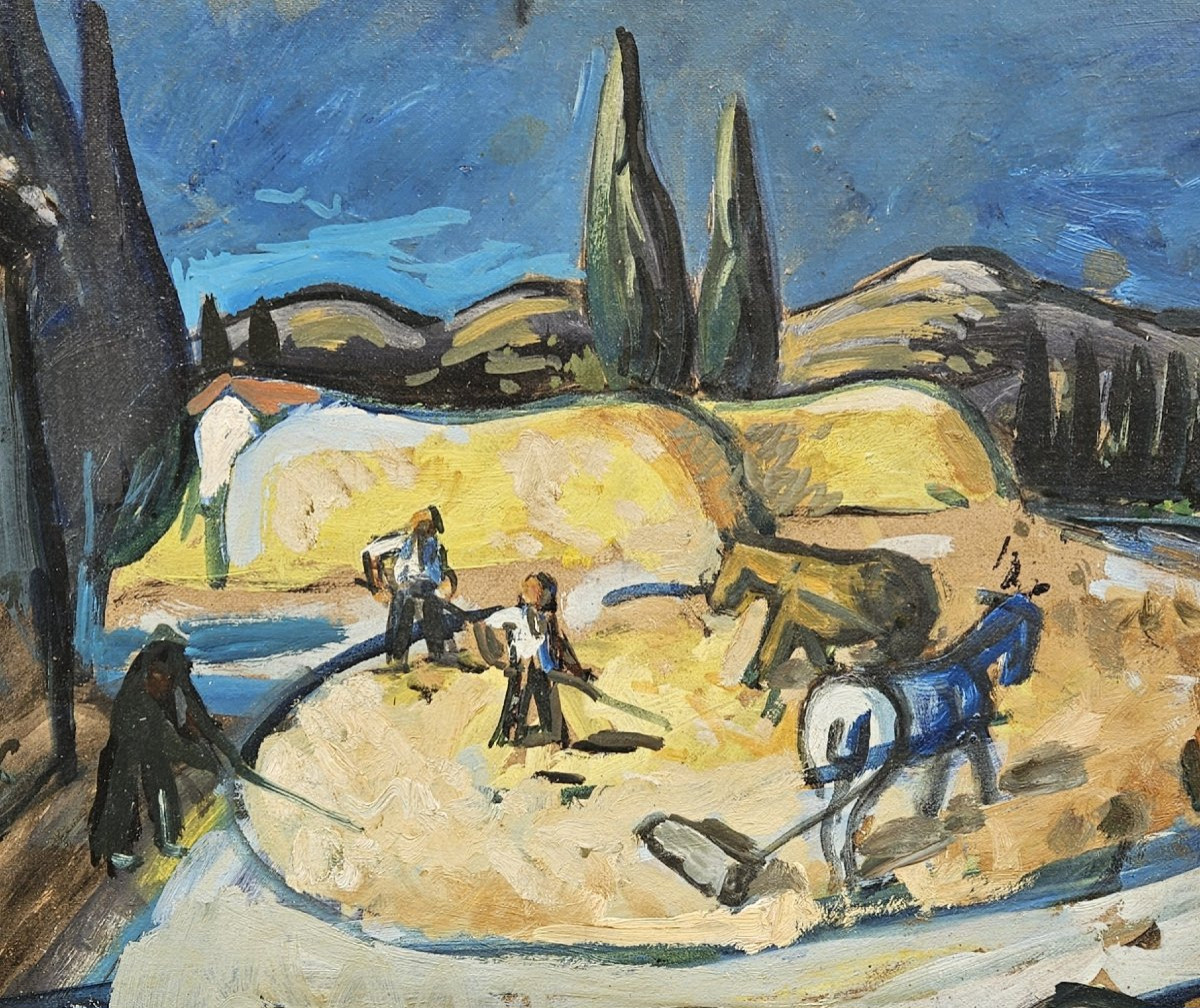
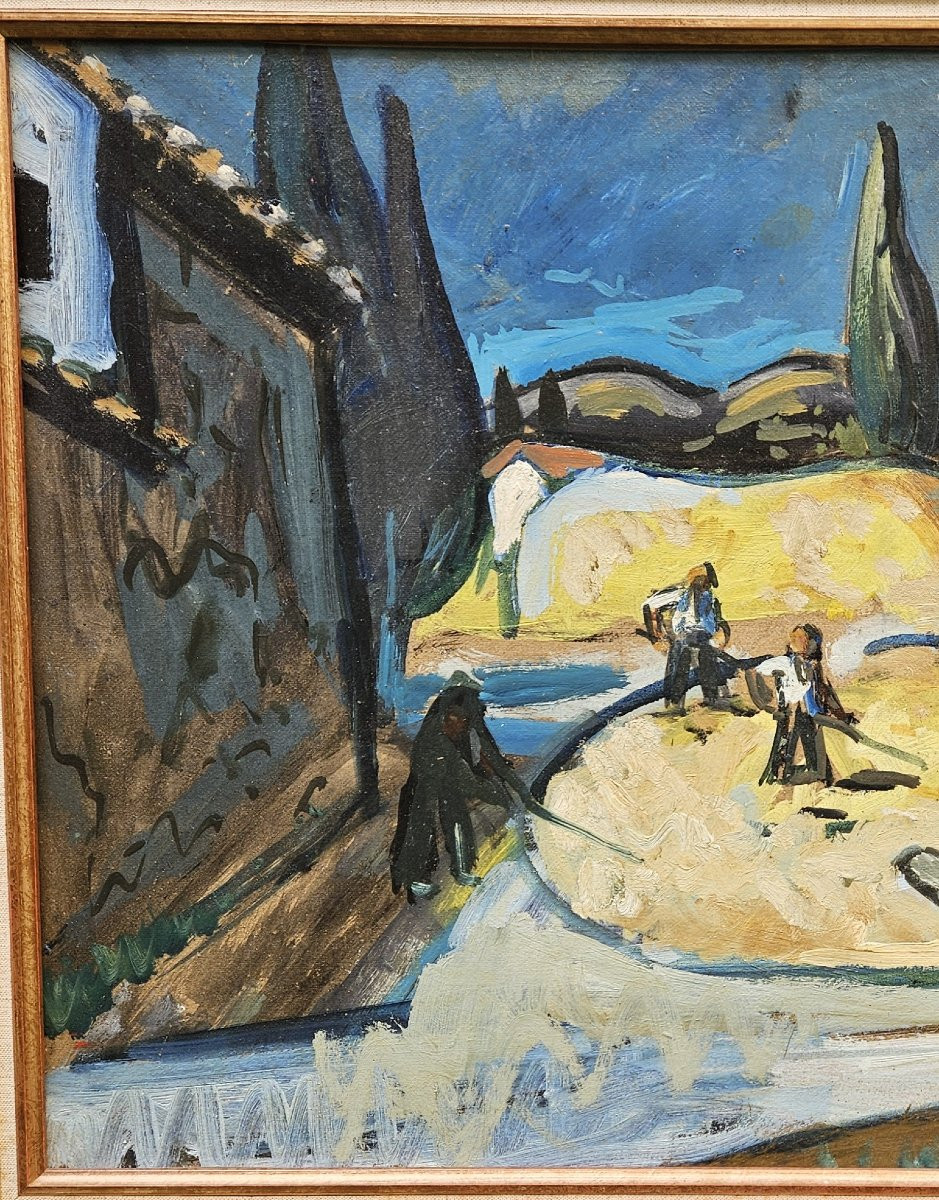
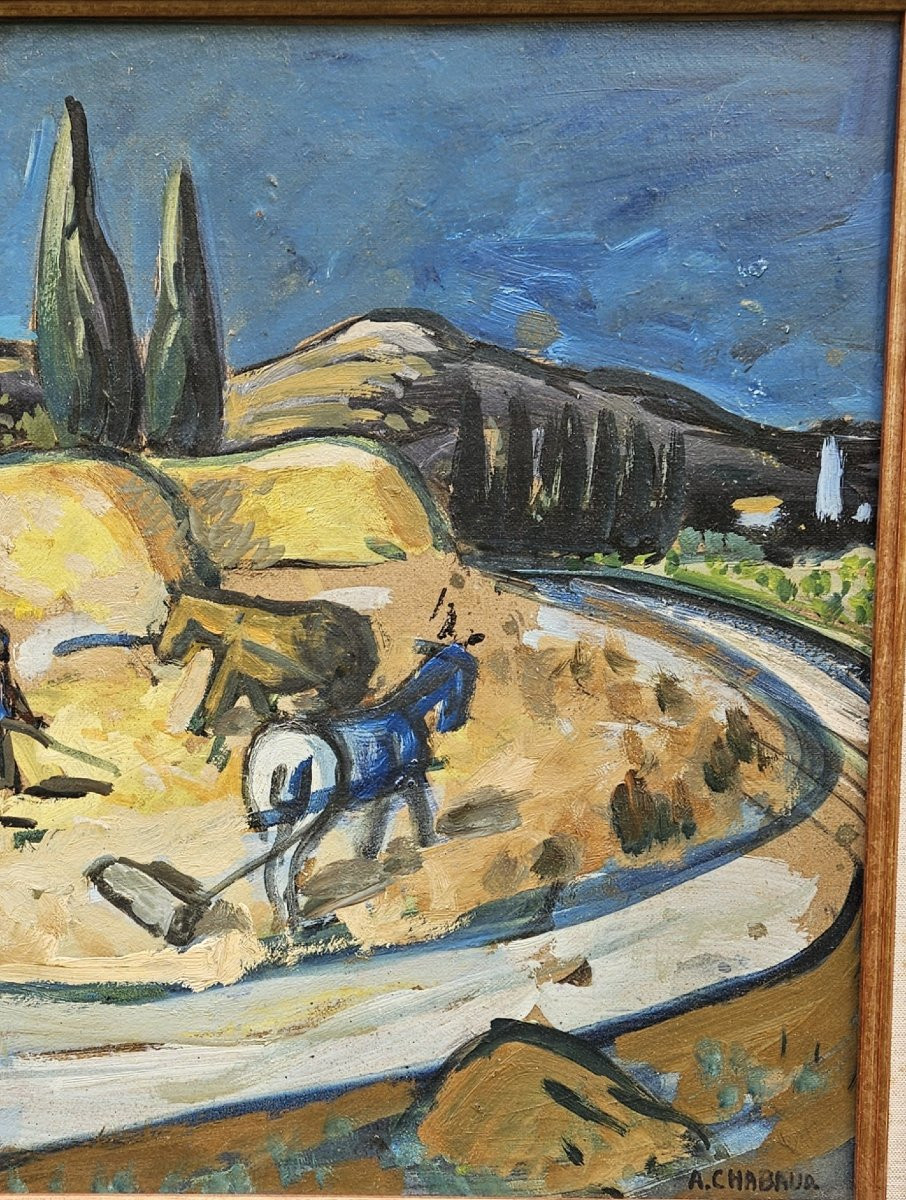
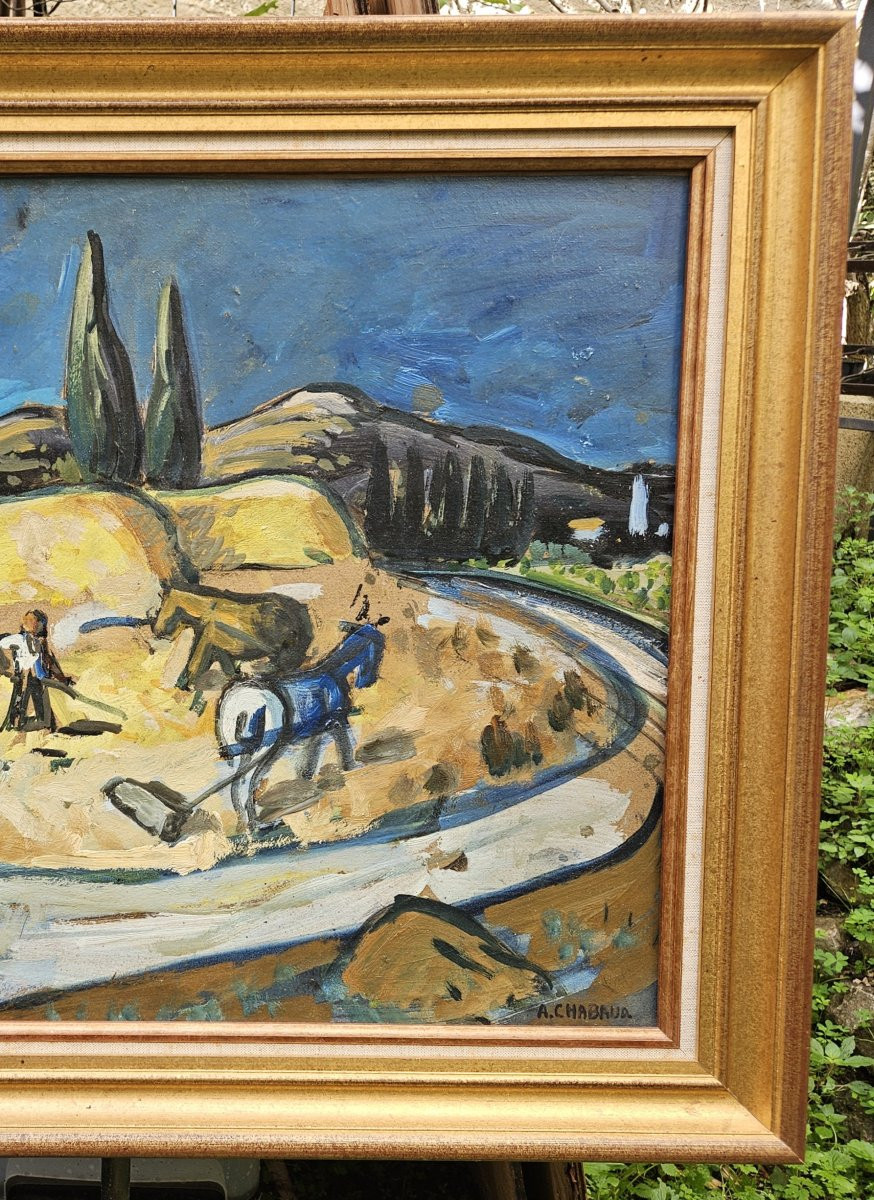
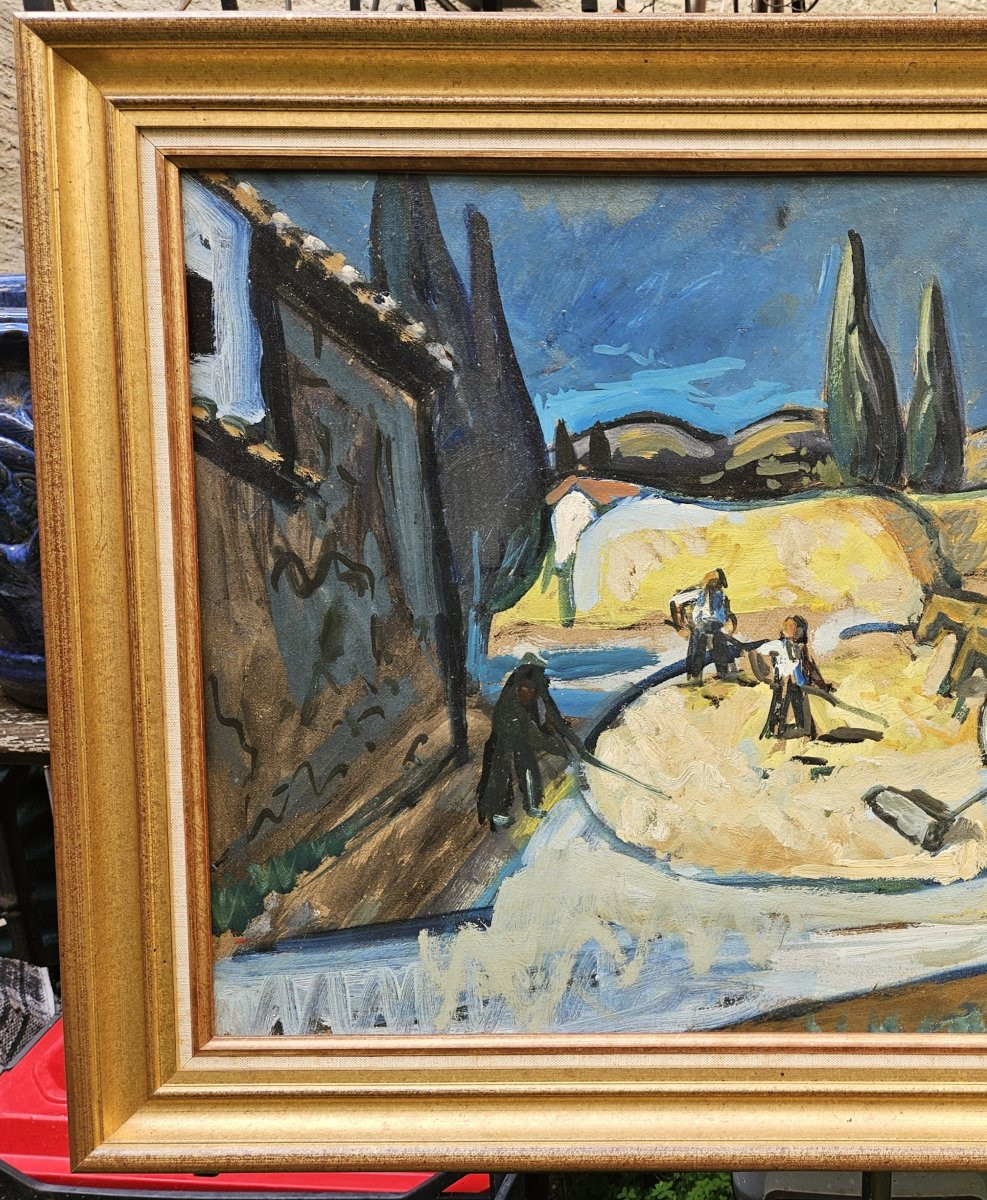


The Wheat Harvest By Auguste Chabaud 1882-1955
Artist: Auguste Chabaud 1882-1955
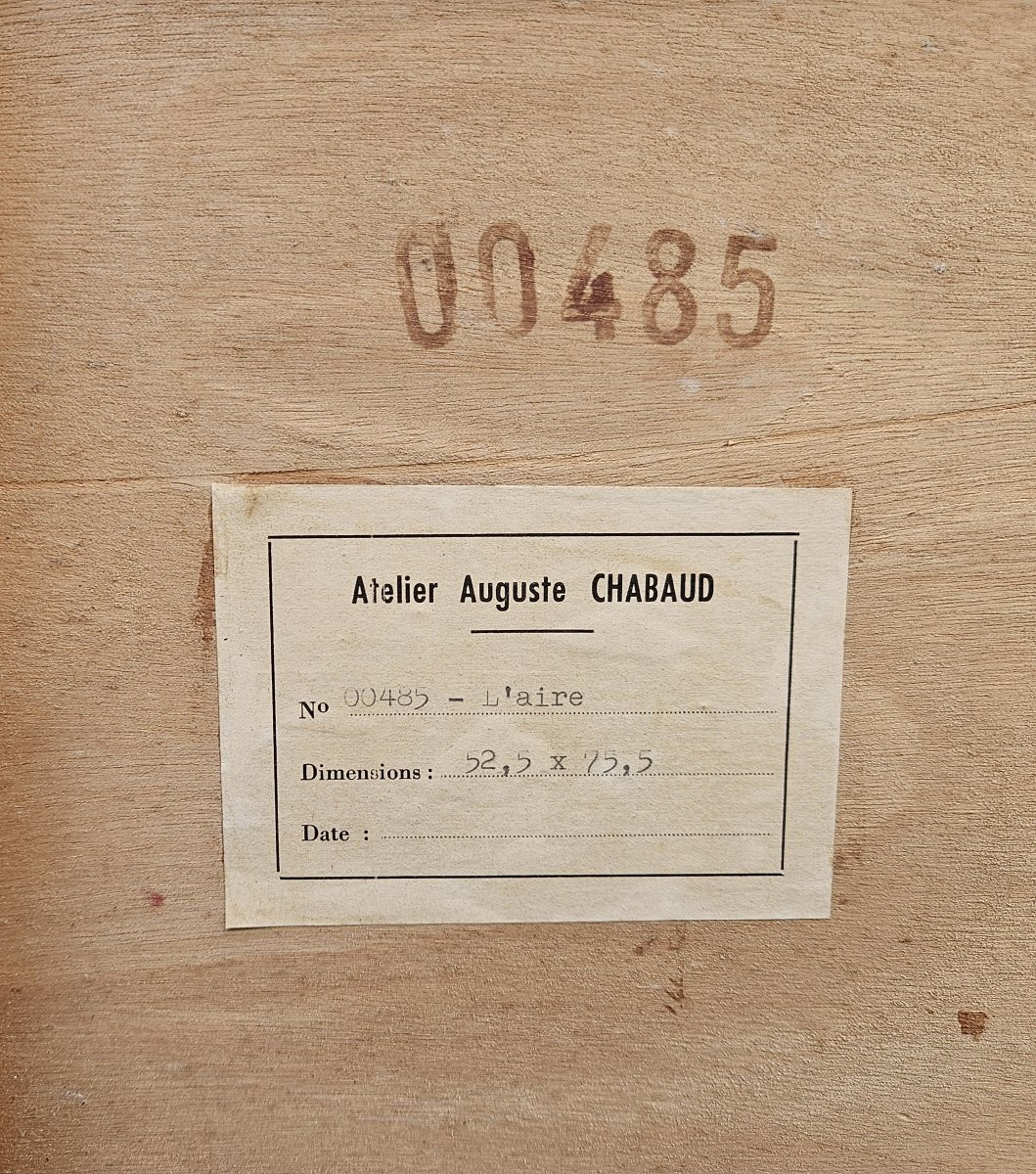
Superb oil painting on cardboard mounted on wood by Auguste Chabaud. Dimensions: 52cm x 75cm plus frame 63cm x 86cm. Signed lower right with the studio stamp. Label on the back: Chabaud studio. It is rare to find luminous paintings by this artist on the market, such as the one I am presenting. A great Provençal artist of international renown, his works are featured in the greatest museums. Entering the Avignon School of Fine Arts in 1896, Auguste Chabaud studied under Pierre Grivolas. Then, in 1899, he went to Paris to continue his studies at the Académie Julian and the École des Beaux-Arts, in the studio of Fernand Cormon (1845-1924). He met Henri Matisse and André Derain. His parents' vineyard suffered during the 1900 crisis, forcing Auguste Chabaud to return to the South of France. In 1901, he had to leave Paris to earn a living, signing on as a pilotman on a ship and discovering the West African coast. That same year, his father died; he and his brother inherited the vineyard and the land, which only his brother would manage. During this period, Chabaud worked extensively on butcher paper. From 1903 to 1906, he served in the military in Tunisia, returning with sketchbooks filled with local scenes, including numerous drawings of soldiers, indigenous people, and bar scenes populated by girls and sailors. Back in Paris, Chabaud made his debut in 1907 at the Salon des Indépendants, exhibiting alongside the Fauves. He was about to discover a new life: that of Parisian nightlife and cabarets. Collectors began to take an interest in his work. In Montmartre, where he had his studio, he painted the bustling and deserted streets and squares, scenes of nightlife, and brothels. In 1911, he began his Cubist period, working on large canvases and sculpting. Numerous exhibitions followed, including one in New York in 1913 where he exhibited alongside Henri Matisse, André Derain, Maurice de Vlaminck, and Pablo Picasso, and later in Chicago and Boston. His Fauvist paintings depict Parisian nightlife: cabarets, café-theaters, and prostitutes, rendered in vibrant colors (yellow, red) contrasting with the colors of the night (navy blue, black). Upon his return from the First World War in 1919, Auguste Chabaud settled permanently in Graveson, in the Alpilles mountains. From 1920 onwards, he began his Blue Period, employing pure Prussian blue, in which Provence, its people, and its customs are prominently featured. The South, which he had never ceased to paint, even during his time in Paris, would henceforth occupy his entire oeuvre. Like Paul Cézanne with Mont Sainte-Victoire, Auguste Chabaud immortalized "the little mountain," painting rural scenes of peasants traversing the hills and paths of the Alpilles. He remained there until the end of his life, living in seclusion in his house with his wife and seven children. Nicknamed the "Hermit of Graveson," he died in 1955. Some of his works are held in Marseille at the Musée Cantini, in Paris at the Musée National d'Art Moderne and the Musée d'Art Moderne de la Ville de Paris, and in Geneva at the Petit Palais. In 1992, the Provence-Alpes-Côte d'Azur regional council opened a museum in his honor in Graveson. Painters regularly pay tribute to him, such as Claude Viallat in 2003. Auguste Chabaud wrote poems and books including *L'Estocade de vérité*, *Le Tambour Gautier*, and *Je me suis pris pour Démosthène*. Free worldwide shipping
8 500 €
Period: 20th century
Style: Modern Art
Condition: Excellent condition
Material: Oil painting on cardboard
Reference (ID): 1643402
Availability: In stock
Print