"Museum – Snuffbox With Engraved Rebus – Curiosa – Folk Art - Erotic – Haute-loire"
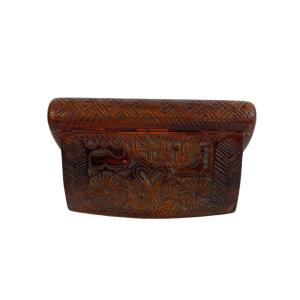
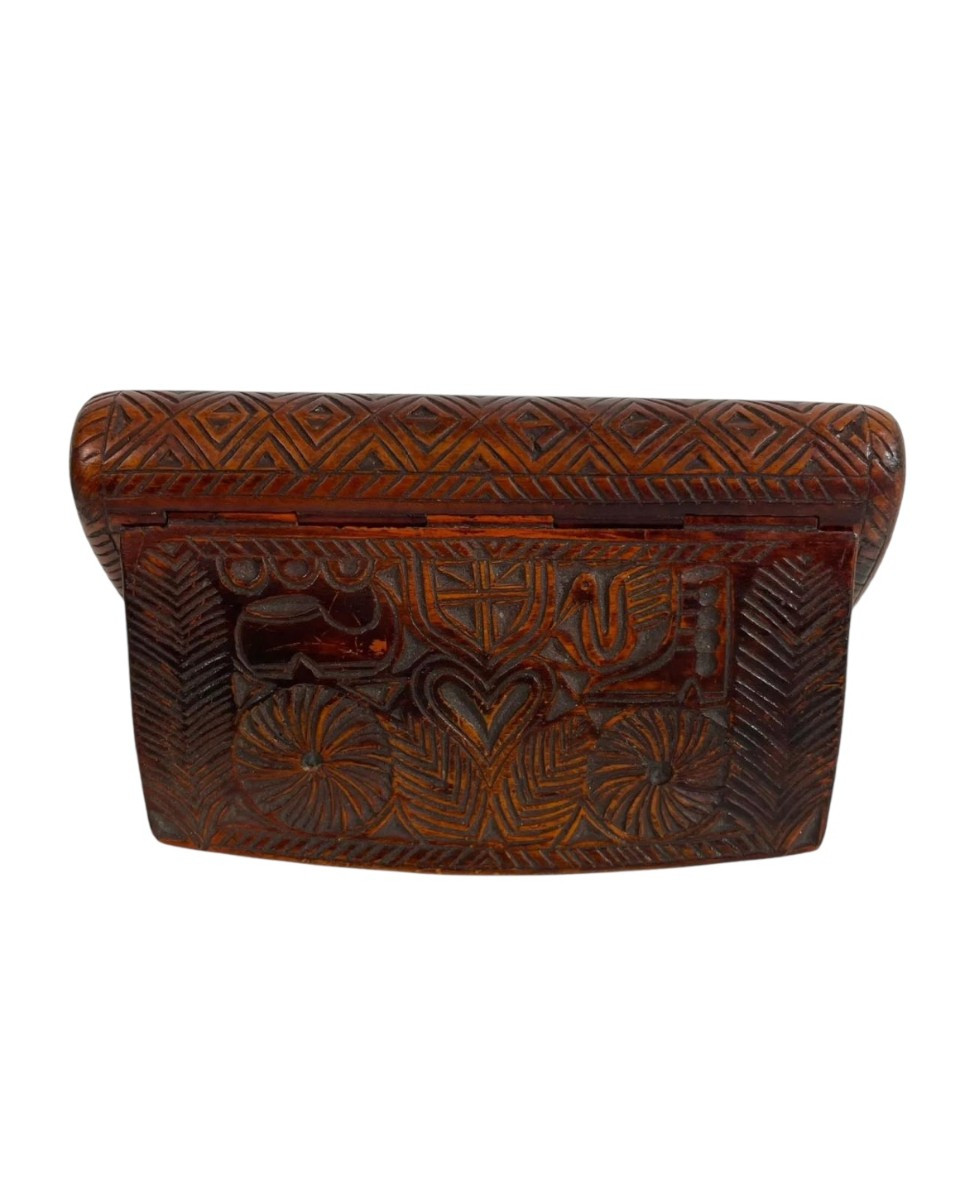
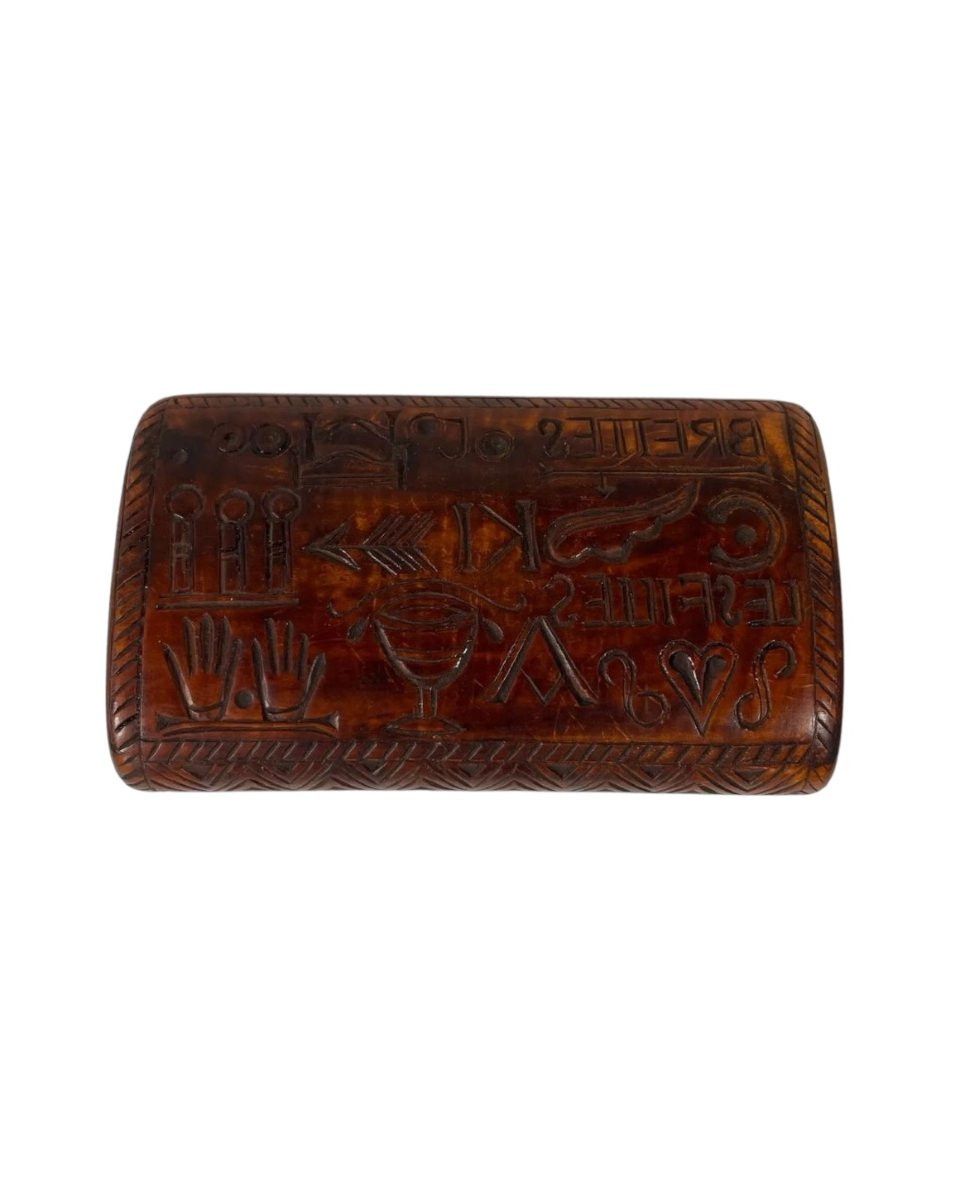
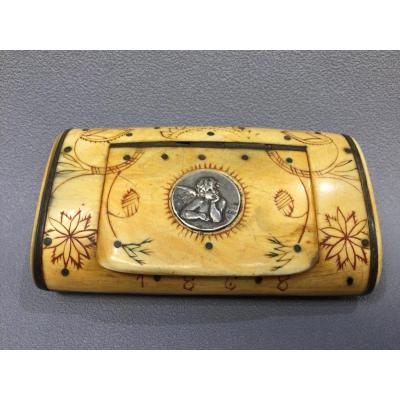
First half of the 19th century France – Haute-Loire, Auvergne Exceptional boxwood snuff box, finely carved and engraved on both sides, featuring remarkable erotic and humorous rebus work, typical of 19th-century village verve. The opening side is decorated with rosettes, a clog bird, and stylized trees of life, symbols of abundance, vitality, and desire. The even more unusual back side reveals a rebus engraved in reverse, combining letters, symbols, and figures—arrows, hands, cups, and hearts—to form a hidden phrase. According to an old transcription preserved inside the snuff box, it reads: “I like girls with full hands, those who prick the needle, and maids with pretty breasts.” This seemingly innocuous phrase is part of the coded erotic language so characteristic of 19th-century popular art. It works on several levels of interpretation: – “Girls with a full hand”: In rural language, the expression refers to women who can be “taken in one’s hands,” in other words, girls of pleasure, accessible, carnal. It is a praise of direct contact, of gesture more than of feeling — a tribute to simple pleasure, experienced without detour or hypocrisy. – “Those who prick the needle”: Under the guise of evoking seamstresses, a symbol of modest female work, the phrase plays on a double meaning: “to prick” becomes synonymous with “to penetrate,” and the needle, a metaphor for male desire, reverses the relationship between activity and passivity. The humor is based on this ironic inversion: the woman who pricks is also the one “who is pricked.” – “The maids with pretty breasts”: Here, we enter the libertine register. The maid, a recurring figure in the popular imagination and songs of the 19th century, embodies free femininity, a little cheeky, always desirable. The expression “à jolis seins” is an assumed bodily compliment, direct but not vulgar, revealing the earthy and good-natured sensuality of the rural world. This type of snuffbox, called “à rébus”, was often the work of self-taught artisans or demobilized soldiers, skilled at handling the burin as the innuendo. These objects, which were exchanged between men, participated in a complicit language where humor and desire were expressed under the cover of wit. They express a frank, earthy freedom, inherited from a world where pleasure was not hidden, but celebrated with cunning and intelligence. The boxwood, with its tight grain and golden patina, allowed for a very fine engraving. The contrast between the symbolic decoration – trees of life, rosettes, bird – and the sensual charge of the rebus makes it a rare piece, on the border of curiosa, male sculpture and coded love language. Unique collector's item, testimony to a popular imagination where modesty was expressed through metaphor and freedom through symbolism. Condition: very beautiful old patina, minimal wear from use. Dimensions: 5.5 x 9.5 cm ALL DELIVERIES ARE MADE BY DHL EXPRESS ONLY. 








 Le Magazine de PROANTIC
 TRÉSORS Magazine
 Rivista Artiquariato