




Planchon, In Paris - Louis XVI Style Mounted Porcelain Vase Clock - Empress. Circa 1870
Artist: Planchon Au Palais Royal Paris
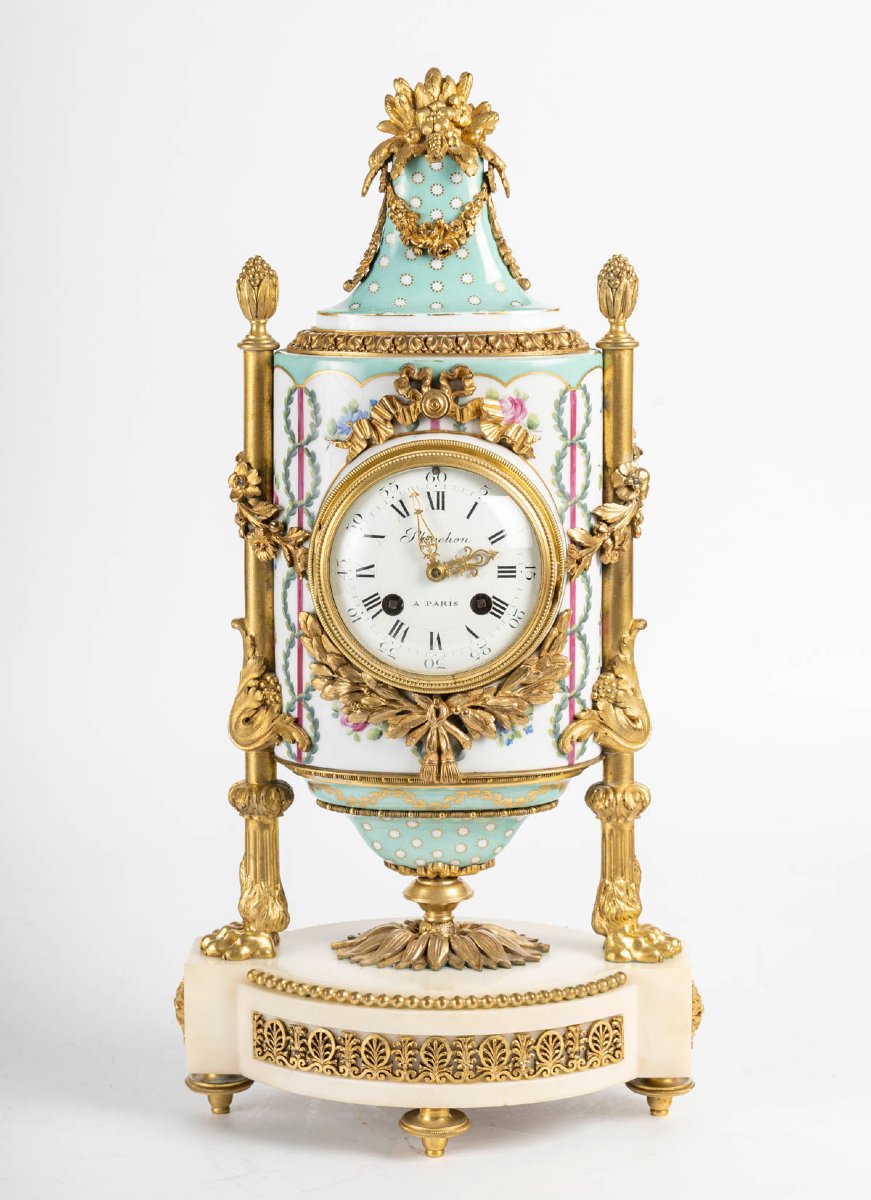
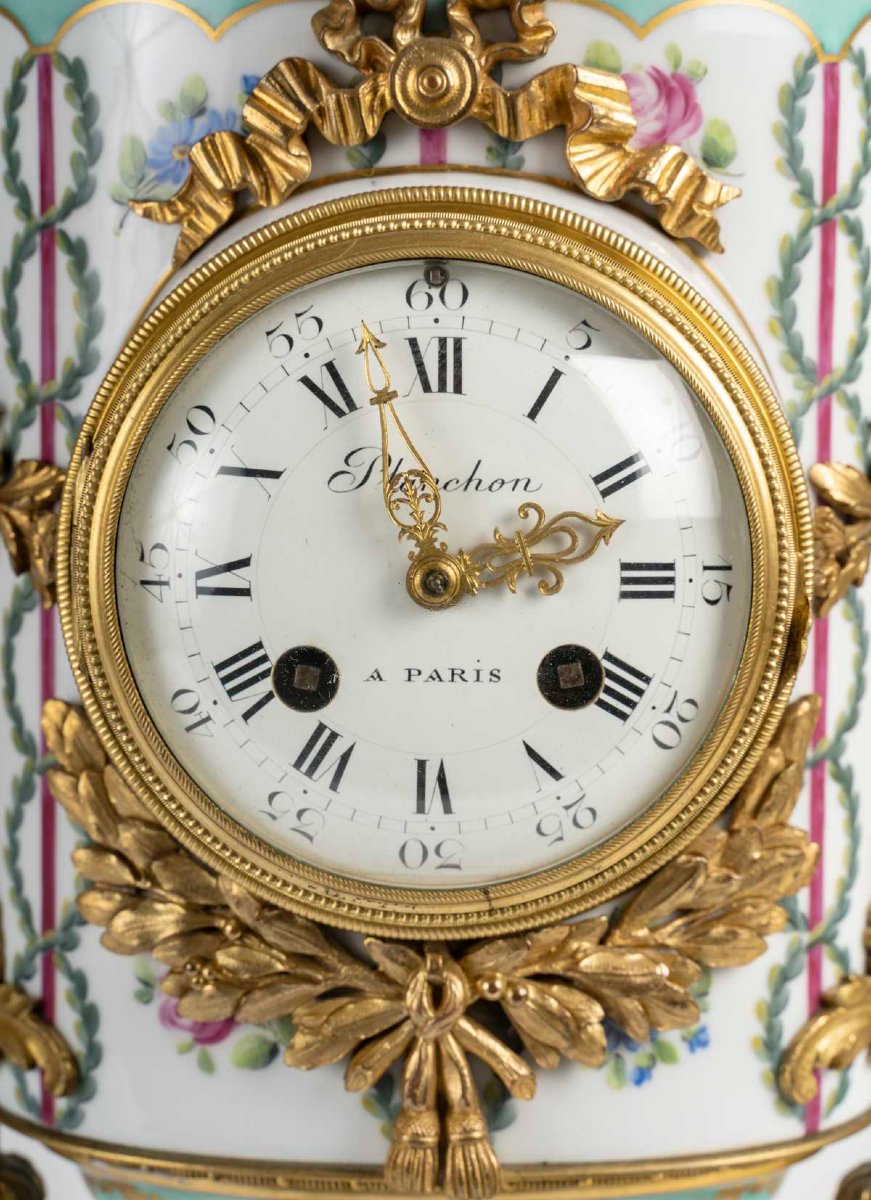
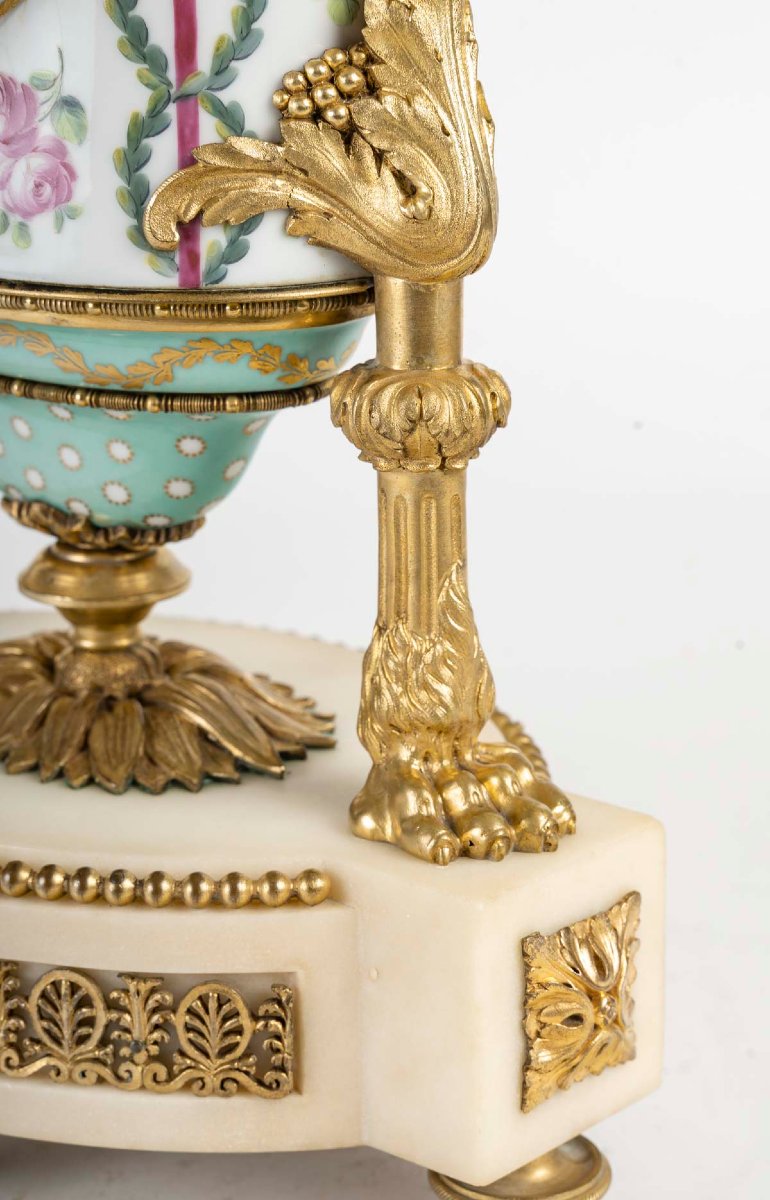
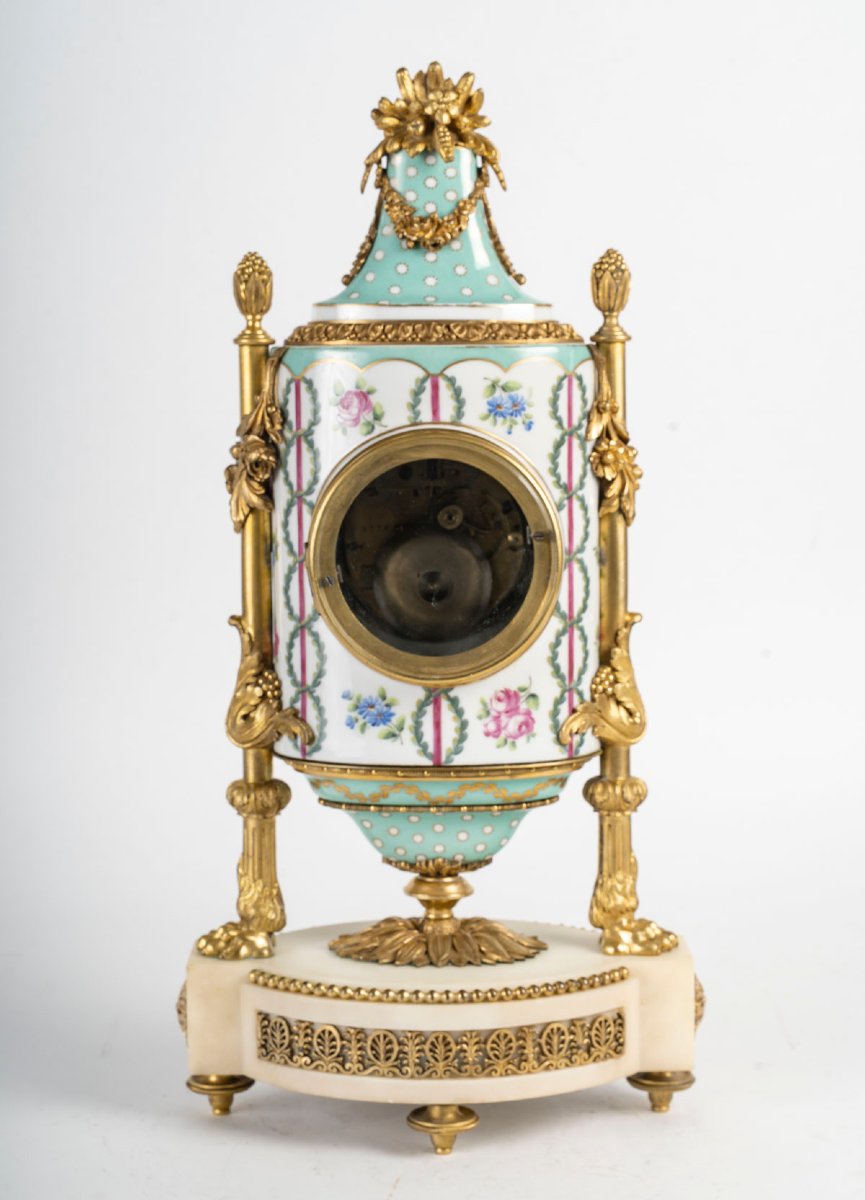
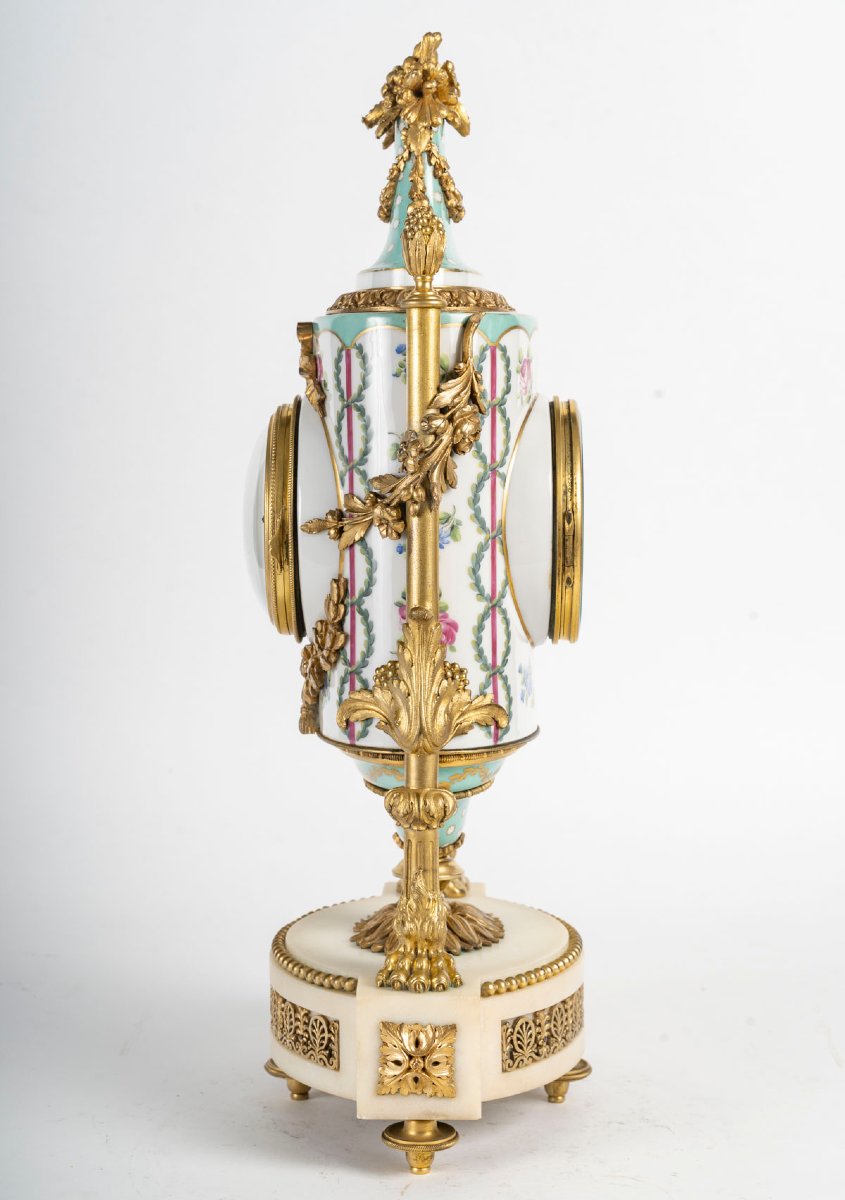
PLANCHON Mathieu (1842-1921), Clockmaker-creator in Paris- Very elegant Clock-Vase in the style called Louis XVI-Empress in Paris porcelain with gold and polychrome decoration on a "Petit Vert" background, white with pointed partridge eyes, ribbons intertwined with foliage, and throws of "au naturel" flowers. Embellished with a very finely chiseled gilt bronze adornment with feminine ornamental motifs (ribbon knotted with shells, tassels of passementerie, pearls, garlands and floral bouquet), it is flanked by garlanded thyrses standing on leonine legs. The whole is set on an oval marble base with projections punctuated with appliques of neo-classical motifs (anthemums and palmettes, acanthus rosettes). Spinning top feet ringed with a cord. The dial with Roman and Arabic numerals for the hours and minutes, signed: "Planchon / A PARIS". Circa 1870
____________
LOUIS XVI-EMPRESS REFINEMENTS
At the sight of this "dazzling" Vase Clock signed by Mathieu Planchon (1842-1921), "the eye is charmed and the taste satisfied (...) One feels in good company." With its "ingenious, original" design and "refined execution," it reflects the remarks made about certain creations by this renowned clockmaker by one of his biographers: "an excellent composition, in the spirit of the 18th century, which in no way gave the impression of déjà vu" (Chapuis, 1941). Standing on hairy leonine legs, two thyrses emerging from leafy acanthus buds, traversed on their slender stems by flowering branches, flank the porcelain body of the clock. Resting on a pedestal with a radiant motif of sunflower petals, this one, crowned at its base with a bouquet of spring flowers displaying their exquisite flowering in festoons, hanging garlands, is covered on its form of great formal elegance with a polychrome decoration of the most refined, stylistic and chromatic harmony. Scanned with friezes of heart-shaped stripes, pearls alternating with finely chiseled coins, bands studded in reserve on a precious turquoise-green background called "Petit-Vert" with a scattering of small gold-pointed discs ("oeil de perdrix")* surround its summit, its base covered with an undulating garland of leaves. Delicate, airy, beautifully touched with lively notes, flat ribbons intertwined with fine foliage, pretty throws of "natural" country flowers arranged under arches highlighted with a gold rim punctuate its middle part wrapped in a luminous white background. Embellished around its edge with a feminine double-shell pleated ribbon bow or opulent myrtle branches embellished with passementerie tassels, the clock's white enamel dial, set on its bezel with a pearled, corded motif, indicates the hours and minutes in Roman and Arabic numerals, with two pierced fleur-de-lis hands.
Set on an oval marble base edged with a string of pearls and with projections decorated with appliques of stylized anthems, palmettes, and volutes, and acanthus rosettes, this timepiece, endowed with a rare formal and decorative eurythmy, rises on six small spinning feet ringed with a cord.
Closely associated, both by its elegant formal aesthetics, the beautiful and intelligent harmony of its materials and by the exquisite choice of its ornamental motifs with varied details, with the memory of remarkable timepieces designed notably by François-Louis Godon (1754-1800) around the years 1770-1780 whose "typology it modernizes without altering", this Vase Clock revives the delicate seductions of an 18th century rediscovered under the enchanting aegis of Queen Marie-Antoinette to whom Empress Eugènie (1826-1920) devoted an inveterate cult.
Of a model of which we do not know of any other examples to date, this quality timepiece is to be counted among the most notable creations imagined by Mathieu Planchon. An original creation with undeniable artistic cachet, it is in fact eminently representative of Parisian luxury watchmaking in the second half of the 19th century, intended for a select clientele of French and European connoisseurs who embraced the decorative arts inclinations of crowned heads.
.*A type of decoration known as "Taillandier Background," named after the painter-porcelain artist attached to the Royal Manufactory of Vincennes, Vincent Taillandier (1736-1790), its initiator.
Mathieu PLANCHON (Bourges, 1842-Paris, 1921):
Trained in the family workshop, a Journeyman Watchmaker by 1862, Mathieu Planchon was able to gain the favor of renowned practitioners in the Parisian capital such as J.E. Robert Houdin (1805-1871) and Adrien Philippe (1815-1894), from whom he acquired the renowned establishment located at 66-67 Galerie Montpensier in the Palais-Royal around 1870. Operating in this place, endowed with a "Middle Ages or Renaissance" charm, until 1896—the year he transferred his "Clockmaking and Art Bronzes" business to 5, rue de la Chaussée d'Antin, a "beautiful store, constantly visited by a wealthy and numerous clientele"—this "ingenious and A learned watchmaker in love with his art," with "sure taste," "strived to manufacture and exploit," unlike many of his colleagues, "only his own models." "Teeming with delightful motifs, with varied details acknowledged by sound tradition," these established his reputation among enthusiasts enamored of their singular aesthetic qualities. The "Planchon Style" was then referred to and praised.
"A curious mind, tireless researcher," "a marvelous collector of prints as a distinguished bibliophile," Mr. Planchon also devoted himself with similar creativity to the reconstruction of antique timepieces. Presented in 1889 at the Universal Exhibition in Paris, this "very beautiful and curious collection, the fruit of considerable and conscientious work," challenges the visitor "from the water clocks described in the translation of Vitruvius (...) to the elegant cartels of the Pompadour or Louis XVI era" through "the clocks of the Wisdoms of the Vices and Virtues, of the symbolic Temperances which adorn the great Flemish tapestries" will be awarded a Gold Medal. Recognized subsequently as an outstanding figure in his field (Grand Prix de l'Horlogerie), Mr. Planchon will be rewarded with honorary works including at the 1900 Exhibition the Report of the Retrospective Museum of Watchmaking.
. Gradually entrusting his business to his son-in-law Paul Brateau (1875-1958), this marginal Watchmaker ventured into writing two works: The Clock, its retrospective, picturesque and artistic history (1898), The Pendulum of Paris (1918). Having become essential "classics" for enthusiasts passionate about ancient and modern watchmaking, they also have the merit of "perpetuating"- just like his creations - the name Mathieu Planchon. He recorded: "We have tried to learn by studying, and it is to learn that we write." A motto that is both humble and apt.
Related literature: Brateau, Paul, Mathieu Planchon, Watchmaker, his life and his work, Paris: 1921; Chapuis, Alfred, "Mathieu Planchon", in: Bulletin of the Swiss Watchmaking Federation, No. 43 of October 23, 1941, pp. 355-356; Saunier, G., "M. Planchon's Clocks", in: Revue Chronomètrique: Organ of Watchmaking Societies, January 1886; Tardy, Dictionary of French Watchmakers, Paris: 1972, p. 525; "M. Planchon", in: Le Journal du Cher of December 7, 1921, p.3.
------------------
Signatures and Marks: Dial signed: "Planchon/ A PARIS". The movement, also stamped PLANCHON and numbered on its plate "1774", bears the stamp of "Vincenti & Cie à Paris/Médaille d'Argent 1855".
Materials: Paris hard-paste porcelain with gold highlights and polychrome decoration on a "Petit vert" and white background; Gilt bronze; enamel and glass; White marble.
Dimensions: Total H: 48 cm; W: 23 cm; D: cm.
High-quality Parisian creation in the Louis XVI-Impress style from the second half of the 19th century, created by Mathieu Planchon (1842-1921), a watchmaker in the spirit of the timepieces designed in the last third of the 18th century by François-Louis Godon (1754-1800). Circa 1870.
Very good condition. Original gilding. Movement serviced and in working order. With its key.
____________
LOUIS XVI-EMPRESS REFINEMENTS
At the sight of this "dazzling" Vase Clock signed by Mathieu Planchon (1842-1921), "the eye is charmed and the taste satisfied (...) One feels in good company." With its "ingenious, original" design and "refined execution," it reflects the remarks made about certain creations by this renowned clockmaker by one of his biographers: "an excellent composition, in the spirit of the 18th century, which in no way gave the impression of déjà vu" (Chapuis, 1941). Standing on hairy leonine legs, two thyrses emerging from leafy acanthus buds, traversed on their slender stems by flowering branches, flank the porcelain body of the clock. Resting on a pedestal with a radiant motif of sunflower petals, this one, crowned at its base with a bouquet of spring flowers displaying their exquisite flowering in festoons, hanging garlands, is covered on its form of great formal elegance with a polychrome decoration of the most refined, stylistic and chromatic harmony. Scanned with friezes of heart-shaped stripes, pearls alternating with finely chiseled coins, bands studded in reserve on a precious turquoise-green background called "Petit-Vert" with a scattering of small gold-pointed discs ("oeil de perdrix")* surround its summit, its base covered with an undulating garland of leaves. Delicate, airy, beautifully touched with lively notes, flat ribbons intertwined with fine foliage, pretty throws of "natural" country flowers arranged under arches highlighted with a gold rim punctuate its middle part wrapped in a luminous white background. Embellished around its edge with a feminine double-shell pleated ribbon bow or opulent myrtle branches embellished with passementerie tassels, the clock's white enamel dial, set on its bezel with a pearled, corded motif, indicates the hours and minutes in Roman and Arabic numerals, with two pierced fleur-de-lis hands.
Set on an oval marble base edged with a string of pearls and with projections decorated with appliques of stylized anthems, palmettes, and volutes, and acanthus rosettes, this timepiece, endowed with a rare formal and decorative eurythmy, rises on six small spinning feet ringed with a cord.
Closely associated, both by its elegant formal aesthetics, the beautiful and intelligent harmony of its materials and by the exquisite choice of its ornamental motifs with varied details, with the memory of remarkable timepieces designed notably by François-Louis Godon (1754-1800) around the years 1770-1780 whose "typology it modernizes without altering", this Vase Clock revives the delicate seductions of an 18th century rediscovered under the enchanting aegis of Queen Marie-Antoinette to whom Empress Eugènie (1826-1920) devoted an inveterate cult.
Of a model of which we do not know of any other examples to date, this quality timepiece is to be counted among the most notable creations imagined by Mathieu Planchon. An original creation with undeniable artistic cachet, it is in fact eminently representative of Parisian luxury watchmaking in the second half of the 19th century, intended for a select clientele of French and European connoisseurs who embraced the decorative arts inclinations of crowned heads.
.*A type of decoration known as "Taillandier Background," named after the painter-porcelain artist attached to the Royal Manufactory of Vincennes, Vincent Taillandier (1736-1790), its initiator.
Mathieu PLANCHON (Bourges, 1842-Paris, 1921):
Trained in the family workshop, a Journeyman Watchmaker by 1862, Mathieu Planchon was able to gain the favor of renowned practitioners in the Parisian capital such as J.E. Robert Houdin (1805-1871) and Adrien Philippe (1815-1894), from whom he acquired the renowned establishment located at 66-67 Galerie Montpensier in the Palais-Royal around 1870. Operating in this place, endowed with a "Middle Ages or Renaissance" charm, until 1896—the year he transferred his "Clockmaking and Art Bronzes" business to 5, rue de la Chaussée d'Antin, a "beautiful store, constantly visited by a wealthy and numerous clientele"—this "ingenious and A learned watchmaker in love with his art," with "sure taste," "strived to manufacture and exploit," unlike many of his colleagues, "only his own models." "Teeming with delightful motifs, with varied details acknowledged by sound tradition," these established his reputation among enthusiasts enamored of their singular aesthetic qualities. The "Planchon Style" was then referred to and praised.
"A curious mind, tireless researcher," "a marvelous collector of prints as a distinguished bibliophile," Mr. Planchon also devoted himself with similar creativity to the reconstruction of antique timepieces. Presented in 1889 at the Universal Exhibition in Paris, this "very beautiful and curious collection, the fruit of considerable and conscientious work," challenges the visitor "from the water clocks described in the translation of Vitruvius (...) to the elegant cartels of the Pompadour or Louis XVI era" through "the clocks of the Wisdoms of the Vices and Virtues, of the symbolic Temperances which adorn the great Flemish tapestries" will be awarded a Gold Medal. Recognized subsequently as an outstanding figure in his field (Grand Prix de l'Horlogerie), Mr. Planchon will be rewarded with honorary works including at the 1900 Exhibition the Report of the Retrospective Museum of Watchmaking.
. Gradually entrusting his business to his son-in-law Paul Brateau (1875-1958), this marginal Watchmaker ventured into writing two works: The Clock, its retrospective, picturesque and artistic history (1898), The Pendulum of Paris (1918). Having become essential "classics" for enthusiasts passionate about ancient and modern watchmaking, they also have the merit of "perpetuating"- just like his creations - the name Mathieu Planchon. He recorded: "We have tried to learn by studying, and it is to learn that we write." A motto that is both humble and apt.
Related literature: Brateau, Paul, Mathieu Planchon, Watchmaker, his life and his work, Paris: 1921; Chapuis, Alfred, "Mathieu Planchon", in: Bulletin of the Swiss Watchmaking Federation, No. 43 of October 23, 1941, pp. 355-356; Saunier, G., "M. Planchon's Clocks", in: Revue Chronomètrique: Organ of Watchmaking Societies, January 1886; Tardy, Dictionary of French Watchmakers, Paris: 1972, p. 525; "M. Planchon", in: Le Journal du Cher of December 7, 1921, p.3.
------------------
Signatures and Marks: Dial signed: "Planchon/ A PARIS". The movement, also stamped PLANCHON and numbered on its plate "1774", bears the stamp of "Vincenti & Cie à Paris/Médaille d'Argent 1855".
Materials: Paris hard-paste porcelain with gold highlights and polychrome decoration on a "Petit vert" and white background; Gilt bronze; enamel and glass; White marble.
Dimensions: Total H: 48 cm; W: 23 cm; D: cm.
High-quality Parisian creation in the Louis XVI-Impress style from the second half of the 19th century, created by Mathieu Planchon (1842-1921), a watchmaker in the spirit of the timepieces designed in the last third of the 18th century by François-Louis Godon (1754-1800). Circa 1870.
Very good condition. Original gilding. Movement serviced and in working order. With its key.
3 600 €
Period: 19th century
Style: Louis 16th, Directory
Condition: Perfect condition
Material: Porcelain
Width: 23 cm
Height: 48 cm
Depth: 12 cm
Reference (ID): 1638152
Availability: In stock
Print