THIS OBJECT WAS SOLD
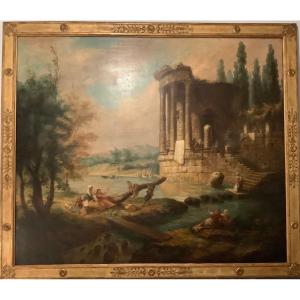
Classical Landscape With Figures And A Castle By Jean-charles-joseph Rémond (1795 - 1875)


“Figures Drawing Water in an Arcadian Landscape,” this painting was painted around 1820 by the famous French painter Jean-Charles-Joseph Rémond (1795 - Paris - 1875).
A pupil of Jean-Victor Bertin and Jean-Baptiste Regnault, he won the Grand Prix de Rome with “The Abduction of Proserpine by Pluto” in 1821. The young artist spent the next five years in Italy, painting outdoor sketches. There, he joined other artists who had come to the Italian countryside, who, far from home, were free from the pressures of the commercial art world and could devote themselves fully to the pleasures of painting. Guided solely by their senses and deprived of the controlled lighting of the studio, the painters were forced to employ a rapid sketching technique that captured the essence of the light and the contours of the hills, valleys, and coastline of the Italian peninsula. His experience marked the beginning of a career dedicated to landscape, which culminated in the teaching of the young Théodore Rousseau, one of the founders of the Barbizon School. Rémond, who devoted himself to the history of landscape, ceased exhibiting in 1848.
In the academic hierarchy of late 18th-century art, landscape painting was considered inferior to history painting, portraiture, and genre painting. This perception gradually changed at the end of the century when neoclassical landscape painters introduced the "historical landscape," a genre that drew on the classical landscape tradition of the 17th century. After 1810, attitudes toward these historical landscapes changed considerably, with them being considered as important as traditional history painting. Many of the artists who dedicated their works to this category were winners of the Prix de Rome for historical landscapes, an award created in 1817 to enable young artists to study in Italy.
Provenance: Christie's sale, London, January 2, 2015; Italian private estate.
Literature: Benezit's artistic lexicon; Larousse Encyclopedia; online: Wikipedia; web gallery (wga.hu).
Inscription: Remains of the signature at the bottom, under the stone.
Technique: Oil on canvas, original period gilt frame.
Dimensions: Unframed: W 46.3 x H 38 cm; Framed: 58.5 x 50.5 cm.
Condition: Good, without retouching or missing parts.
A pupil of Jean-Victor Bertin and Jean-Baptiste Regnault, he won the Grand Prix de Rome with “The Abduction of Proserpine by Pluto” in 1821. The young artist spent the next five years in Italy, painting outdoor sketches. There, he joined other artists who had come to the Italian countryside, who, far from home, were free from the pressures of the commercial art world and could devote themselves fully to the pleasures of painting. Guided solely by their senses and deprived of the controlled lighting of the studio, the painters were forced to employ a rapid sketching technique that captured the essence of the light and the contours of the hills, valleys, and coastline of the Italian peninsula. His experience marked the beginning of a career dedicated to landscape, which culminated in the teaching of the young Théodore Rousseau, one of the founders of the Barbizon School. Rémond, who devoted himself to the history of landscape, ceased exhibiting in 1848.
In the academic hierarchy of late 18th-century art, landscape painting was considered inferior to history painting, portraiture, and genre painting. This perception gradually changed at the end of the century when neoclassical landscape painters introduced the "historical landscape," a genre that drew on the classical landscape tradition of the 17th century. After 1810, attitudes toward these historical landscapes changed considerably, with them being considered as important as traditional history painting. Many of the artists who dedicated their works to this category were winners of the Prix de Rome for historical landscapes, an award created in 1817 to enable young artists to study in Italy.
Provenance: Christie's sale, London, January 2, 2015; Italian private estate.
Literature: Benezit's artistic lexicon; Larousse Encyclopedia; online: Wikipedia; web gallery (wga.hu).
Inscription: Remains of the signature at the bottom, under the stone.
Technique: Oil on canvas, original period gilt frame.
Dimensions: Unframed: W 46.3 x H 38 cm; Framed: 58.5 x 50.5 cm.
Condition: Good, without retouching or missing parts.
Explore similar pieces and discover your ideal find:
Landscapes