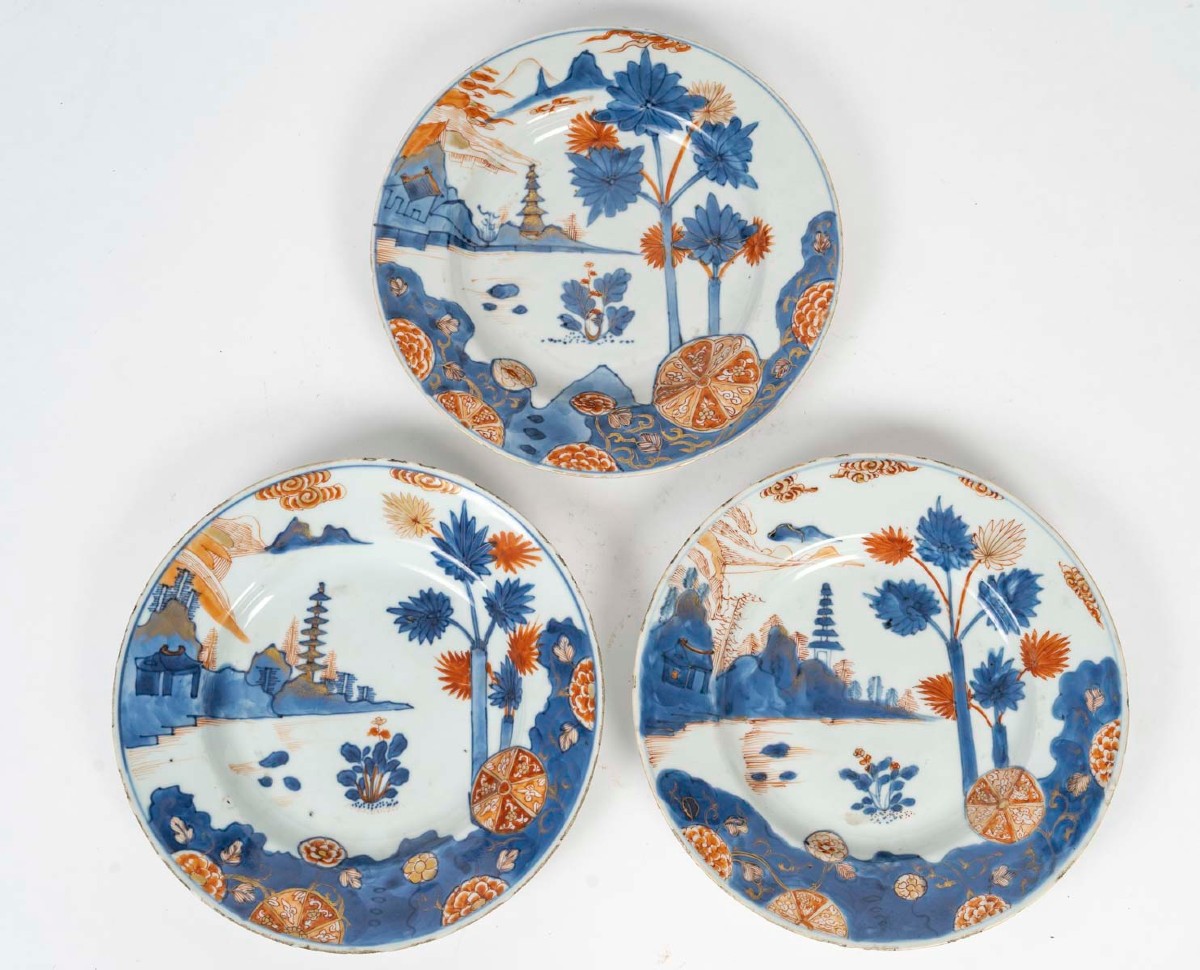


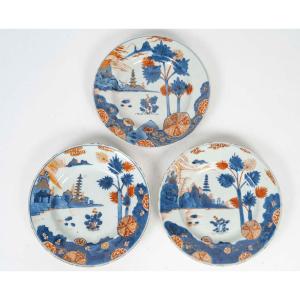


Three Chinese Porcelain Plates, Imari, 18th Century.
Three charming plates in Chinese porcelain "Imari" with decorations of a polychrome lake landscape, cobalt blue, iron red and gold, some chips to note on the edges.
China 18th century. What is called "Chinese Imari"? In the middle of the 17th century, China experienced a period of political unrest due to the transition from the Ming dynasty to the Qing dynasty. As the production of export porcelain was considerably reduced, Europeans sought to find other supplier countries. The Dutch, who had a monopoly on trade with Japan, then began to import Japanese porcelain. This porcelain is characterized by a decoration using three colors: cobalt blue placed underglaze, iron red and gold placed overglaze. It mainly features floral motifs and was called "Imari" after the port on the island of Kyushu from which it was exported. Once the Chinese resumed their porcelain production, they adapted to the European craze for Imari and produced pieces inspired by Japanese porcelain, Chinese Imari. The Europeans then turned again to Chinese production centers which offered pieces less expensive than the Japanese pieces.
China 18th century. What is called "Chinese Imari"? In the middle of the 17th century, China experienced a period of political unrest due to the transition from the Ming dynasty to the Qing dynasty. As the production of export porcelain was considerably reduced, Europeans sought to find other supplier countries. The Dutch, who had a monopoly on trade with Japan, then began to import Japanese porcelain. This porcelain is characterized by a decoration using three colors: cobalt blue placed underglaze, iron red and gold placed overglaze. It mainly features floral motifs and was called "Imari" after the port on the island of Kyushu from which it was exported. Once the Chinese resumed their porcelain production, they adapted to the European craze for Imari and produced pieces inspired by Japanese porcelain, Chinese Imari. The Europeans then turned again to Chinese production centers which offered pieces less expensive than the Japanese pieces.
330 €
Period: 18th century
Style: Other Style
Condition: Condition of use
Material: Ceramic
Diameter: 24 cm
Reference (ID): 1634414
Availability: In stock
Print