THIS OBJECT WAS SOLD
Gilded Bronze Buddha On A Lotus Throne, Thailand, 19th Century


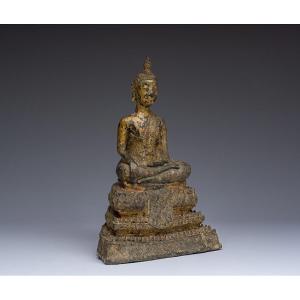


This unique bronze Buddha, dating from the Rattanakosin period, dates back to the first half of the 19th century.
The Rattanakosin period, which began in 1782 with the founding of the Chakri dynasty, was a flourishing period for Thai art and culture. Buddha statues made during this period display specific characteristics that reflect both continuity with earlier styles and innovation. The Buddha's expression is serene, his half-closed eyes symbolizing a state of meditation and enlightenment. The highly detailed depiction of the robe elegantly draped over the body is also characteristic of this period and symbolizes detachment from worldly desires.
This 19th-century Buddha statue was cast in bronze using the lost-wax method and fully gilded. The artist first creates the statue entirely from wax, which allows for refined details. Then, the wax statue is covered with a layer of clay over which the mold is heated and the wax removed from the mold. In the final step, the bronze is poured into the mold. Since the mold is broken after the bronze has cooled, each statue is unique. During the Rattanakosin period, this ancient technique was refined and often implemented by specialized craftsmen associated with temples or royal workshops.
The Rattanakosin period, which began in 1782 with the founding of the Chakri dynasty, was a flourishing period for Thai art and culture. Buddha statues made during this period display specific characteristics that reflect both continuity with earlier styles and innovation. The Buddha's expression is serene, his half-closed eyes symbolizing a state of meditation and enlightenment. The highly detailed depiction of the robe elegantly draped over the body is also characteristic of this period and symbolizes detachment from worldly desires.
This 19th-century Buddha statue was cast in bronze using the lost-wax method and fully gilded. The artist first creates the statue entirely from wax, which allows for refined details. Then, the wax statue is covered with a layer of clay over which the mold is heated and the wax removed from the mold. In the final step, the bronze is poured into the mold. Since the mold is broken after the bronze has cooled, each statue is unique. During the Rattanakosin period, this ancient technique was refined and often implemented by specialized craftsmen associated with temples or royal workshops.
Explore similar pieces and discover your ideal find:
Other Religions and Rituals