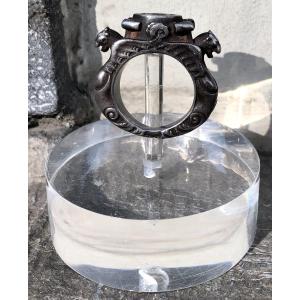

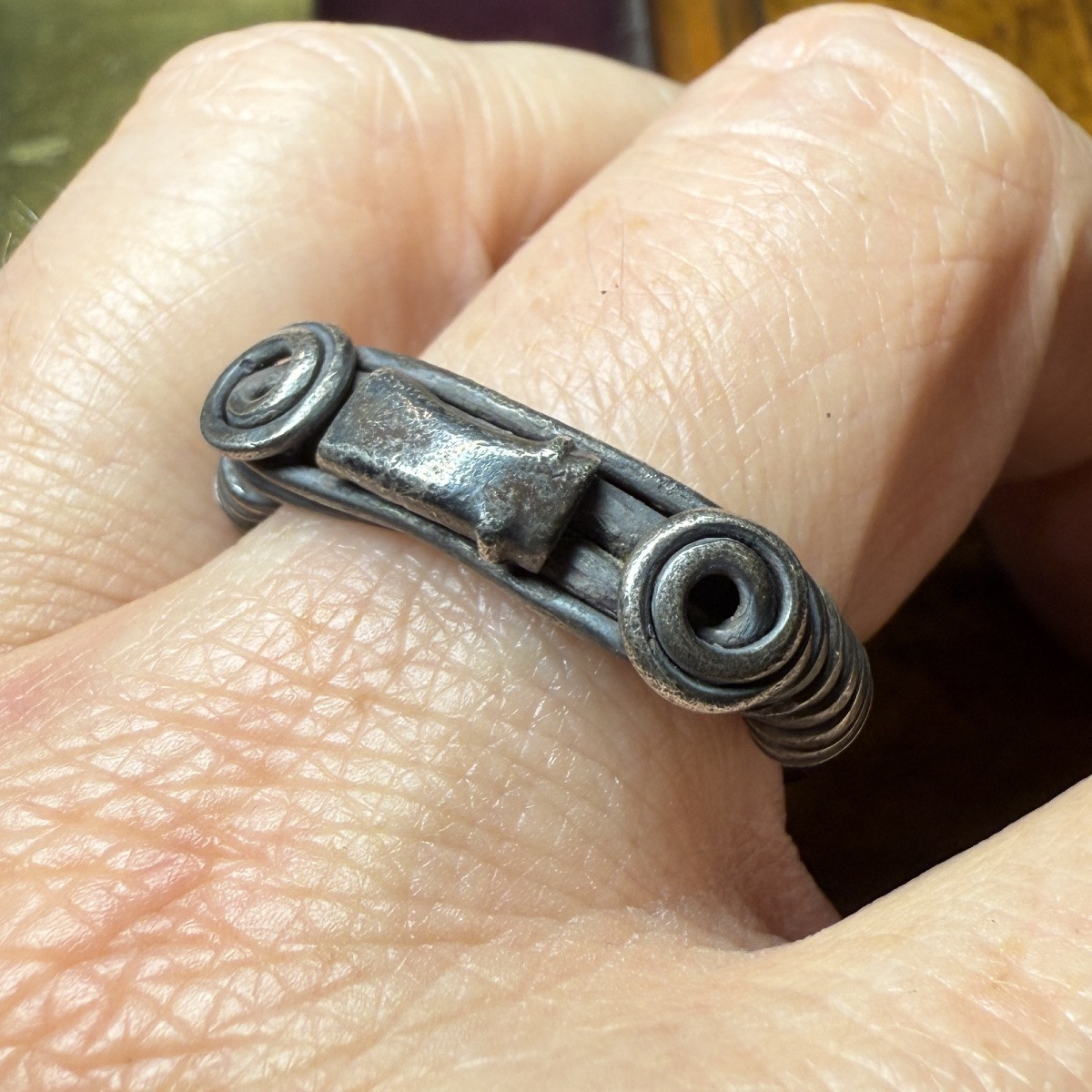


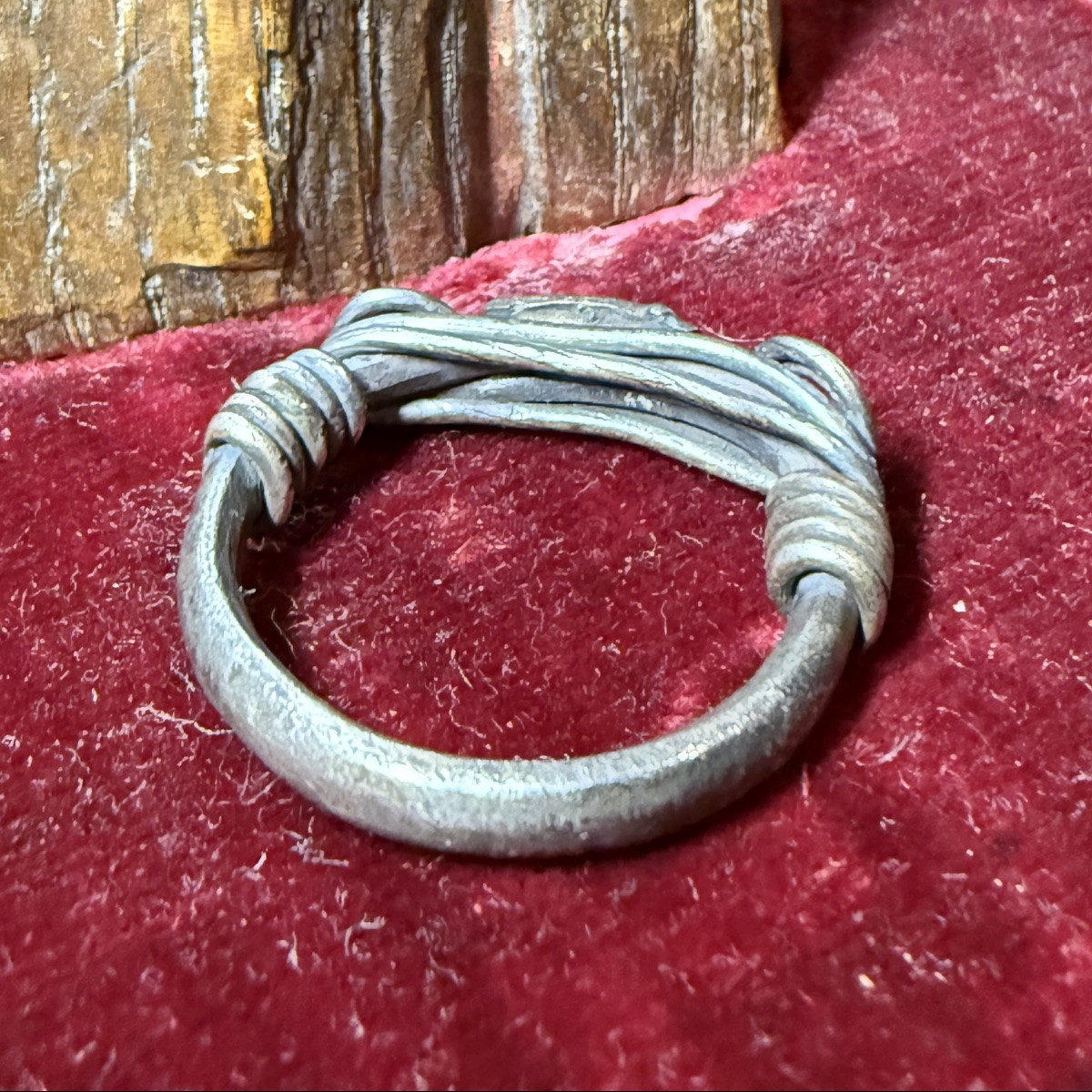


Silver Ring With Spiralled Terminals And Axe-motif. Balkans, 1st–2nd Century Ad.
Silver Ring with Spiralled Terminals and Axe-Motif Ornament
Central Balkans (Balkan–Danubian provincial style), 1st–2nd century A.D.
Measurements
Ring size: UK T ½ / US 9.75 / EU 62
Outer diameter: 2.8 × 2.7 cm
Weight: 8.32 grams
Description
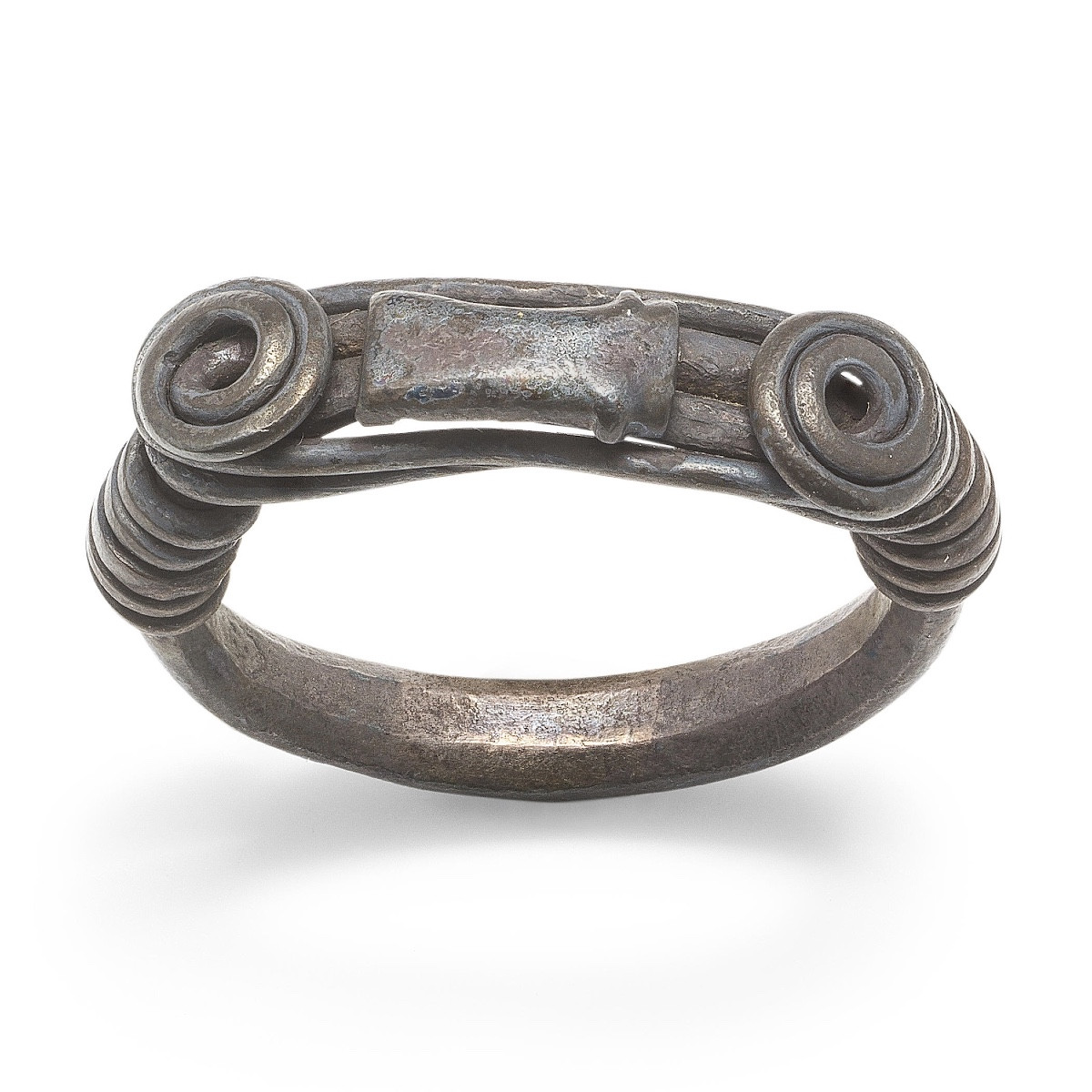
A robust silver ring of octagonal section, fashioned from drawn and hammered wire. The hoop terminates in tightly coiled spirals, which flank a rectangular ornament soldered across the bezel, its form recalling a miniature axe-head. The coils are further reinforced with wrapped silver wire, securing the decorative composition. The surface shows a soft grey patina, consistent with burial and prolonged age.
Discussion
This ring belongs to the repertoire of autochthonous Balkan silverwork that flourished from the Roman conquest through the mid-3rd century. The type is closely related to ornaments documented in the Tekija and Bare hoards, where bracelets and rings with spiral-wrapped ends and miniature axes appear as apotropaic symbols . While the axe motif was deeply embedded in Dacian and Balkan visual culture, its execution here in silver, combined with wire wrapping and spiralled terminals, reflects the enduring influence of Hellenistic toreutics upon local craftsmanship.
Rather than a Viking jewel, the ring finds its most convincing parallels among the Balkan-Danubian silver hoards of the early Roman Empire, where such spiralled ornaments, lunulae, and miniature tool pendants carried both decorative and protective significance.
Provenance
Anonymous sale; Bonhams, Fine Antiquities, 4 July 1998, lot 19.
Private collection, UK, 1990s.
With Rupert Wace Ancient Art Ltd, London.
With Ariadne Galleries, New York and London, acquired from the above at TEFAF 2014, New York.
Private American collection, acquired from the above, 23 January 2017.
Comparisons
Tekija hoard, Upper Moesia: gold and silver ornaments with spiral terminals and miniature axe motifs (Popović 1992; Mano-Zisi 1957).
Bare hoard, Serbia: bracelets with overlapped spirals and tool pendants (Popović – Borić-Brešković 1994).
Bela Reka hoard: continued use of filigree and granulation alongside spiral silver ornaments (Popović 1996).
Central Balkans (Balkan–Danubian provincial style), 1st–2nd century A.D.
Measurements
Ring size: UK T ½ / US 9.75 / EU 62
Outer diameter: 2.8 × 2.7 cm
Weight: 8.32 grams
Description
A robust silver ring of octagonal section, fashioned from drawn and hammered wire. The hoop terminates in tightly coiled spirals, which flank a rectangular ornament soldered across the bezel, its form recalling a miniature axe-head. The coils are further reinforced with wrapped silver wire, securing the decorative composition. The surface shows a soft grey patina, consistent with burial and prolonged age.
Discussion
This ring belongs to the repertoire of autochthonous Balkan silverwork that flourished from the Roman conquest through the mid-3rd century. The type is closely related to ornaments documented in the Tekija and Bare hoards, where bracelets and rings with spiral-wrapped ends and miniature axes appear as apotropaic symbols . While the axe motif was deeply embedded in Dacian and Balkan visual culture, its execution here in silver, combined with wire wrapping and spiralled terminals, reflects the enduring influence of Hellenistic toreutics upon local craftsmanship.
Rather than a Viking jewel, the ring finds its most convincing parallels among the Balkan-Danubian silver hoards of the early Roman Empire, where such spiralled ornaments, lunulae, and miniature tool pendants carried both decorative and protective significance.
Provenance
Anonymous sale; Bonhams, Fine Antiquities, 4 July 1998, lot 19.
Private collection, UK, 1990s.
With Rupert Wace Ancient Art Ltd, London.
With Ariadne Galleries, New York and London, acquired from the above at TEFAF 2014, New York.
Private American collection, acquired from the above, 23 January 2017.
Comparisons
Tekija hoard, Upper Moesia: gold and silver ornaments with spiral terminals and miniature axe motifs (Popović 1992; Mano-Zisi 1957).
Bare hoard, Serbia: bracelets with overlapped spirals and tool pendants (Popović – Borić-Brešković 1994).
Bela Reka hoard: continued use of filigree and granulation alongside spiral silver ornaments (Popović 1996).
2 280 €
Period: Before 16th century
Style: Renaissance, Louis 13th
Condition: Good condition
Material: Sterling silver
Reference (ID): 1608985
Availability: In stock
Print