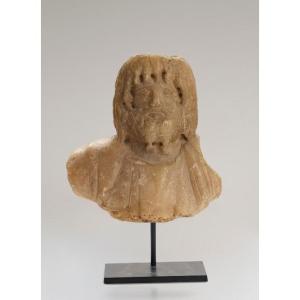


Roman Marble Bust Of Serapis / Alabaster
Small alabaster bust of Serapis Roman Egypt, 3rd century AD
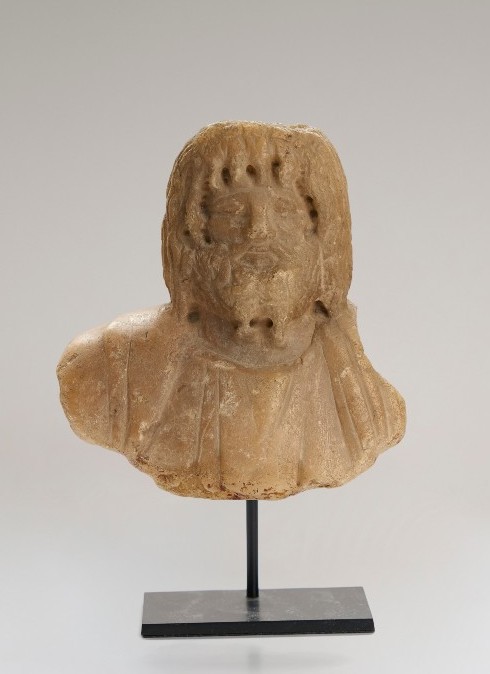
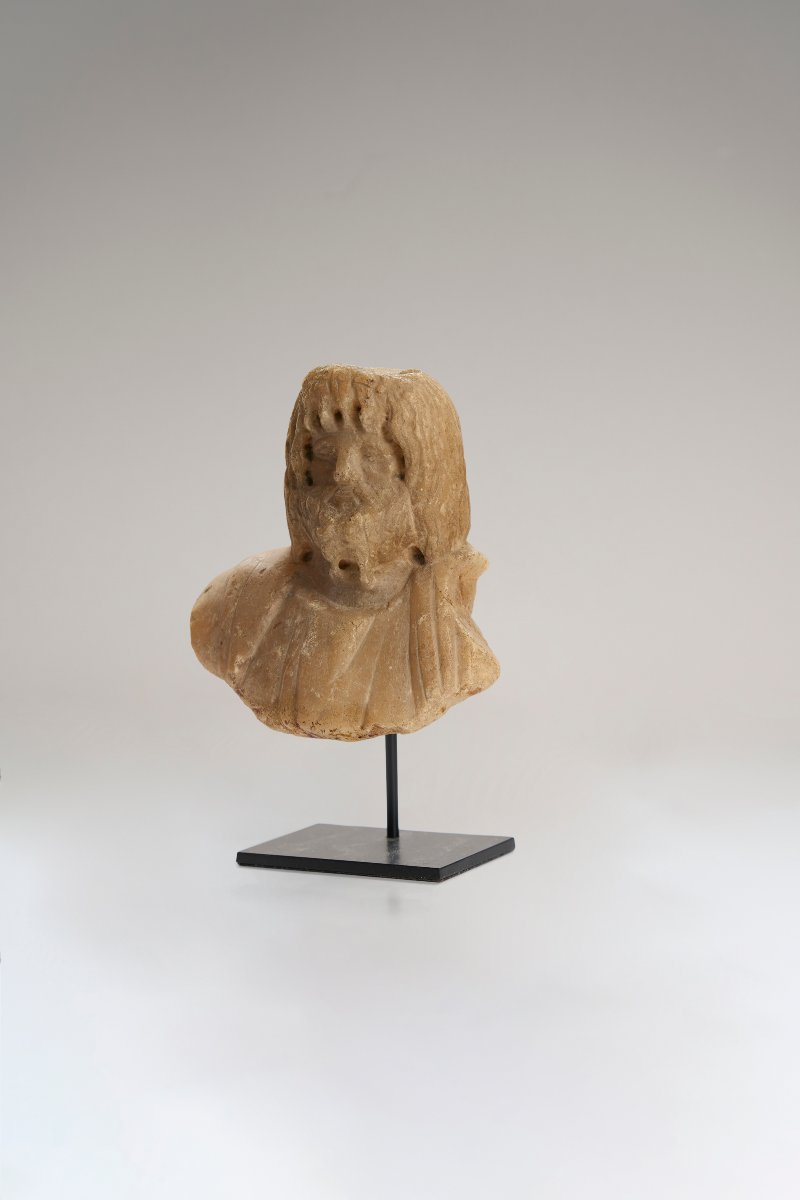
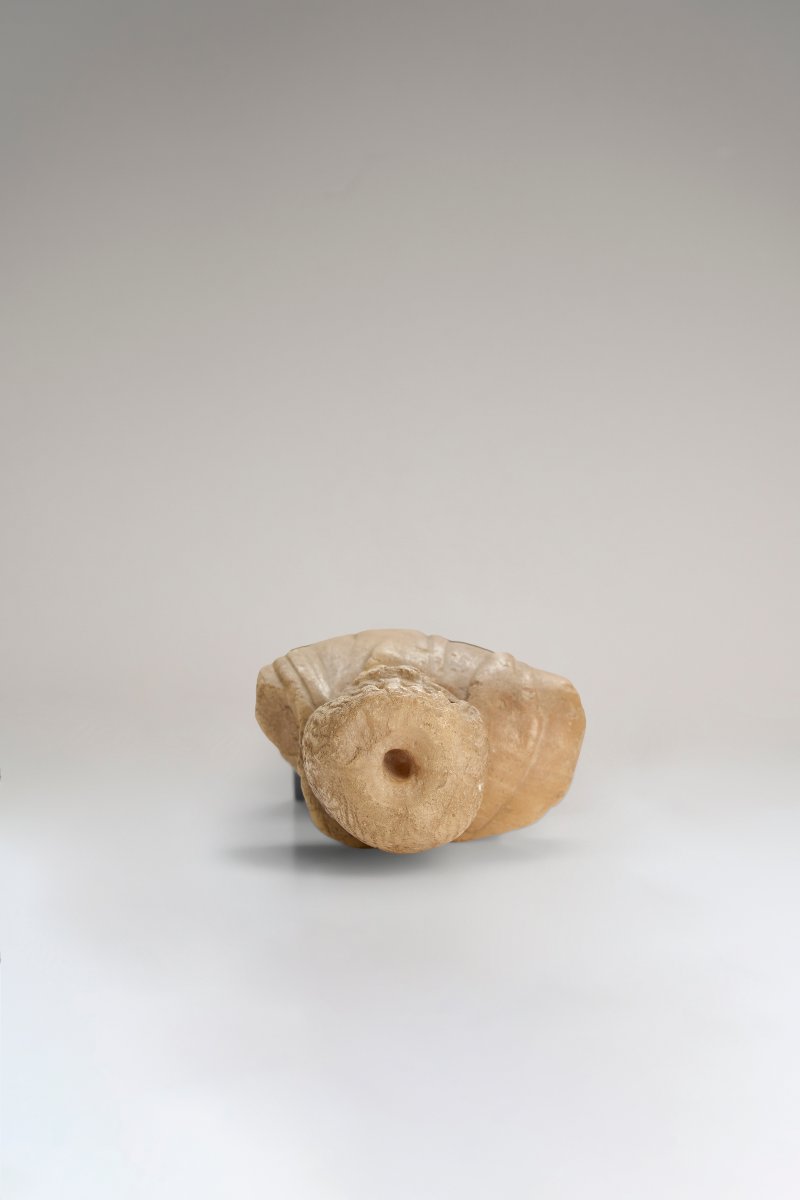
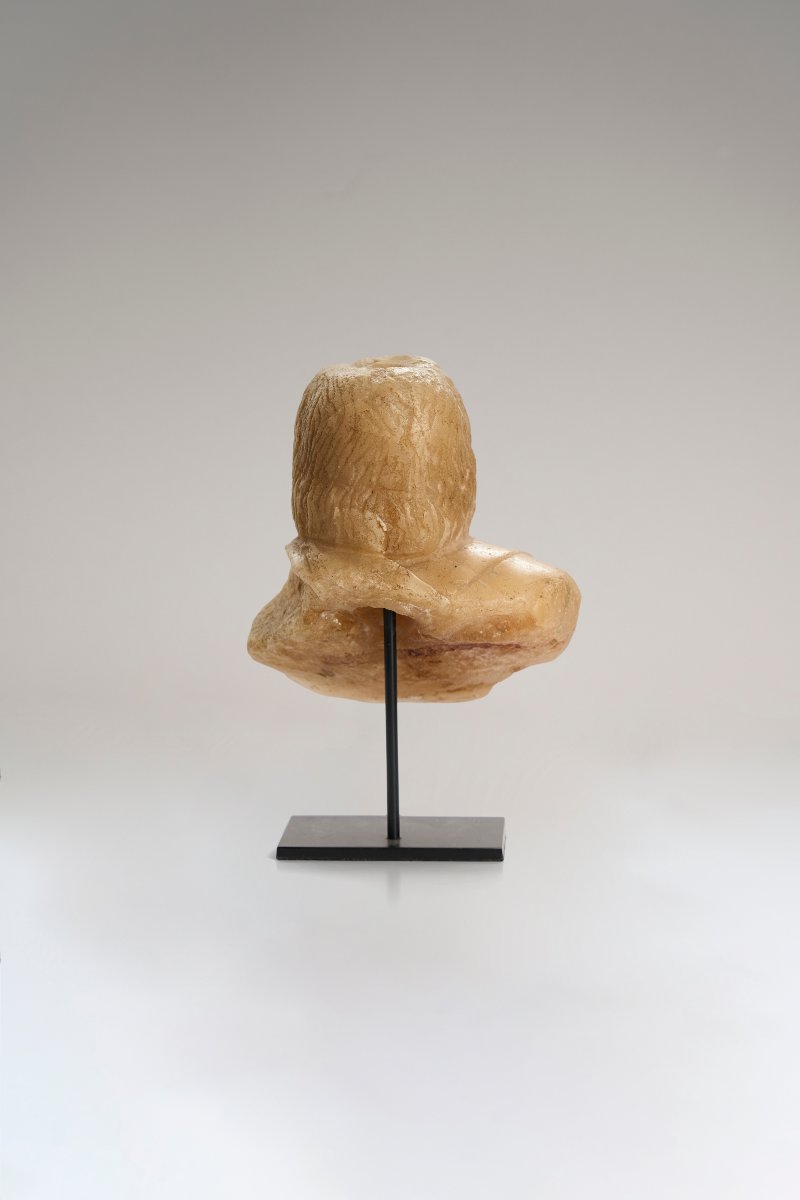
This small bust represents the god Serapis, sculpted in beige alabaster weathered by time. The face of the god retains legible features: dense, wavy hair framing the face and falling onto the shoulders, as well as a short, stylized beard, in symmetrical curls, accentuating the majestic appearance of the character. The head is hollowed out with a hole intended to accommodate the modius (cylindrical grain measure) – a typical symbol of Serapis. The torso is dressed in a Roman drape, treated with wide incised folds.
The god Serapis was born from the cultural syncretism implemented by the Ptolemies, Greek rulers of Egypt from the 3rd century BC, who wanted to create a unifying deity between their Greek and Egyptian subjects. Serapis combines elements of Osiris, the Egyptian god of the dead, and Zeus-Hades, the Greek deity of the underworld. He thus inherits a funerary and salvific function, but with profoundly Greco-Roman features: bearded, coiffed, draped, enthroned in majesty – all elements designed to facilitate his adoption in the provinces of the Empire. Under the Roman emperors, the cult of Serapis enjoyed great popularity, not only in Egypt but also in Rome, Asia Minor, and the western provinces. This type of domestic representation illustrates the anchoring of this cult in the private religious lives of many citizens of the Empire.
Egyptian alabaster, also called calcite or "oriental marble," has been extracted mainly in the quarries of Hatnoub or Tell el-Amarna since the Pharaonic era. Highly prized for its translucency, softness to the touch, and warm tones ranging from light honey to veined ochre, alabaster was a prized material for luxury goods, canopic jars, and small religious sculptures. In the 3rd century AD, in the Greco-Roman context, it continued to be used for votive, funerary, and decorative works, often in miniature forms suitable for domestic distribution.
This small bust represents the god Serapis, sculpted in beige alabaster weathered by time. The face of the god retains legible features: dense, wavy hair framing the face and falling onto the shoulders, as well as a short, stylized beard, in symmetrical curls, accentuating the majestic appearance of the character. The head is hollowed out with a hole intended to accommodate the modius (cylindrical grain measure) – a typical symbol of Serapis. The torso is dressed in a Roman drape, treated with wide incised folds.
The god Serapis was born from the cultural syncretism implemented by the Ptolemies, Greek rulers of Egypt from the 3rd century BC, who wanted to create a unifying deity between their Greek and Egyptian subjects. Serapis combines elements of Osiris, the Egyptian god of the dead, and Zeus-Hades, the Greek deity of the underworld. He thus inherits a funerary and salvific function, but with profoundly Greco-Roman features: bearded, coiffed, draped, enthroned in majesty – all elements designed to facilitate his adoption in the provinces of the Empire. Under the Roman emperors, the cult of Serapis enjoyed great popularity, not only in Egypt but also in Rome, Asia Minor, and the western provinces. This type of domestic representation illustrates the anchoring of this cult in the private religious lives of many citizens of the Empire.
Egyptian alabaster, also called calcite or "oriental marble," has been extracted mainly in the quarries of Hatnoub or Tell el-Amarna since the Pharaonic era. Highly prized for its translucency, softness to the touch, and warm tones ranging from light honey to veined ochre, alabaster was a prized material for luxury goods, canopic jars, and small religious sculptures. In the 3rd century AD, in the Greco-Roman context, it continued to be used for votive, funerary, and decorative works, often in miniature forms suitable for domestic distribution.
2 400 €
Period: Before 16th century
Style: Rome and Antic Greece
Condition: Excellent condition
Material: Alabaster
Height: 12 cm
Reference (ID): 1574174
Availability: In stock
Print