







16-17th Pair Of Bronze Statues Tiziano Aspetti (1559-1606)
Artist: Venise Atelier Tiziano Aspetti (1559-1606)
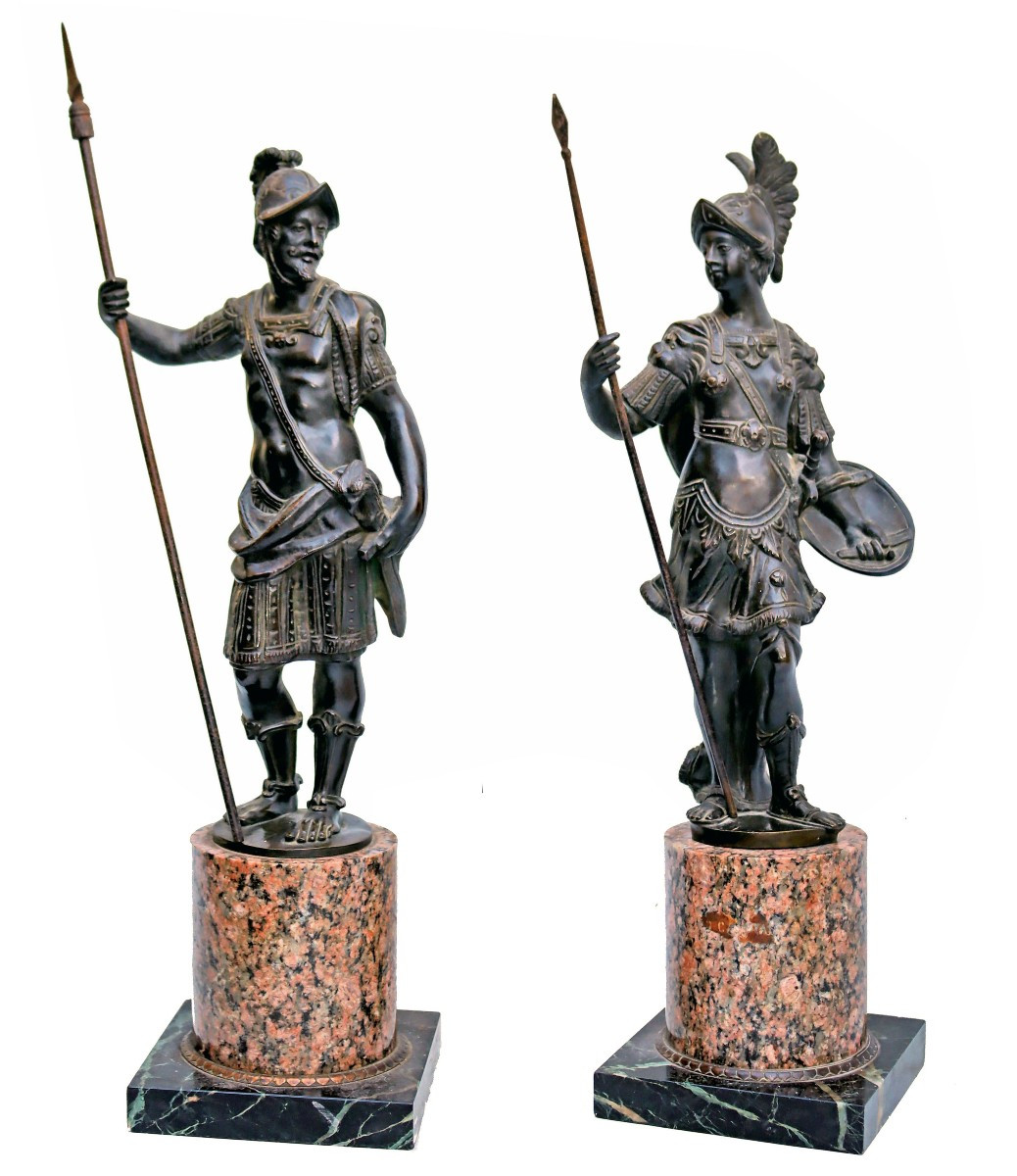
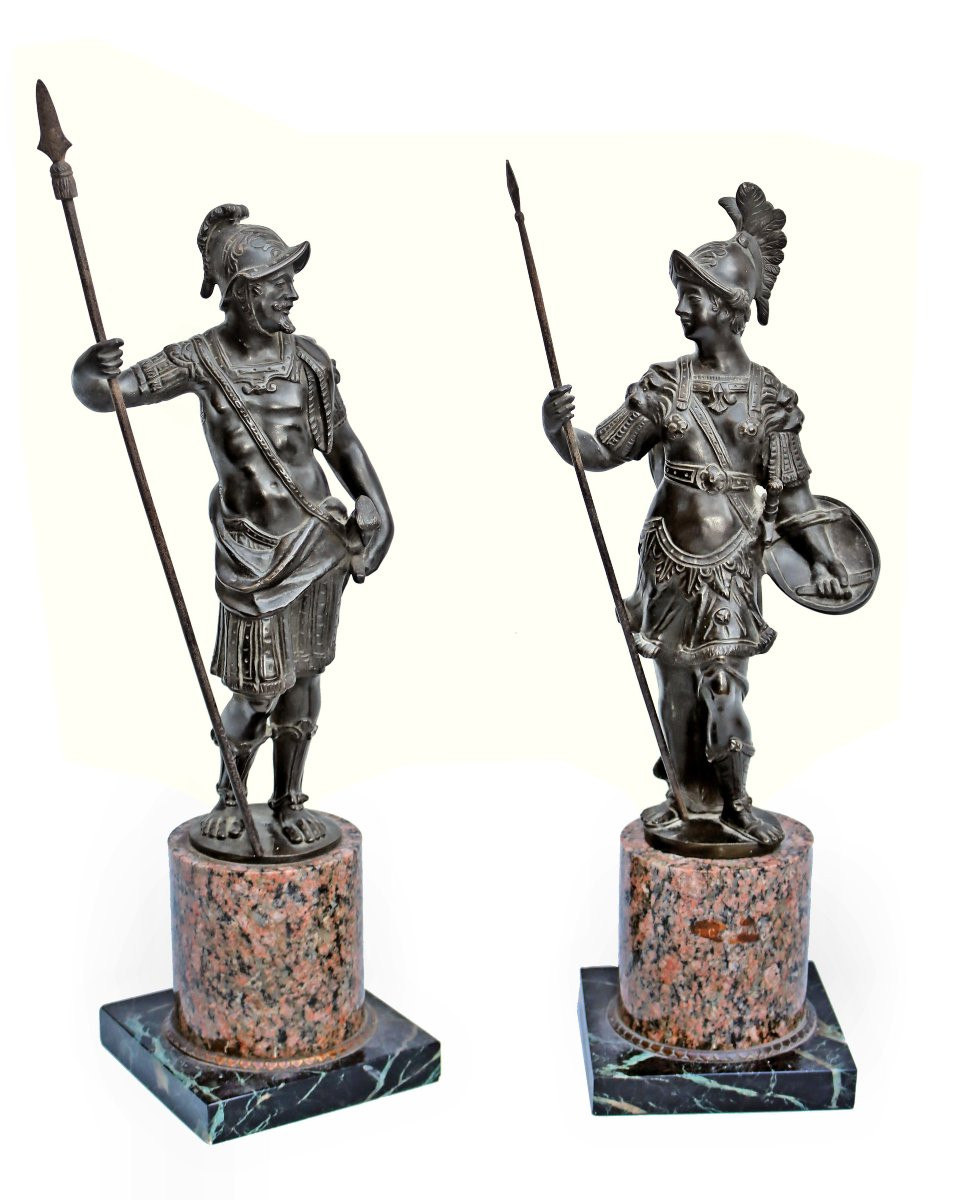
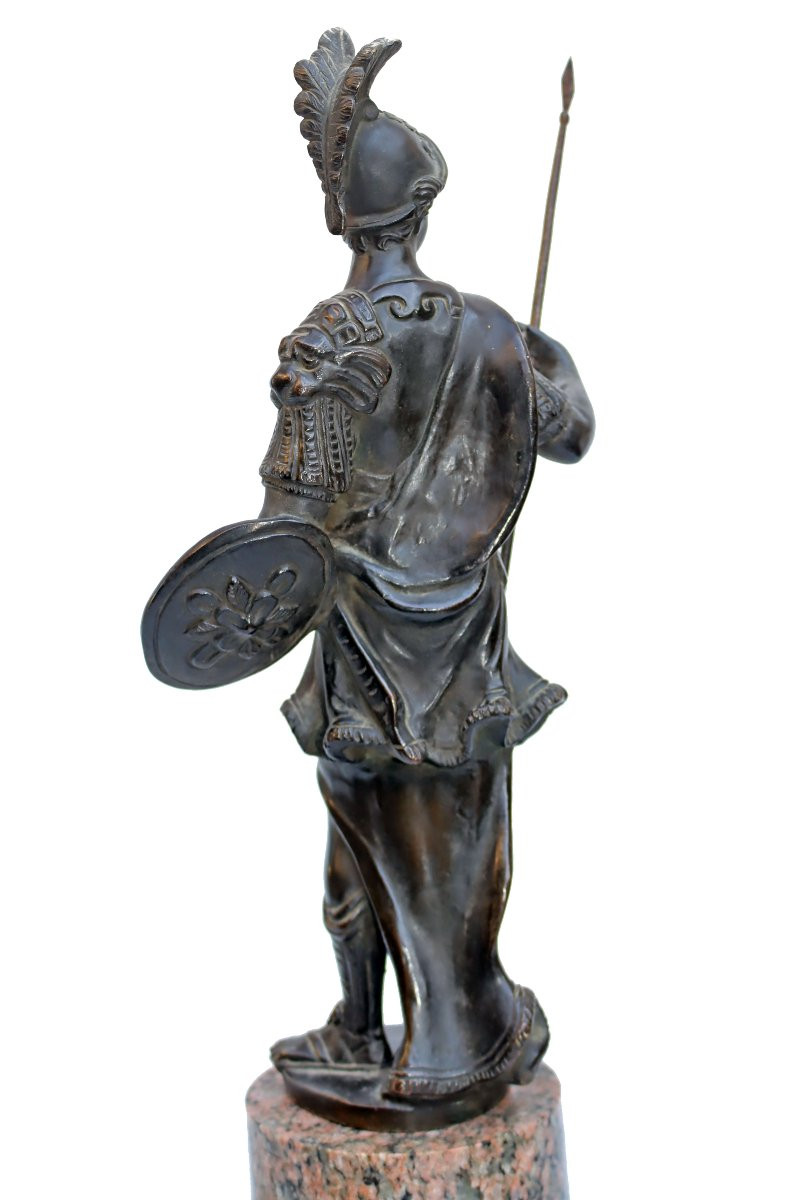
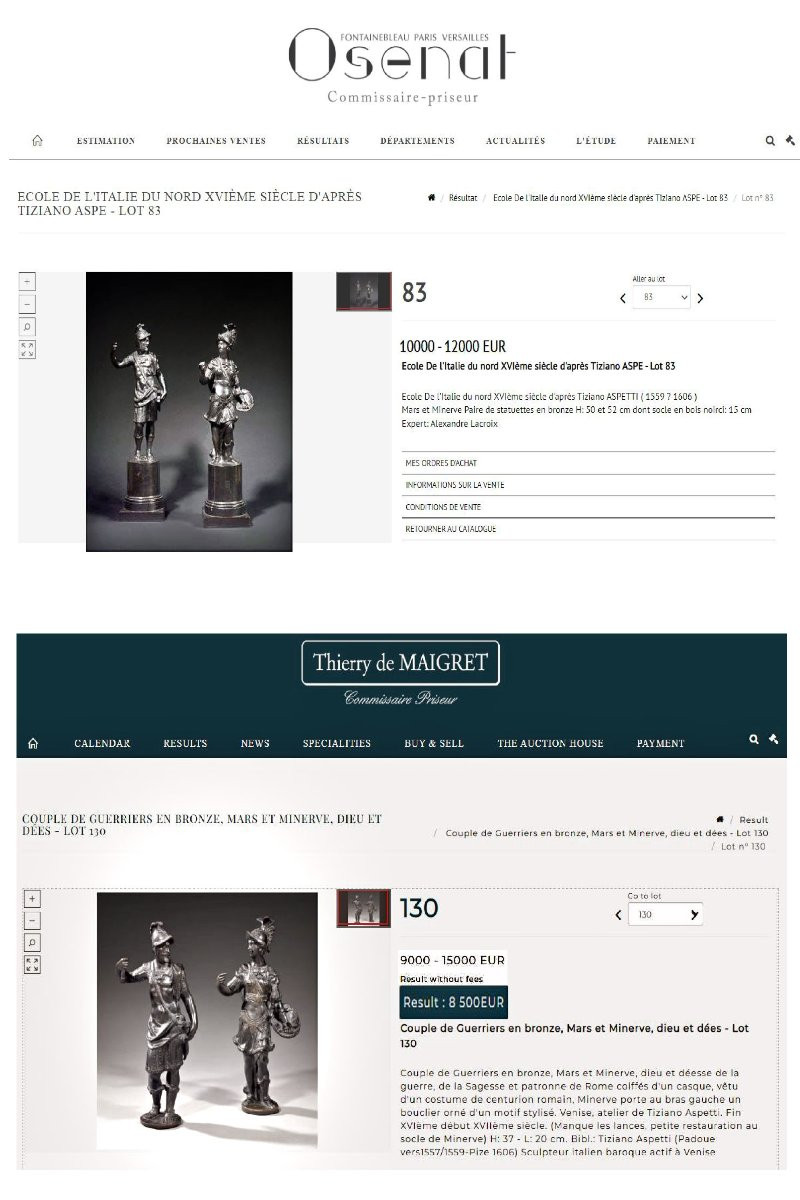
Rare pair of finely chiseled bronze sculptures from the late 16th and early 17th centuries, Venice, workshop of Tiziano Aspetti (1557-1606). Offered in their largest version, representing a couple of mannered warriors in contrapposto, depicting Mars and Minerva in the Glory of Arms, Sciences and Arts, god and goddess of war, Wisdom and patron saint of Rome. Both wearing plumed helmets and dressed as Roman centurions. Bases composed of refined columns in precious pink granite from Aswan resting on a sea green marble counter-plinth decorated with a bronze ring. Good general condition, Total height: 55 cm and 50 cm / Bronzes alone: 36.5 cm and 35 cm. (See photo No. 12 for a reference to a pair of identical models with non-original wooden bases estimated at 10-12,000 euros by the Osenat Auction House, 5 rue Royal in Fontainebleau / As well as another pair without bases and missing lances sold for 8,500 => 10,534 € including fees at Me Thierry De Maigret at HÔTEL DROUOT - Rooms 5 and 6, 9 rue Drouot - 75009 PARIS on Wednesday, June 6, 2012)
These models of Mars and Minerva are typical works of Venetian Renaissance foundries, sometimes used at the top of monumental firedogs; they are universally attributed to the foundry of Tiziano Aspetti. Our sculptures are among the most successful examples and are comparable to those in the Bottacin Museum in Padua (Banzato, Pellegrini, 1989, cat. nos. 171-175) and that in the Hermitage (Androsov, 2008, cat. no. 183). See also the parallels preserved in the Museo di Arte Medievale in Bologna and the Palazzo di Venezia in Rome. In the early 1590s, Tiziano Aspetti, a pupil of Girolamo Campagna and a pioneer of Italian Mannerist art, produced a series of bronzes in several variations representing a goddess and a god surmounting firedogs. The oldest composition represented the figures of Vulcan and Venus, but with modified attributes and costumes (see L. Planiscig, Venezianische Bildhauer der Renaissance, Vienna, 1921, pp. 616-644).
Tiziano Aspetti was an Italian Baroque sculptor who was active in Venice in the late 16th and early 17th centuries. Born into a family of bronze founders, Tiziano Aspetti learned sculpture from Girolamo Campagna, the most important sculptor in Venice, supplying the city, Padua, and Tuscany. For most of his life, Tiziano worked for Giovanni Grimani, an important church figure, antique collector, and patron, for whom he restored ancient statues and made numerous sculptures. At the end of his life, Tiziano moved to Pisa to live in the house of Grimani's great-nephew, where he worked as a renowned sculptor until his death in 1606. Moses Church of San Francesco della Vigna in Venice Saint Paul Church of San Francesco della Vigna in Venice
These models of Mars and Minerva are typical works of Venetian Renaissance foundries, sometimes used at the top of monumental firedogs; they are universally attributed to the foundry of Tiziano Aspetti. Our sculptures are among the most successful examples and are comparable to those in the Bottacin Museum in Padua (Banzato, Pellegrini, 1989, cat. nos. 171-175) and that in the Hermitage (Androsov, 2008, cat. no. 183). See also the parallels preserved in the Museo di Arte Medievale in Bologna and the Palazzo di Venezia in Rome. In the early 1590s, Tiziano Aspetti, a pupil of Girolamo Campagna and a pioneer of Italian Mannerist art, produced a series of bronzes in several variations representing a goddess and a god surmounting firedogs. The oldest composition represented the figures of Vulcan and Venus, but with modified attributes and costumes (see L. Planiscig, Venezianische Bildhauer der Renaissance, Vienna, 1921, pp. 616-644).
Tiziano Aspetti was an Italian Baroque sculptor who was active in Venice in the late 16th and early 17th centuries. Born into a family of bronze founders, Tiziano Aspetti learned sculpture from Girolamo Campagna, the most important sculptor in Venice, supplying the city, Padua, and Tuscany. For most of his life, Tiziano worked for Giovanni Grimani, an important church figure, antique collector, and patron, for whom he restored ancient statues and made numerous sculptures. At the end of his life, Tiziano moved to Pisa to live in the house of Grimani's great-nephew, where he worked as a renowned sculptor until his death in 1606. Moses Church of San Francesco della Vigna in Venice Saint Paul Church of San Francesco della Vigna in Venice
11 000 €
Period: 16th century
Style: Renaissance, Louis 13th
Condition: Excellent condition
Material: Bronze
Reference (ID): 1535823
Availability: In stock
Print