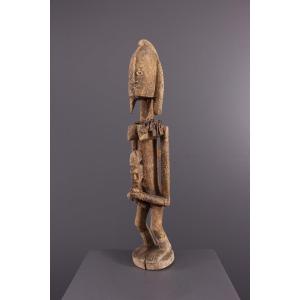
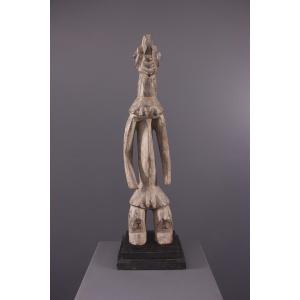
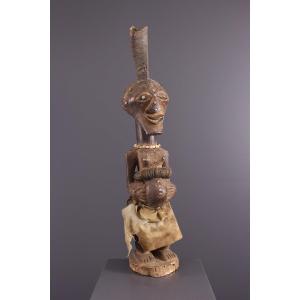
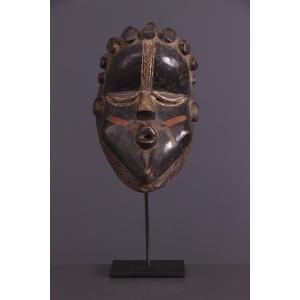
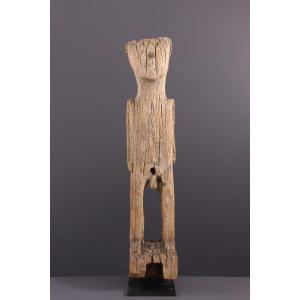
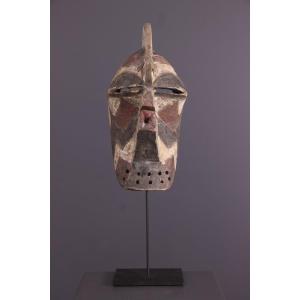
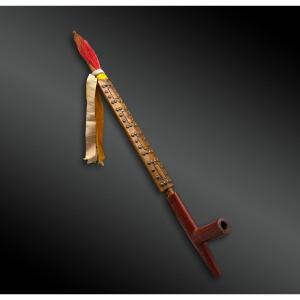
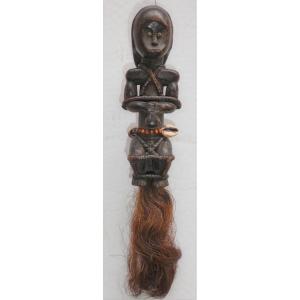
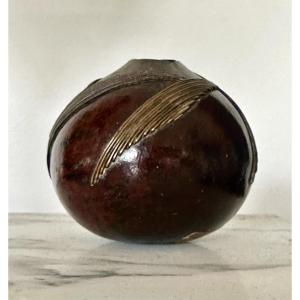
African Tribal Art - Sakalava Figure
From the tribal art collection of Guy Mercier, consultant for the Solvay group, who undertook it at the beginning of the 20th century. While radiating throughout West and Central Africa as part of his work, and collecting works in situ, the majority of his collection nevertheless comes from "cabinets of curiosities" that flourished in European capitals during the 1920s. It also comes from prestigious galleries (Paris, Brussels, London, New York).
The most famous plastic works of Madagascar are mainly linked to funerary statuary. The statues of the Mahafaly, integrated into the aloalo pillars, are often accompanied by fragments of panels placed above the heads. On the other hand, the figures of Sakalava ancestors, sculpted in the round, frequently represent the deceased accompanied by his partner of the opposite sex. The northeast of the tomb, a sacred area associated with dawn and resurrection, but also with the rite of circumcision, was considered by the Malagasy as the ideal location for installing the statue of the deceased. On the other hand, to the southwest of the tomb, the figure of the deceased's partner was placed, symbolizing a perfect union. Ancestor statues are usually depicted frontal, with a straight and rigid bust. Wind, salt and sand have altered these sculptures, hollowing and cracking the wood, which has given it this dry and characteristic texture, as well as a light patina of remarkable mattness. Madagascar, a tropical island located off the east coast of Africa, has long been inhabited by peoples of Polynesian origin, who are said to have settled on the eastern coast of the African continent before being pushed back by Arab-Muslim traders. Several kingdoms were formed on the island from the beginning of the 16th century, including that of the Sakalava on the west coast. Some sources suggest that the Vezo fishermen of the south coast also created similar sculptures.
Piece accompanied by its certificate of authenticity.
PS: what is the certificate of authenticity? https://www.galerie-art-africain.com/faq.aspx?qid=8
PLEASE NOTE THE TRANSPORT PRICE INCLUDES LOSS, THEFT AND BREAKAGE INSURANCE.
The most famous plastic works of Madagascar are mainly linked to funerary statuary. The statues of the Mahafaly, integrated into the aloalo pillars, are often accompanied by fragments of panels placed above the heads. On the other hand, the figures of Sakalava ancestors, sculpted in the round, frequently represent the deceased accompanied by his partner of the opposite sex. The northeast of the tomb, a sacred area associated with dawn and resurrection, but also with the rite of circumcision, was considered by the Malagasy as the ideal location for installing the statue of the deceased. On the other hand, to the southwest of the tomb, the figure of the deceased's partner was placed, symbolizing a perfect union. Ancestor statues are usually depicted frontal, with a straight and rigid bust. Wind, salt and sand have altered these sculptures, hollowing and cracking the wood, which has given it this dry and characteristic texture, as well as a light patina of remarkable mattness. Madagascar, a tropical island located off the east coast of Africa, has long been inhabited by peoples of Polynesian origin, who are said to have settled on the eastern coast of the African continent before being pushed back by Arab-Muslim traders. Several kingdoms were formed on the island from the beginning of the 16th century, including that of the Sakalava on the west coast. Some sources suggest that the Vezo fishermen of the south coast also created similar sculptures.
Piece accompanied by its certificate of authenticity.
PS: what is the certificate of authenticity? https://www.galerie-art-africain.com/faq.aspx?qid=8
PLEASE NOTE THE TRANSPORT PRICE INCLUDES LOSS, THEFT AND BREAKAGE INSURANCE.
3 500 €
Period: 20th century
Style: Tribal Art
Condition: En l'etat
Material: Solid wood
Width: 13 cm
Height: 56 cm
Reference (ID): 1432369
Availability: In stock
Print