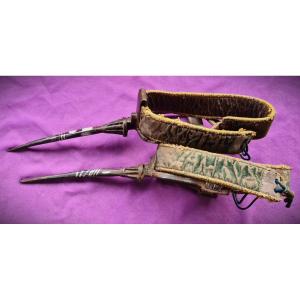
This pair of Mamluk spurs is exceptional. Oriental spurs from the Ottoman Empire are not very common. Those predating the 19th century are extremely rare, and for45 years, this is the first time I hav[...]
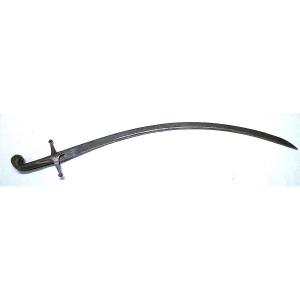
Ottoman shamrock, 18th century, without scabbard. The blade has a pronounced curve, with a 10 cm overhang, a gray bolster with a flat back and a fuller. The blade is engraved on both sides with a seri[...]
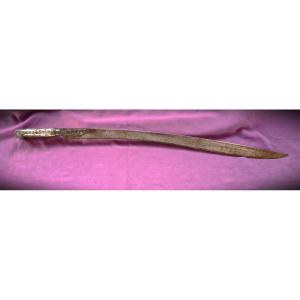
This sword is a yataghan. It could be either Ottoman or Greek, as its decoration corresponds to both possibilities. It can be dated to the second half of the 18th century, or at the latest, the first [...]
SABRE known as NimchaMoroccoLate 18th centurySteel, wood, copperTotal length: 103 cm; blade length: 87 cmSlightly curved blade, with one cutting edge and three grooves on each side; geometric-shaped p[...]
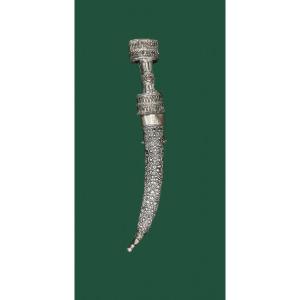
The khanjar is a type of dagger originating in Persia and widely adopted in most Islamic cultures. Besides its functional use, the khanjar also served to indicate rank or social status. The more ornat[...]
Damascus steel (wootz) blade, finely decorated in gold damascening bearing the complete Islamic profession of faith (shahāda) distributed on its two sides: "Lā ilāha illā Allāh, Muḥammad rasūl Allāh" [...]
India (North or Deccan), 18th centuryElegant curved khanjar with an 18th century wootz damascus steel blade, featuring a characteristic crystalline moiré veining. The ovoid handle in chased and openwo[...]
These very rare large war axes are typical of the Khond ethnic group (Kond, Kondh, several spellings) of central India. They date from the end of the 18th century or the first quarter of the 19th cent[...]
Exceptional steel blade, double-edged, with median ridges and double hollow fullers. Point in chainmail. The forging is integral, it opens onto a U-shaped handle, composed of a double branch and conne[...]
Nimcha saber - Maghreb, Algeria, 18th century Horn handle with ivory or bone inlays (missing a roundel on one side). Chiseled bronze guard. Very slightly curved blade imported from Europe. Stars, a de[...]
This sabre called pulwar is typical of Afghanistan. It dates from the second half of the 18th century or the beginning of the 19th century for the mount, the blade is rather dated from the 18th centu[...]
Long saber with curved blade and double edge from the end of the 18th century, beginning of the 19th century Ottoman.
Chiseled handle with its two curved quillons.
Mark on the top of the blade repre[...]
This ax is a Persian “Tabarzin” or “saddle axe”. Unlike many examples dating from the second half of the 19th century, which are very light and often a little crudely decorated, it is a real weapon, w[...]
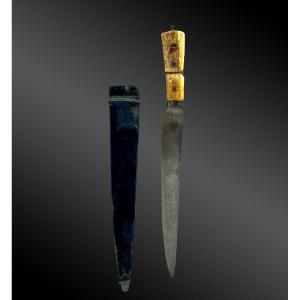
Afghan or Bukhara straight dagger, called Kard, with scabbard
Afghanistan 18th century
Damascus steel, marine ivory, gold. Wood and velvet
Length of the knife Total length of the knife : 37 ; Blade[...]
Proantic uses a cookie to analyze traffic and improve its service by using Google Analytics. Data sent to Google Analytics (frequency of visits to the site and pages visited) are anonymous. No other cookie tracks your activity, your personal data is not collected. Thank you for helping us to have better understanding how Proantic is used.













 Le Magazine de PROANTIC
 TRÉSORS Magazine
 Rivista Artiquariato