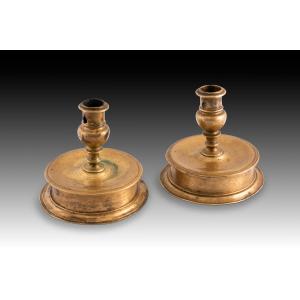
Pair of bronze candlesticks. 16th century. Pair of bronze candlesticks with a raised circular base embellished with smooth, projecting moldings, a central axis decorated with discs, and a bulbous top.[...]
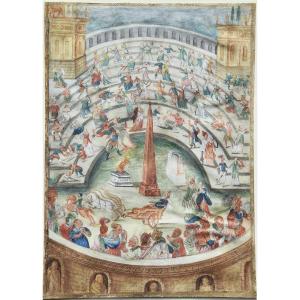
Northern School, circa 1500. Festive scene in an amphitheater. An obelisk in the center, a stele on the right, and a hearth on the left. Gouache & gold on parchment. A gold border surrounds the work. [...]
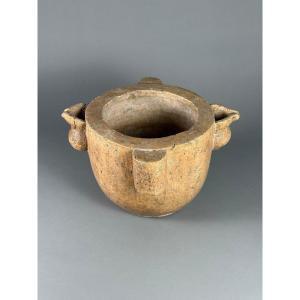
Antique 16th-century yellow marble mortar from Torri del Benaco, hand-chiseled from a single piece of marble and featuring two handles for ease of use. Mortars were used not only to crush spices and h[...]
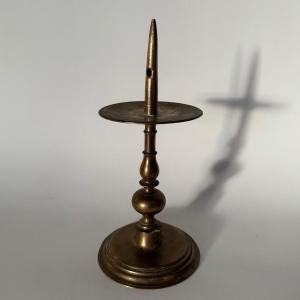
This gilt bronze candlestick is natural, preserved from time. We note scratches due to use, a small accident to report (visible on one of the photos), it remains however in a generally acceptable cond[...]
Fragments of 16th-century stained-glass windows. There are three glass panels in total, in which fragments of 16th-century stained-glass windows were later joined together using the stained-glass tech[...]
This embossed leather panel was made in the late 16th century. It features a refined Renaissance decoration. It features putti, small childlike figures symbolizing innocence. The panel is also decorat[...]
Capital. Carved granite. Spain, 16th century. Capital of a circular column in carved granite, with volutes inspired by classical Corinthian capitals (three in total) and a series of moldings. This is [...]
Chest. Leather, wood, metal. Spain, circa 1500. Rectangular chest with a semicircular lid made of carved wood and covered in worked leather, reinforced by a series of fittings, a material also used fo[...]
Small box with opening top, slightly convex urn front with shaped shelf support, decorated on the front with carved tablet, while the rest of the object is simply painted. The front started with four [...]
Spanish Renaissance casket, 16th century. Carved, polychrome and gilded wood, decorated with a vase adorned with cornucopias, cherub heads and fruit. In the lock, a shield with two feathers. Dimension[...]
Extraordinary pair of candlesticks (real sculptures!) in carved, painted and gilded wood, from the Tuscan area, from the end of the 16th century (around 1580).The structure of the two candlesticks can[...]
Morillo. Wrought iron. 16th century. Wrought iron of the type commonly used for cooking in large fireplaces or hearths. It features a series of upward-facing hooks to accommodate spits when the andiro[...]
Extraordinary pair of carved and gilded wooden columns, of a discrete size (82 cm H), dating back to the mid-16th century.One of the two columns has, under the capital, two angel faces.In the body of [...]
Wrought iron kitchen hearth, 16th century. Kitchen hearth with three hooks joined on a horizontal crosspiece with engraved decoration and square and rectangular rings and bars, some of which are twist[...]
Parapet. Wrought iron. Castilian School, 16th century. Wrought iron antepecho decorated with a series of vertical abalaustrada shapes enhanced by curves topped with simple floral elements, and a spher[...]
Door knocker. Wrought iron. 16th century. Wrought iron knocker composed of several pieces, the main one of which stands out. It has two bands that start in parallel and then separate to form two volut[...]
Candlestick, 16th century Bronze. Polished bronze candlestick with a wide circular base from which emerges a conical trunk that opens onto a smooth plate housing the candlestick. Renaissance candlesti[...]
Small roof box with remains of polychromy, 16th century.
Rectangular box with a roof-shaped lid, which gives its name to this typology, very common in the Gothic period. The shield and the bolt are o[...]
Frame. Carved, polychrome and gilded wood. 16th century.
Carved, polychrome and gilded wooden frame, composed of different elements with a marked Renaissance influence, which gives an architectural c[...]
Exceptional pair of miniatures painted on gold-ground tin from the first half of the 16th century, depicting Saint Francis and Saint Clare. Presumably of central Italian origin, the miniatures are in [...]
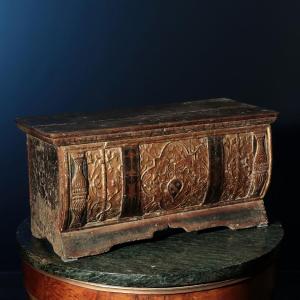
Chest. Carved wood, metal. Spanish school, 16th century.
Rectangular box with flat lid decorated on the outside with a series of figurative reliefs arranged symmetrically, with a theme and lines clea[...]
Important gilded carved wooden frame from the end of the 16th century with beautiful carving work both on the part of the rabbet with plant motifs and on the external edge of it. It has a large groove[...]
Stained glass window presenting a medallion painted in grisaille, enamels and silver yellow surrounded by a red bistre border having Saint Francis of Assisi as subject, flowers and fruits frame the Sa[...]
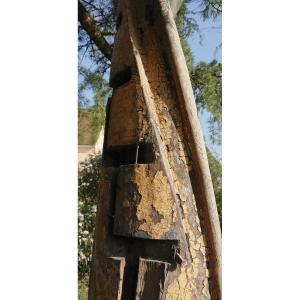
Magnificent central stringer – mast – barrel – spiral staircase heart – helical in oak.
Handrail carved from the mass.
Origin: medieval castle in the Rhineland (Germany) dating from 1550 Very good c[...]
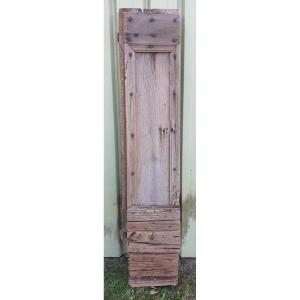
Oak door piece probably dating from the 16th or 17th century.
Comes from a church in Tarn (France).
2 wrought iron hinges with heart-shaped ends.
dimensions: height = 206 cm; width = 45cm; thicknes[...]
Polychrome and gilded carved oak base. Original polychromy. In the center two coats of arms, surmounted by a helmet topped with an eagle and surrounded by two lions.
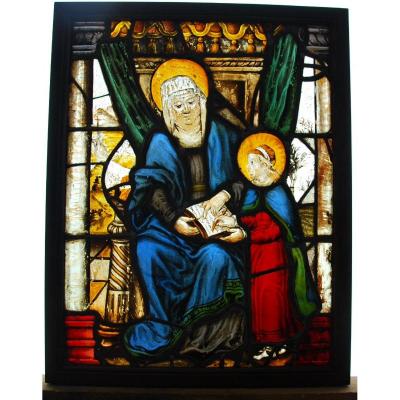
Stained glass window painted in grisaille and enamels with colored glasses representing Saint Anne seated holding a book which she forwards the reading to the virgin surrounded by two columns. Wooden [...]
Stained glass window crowned virgin with child painted in grisaille and enamels with colored glass surrounded by two paving columns treated in perspective on a draped background. Wooden frame
Very rare pair of heads, presumably coming from a fountain or a decorative element in architecture, embedded in a wall or in the form of a fountain, stone or terracotta. Former Sube collection.
Proantic uses a cookie to analyze traffic and improve its service by using Google Analytics. Data sent to Google Analytics (frequency of visits to the site and pages visited) are anonymous. No other cookie tracks your activity, your personal data is not collected. Thank you for helping us to have better understanding how Proantic is used.















 Le Magazine de PROANTIC
 TRÉSORS Magazine
 Rivista Artiquariato