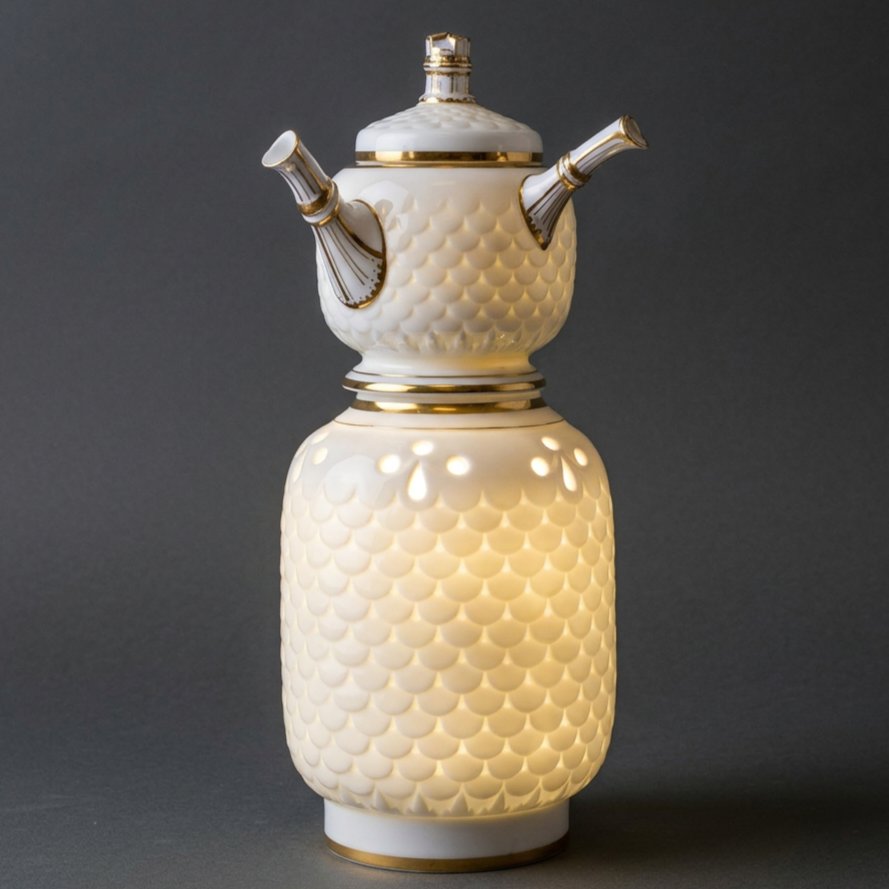
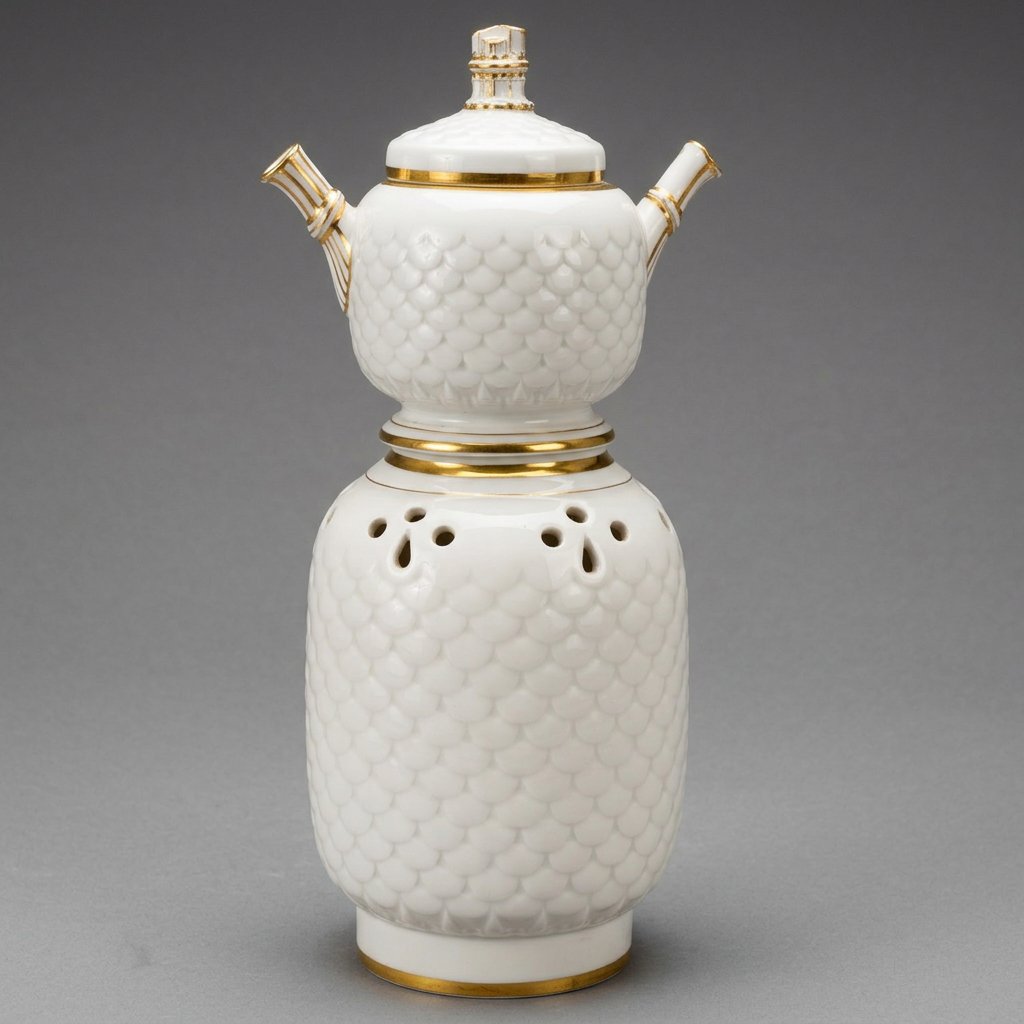
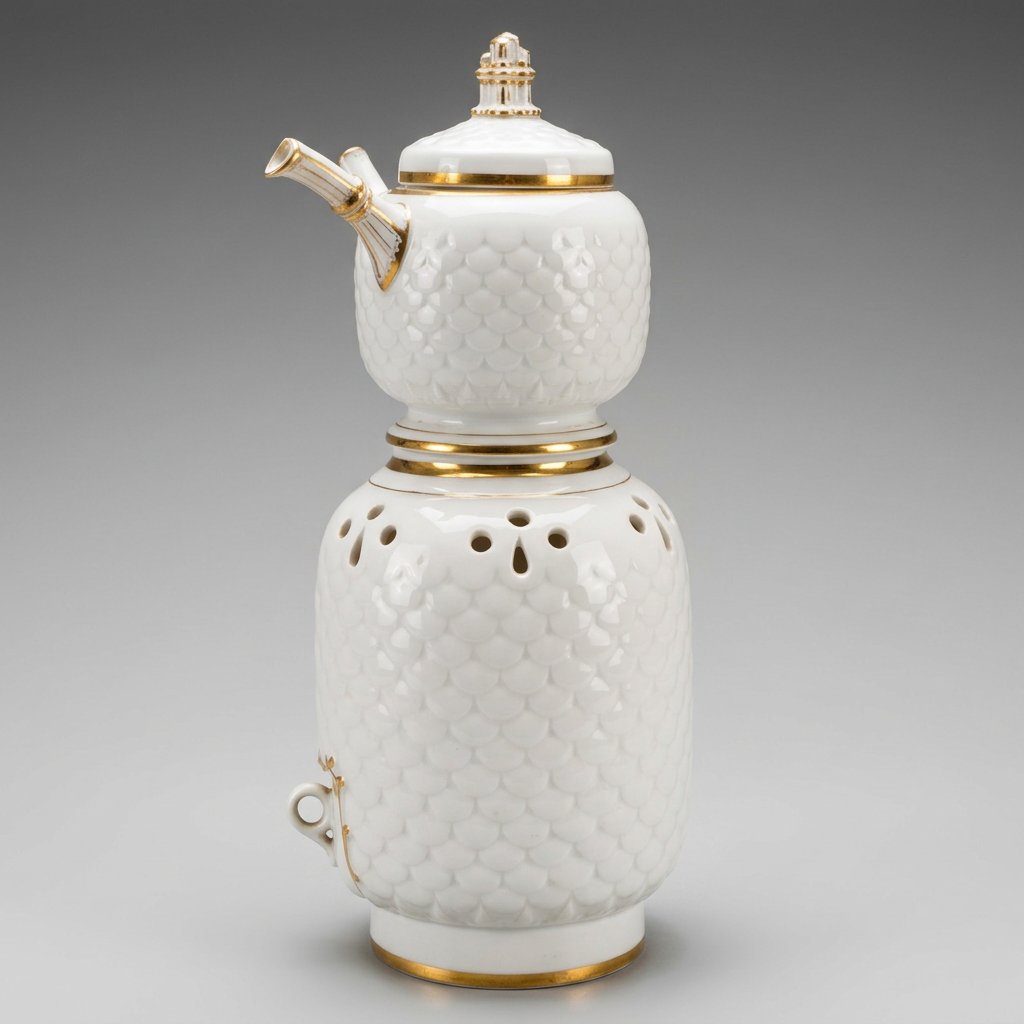
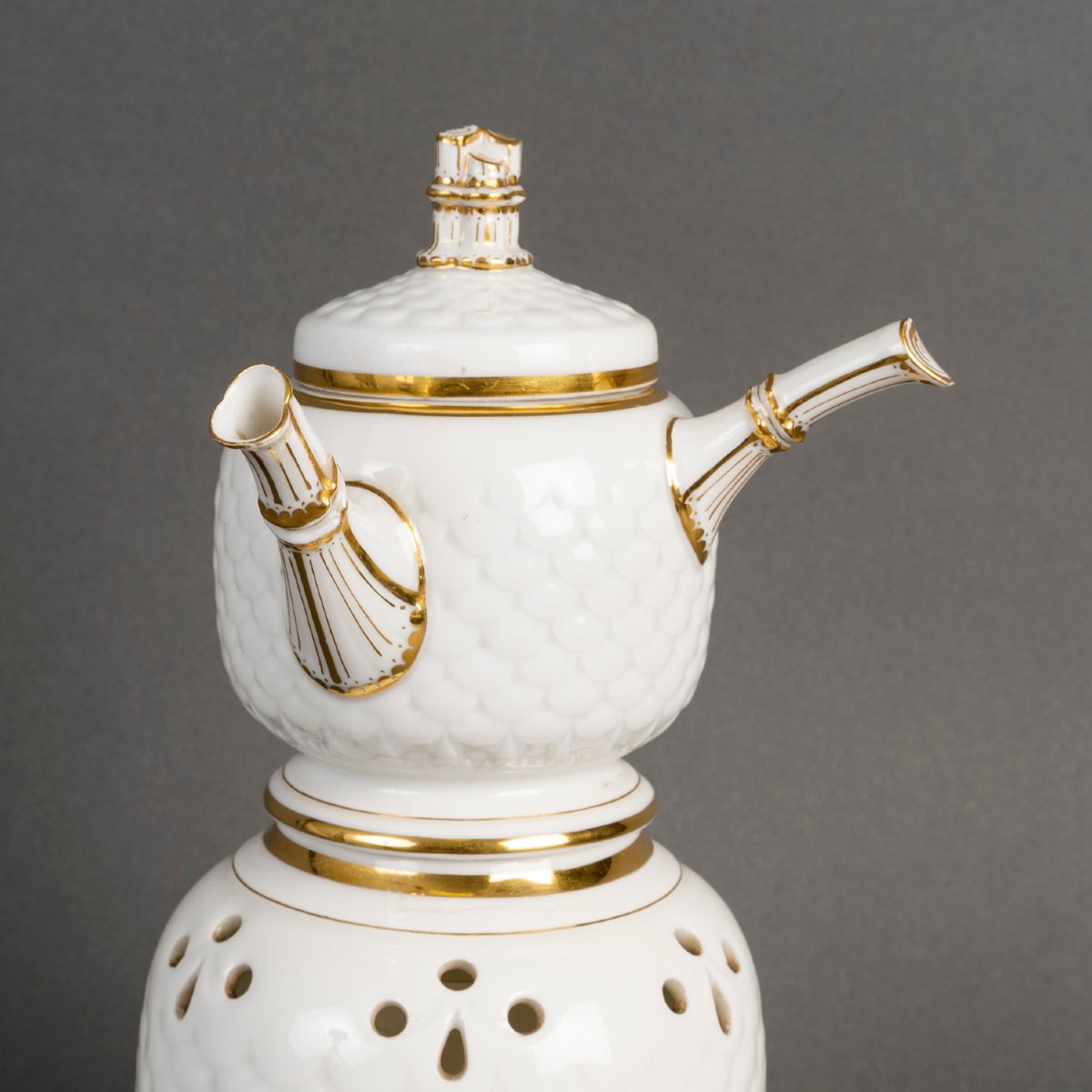
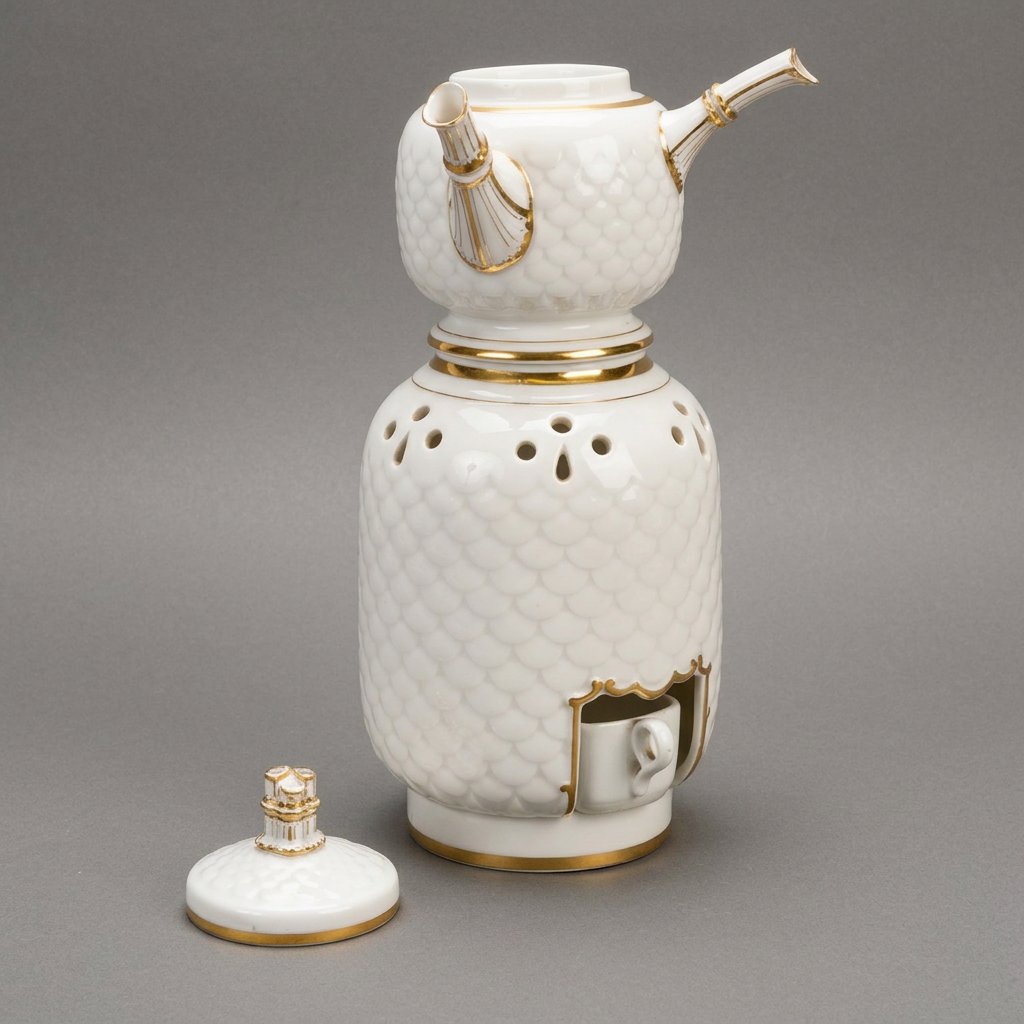
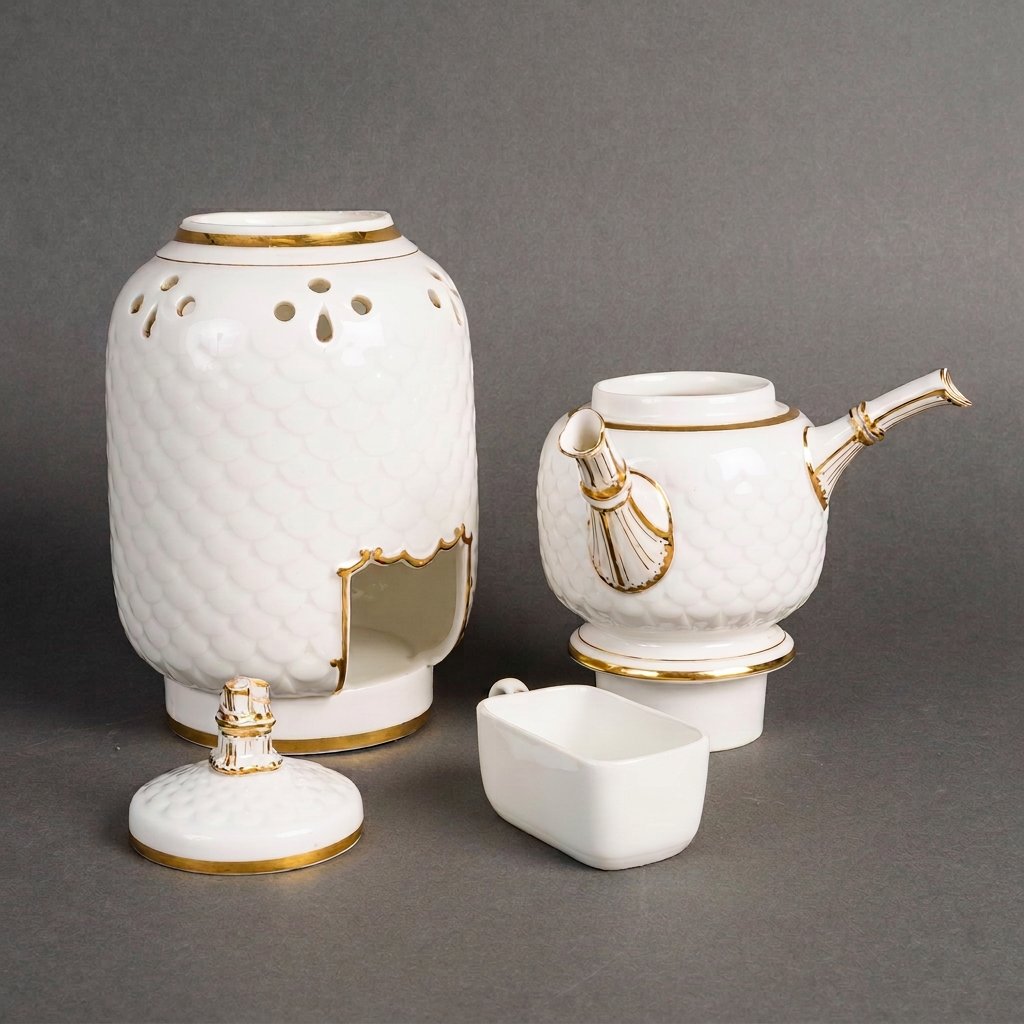
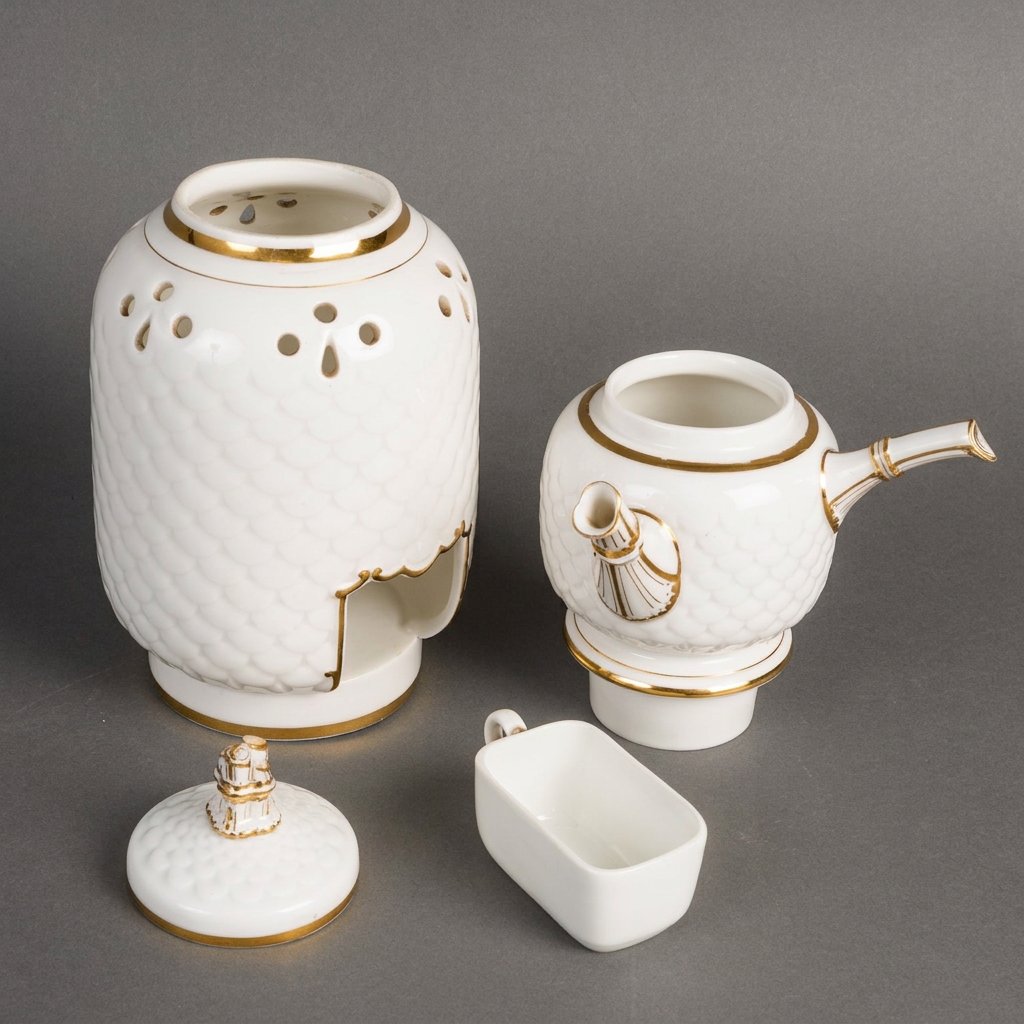
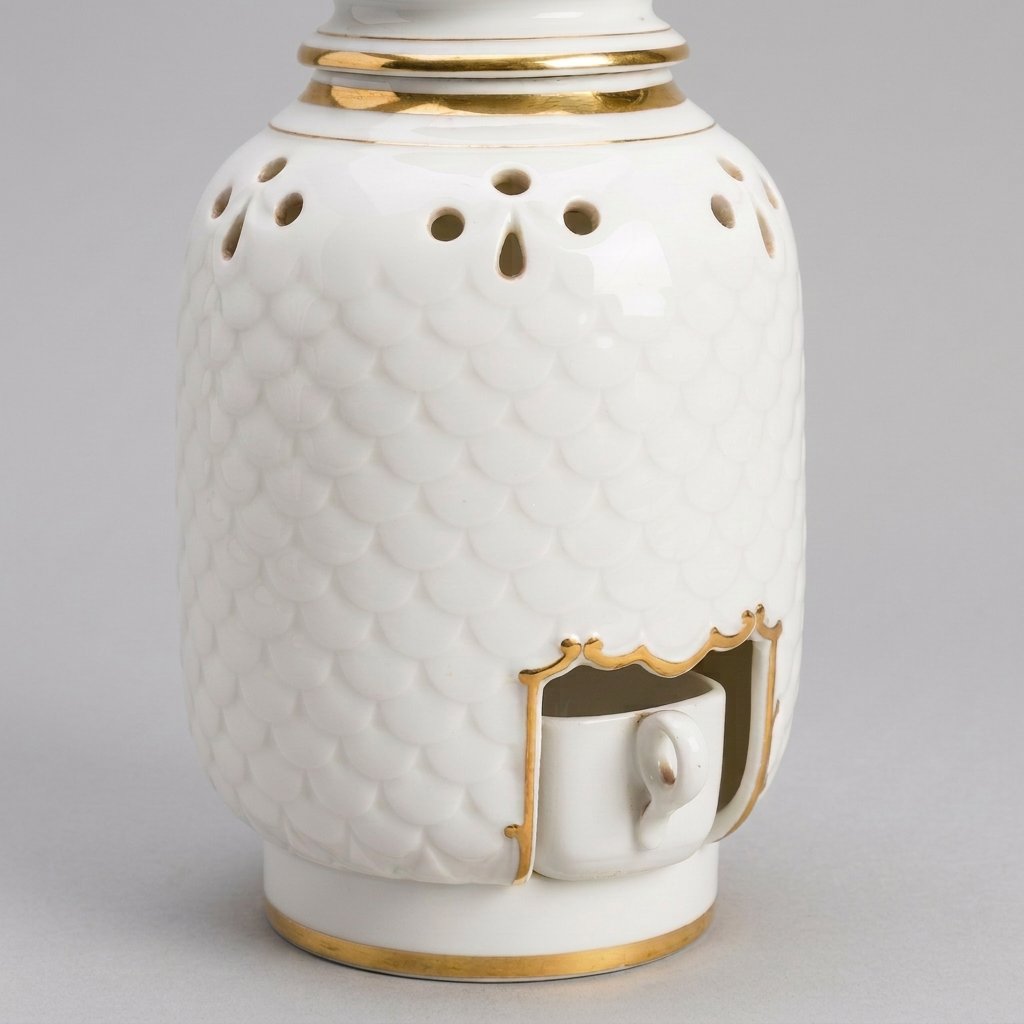


Limoges - Jean Pouyat: 19th-century Porcelain Tea Pot With Nightlight
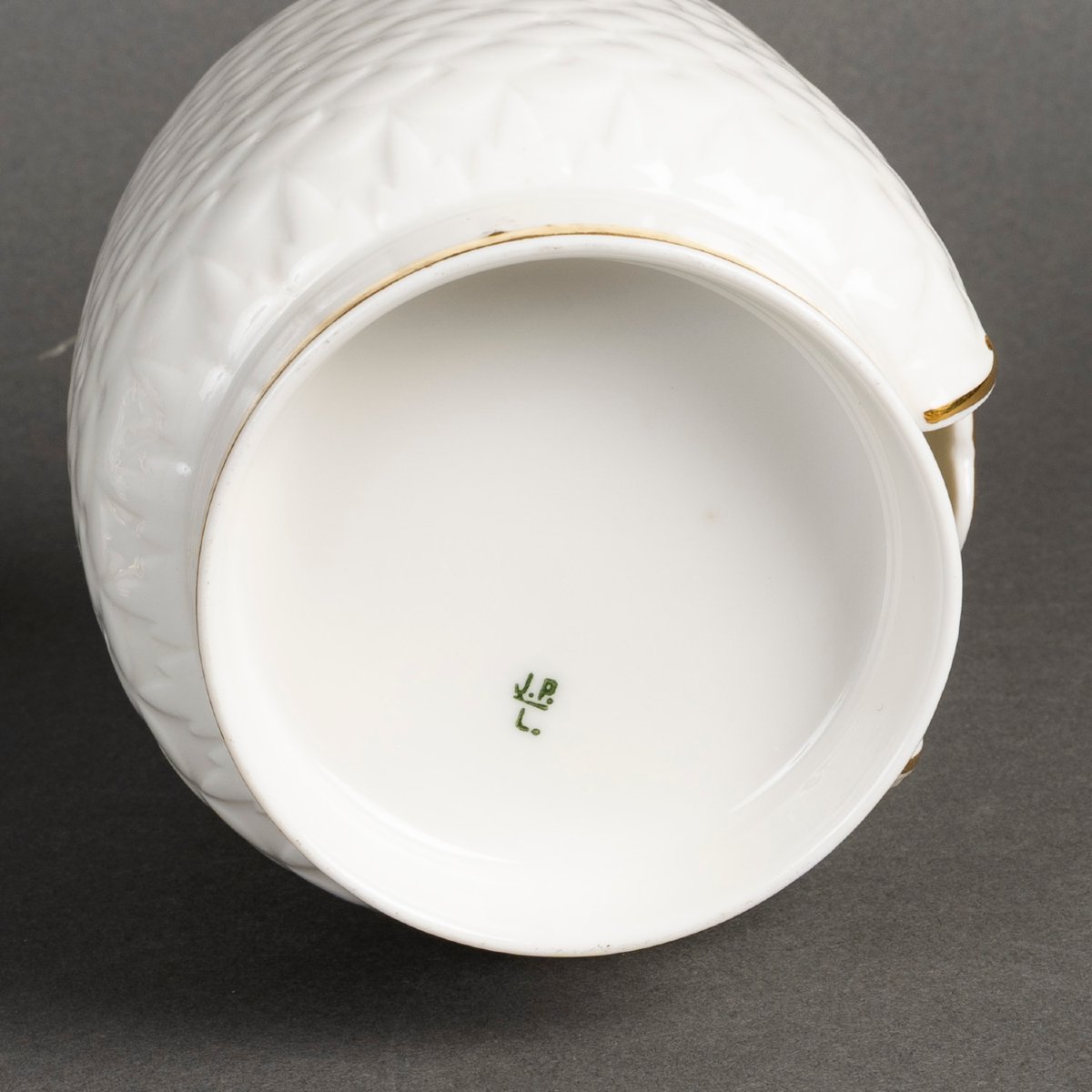
Jean Pouyat, Limoges (France) — green mark with the hidden inscription “J.P. / L. ” on the reverse of the base.
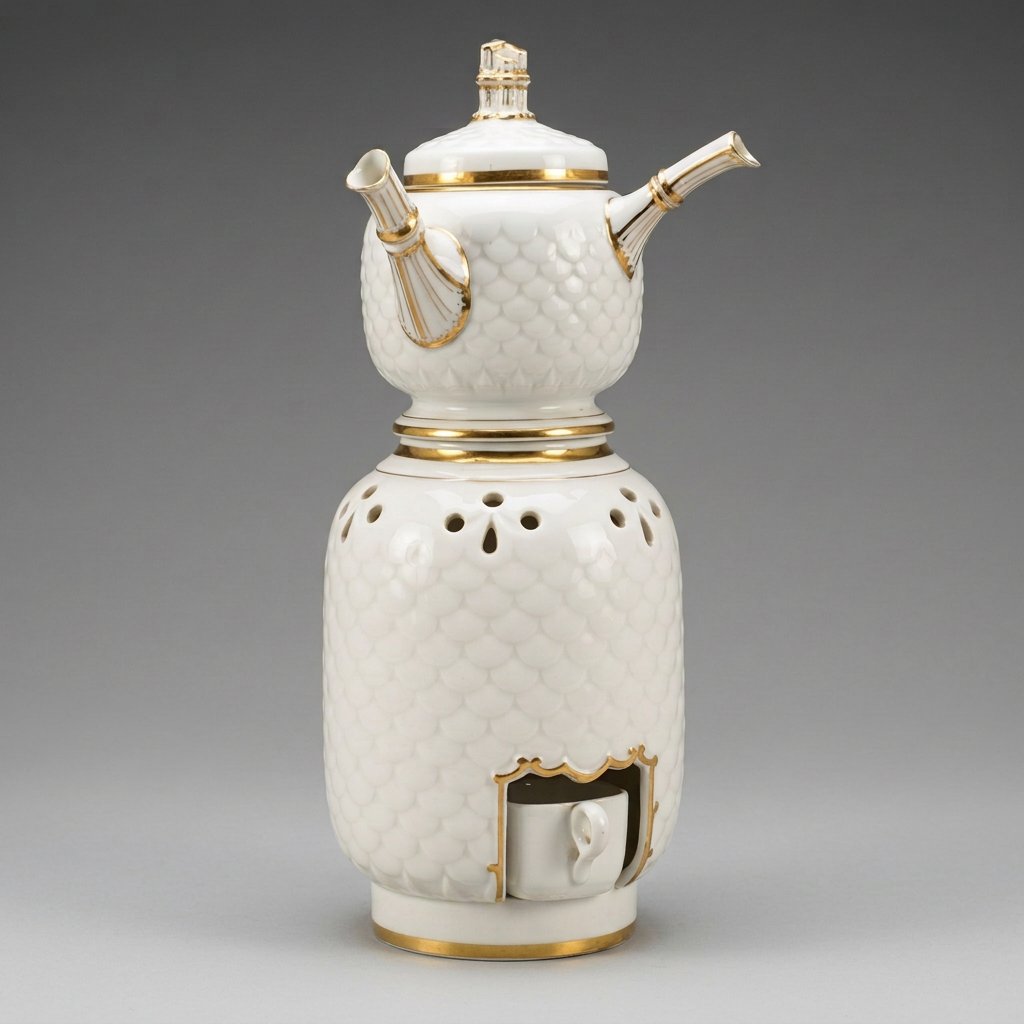
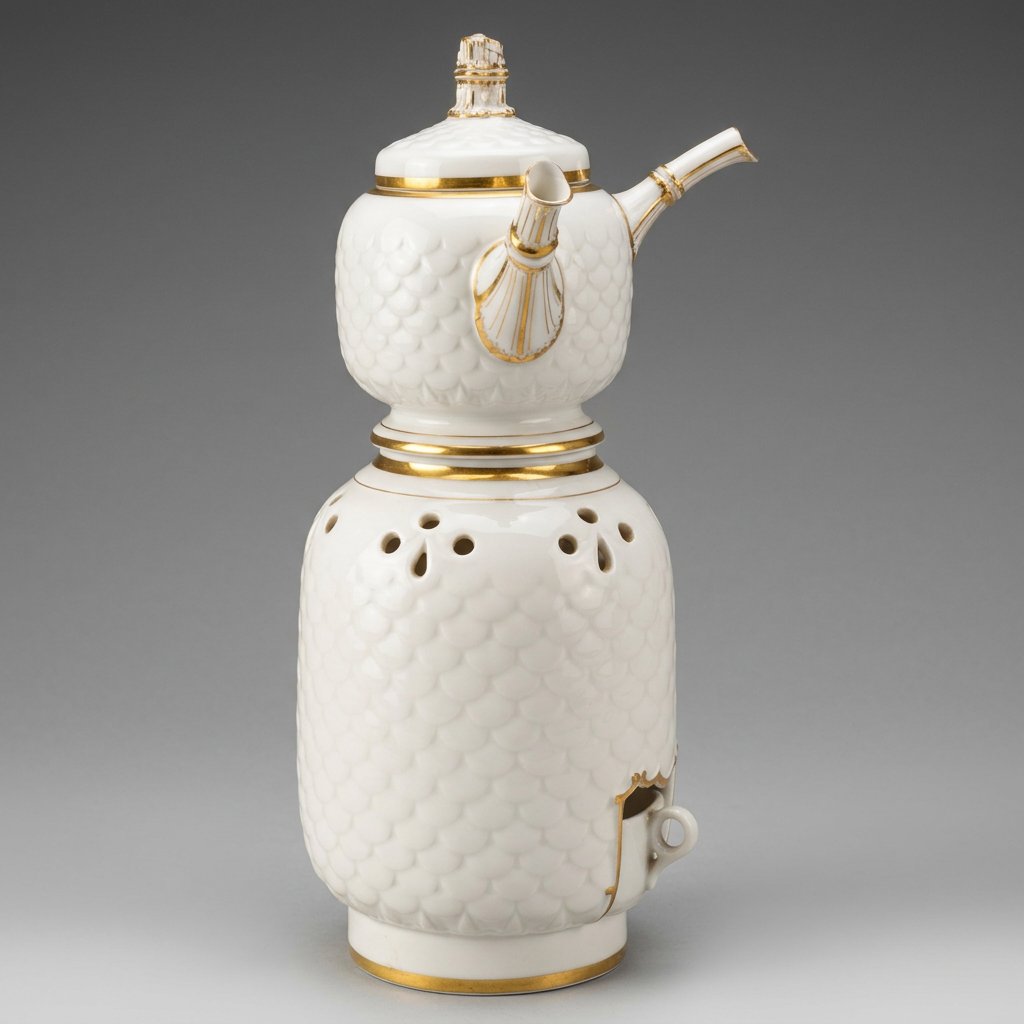
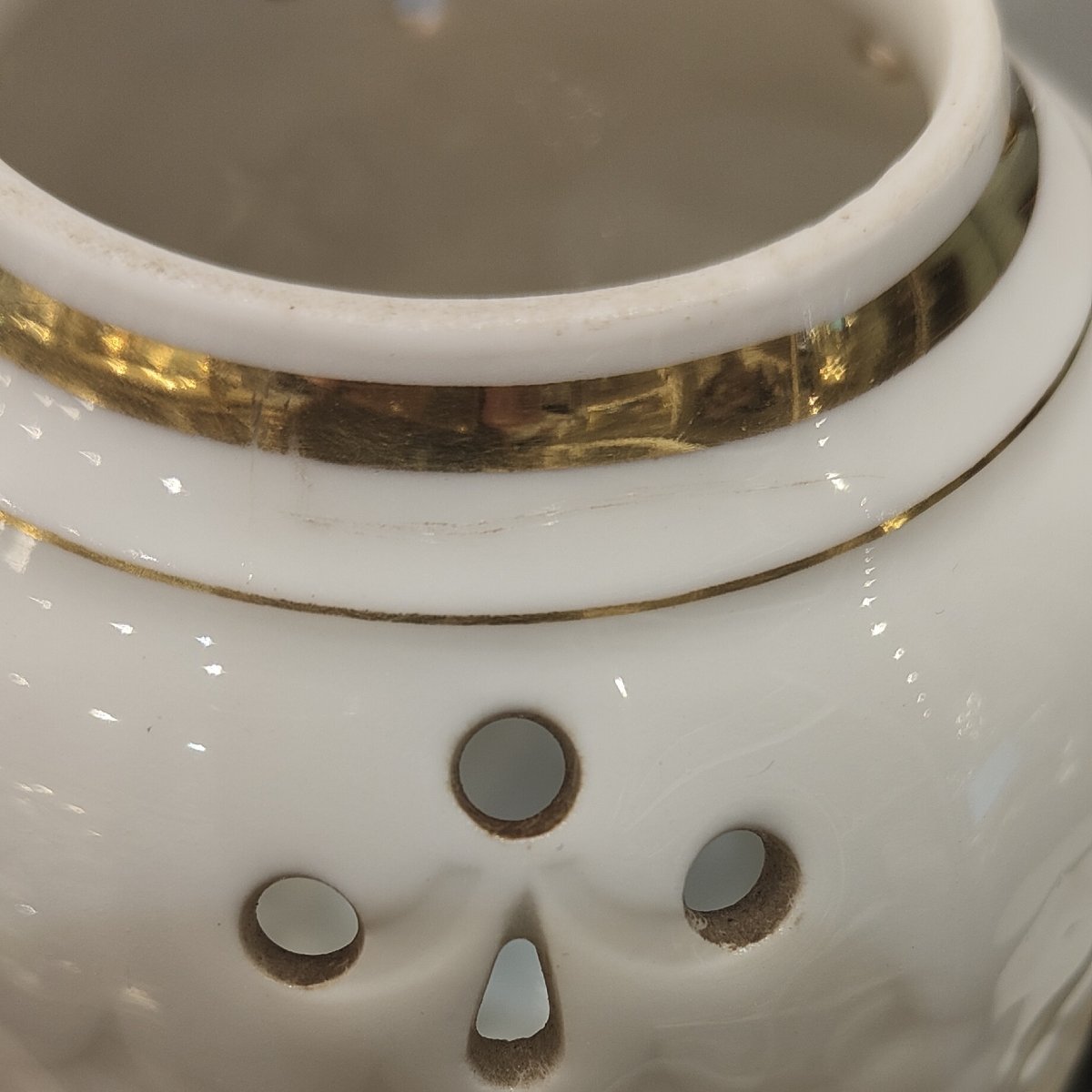
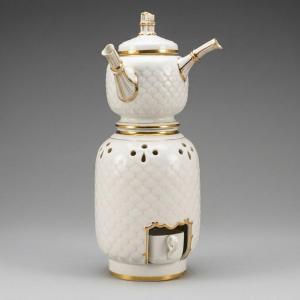
Circa 1890, herbal tea pot with built-in warmer: a tea set with an integrated heating chamber, whose upper part—the teapot— fits onto a cylindrical warmer containing a burner cup. The set keeps the infusion warm at the table and consists of four complementary elements. Bulging cylindrical heating base Bulging cylindrical body resting on a circular foot accented with gold. The shoulder is openwork with six rosette-shaped perforations, cut into the wall to ensure airflow and the diffusion of light from the burner’s flame. At the base, a scalloped opening with a gilded border provides access to the interior compartment and holds the burner cup. Burner cup Rectangular, with a small side handle, it fits into the lower compartment of the body. It serves as the receptacle for the heat source—a candle or pilot fuel. Spherical pitcher: A spherical body fitted onto the top of the vessel, upon which it rests via a molded base. It features a ribbed tubular spout and a straight side handle inspired by Japanese design (kyusu), both accented with gold. Snapping-on lid Decorated with a scale pattern, it snaps onto the pitcher. It is topped by a handle molded in the shape of bound bamboo stalks, accented with gold—a motif inspired by Far Eastern motif that echoes the Japanese-style side handle of the pitcher. The “Écaille” Decoration The piece features a molded decoration of interlocking scales in slight relief—the “Écaille” decoration, created using a mold, which gives the surface a pearlescent appearance characteristic of Limoges porcelain. The highlights are applied in fine gold.
TheJean Pouyat factory is no minor player in theLimoges porcelain industry. In 1860, it employed five hundred workers,had five wood-fired kilns in operation, and a sixth coal-fired kilnunder construction; one-third of its production was exported,primarily to America, placing it secondonly to the Haviland factory. It mastered all three phases ofproduction—body, decoration, and firing—and garnerednumerous international accolades. In the 19th century, its porcelain wasrenowned for its whiteness, translucency, and the brilliance of itsglaze.
ThePouyat company won a gold medal at theParis World’s Fair in 1878. It competed in Group 3(“Furniture and Accessories”), Class 20(“Ceramics”).
Theofficial report on hard-paste porcelain, written by Victorde Luynes, a member of the jury, begins as follows:
“Wewill first mention the Pouyat company, of whichMr. Dubreuil; its exhibition was remarkable for theexceptional quantity and the finish of the pieces on display.It was above all its white porcelain that attractedattention; the perfection of the forms, the purity and precisionof the details, and a dazzling whiteness were the hallmarks of theseexceptional products. White porcelain, under suchconditions, becomes a true luxury item.”
https://bfm.limoges.fr/patrimoine/tous-les-billets/le-catalogue-des-porcelaines-pouyat
Dimensions:
Totalheight: 28 cm
Diameter:15 cm
Condition:
Verygood condition. 1 scratch (see photo)
Period: 19th century
Style: Napoleon 3rd
Condition: Excellent condition
Material: Porcelain
Diameter: 15 cm
Height: 28 cm
Reference (ID): 1862944
Availability: In stock