



Antwerp 1798–1809, Solid Silver, Jean-baptiste De Keyser Louis XVI-style Mustard Shakers And Salt Shakers
Solid Silver Mustard Pot and Pair of Salt Cellars with Blue Glass Liners — Antwerp, Empire Period, 1798–1809
Louis XVI style — Empire period — Antwerp silverwork under French occupation — Probably by the silversmith Joannes Baptista De Keyser.
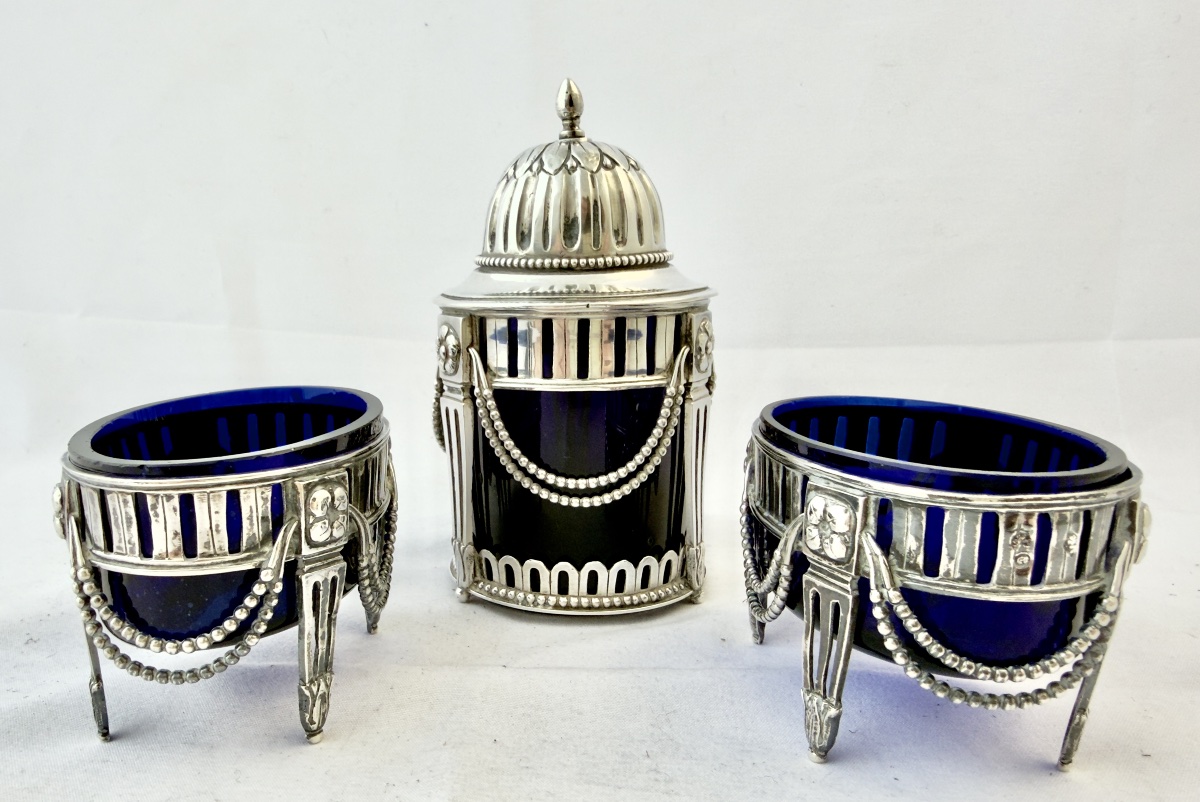
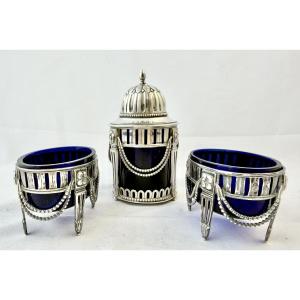
An elegant table set comprising a covered mustard pot and a matching pair of salt cellars, made of solid silver and fitted with their original cobalt-blue blown-glass liners, all three preserved in perfect condition.
This ensemble is distinguished by the elegance of its Neoclassical design, directly inspired by the Louis XVI style, whose decorative vocabulary remained particularly influential in silverwork during the early years of the nineteenth century.
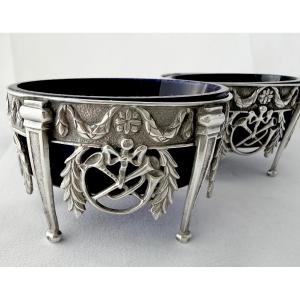
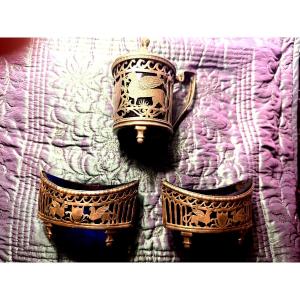
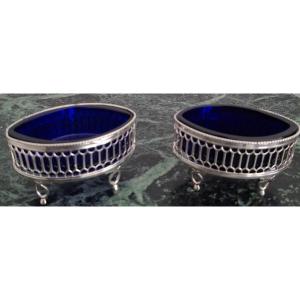
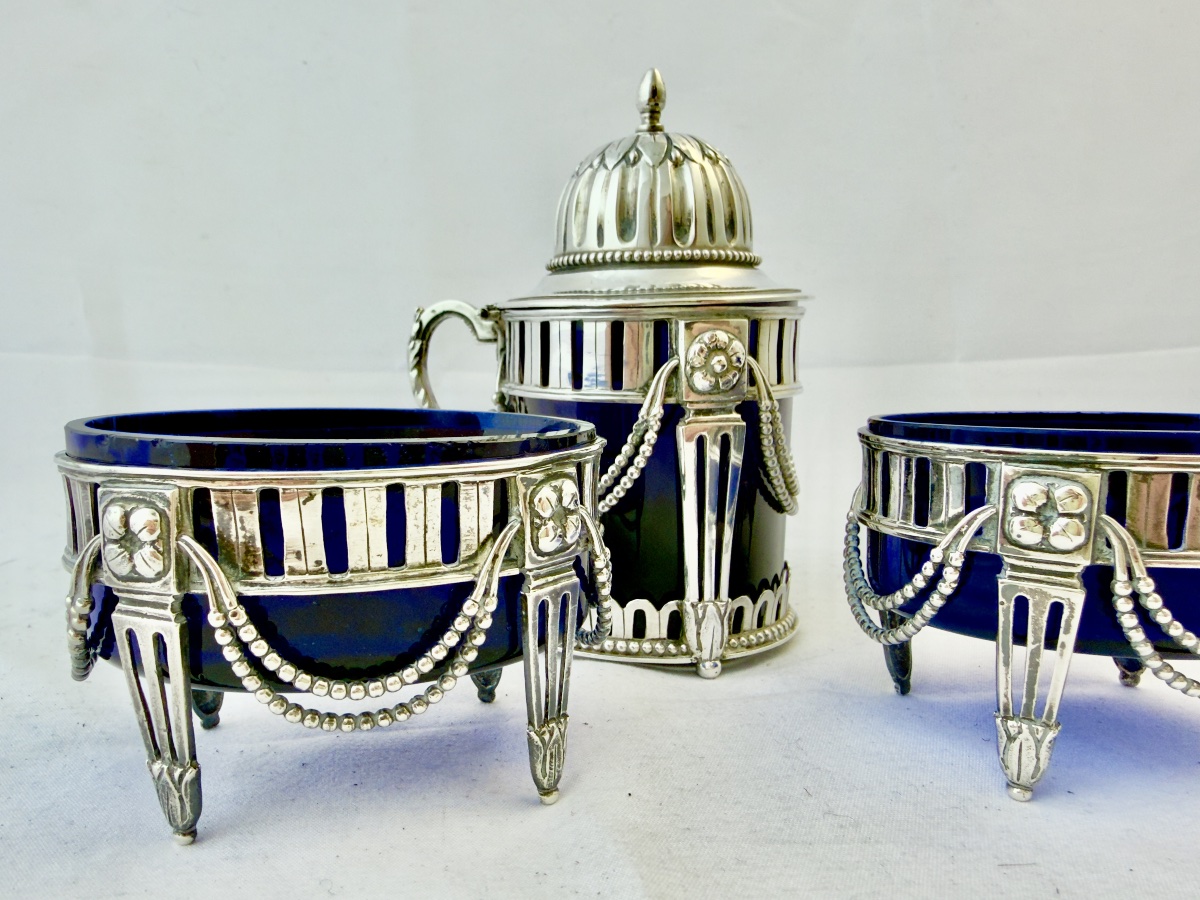
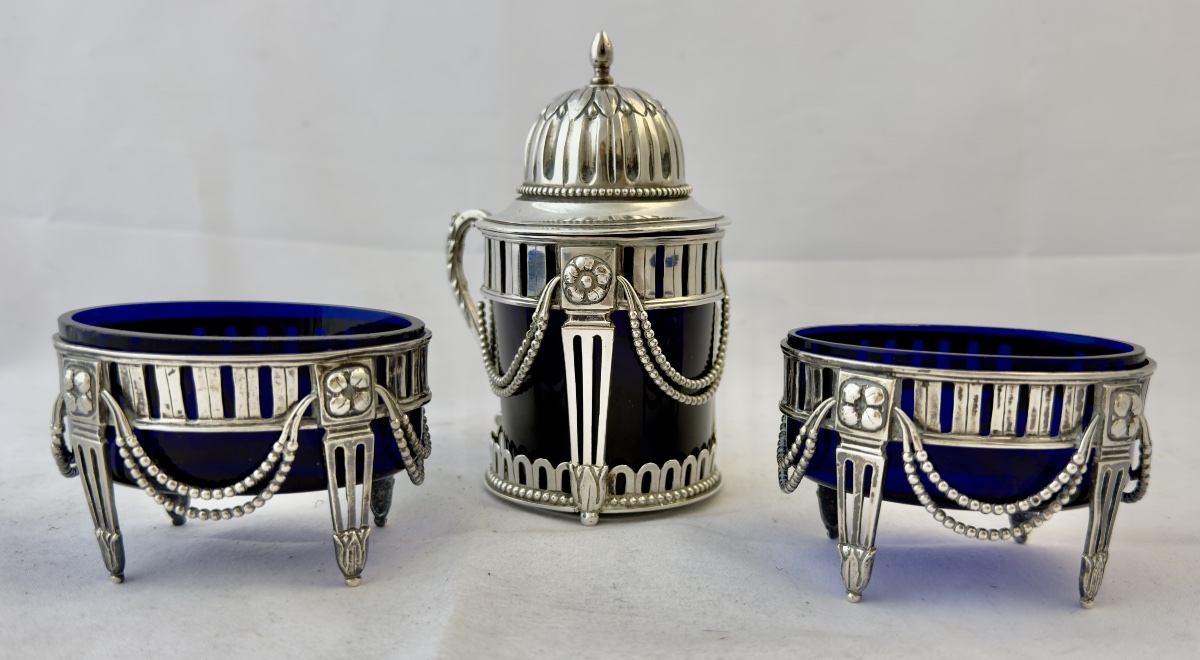
All three pieces feature pierced cylindrical bodies composed of regularly spaced vertical uprights, allowing the deep blue surfaces of the glass liners to show through. The contrast between the brilliance of the silver and the rich, translucent colour of the glass contributes greatly to the decorative appeal of the ensemble.
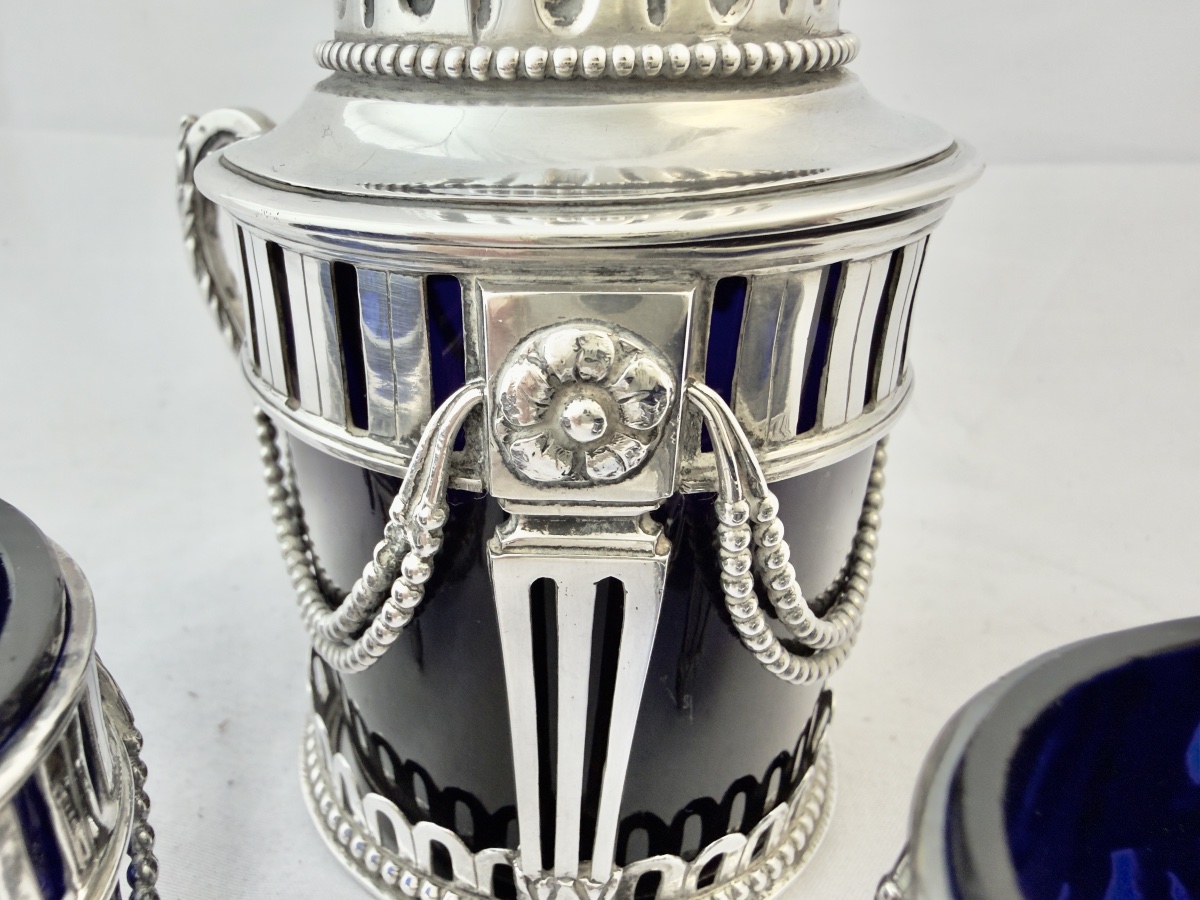
Each of the two salt cellars stands on four tapering feet, decorated with fluting and terminating in small hoof-shaped supports. These are surmounted by circular rosettes from which delicate beaded garlands are suspended in graceful swags around the openwork bodies.
The mustard pot, standing on three feet, displays precisely the same decorative vocabulary, with its fluted uprights, rosettes and beaded garlands. It is fitted with an elegantly curved lateral handle embellished with foliage, while its domed cover features broad radiating flutes and is surmounted by a finely shaped, tapering finial.
The rim of the cover is outlined by a beaded border, while the lower section of the mustard pot displays a succession of pierced, arch-shaped motifs.
The ensemble is a particularly attractive example of the persistence of the Louis XVI taste during the Empire period. While fashionable Parisian silverwork was evolving towards more monumental forms and ornamentation inspired by Classical Antiquity, certain provincial workshops, particularly those in the former Austrian Netherlands, continued to preserve the refined Neoclassical traditions of the late eighteenth century.
Hallmarks and Attribution
The pieces bear the French hallmarks introduced in the Belgian territories following their annexation by France in the aftermath of the French Revolution.
Among these is the silver standard hallmark known as the “First Rooster” (Premier Coq), used between 1798 and 1809, together with a guarantee mark corresponding to the Antwerp assay office, bearing the departmental number 67.
These marks allow the ensemble to be dated to the period of French administration, more precisely between 1798 and 1809.
The maker’s mark, struck within a lozenge-shaped punch, consists of a capital letter preceded by a floral motif resembling a cornflower, of the kind traditionally found growing among wheat and other cereal crops.
This mark may be associated with a member of the De Keyser family, a name well represented among Antwerp silversmiths during the eighteenth and nineteenth centuries.
One possible attribution is to Joannes Baptista De Keyser, born in Antwerp on 13 November 1751 and still recorded in the city’s professional registers between 1816 and 1821, according to the available biographical documentation.
This identification remains to be confirmed through comparison with the original registers and reference tables of Antwerp silversmiths’ marks.
The interest of this possible attribution lies partly in the remarkable historical transition it represents: that of a silversmith trained in the traditions of the Ancien Régime, whose career extended beyond the abolition of the old guild system and into the period governed by the newly introduced French regulations concerning precious metals.
A Transitional Period in Antwerp Silverwork
This ensemble provides an interesting testimony to a particularly significant chapter in the history of Belgian silverwork.
Following the annexation of the Southern Netherlands by the French Republic in 1795, the former local systems of hallmarking were gradually replaced by French legislation. Antwerp silversmiths were henceforth required to submit their work to the new assay and guarantee offices, while continuing artistic and technical traditions established over several generations.
The hallmarks of this period are therefore of particular historical interest. Not only do they allow silver objects to be dated with considerable precision, but they also provide tangible evidence of the profound political and administrative transformations experienced by the Belgian territories at the turn of the nineteenth century.
This mustard pot and its matching pair of salt cellars perfectly illustrate the continuity of artistic traditions during a period of considerable historical change.
The preservation of all three original blue blown-glass liners, each entirely intact, further enhances the appeal of this harmonious ensemble, which is as attractive for its refined appearance as it is interesting for its historical context.
Period: 18th century
Style: Louis 16th, Directory
Condition: Excellent condition
Material: Sterling silver
Reference (ID): 1862495
Availability: In stock