

Augsburg, 1707–1711, Pair Of Egg Cups, Solid Silver And Vermeil, Johann Philip Gross
Extremely Rare Doppeleierbecher, Double Egg Cup in Solid Silver and Silver-Gilt – Augsburg, 1707–1711 – Johann Philipp Gross (1660–1742)
Germany, Augsburg, early 18th century, circa 1707–1711.
An exceptionally rare double egg cup in solid silver, formerly gilded (silver-gilt), known in German as a Doppeleierbecher, bearing the town mark of Augsburg and the maker’s mark PG of the silversmith Johann Philipp Gross (1660–1742), who was admitted as a master in 1689.
This remarkable object provides a particularly interesting insight into the dining customs of the German aristocracy in the early 18th century. Its ingenious construction allowed soft-boiled eggs to be presented and eaten in two different ways, reflecting the culinary traditions then prevailing throughout Europe.
Description
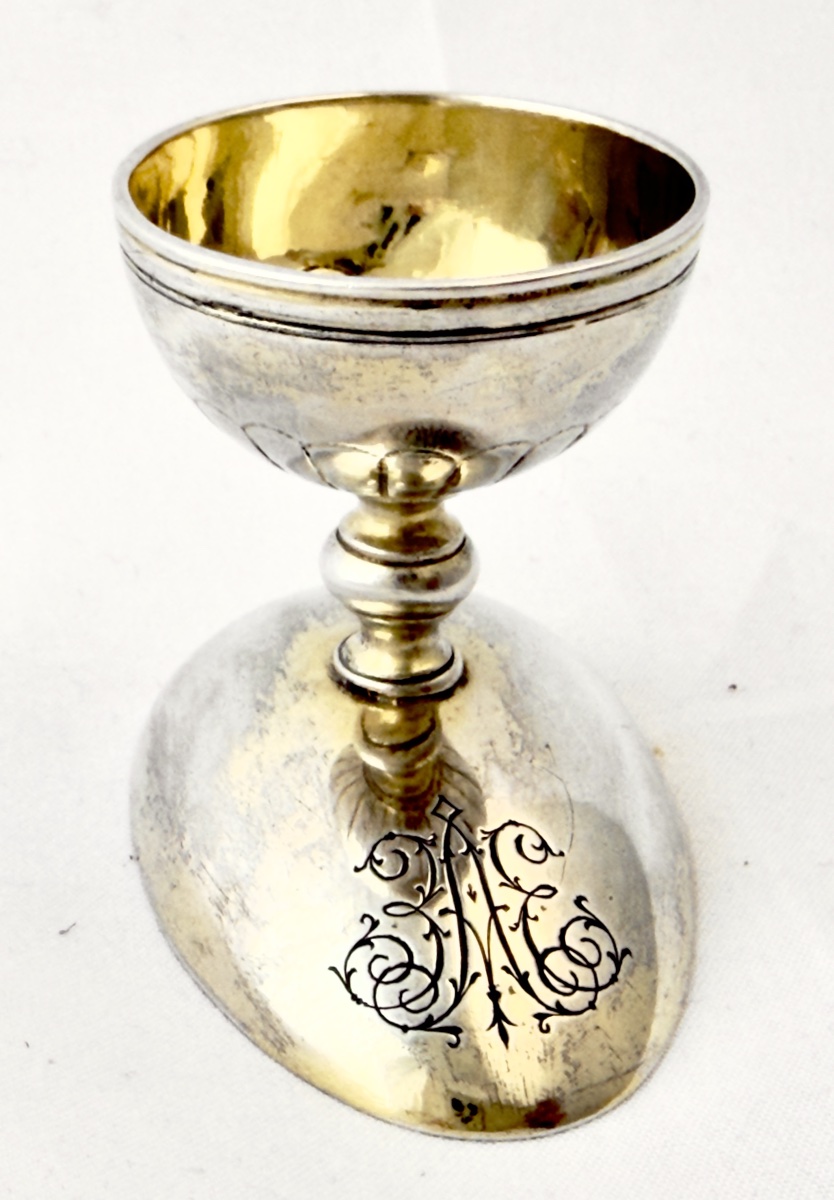
The egg cup consists of two receptacles of deliberately different shapes, arranged in opposite directions and connected by a short central baluster-shaped stem with moulded rings.
The first cup, deep and hemispherical, was designed to hold an egg upright, in a position corresponding to the way soft-boiled eggs are generally served today. Its rim is accentuated by fine concentric mouldings, while its interior retains a beautiful original gilding.
The second cup, considerably wider and shallower, takes the form of a flared bowl, allowing the egg to be placed horizontally. When inverted, it rests on a domed circular foot decorated with radiating flutes reminiscent of the petals of a flower. This arrangement gives the object an elegant and perfectly balanced silhouette.
The decoration is distinguished by its restraint and the refinement of the silversmith’s craftsmanship. The smooth, carefully polished surfaces emphasise the proportions of the two cups, the mouldings of the central stem and the fluting of the foot.
The exterior of the wider cup bears an elegant antique monogram, engraved in an English cursive style, consisting of three intertwined letters: two symmetrically arranged E’s, one facing left and the other facing right, framing a central capital A executed in graceful English script. This refined composition, in which the letters are harmoniously interlaced, bears witness to an earlier private ownership.
The egg cup was originally gilded on both its interior and exterior surfaces. The original gilding remains well preserved inside both receptacles, whereas the silver-gilt finish on the exterior surfaces has largely worn away, revealing the silver beneath and its beautiful natural patina. Traces of gilding still visible in certain areas provide evidence of the object’s original appearance.
The piece admirably illustrates the craftsmanship of Augsburg’s silversmiths, whose creations were among the most highly prized in Europe during the 17th and 18th centuries.
The Silversmith Johann Philipp Gross (1660–1742)
Johann Philipp Gross, also recorded under the spelling Groß, was an Augsburg silversmith active during the transitional period between the Baroque of the 17th century and that of the early 18th century.
Baptised in 1660, he was admitted as a master silversmith in 1689. In 1690, he married his first wife, Maria Regina Bretting, daughter of the silversmith Johann Conrad Bretting. Following her death, he married Susanna Barbara Priester in 1703, herself a member of a family of silversmiths. He continued working until his death in 1742.
His production included cups, beakers, presentation pieces and silver and silver-gilt tableware intended for wealthy and aristocratic patrons.
Several works by this silversmith are preserved today in important European public collections:
- A silver-gilt two-handled cup, dated 1697–1699, in the State Historical Museum, Moscow, inventory no. 53030/117 OK 1287.
- A partly gilded fruit bowl, dated 1703–1707, in the Kunsthistorisches Museum, Vienna, inventory no. 1152.
- Two partly gilded beakers, dated 1707–1711, in the Tiroler Landesmuseum Ferdinandeum, Innsbruck, inventory no. GO 64 a–b.
These documented works place the present egg cup within the production of a master whose creations are still represented in several major museum collections.
His maker’s mark, consisting of the letters PG, is recorded in the specialist literature devoted to Augsburg silversmiths.
Double Egg Cups and the Different Ways of Eating Eggs
Double egg cups, generally made of silver or silver-gilt, represent a particularly interesting category of European table silver from the 17th and 18th centuries.
Their design responded to a largely forgotten peculiarity of historical dining customs: soft-boiled eggs were not eaten in the same way throughout Europe.
In France, as in several other European countries, eggs were generally served upright, with the pointed end facing upwards. The upper part of the shell was then removed, allowing the egg to be eaten with a spoon.
In German-speaking countries, another custom consisted of placing the egg horizontally, making an opening in the side of the shell and dipping pieces of bread into it.
This difference in table manners was already documented in the 17th century.
The German Baroque poet and writer Georg Philipp Harsdörffer (1607–1658) described it in his celebrated Frauenzimmer Gesprächspiele, published during the 1640s:
“An egg, boiled in its shell, is opened in three different ways: the Jews open the egg at the end […], the French open it at the top, and we Germans open it along the flanks or sides.”
The Doppeleierbecher offered an elegant solution to these different culinary traditions.
By simply turning the egg cup upside down, its owner could choose between a deep receptacle designed to hold the egg vertically and a wider, shallower cup allowing it to be presented horizontally.
Another striking feature of these early German egg cups is their generally very small size. Their receptacles often appear surprisingly diminutive when compared with the chicken eggs we consume today. This observation suggests that eggs intended for consumption were once considerably smaller and that their average size gradually increased during the 18th, 19th and particularly the 20th centuries, notably as a result of selective breeding of laying hens and improvements in their feeding. It is even possible that some eggs consumed during the 17th and 18th centuries were almost half the size of modern eggs. Although this proportion is difficult to establish precisely, the modest dimensions of these early egg cups provide a particularly evocative testimony to this evolution.
This ingenious arrangement was of particular interest to travellers, enabling them to preserve their personal dining habits regardless of the customs prevailing in the country they were visiting.
Double egg cups were also among the accessories included in precious travelling table sets, known as Reisemundzeug, used by princes, members of the nobility and other persons of high rank. These sets contained cutlery, spice containers and various dining implements, carefully arranged in leather-covered cases lined with velvet.
The distinctive use of these egg cups is also documented in 17th- and 18th-century still-life paintings, which sometimes depict eggs placed horizontally, opened at the side and accompanied by pieces of bread.
The present example thus constitutes a fascinating testimony to these European culinary traditions, now largely forgotten.
Hallmarks and Dating
The egg cup bears two hallmarks:
- The town mark of Augsburg, depicting the heraldic pine cone (Pyr), the traditional emblem of the city.
- The maker’s mark PG, attributed to Johann Philipp Gross, who became a master silversmith in 1689.
The Augsburg town mark used during the period 1707–1711 displays a remarkable characteristic that makes it readily distinguishable from the numerous variants of the pine-cone mark employed by the city over the centuries.
Unlike other versions, in which the pine cone is accompanied by two small pellets at its base, this particular variant is distinguished by the presence of two small lozenges instead of the usual pellets.
This highly characteristic heraldic and graphical detail greatly facilitates its identification and allows this period to be distinguished from the preceding and subsequent versions of the municipal hallmark.
The dating to circa 1707–1711 is therefore based on the identification of this particular variant of the Augsburg town mark, together with the maker’s mark of Johann Philipp Gross.
This period also corresponds to that of two beakers by the same silversmith preserved in the Tiroler Landesmuseum Ferdinandeum in Innsbruck.
Condition
Beautiful state of preservation. The egg cup displays an attractive antique patina. The original gilding is well preserved inside both cups, while the gilding on the exterior surfaces has largely worn away, revealing the solid silver beneath. Some traces of the original silver-gilt finish nevertheless remain on the exterior.
The mouldings and fluting remain sharply defined, and the elegant antique monogram, composed of two opposing E’s framing a capital A in English cursive script, is perfectly visible.
An exceptionally rare piece of early 18th-century German table silver, remarkable for the ingenuity of its reversible construction, the quality of its craftsmanship, its antique monogram and the historical interest of the culinary traditions with which it is associated.
Documentary references: Helmut Seling, Die Kunst der Augsburger Goldschmiede 1529–1868; Neumeister auction catalogues devoted to Augsburg silver; Georg Philipp Harsdörffer, Frauenzimmer Gesprächspiele; collections of the State Historical Museum, Moscow, the Kunsthistorisches Museum, Vienna, and the Tiroler Landesmuseum Ferdinandeum, Innsbruck.
Period: 18th century
Style: Louis 14th, Regency
Condition: Excellent condition
Material: Sterling silver
Diameter: 3,5 cm
Height: 5 cm
Reference (ID): 1862280
Availability: In stock