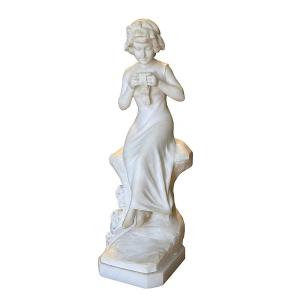
Giuseppe Gambogi (pisa, 1862 – Florence, 1938), Reclining Female Figure, 1900
Giuseppe Gambogi (Pisa, 1862 – Florence, 1938)
Reclining Female Figure, 1900
Alabaster, 25 x 15 x 21 cm
Signed on the side: G. Gambogi
Giuseppe Gambogi (Pisa, 1862 – Florence, 1938) was a refined Italian sculptor and a leading figure in the field of decorative and figurative sculpture at the turn of the 19th and 20th centuries. Trained in Tuscany, Gambogi soon moved his practice to Florence, establishing a renowned studio-workshop on Via Cimarosa, in the San Jacopino neighborhood. In this studio, where he was joined over the years by his sons Mario and Gastone, the artist produced a prolific and versatile body of work that resonated with the tastes of the upper middle class of the time and captured a vast international collectors’ market, particularly in the Anglo-Saxon and American worlds. Gambogi’s sculptural language lies at the intersection of Umbertine-era Verismo, Romantic-Orientalist sensibilities, and the sinuous allure of Art Nouveau. His stylistic signature is distinguished by extraordinary technical skill in working with fine materials, primarily Carrara marble, bronze, and—above all—sculptural alabaster, which he masterfully carved to achieve patinated surfaces, effects of translucency, and delicate play of light. Among his best-known works are both pieces with historical and literary themes—such as the famous relief *The Meeting of Dante and Beatrice* or the moving *Bust of Gemma Mugnai* (1898)—as well as allegorical figures and works set in exotic settings, such as *Salomé*, Cleopatra, and the *Allegory of Music*, in which narrative gives way to a decorative style rich in sensual charm and stylistic refinement. The female figure undoubtedly holds a place of paramount importance within his body of work, serving as the preferred subject through which Gambogi best expressed the transition toward fin-de-siècle taste and Art Nouveau. Gambogi’s women are not merely ideal muses or sugarcoated academic figures, but embody the aesthetic of the dreamy, languid, and self-aware femininity typical of the early 20th century. The alabaster sculpture analyzed here, signed by the artist on the side, is an emblematic example of this poetic and artistic style. Created approximately between 1900 and 1910, the work depicts a young woman captured in a moment of intimate relaxation, reclining naturally on an upholstered armchair. The figure surrenders to a gentle stretch, bringing her arms back behind her head in a pose of classical sensuality that highlights the three-dimensionality of the carved block. The artist demonstrates a masterful command of alabaster: the surface feels almost silky to the touch, and the stone’s natural veining accentuates the chiaroscuro and the depth of the forms. The light, form-fitting gown delicately emphasizes the body’s contours, transforming the drapery into a fluid rhythm that guides the viewer’s gaze along her crossed legs down to her bare feet. With this work, Giuseppe Gambogi succeeds in transforming the heaviness of the stone into a sense of extreme lightness, weaving the legacy of Tuscan Verismo into the sophisticated elegance of European Art Nouveau.
Period: 20th century
Style: Other Style
Condition: Good condition
Material: Marble
Width: 15
Height: 25
Depth: 21
Reference (ID): 1861048
Availability: In stock