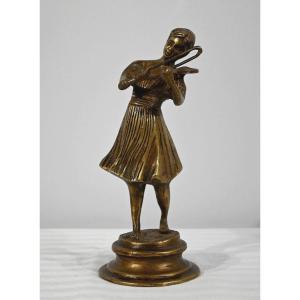
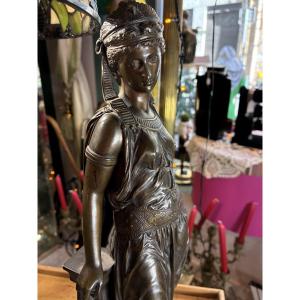
Joan Of Arc's Oath
Height:approx. 14 cm
Width: approx. 7 cm
Terrace:approx. 4.3 x 4 cm
Weight:463 g
Unsigned
Aheroine for the Royalists of the July Monarchy, as well as for the Republicans of the 1880s and 1890s, the figure of Joan of Arc flourished in literature, sculpture, painting, and music alike. On June 10, 1837, King Louis-Philippe grandly inaugurated, at the Palace of Versailles, the galleries dedicated to all the glories of France, where, incidentally, the sculpture *Jeanne in Prayer*, by his
daughter, Princess Marie d’Orléans, was prominently displayed.
This momentum continued under the Third Republic, which sought to establish its legitimacy and strengthen nationalism, which had been undermined by the war of 1870 and the loss of Alsace and Lorraine. Joan of Arc featured prominently in school textbooks. In 1874, the Republic’s first commemorative monument to the national heroine—a breathtaking equestrian statue by Emmanuel FREMIET—was unveiled at Place des Pyramides. In 1896, President Félix FAURE unveiled, on the forecourt of the
Reims Cathedral—but with his back to the cathedral—the equestrian statue of Joan of Arc by Paul DUBOIS.
DFor its part, the Church took action. In 1855, Monsignor DUPANLOUP, the Bishop of Orléans, deeply moved by the accounts of Joan of Arc’s trial published by the historian Jules QUICHERAT, was convinced that the young heroine could only have acted by the will of God. In 1869, he asked Pope Pius IX to initiate her canonization process, which would culminate more than 50 years later, in 1894, when she was declared Venerable.
CIt was amid this fervor surrounding Joan that many sculptors succumbed to the craze. Our unknown sculptor could not resist and presents us with a Joan who is as much a warrior as she is a woman of faith. Clad in armor, she raises her sword toward Heaven, which inspires her and guides her actions. The inscription on the terrace reinforces this dual identification of Joan of Arc with “God and France.”
This depiction of Joan—whether as a warrior, on horseback or not, wearing a helmet or not, clad in armor, sword in hand—owed much to the works of Marie d’Orléans, Henry SCHEFFER, Jean-Auguste Ingres, and François Rude: a warrior Joan of Arc, protector of the nation.
© Copyright Les Trésors de Gamaliel: texts and photos
Period: 20th century
Style: Other Style
Condition: Condition of use
Width: 7
Height: 14
Depth: 4
Reference (ID): 1858011
Availability: In stock