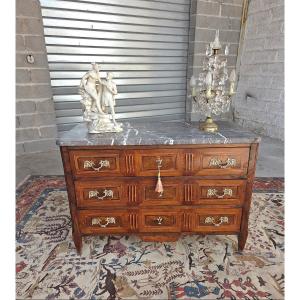
Demi-lune Commode By Jacques-pierre Letellier And André-louis Gilbert, Louis XVI Period
Artist: Jacques-pierre Letellier Et André-louis Gilbert
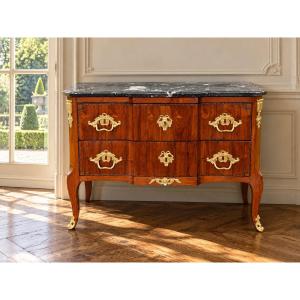
An elegant Louis XVI-period demi-lune commode, stamped twice by J.P. LETELLIER and bearing the JME (Jurande des Menuisiers-Ébénistes) hallmark; the piece was likely created in collaboration with André Louis Gilbert.
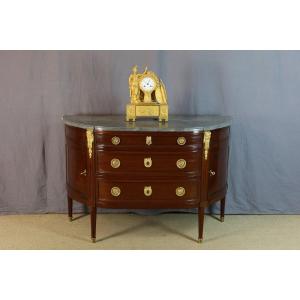
Well-proportioned and executed with exceptional care, the commode features a curved front with two large, seamless drawers, concealing the horizontal rail between them. It rests on four tapered legs, decorated with simulated fluting and finished with gilt-bronze sabots. The piece is finely crafted, featuring veneers of stained sycamore, fruitwood, and rosewood. These compositions are defined by rich geometric borders of rosewood and kingwood, accented by boxwood stringing.
The front is adorned with a remarkable figurative marquetry scene depicting an architectural landscape. Set against a background of green-stained sycamore, the design features trees with delicately rendered silhouettes, alongside various buildings, ruins, and structures incorporating columns. The lower section includes smaller buildings and landscape elements, creating a scene that is both picturesque and masterfully composed.
The two sides feature doors with symmetrical decoration, each centered on a landscape panel framed by a geometric border. Here, ruined structures appear alongside trees with finely detailed foliage, maintaining a stylistic continuity with the decoration on the front. Each door opens with a key to reveal an interior compartment divided by a single shelf.
The piece is topped with a white, veined marble slab featuring a cavetto-molded edge that perfectly follows the demi-lune shape of the furniture.
The commode is adorned with gilt-bronze mounts that complete the design, including pull rings, keyhole escutcheons, drawer pulls, feet mounts,corner mounts, and frames for the decorative panels. These bronzes, arranged with precision, accentuate the architectural lines of the piece and clarify the distinction between its various registers.
While the maker’s stamp identifies Jacques-Pierre Letellier, the nature and quality of the marquetry suggest a connection to the work of André-Louis Gilbert (1746–1809), who was admitted as a master craftsman in Paris on July 20, 1774.
Gilbert is particularly renowned for his compositions featuring architectural landscapes, such as ancient ruins, colonnades, temples, buildings, and cityscapes, often enlivened by the inclusion of trees and botanical motifs.
These decorative elements, which are characteristic of his oeuvre, serve as a true stylistic signature and can be found on several other commodes and secretaires attributed to him.
It is therefore highly probable that Letellier and Gilbert collaborated on the creation of this piece, particularly regarding the marquetry panels.
This collaboration is consistent with the practices of 18th-century Parisian workshops.
The creation of a piece of furniture often involved several specialized craftsmen: the cabinetmaker was responsible for the design, construction, and assembly, while specialized marquetry artists might produce figurative panels to be integrated into the piece. Such compositions could also be supplied to other cabinetmakers or "marchands-merciers" .
The presence of decorative elements highly characteristic of Gilbert on furniture bearing the stamp of other masters can be explained by this specific organization of labor. It does not necessarily imply a permanent partnership between the two craftsmen, but rather reflects the circulation of expertise and specialized components within the Parisian trade.
In this instance, the stylistic consistency of the landscapes, their architectural treatment, and the high quality of their execution strongly support the hypothesis that André Louis Gilbert was involved. The stamp of Letellier identifies the master cabinetmaker under whose direction the piece was crafted, or the "marchand-mercier" through whom it was sold.
Parisian work, Louis XVI period,
Stamped twice "J.P. LETELLIER" and bearing the "JME" hallmark,
in collaboration with André Louis Gilbert.
Dimensions: H 84 cm x W 98.5 cm x D 49 cm
22 000 €
Period: 18th century
Style: Louis 16th, Directory
Condition: Excellent condition
Material: Wood marquetry
Length: 98,5
Height: 84
Depth: 49
Reference (ID): 1857346
Availability: In stock
Print