

Counts Of Oultremont-ysebrant, 12 Table Knives, Solid Silver, Belgium, Circa 1780–1830
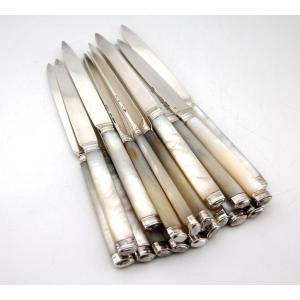
Set of twelve solid silver dessert knives bearing the alliance arms of the d’Oultremont and Ysebrant de Difque families
Brussels, late 18th – early 19th century.
Alliance arms, circa 1888.
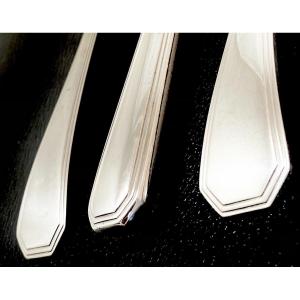
An elegant set of twelve dessert knives entirely made of solid silver, including both the handles and the blades. The elongated handles, slightly rounded at their terminals, are decorated with fine longitudinal fluting and fitted with reeded collars. The long, tapering silver blades display the characteristic profile of dessert knives of the late 18th and early 19th centuries.
These knives originally formed part of an extensive silver flatware service, several pieces of which bore the hallmarks of the Brussels silversmiths’ guild dating from the late 18th century, while others carried Brussels assay marks from the early 19th century. Although the knives themselves are unmarked, their provenance and distinctive design firmly place them within this period of production.
Each of the twelve blades and each of the twelve handles has been individually tested, confirming that all are made of solid silver.
The alliance arms
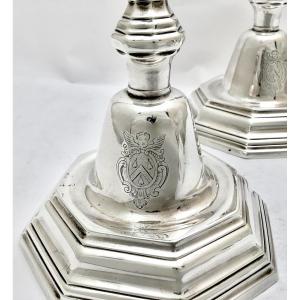
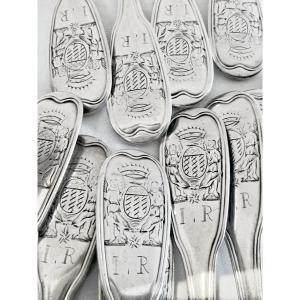
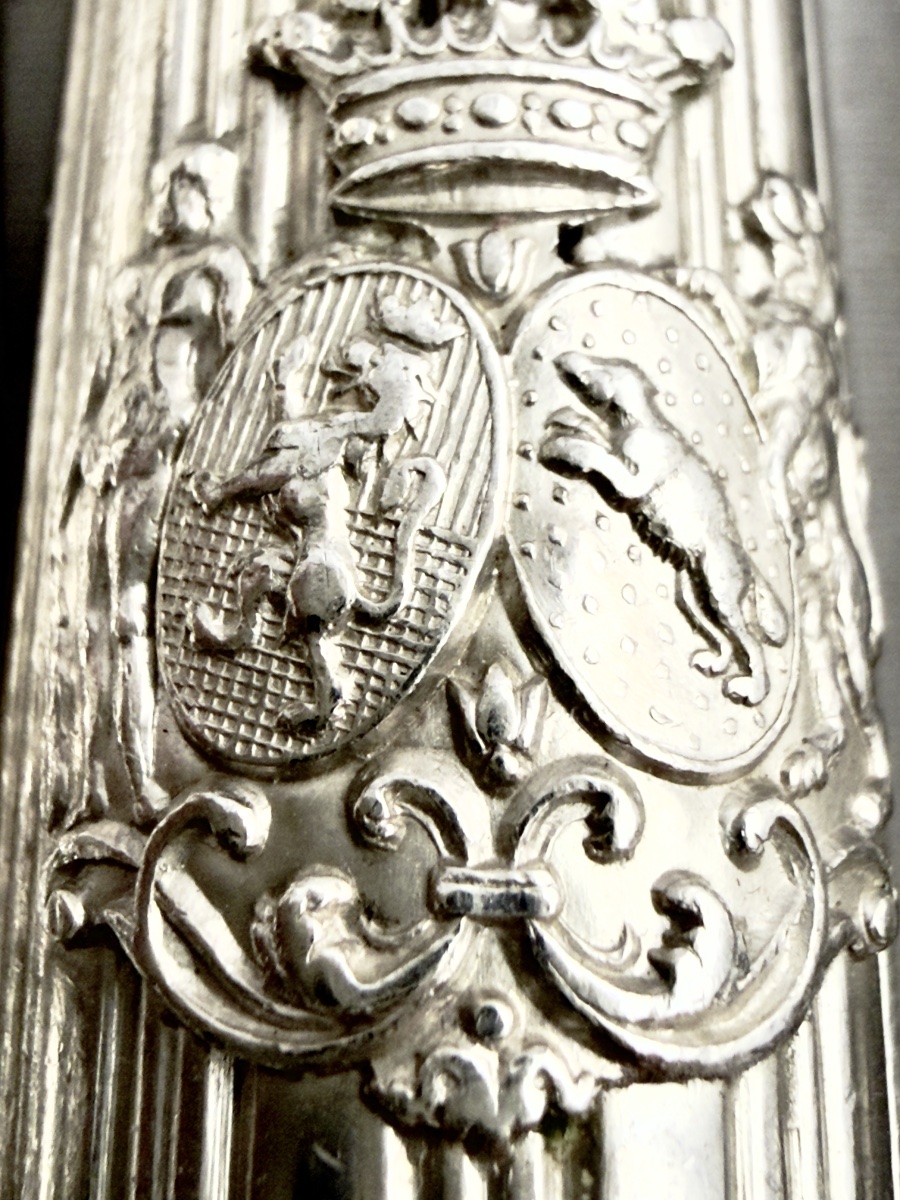
Of particular interest are the beautifully executed solid silver alliance arms adorning each handle. Finely worked in relief, they consist of two adjoining oval shields surmounted by a count’s coronet with five fleurons.
To dexter are the arms of the d’Oultremont family: per fess gules and sable, a lion rampant argent overall, armed, langued and crowned or.
To sinister are the arms of the Ysebrant family: or, a beaver salient bendwise proper.
The heraldic tinctures are represented according to traditional heraldic conventions: vertical hatching for gules, cross-hatching for sable and stippling for or.
These coats of arms, separately fashioned and applied to the handles, postdate the manufacture of the knives. They almost certainly commemorate the marriage celebrated in Brussels on 26 April 1888 between Count Frédéric d’Oultremont (1864–1903) and Émilie Ysebrant de Difque (1864–1895).
They thus provide a fine example of the transmission of silverware within prominent aristocratic families, where inherited pieces were frequently personalised with the arms of their new owners on the occasion of a marriage.
The d’Oultremont family
Descended from the ancient lords of Warnant, in the Hesbaye region near Liège, the House of d’Oultremont ranks among the oldest families of the Belgian nobility. Its documented lineage dates back to the 14th century.
Under the Ancien Régime, members of the family held important civil, military and ecclesiastical positions within the Prince-Bishopric of Liège. On 25 February 1731, Emperor Charles VI granted the family the title of Count of the Holy Roman Empire, hereditary among all legitimate descendants.
One of the most distinguished representatives of the family was Charles-Nicolas d’Oultremont (1716–1771), Prince-Bishop of Liège from 1764 until 1771.
During the 19th century, several members of the family held prominent positions at the royal court, in the military, diplomacy and Belgian political life. The castles of Warfusée and Wégimont are among the great historic residences associated with the family, whose motto is Nobilitas virtute nititur — Nobility rests upon virtue.
The Ysebrant de Difque family
The Ysebrant family likewise belongs to the ancient nobility of the Southern Netherlands. Historically established in the Land of Waas, the family numbered among its members bailiffs, magistrates and landed seigneurs.
In 1729, Pierre Jacques Emmanuel Ysebrant held the office of high alderman of the Land of Waas. Over successive generations, members of the family also settled in Ghent, Mons, Tournai and Brussels.
The Ysebrant de Difque and Ysebrant de Lendonck branches share the same heraldic emblem, the beaver, which has long been documented in the family’s armorial records.
Émilie Ysebrant de Difque was the daughter of Jules Ysebrant de Difque and Eulalie de la Coste, and the granddaughter of Charles Idesbald Ysebrant de Difque, Viscount of Hérinnes.
The marriage of 1888
Count Frédéric d’Oultremont, son of Count Émile d’Oultremont and Baroness Juliette Tahon de la Motte, married Émilie Ysebrant de Difque in Brussels on 26 April 1888.
Their only son, Count Alain d’Oultremont (1889–1890), died in infancy. Émilie died in 1895, aged thirty-one, and her husband in 1903. Their marriage consequently left no surviving descendants.
Remarkably, the two families renewed their alliance nearly seventy years later through two marriages celebrated within a few months of one another: that of Count Roland d’Oultremont to Chantal Ysebrant de Lendonck in 1954, followed by that of his brother, Count Jean-Pierre d’Oultremont, to Auriane Ysebrant de Lendonck in 1955.
This set of twelve dessert knives constitutes a remarkable example of Brussels silverware from the transitional period between the Ancien Régime and the 19th century, enhanced by exceptionally fine alliance arms that lend it a particularly distinguished Belgian aristocratic provenance.
Historical and genealogical references
- Jean-François Houtart, Anciennes familles de Belgique, Association royale Office généalogique et héraldique de Belgique, 2008.
- Annalen van den Oudheidkundigen Kring van het Land van Waas, vol. I, p. 94, concerning the history and heraldic arms of the Ysebrant family.
- Genealogical records of the House of d’Oultremont, particularly the branch descended from Count Émile d’Oultremont.
Period: 18th century
Style: Louis 16th, Directory
Condition: Excellent condition
Material: Sterling silver
Reference (ID): 1856881
Availability: In stock