

Bruges 1831–1847, Pair Of Salt Shakers, Philippe Mys, Solid Silver
Pair of solid silver salt cellars – Philippus Bellarminus Mys – Bruges, 1831–1847
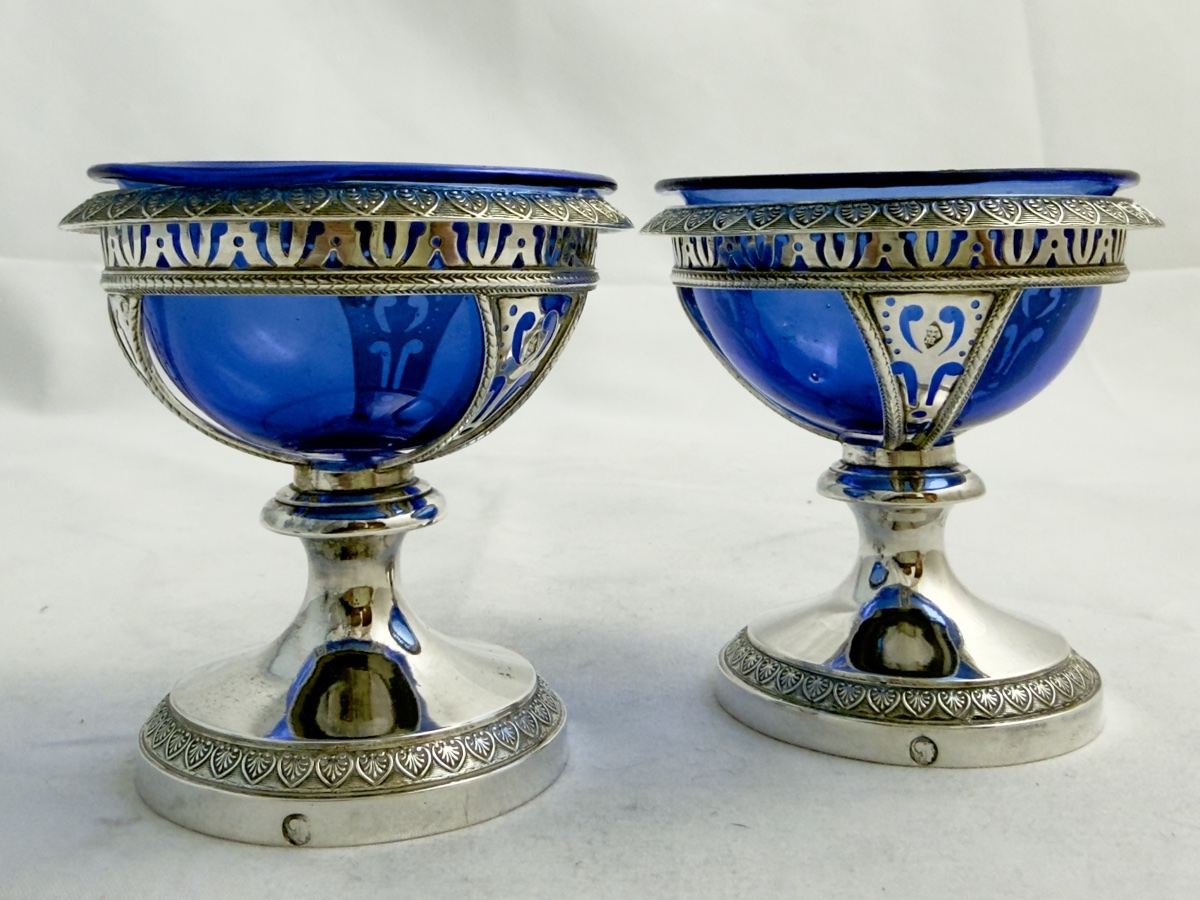
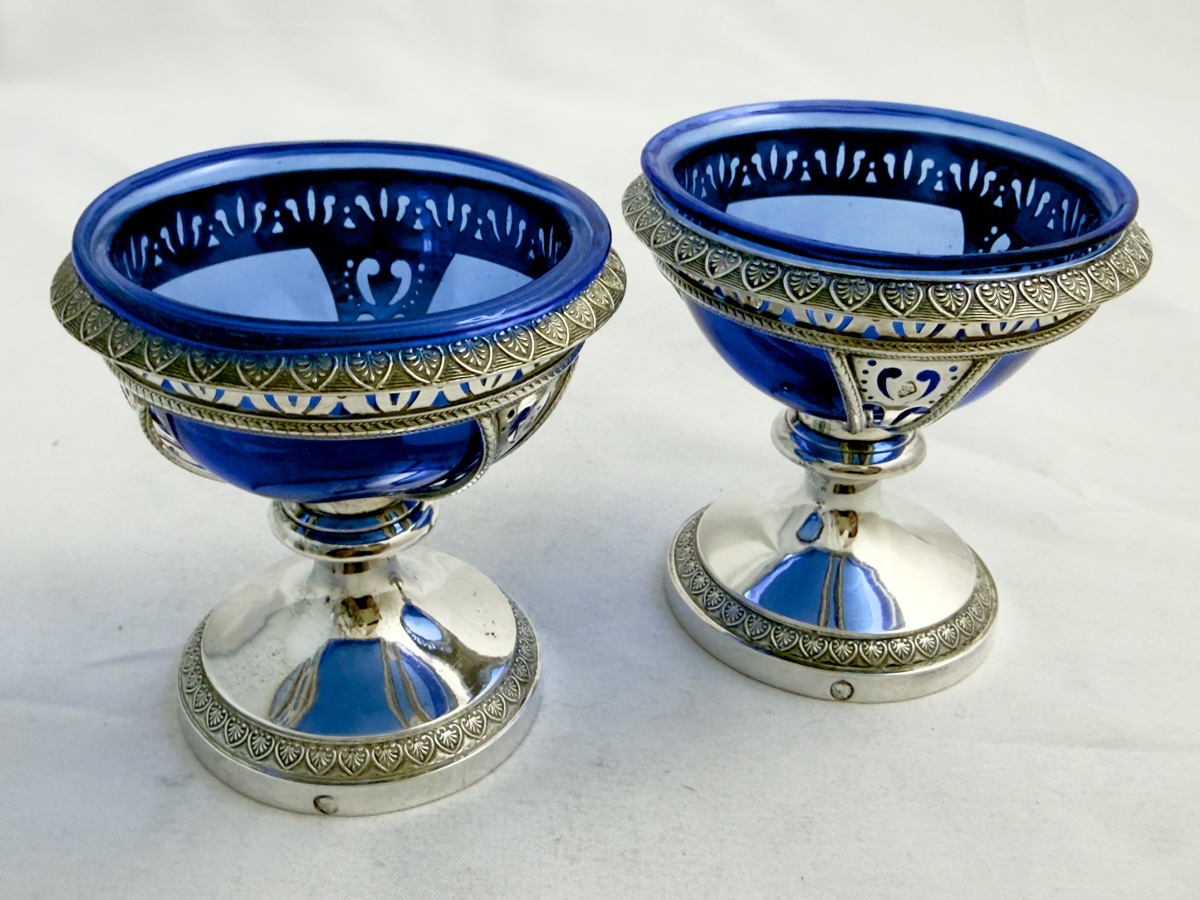
An elegant pair of salt cellars in solid silver and cobalt blue glass, crafted in Bruges by silversmith Philippus Bellarminus Marianus Mys (1759–1847).
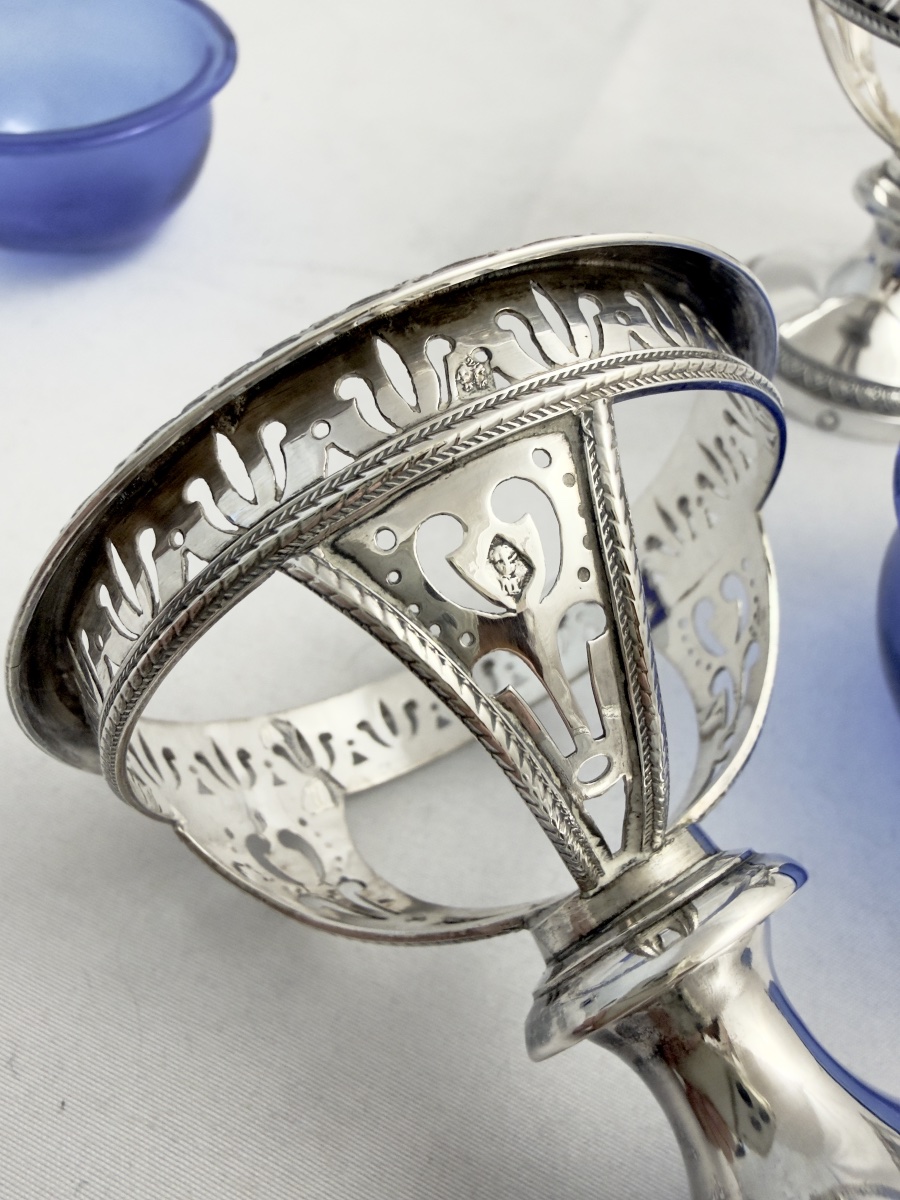
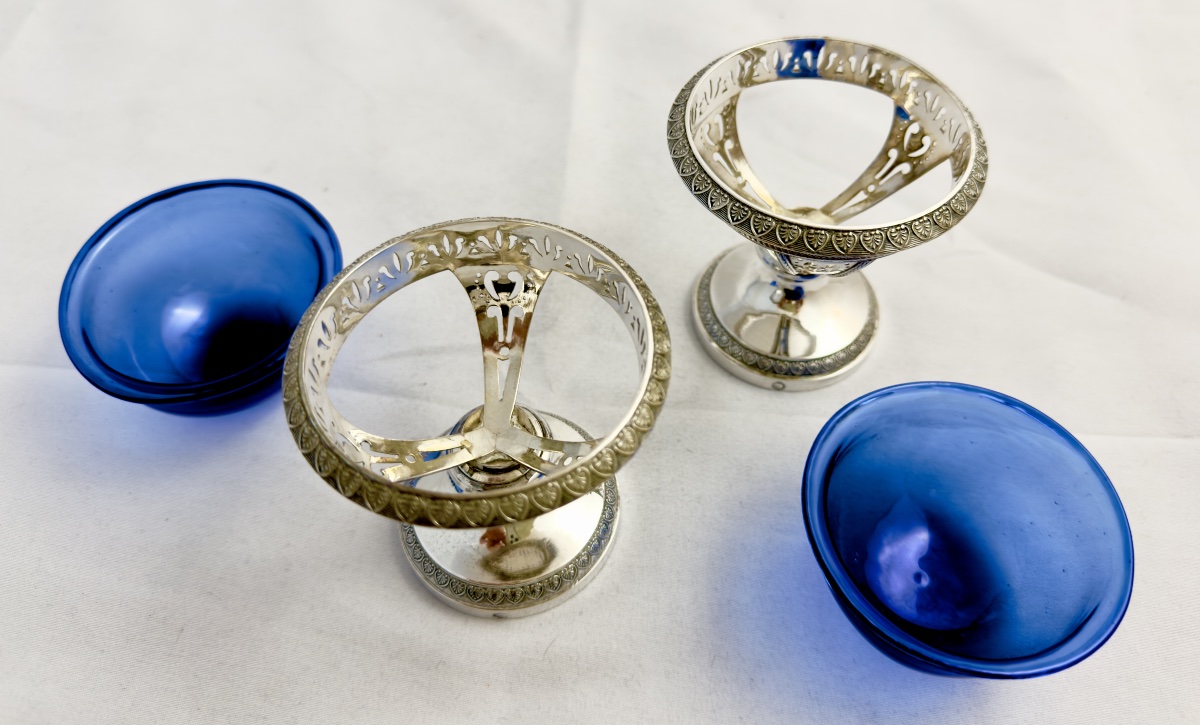
The finely openwork silver mounts hold removable cobalt-blue glass bowls. The decoration combines palmettes, stylized plant motifs, and gadrooned friezes, drawing on an ornamental repertoire inherited from Neoclassicism. The contrast between the blue glass and the luster of the silver particularly highlights the delicacy of the openwork.
This pair of salt shakers matches the mustard pot featured later in our catalog, crafted by the same silversmith during the preceding period. This connection attests to the continuity of designs within his workshop, both before and after Belgium’s independence.
The silversmith Philippus Bellarminus Marianus Mys (1759–1847)
Born in Oudenaarde on January 26, 1759, Philippus Mys—also spelled Meys—began his apprenticeship in 1772 with the silversmith Joannes Benedictus Van der Meersch.
He then continued his training in Paris, where he worked as a journeyman for Antoine Boullier, goldsmith to the Duke of Orléans. In a certificate dated November 2, 1788, the latter highlighted Mys’s exceptional qualities, describing him as “highly distinguished in his art” and capable of executing even the most difficult pieces with ease and success, in both goldsmithing and jewelry making.
After becoming a master goldsmith in Bruges in 1789, he established his workshop on Steenstraat, in a house known as “Amsterdam.”
The tax records from 1819, 1825, 1830, and 1835, in which he is listed as a Category 8B manufacturer, confirm his status as the most important Bruges goldsmith of the first half of the 19th century.
His son, Philippus Petrus Mys (1801–1881), worked with him before taking over the family business. Many of Philippus Mys’s works are now preserved in church treasuries and private collections.
He died in Bruges on February 15, 1847.
Hallmarks and Dating
The salt shakers bear the hallmark of the Bruges Assay Office for the period 1831–1868, as well as the maker’s mark of Philippus Bellarminus Mys, consisting of the letter M surmounted by a child’s head, inscribed within a diamond.
The silversmith’s death in 1847 allows us to date their production precisely to between 1831 and 1847.
Characteristics
Origin: Bruges, Belgium
Silversmith: Philippus Bellarminus Marianus Mys (1759–1847)
Date: 1831–1847
Material: solid silver and cobalt blue glass
Bibliography: biographical entry on Philippus Bellarminus Marianus Mys, no. 65, pp. 61–64, hallmark reproduced in figure 33; A. Vandewalle, 1993, no. 456.
Period: 19th century
Style: Consulat, Empire
Condition: Excellent condition
Material: Sterling silver
Diameter: 8 cm
Height: 7,5 cm
Reference (ID): 1856484
Availability: In stock