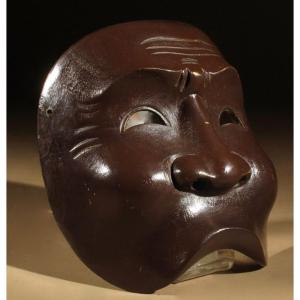
Waka Onna Noh Mask By Ogawa Kendo
Artist: Ogawa Gendo
Waka-onna* mask by Ogawa Gendō, complete with its storage bag and box.
Ogawa Gendō (was a master carver of Japanese Nō masks, active during the mid-20th century.
He belongs to a highly respected artistic lineage, having been a student of Nagasawa Ujiharu —a legendary craftsman designated a "Living National Treasure" in Japan for his expertise in the creation of Nō masks (*noh-men*). Working within the carving tradition associated with Nagasawa Ujiharu, Ogawa Gendō upheld the rigorous, traditional techniques dating back to the Muromachi period.
As a mentor, he notably trained the renowned contemporary mask artist Yamaguchi Hiroki (known by the artist name "Bidou"), whom he took under his wing in the early 1990s after recognizing his early talent.
His work: Masks carved by Ogawa Gendō are highly sought after by collectors of Japanese art for their refinement and their absolute adherence to classical aesthetic canons. His creations include masks of young women, characterized by a pure and idealized beauty.
These masks are traditionally hand-carved from a single block of Japanese cypress (*hinoki*) and finished with successive layers of natural pigments mixed with powdered seashell (*gofun*). Authentic pieces bear his signature—either branded or carved—on the reverse side and are frequently accompanied by their original wooden storage box (*tomobako*). As a traditional 20th-century artisan working within a quiet, niche field, biographical details regarding Ogawa Gendō (小川弦堂) remain poorly documented in both Western and Japanese public sources. Date of birth: His exact date of birth is not publicly recorded. Based on his artistic timeline—notably the period when he took the sculptor Bidou Yamaguchi under his wing in the very early 1990s—it is known that he was born in the first half of the 20th century, most likely between the 1920s and 1940s.
Other names: In keeping with the tradition of Japanese master artisans (*shokunin*), "Gendō" (弦堂) is not his birth name, but rather an artist name (*gō*) or studio name. He either adopted this name or was granted it upon achieving mastery of his craft under the tutelage of Nagasawa Ujiharu. His legal birth name is not disclosed commercially; his works are exclusively signed and authenticated under his professional name, Ogawa Gendō.
Ogawa Gendō’s technique for applying patina and color is rooted directly in the teachings of his master, Nagasawa Ujiharu, who was renowned for his exceptional skill in rendering skin tones and giving masks an antique appearance.
In Noh theater, the final patina (*koshoku*) serves a purpose beyond mere embellishment; it imparts spiritual depth to the mask and allows shadows to come alive under stage lighting. The traditional process employed by Ogawa Gendō to achieve this unique patina involves several meticulous stages:
1. Preparation of the base (Gofun): Before any patina is applied, the cypress wood (*hinoki*) receives an essential foundation: dozens of layers of *gofun*—a fine white powder derived from crushed oyster shells—mixed with *nikawa* (animal-hide glue). Each layer is sanded repeatedly until the surface achieves an absolute, porcelain-like smoothness.
2. Artificial aging (*Koshoku-zuke*): To prevent a new mask from having an overly stark or modern white sheen, Ogawa Gendō utilized an ancestral aging technique: Natural pigments: The base skin tone is created using traditional pigments (*gansai*) diluted in water. Smoke and soot patina: To impart the "antique" and sacred quality characteristic of aged pieces, artisans use charcoal soot, fine incense dust, or even a mixture of brewed green tea and glue. Application by dabbing: This dark solution is delicately applied with a brush or dabbed on with a cloth, then partially wiped away so that it settles realistically into the crevices of wrinkles, the corners of the mouth, and the contours of the eyes.
Fixing and treating the reverse side: The back of the mask: To protect the wood from moisture and the actors' perspiration, the reverse side of the mask undergoes a heat treatment—being lightly singed over a candle—and is then sealed with traditional *Urushi* lacquer or wax. Surface finish: The patina on the front of the mask is sometimes set with a very light veil of wax, or otherwise left matte, depending on the character being portrayed (masks representing young women remain smoother and more matte, while those of demons or elderly figures feature much sharper contrasts). This alchemy—combining mineral pigments, animal glue, and the meticulous wiping away of soot—gives Ogawa Gendō’s masks a "living" skin-like texture, capable of shifting from joy to...
1 400 €
Period: 20th century
Style: Asian art
Condition: Good condition
Material: Painted wood
Height: 21 cm
Reference (ID): 1855254
Availability: In stock
Print