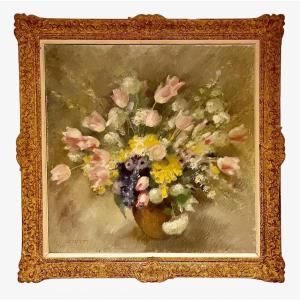
Horace Richebé (1871–1964), Still Life With Flowers
Still Life with Flowers
Oil on panel, signed lower right
Dimensions: 67 x 47 cm
Dimensions with frame: 83 x 63 cm
Note that the work is composed of two wooden panels, which explains the small horizontal mark running across the work (barely visible). I have noticed that he uses this technique in other works.
Probably a former exhibition label on the back of the antique gilded wooden frame: No. 968
Artist’s biography:
Horace Charles Richebé was a French painter born in Algiers in 1871. He began his artistic training at the École des Beaux-Arts in Marseille before continuing his studies in Paris, where he became a student of the famous academic painter Jean-Léon Gérôme. This classical training gave him a solid mastery of drawing and composition, which he would gradually develop into a freer and more personal style of painting.
In 1901, he entered the Prix de Rome competition. He then pursued his career in the south of France, while regularly participating in major art events in Paris. In particular, he took part in the Colonial Exhibition in Marseille in 1906–1907 and became a member of the Salon des Artistes Français in 1907. His work quickly gained recognition: he received an honorable mention in 1907, a third-class medal in 1910, and then a gold medal in 1924—a major achievement in his career.
An artist with a diverse range of subjects, Horace Richebé was as interested in Provençal landscapes and harbor scenes as he was in floral arrangements, portraits, and Orientalist subjects. His stays in and deep attachment to the Mediterranean region fueled a body of work in which light and color play an essential role. His views of the port of Marseille, his landscapes of the Midi, and his floral arrangements reveal a particular sensitivity to atmosphere and chromatic effects.
In 1924, his career took on a new dimension when he was appointed director of the École des Beaux-Arts and curator of the museums in Arles, notably the Musée Réattu. This position attested to the institutional recognition he enjoyed at the time. He was made a Knight of the Legion of Honor in 1926.
After several decades devoted to painting and the artistic life of Provence, Richebé settled permanently in Nice in 1950, where he continued his work until the end of his life.
Analysis of the work:
The work is characterized by a fairly free style and a generous brushstroke. The painter works with small, thick brushstrokes—sometimes almost juxtaposed—to suggest the petals rather than depict them in minute detail. Whites, pinks, reds, and mauves blend with the more muted tones of the foliage.
The bouquet is built around a balance between warm and cool colors. The dark background plays an essential role: it lends depth to the composition and brings out the luminosity of the flowers.
The treatment of the vase and the table is also particularly noteworthy. The impasto is visible, especially in the depiction of the wood, where the horizontal brushstrokes lend a certain materiality to the surface.
The work as a whole reflects a style of painting that is, above all, focused on texture, color, and the spontaneity of execution.
Period: 20th century
Style: Other Style
Condition: Good condition
Material: Oil painting on wood
Width: 47
Height: 67
Reference (ID): 1855049
Availability: In stock