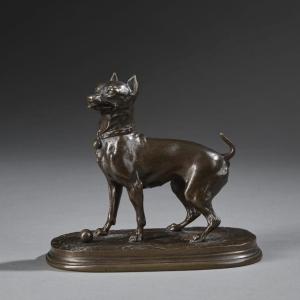
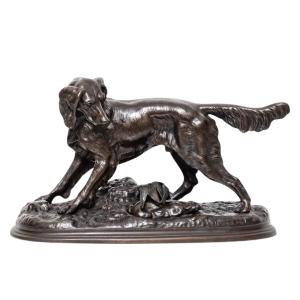
Large Bronze Stag By Antoine-louis Barye
Artist: Antoine-louis Barye
An imposing bronze sculpture, representing a "Standing Stag" (*Cerf Debout*), by the sculptor Antoine-Louis Barye (1795–1875).Through this work, the sculptor highlights the majestic and imposing nature of the stag.The bronze is signed "BARYE" (incised) on a richly chased and detailed naturalistic base.It bears the foundry stamp "Susse Frères Editeurs Paris" and the foundry signature "Susse Frères EDT."In perfect condition.Antoine-Louis Barye was the greatest animal sculptor of the 19th century and a major figure in French Romanticism. The son of a goldsmith—trained in metalworking before turning to sculpture—he established the animal as a subject in its own right, equal to the human figure, and made anatomical observation the foundation of his art. His career, which spanned nearly half a century, is also closely linked to the history of commercial bronze casting; Barye was one of the first sculptors to take on the production and marketing of his own models. Born in Paris on September 24, 1795, into a modest family of jewelers, Antoine-Louis Barye was the son of Pierre Barye, who descended from a line of goldsmiths from Lyon and practiced the trade himself. At the age of thirteen, the boy was apprenticed to Fourier, a metal engraver who produced military equipment; there, he learned the arts of engraving, chasing, and *repoussé*. His apprenticeship was interrupted by conscription. In 1812, the Empire called for men; Barye was conscripted into the topographical brigade of the Engineering Corps, and subsequently into the second battalion of sappers. Demobilized on March 30, 1814—having just turned eighteen—he returned to the Fourier workshop. His calling soon began to take clear shape. In 1816, he entered the studio of François-Joseph Bosio—official sculptor to both Napoleon I and later Louis XVIII—to study modeling, while simultaneously receiving instruction in drawing from the painter Antoine-Jean Gros. He was admitted to the École des Beaux-Arts in 1818. After an unsuccessful attempt to win the Prix de Rome, he left the school without the prize and, in 1823, joined the workshop of the goldsmith Jacques-Henri Fauconnier, where he would remain for eight years. This period proved decisive: it was here that Barye modeled animals for use in goldsmithing, gaining an intimate understanding of casting and chasing techniques—a skill set that would distinguish him throughout his career from sculptors trained exclusively in working with marble.
3 600 €
Period: 19th century
Style: Napoleon 3rd
Condition: Excellent condition
Material: Bronze
Length: 47
Width: 19
Height: 48
Reference (ID): 1853071
Availability: In stock
Print