16th-century Nobleman's Cinquedea
16th-Century Nobleman’s Cinquedea
This is one of the newest pieces in the collection. The cinquedea is among the rarest daggers, due to a production period limited to a single century, roughly from 1450 to 1550.
This dagger is particularly rare, reflecting its exceptional craftsmanship, which suggests it was made for a nobleman; it also bears references to Charles V, Holy Roman Emperor, and his son, Philip II of Spain. The connection to this illustrious royal family cannot be overlooked, as Charles V, Holy Roman Emperor, nearly unified most of Europe. Emperor of the Holy Roman Empire and Archduke of Austria from 1519 to 1556, King of Spain (Castile and Aragon) from 1516 to 1556, and Lord of the Netherlands as titular Duke of Burgundy from 1506 to 1555, he stood at the head of the rapidly rising House of Habsburg during the first half of the 16th century. His European domains encompassed the Holy Roman Empire—stretching from Germany to northern Italy, with direct authority over the hereditary Austrian lands and the Burgundian Netherlands—as well as the Kingdom of Spain, including its possessions in southern Italy: Naples, Sicily, and Sardinia. Furthermore, he oversaw both the continuation of Spanish colonization of the Americas and the brief attempt at German colonization. The personal union of European and American territories under Charles V constituted the first collection of kingdoms described as “an empire on which the sun never sets.”
Charles V also spent a considerable amount of time in northern Italy, the region where this dagger was forged. The fact that it bears engravings of both a portrait of Charles V and the coat of arms of his son, Philip II of Spain, suggests that it may have belonged to the latter, or to a high-ranking official in his immediate entourage.
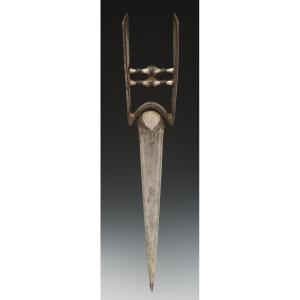
The hilt is characteristic of the “cinquedea” style, featuring curved iron quillons; its all-iron construction makes it an extremely rare piece, of which very few known examples exist. The entire piece is richly decorated with floral motifs and detailed engravings, depicting, in particular, battle scenes and other violent confrontations. The silver inlays on the pommel were likely added at a later date, during the object’s long history, most likely between the 18th and 19th centuries.
The blade, wide and designed for combat, features the multiple deep fuller grooves characteristic of this type of weapon; it is also richly engraved with battle scenes. The presence of impact marks, visible on both the cutting edge and the tip, adds an extra dimension to this piece.
Needless to say, this dagger... Its creation must have required a considerable financial investment, involving numerous artisans to produce the final product. It is hardly surprising that this dagger could have been used in combat, as the reign of Charles V was marked by numerous uprisings, offensives, and conflicts.
A truly exceptional work of art, worthy of a place in any museum.
References regarding the royal family:
https://en.wikipedia.org/wiki/Charles_V,_Holy_Roman_Emperor#Holy_Roman_Empire
https://en.wikipedia.org/wiki/Philip_II_of_Spain
Dimensions:
Total length: 59.2 cm
Blade: 44 cm
20 000 €
Period: 16th century
Style: Other Style
Condition: Good condition
Material: Metal
Length: 59.2 cm
Reference (ID): 1852515
Availability: In stock
Print