

Enameled Tile - Erotic Motif - China, C. 1900
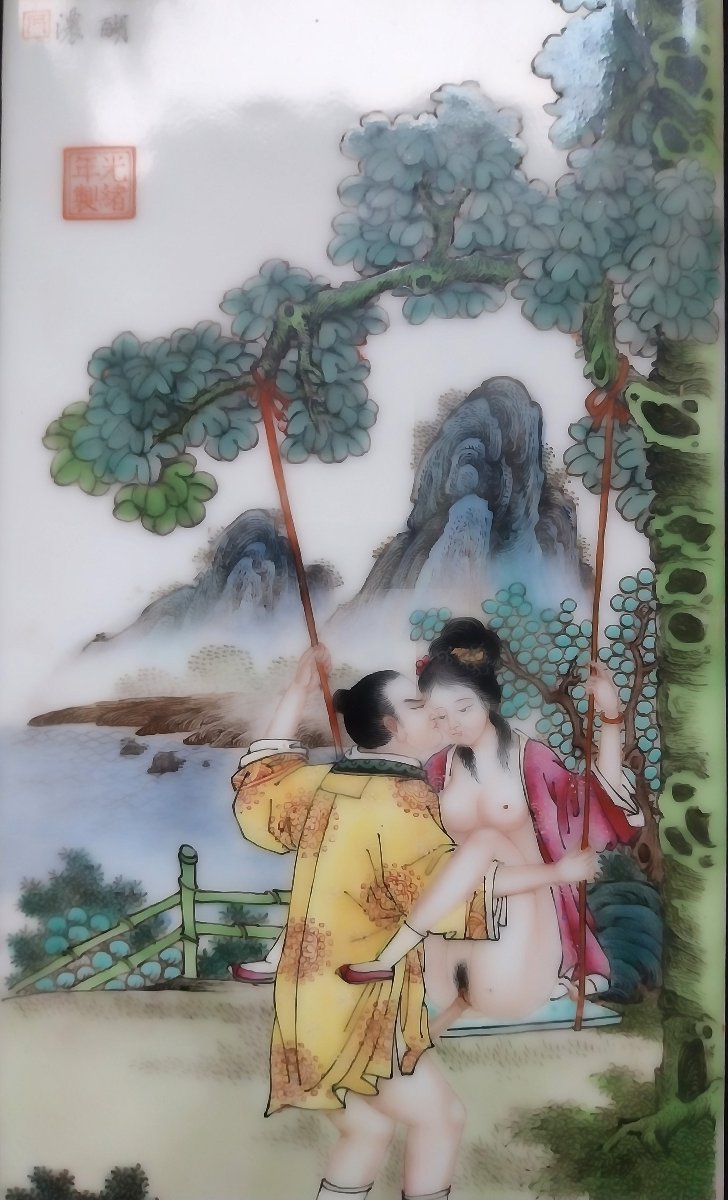
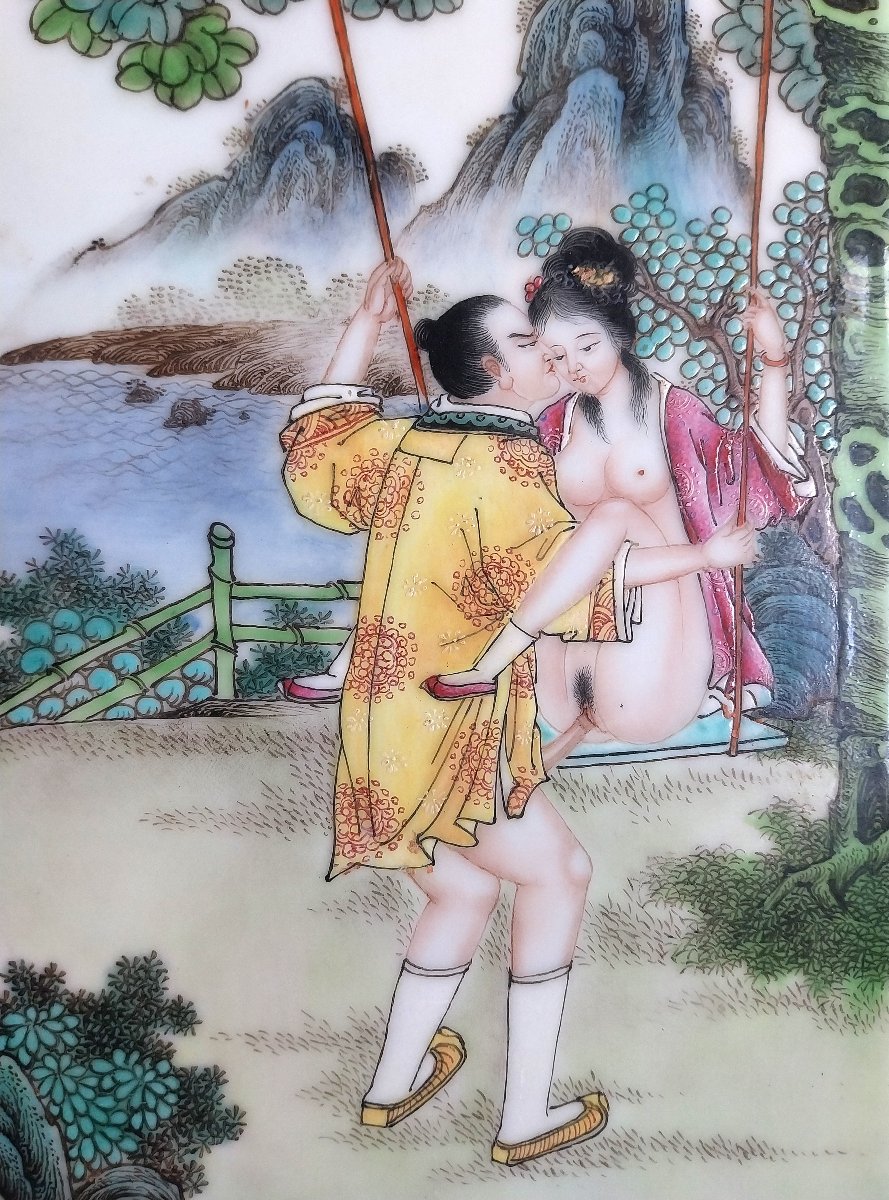
A faience plate decorated with polychrome enamels in the Famille Rose style. Pieces of this kind from the late Qing Dynasty (Guangxu period, as indicated by the red mark at the bottom left of the inscription) were sometimes intended for export or for private collections.
The scene draws inspiration from romantic and erotic themes in classical Chinese painting, here freely and boldly transposed onto a ceramic surface.
In Chinese romantic literature (chun gong tu or “spring paintings”), the back-and-forth motion of the swing is a traditional metaphor for the act of love. The inscription on the plaque (“Swinging on the swing, pleasure reaches its peak”) explicitly confirms this: this is an erotic code that has been established in Asia for centuries, long before Western artists adopted it.
The inscription reads from right to left and from top to bottom, divided into two columns:
Column 1 (right): 飮食男女...Transcription: Yǐn shí nán nǚ...Meaning: “Drinking, eating, man and woman” (a classical reference to Confucius’s Book of Rites, reminding us that food and sexual desire are part of fundamental human nature). The following characters evoke harmony and shared pleasure (similar to 愛融融 or 情意融).
Column 2 (left) : 搖蕩秋千興趣濃Transcription: Yáo dàng qiū qiān xìng qù nóngMeaning: “Swinging on the swing, pleasure and excitement are at their peak.” (A literal description of the scene depicted).
The large reign seal (red square seal) Located just below the text, this seal bearing four characters written in regular script (Kaishu) provides the date of the piece: Transcription: 「光緒年製」 (Guāngxù Nián Zhì) Meaning: “Made during the reign of Guangxu” (emperor of the Qing dynasty who reigned from 1875 to 1908). On erotic pieces from this period (circa 1900), this mark indicates the style of the era, although these objects were often produced on a semi-private basis or for export. .
Artist’s signature seals At the bottom of the two columns of text, two small red square seals can be seen, one below the other. They typically feature the name or studio of the painter (such as 「趣」 (Qù) and 「濃」 (Nóng) or a studio name associated with the pleasure and poetry of the scene).
2 500 €
Period: 19th century
Style: Asian art
Condition: Excellent condition
Material: Earthenware
Length: 41,5 cm
Width: 16 cm
Reference (ID): 1851912
Availability: In stock
Print