

Louis-auguste Lapito (1803–1874) The Painter In The Forest Of Fontainebleau
Artist: Louis-auguste Lapito
Louis-Auguste LAPITO
(Joinville-le-Pont, 1803 – Boulogne-Billancourt, 1874)
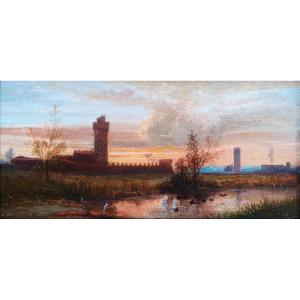
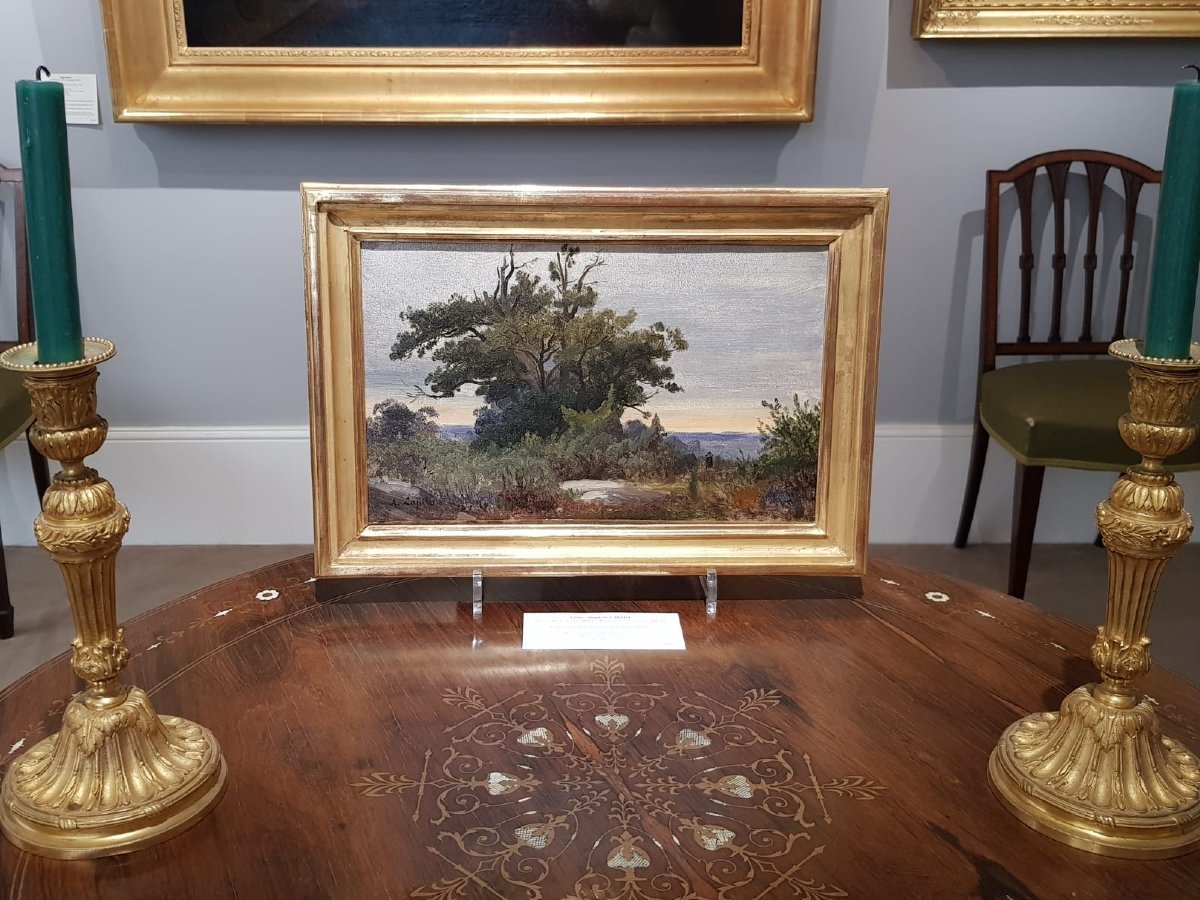
The Painter in the Forest of Fontainebleau
Oil on paper mounted on canvas
H. 21 cm; W. 34 cm
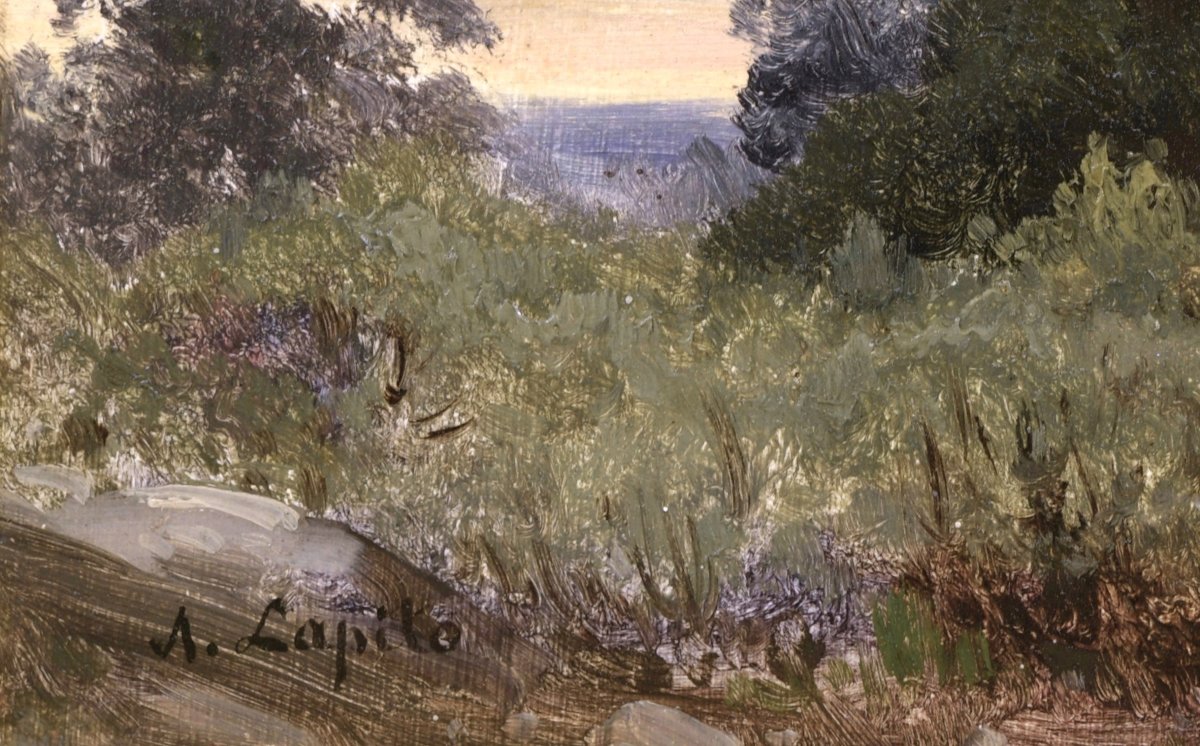
Signed lower left
Louis-Auguste Lapito belongs to the second generation of neoclassical landscape painters, influenced and trained by artists such as Valenciennes, Jean-Victor Bertin, and Louis-Étienne Watelet, but who would develop a more naturalistic sensibility, at times tinged with romanticism and the picturesque. This generation, led by Corot, included painters such as Caruelle d’Aligny, André Giroux, Guillaume Bodinier, Jules Coignet, Charles-Joseph Rémond, Léon Fleury, and Léopold Leprince—all of whom were generally born between 1795 and 1805.
These artists retained a lasting fascination with Italy, but were more inclined to travel and motivated by the discovery of new regions; Lapito thus visited numerous French provinces, with a particular fondness for the Dauphiné, Auvergne, Normandy, and Corsica, and abroad, the Netherlands, Germany, and especially Switzerland.
But they are also known for having been the first to visit the Forest of Fontainebleau in the very early 1820s, where they produced a significant body of work. Lapito depicted Fontainebleau throughout his career, with painted studies and works exhibited at the Salon in the 1830s, 1840s, and even during his final appearance in 1870.
A student of Watelet and the history painter François-Joseph Heim, Lapito enjoyed success throughout his career, winning several medals and having his works acquired by the state (purchases made by Louis-Philippe for the palaces of Saint-Cloud and Compiègne). He was equally adept at plein air painting and compositions refined in the studio—a result of his classical training—in both cases demonstrating a precise brushstroke and a very distinct sense of color. Among his many favorable reviews, one from the *Journal des Artistes* in 1838 stands out: “… Mr. Lapito continues to deserve acclaim… His drawing is always precise; despite a broad and effortless brushstroke, his subjects are always well chosen, and his color is generally true, though somewhat golden. Mr. Lapito’s works always stand out for their picturesque composition and the spirited manner in which they are executed… .”
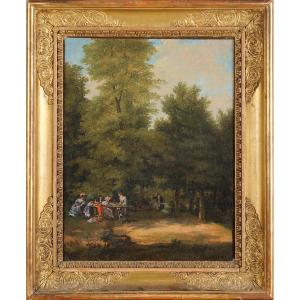
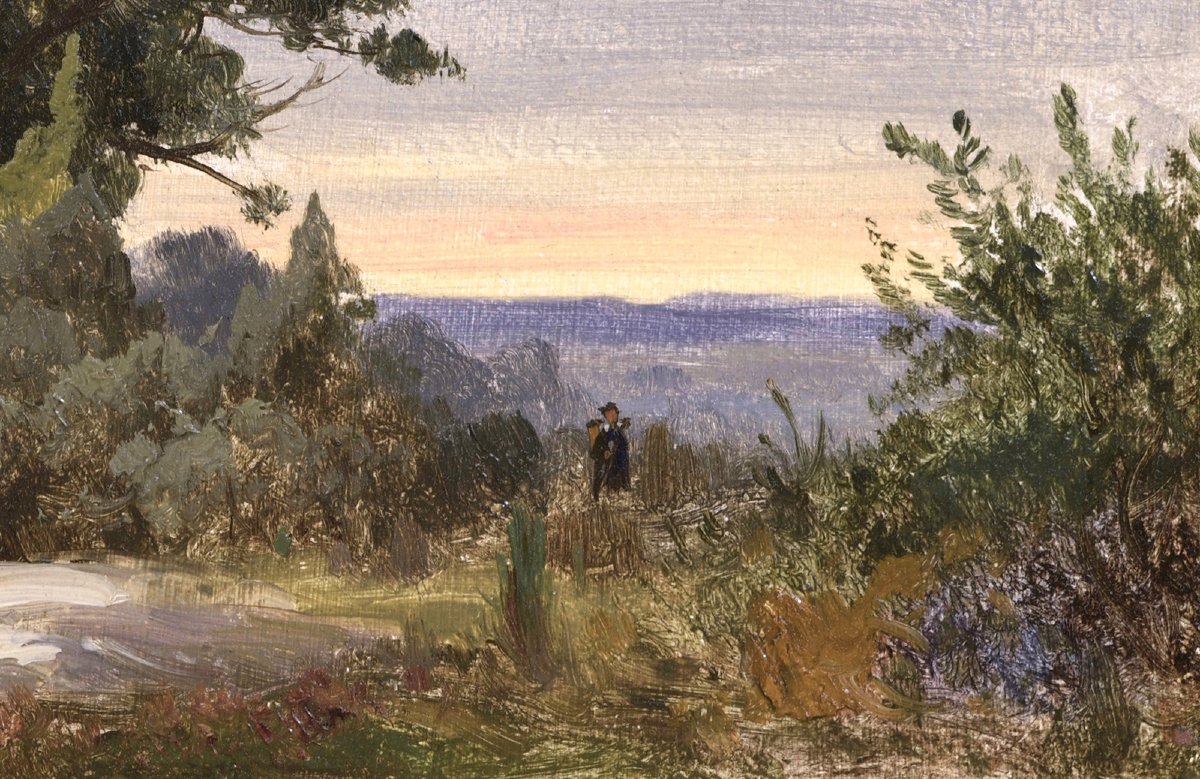
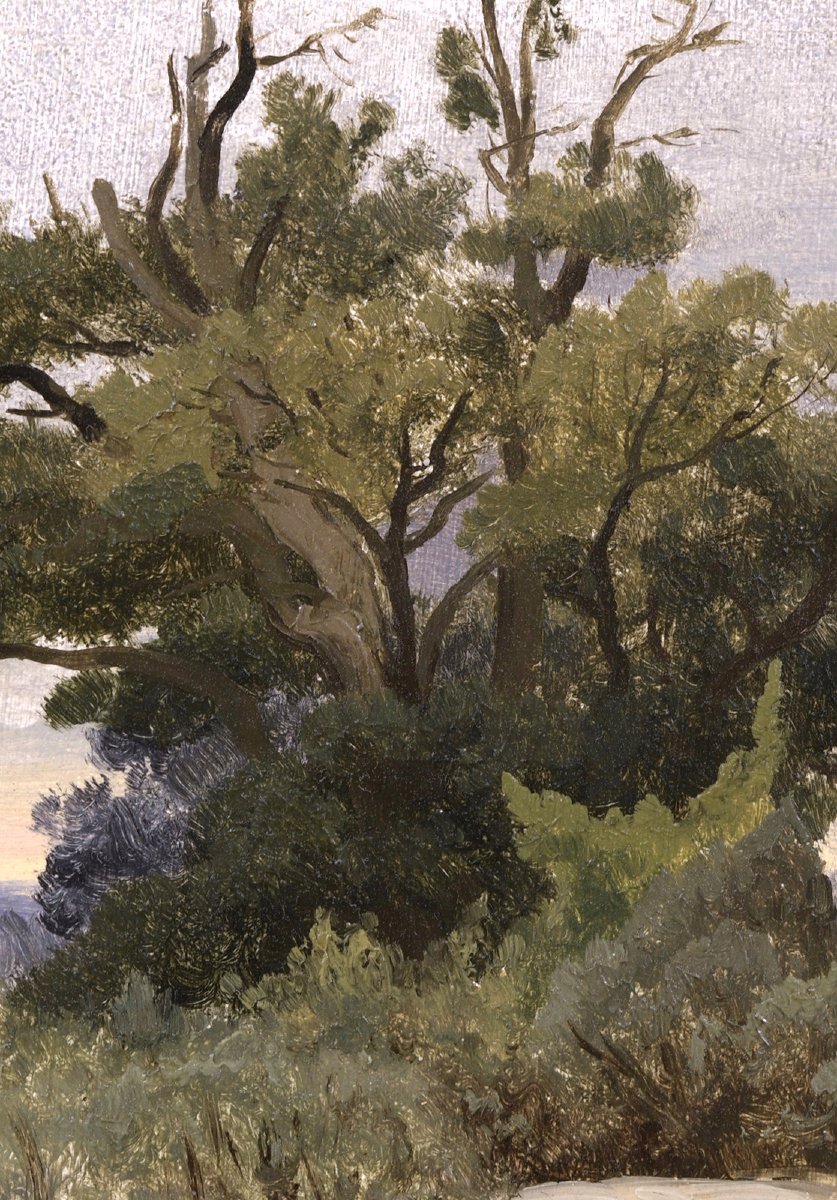
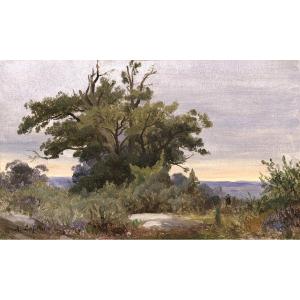
Here, the artist is likely depicting himself—a tiny silhouette lost in the foliage, with his painter’s gear slung over his back. It is late in the day in the Forest of Fontainebleau, likely in the northern part, at the viewpoint known as the Camp de Chailly-en-Bière. At the 1838 Arras Salon, Lapito presented a watercolor titled View Taken at Chailly, Near Fontainebleau.
On view in Paris.
(Joinville-le-Pont, 1803 – Boulogne-Billancourt, 1874)
The Painter in the Forest of Fontainebleau
Oil on paper mounted on canvas
H. 21 cm; W. 34 cm
Signed lower left
Louis-Auguste Lapito belongs to the second generation of neoclassical landscape painters, influenced and trained by artists such as Valenciennes, Jean-Victor Bertin, and Louis-Étienne Watelet, but who would develop a more naturalistic sensibility, at times tinged with romanticism and the picturesque. This generation, led by Corot, included painters such as Caruelle d’Aligny, André Giroux, Guillaume Bodinier, Jules Coignet, Charles-Joseph Rémond, Léon Fleury, and Léopold Leprince—all of whom were generally born between 1795 and 1805.
These artists retained a lasting fascination with Italy, but were more inclined to travel and motivated by the discovery of new regions; Lapito thus visited numerous French provinces, with a particular fondness for the Dauphiné, Auvergne, Normandy, and Corsica, and abroad, the Netherlands, Germany, and especially Switzerland.
But they are also known for having been the first to visit the Forest of Fontainebleau in the very early 1820s, where they produced a significant body of work. Lapito depicted Fontainebleau throughout his career, with painted studies and works exhibited at the Salon in the 1830s, 1840s, and even during his final appearance in 1870.
A student of Watelet and the history painter François-Joseph Heim, Lapito enjoyed success throughout his career, winning several medals and having his works acquired by the state (purchases made by Louis-Philippe for the palaces of Saint-Cloud and Compiègne). He was equally adept at plein air painting and compositions refined in the studio—a result of his classical training—in both cases demonstrating a precise brushstroke and a very distinct sense of color. Among his many favorable reviews, one from the *Journal des Artistes* in 1838 stands out: “… Mr. Lapito continues to deserve acclaim… His drawing is always precise; despite a broad and effortless brushstroke, his subjects are always well chosen, and his color is generally true, though somewhat golden. Mr. Lapito’s works always stand out for their picturesque composition and the spirited manner in which they are executed… .”
Here, the artist is likely depicting himself—a tiny silhouette lost in the foliage, with his painter’s gear slung over his back. It is late in the day in the Forest of Fontainebleau, likely in the northern part, at the viewpoint known as the Camp de Chailly-en-Bière. At the 1838 Arras Salon, Lapito presented a watercolor titled View Taken at Chailly, Near Fontainebleau.
On view in Paris.
3 200 €
Period: 19th century
Style: Louis Philippe, Charles 10th
Condition: Perfect condition
Material: Oil painting on paper
Length: 21 cm hors cadre
Width: 34 cm hors cadre
Reference (ID): 1833404
Availability: In stock
Print