

Nuo Mask Hunan (湖南), China 19th Century
Nuo (傩) theater mask depicting
Heshang (和尚) The Smiling Monk.
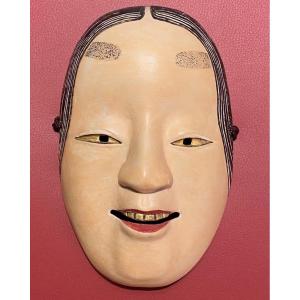
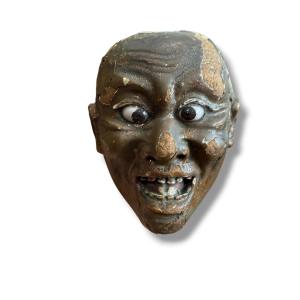
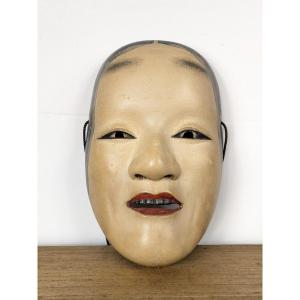
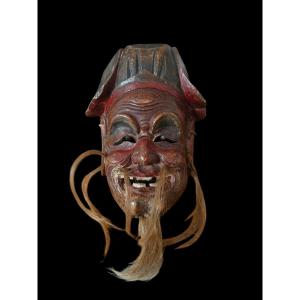
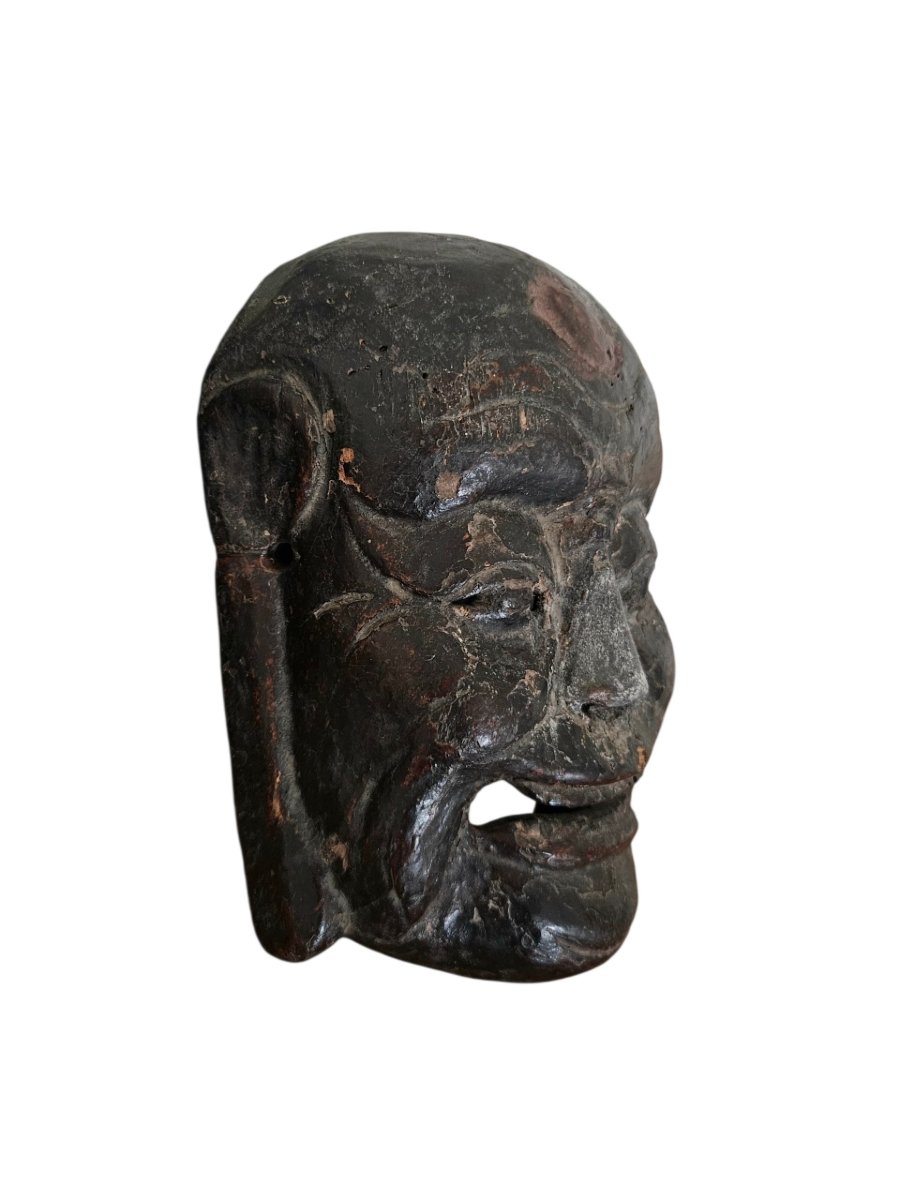
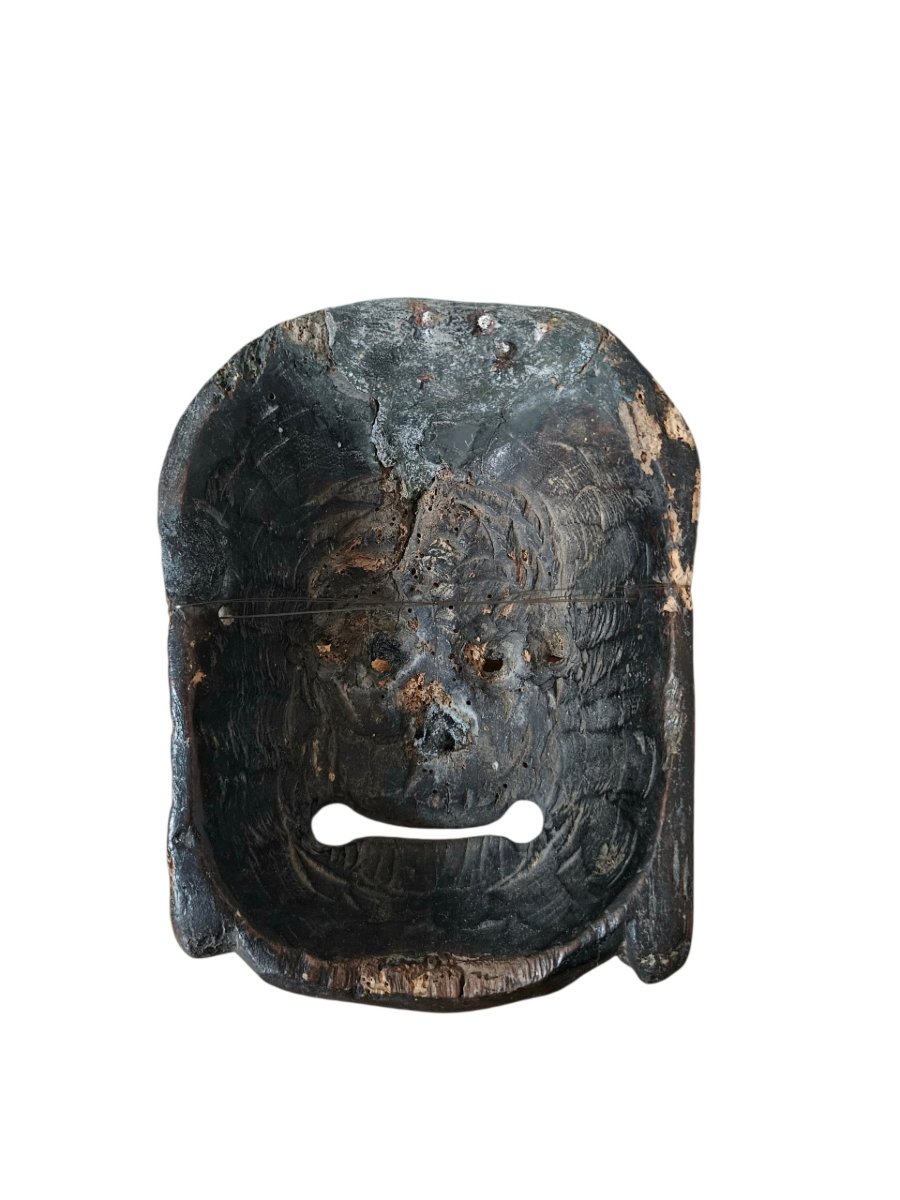
Hardwood, aged brown patina, signs of wear on the inside, a few small chips, restoration on the nose and upper forehead, remnants of red pigment in the center of the forehead.
Hunan (湖南), China, 19th century. Dimensions: 22 x 16 cm
The Heshang (和尚)—the monk—is one of the most popular and distinctive characters in the Nuo (傩) and Dixi (地戲) repertoires.
His uniqueness stems first and foremost from his universality: he embodies both the Buddhist monk and the Taoist monk, thus bridging the boundaries between the two great spiritual traditions of rural China. Whether young or old, austere or mischievous, the Heshang is above all a man of the community—the one who dances, sweeps, teases, and playfully tests the audience’s faith.
In the iconic play of the Nuo repertoire, he teases XiaoTie in the ritual comedy *The Crying Monk Teases Xianfeng Xiaojie* (哭和尚戏先锋小姐)—a play in which laughter itself becomes an act of collective purification."For the Heshang’s success in Nuo ceremonies does not rest on fear or solemnity, but on the infectious joy he generates. He performs every possible task—he dances, he sweeps the ceremonial space to purify it, he averts disasters, and he strengthens the community’s faith through his acrobatics and games. In doing so, he fulfills an essential spiritual function: connecting the world of humans to the world of the gods through laughter and lightheartedness, reminding us that divine benevolence can also take the form of comedy. The red medallion at the center of the forehead—whose pigments are still visible on this mask—signifies the character’s spiritual awakening, a discreet sign that beneath the jest lies a genuine protective power."
This mask, with its beautiful sculptural richness, accurately captures the character’s ambivalence: the broad, tooth-baring smile, the slightly furrowed eyebrows, the shaved head rendered in supple volumes—all combine to evoke a being who is both grounded in everyday life and imbued with a quiet spiritual strength.
It is reproduced in: Paul Louis Couailhac, *The Dragon’s Daughter and Other Characters You Might Encounter in China*, Éditions Couailhac, 2019, p. 73.
Provenance: Former Collection of Paul-Louis Couailhac (1945–2025) A French expert in East Asian studies, a graduate of INALCO, and a renowned bibliophile known for having assembled one of the most significant private collections of Chinese ritual masks from Nuo theater in Europe. An exhibition showcasing his collection of Nuo masks was dedicated to him in 2026 in Issigeac, organized by the Ocarina Gallery.
Sold with a certificate of authenticity from expert S. Reynes and an invoice from Galerie Ocarina.
* Shipping costs upon request.
Heshang (和尚) The Smiling Monk.
Hardwood, aged brown patina, signs of wear on the inside, a few small chips, restoration on the nose and upper forehead, remnants of red pigment in the center of the forehead.
Hunan (湖南), China, 19th century. Dimensions: 22 x 16 cm
The Heshang (和尚)—the monk—is one of the most popular and distinctive characters in the Nuo (傩) and Dixi (地戲) repertoires.
His uniqueness stems first and foremost from his universality: he embodies both the Buddhist monk and the Taoist monk, thus bridging the boundaries between the two great spiritual traditions of rural China. Whether young or old, austere or mischievous, the Heshang is above all a man of the community—the one who dances, sweeps, teases, and playfully tests the audience’s faith.
In the iconic play of the Nuo repertoire, he teases XiaoTie in the ritual comedy *The Crying Monk Teases Xianfeng Xiaojie* (哭和尚戏先锋小姐)—a play in which laughter itself becomes an act of collective purification."For the Heshang’s success in Nuo ceremonies does not rest on fear or solemnity, but on the infectious joy he generates. He performs every possible task—he dances, he sweeps the ceremonial space to purify it, he averts disasters, and he strengthens the community’s faith through his acrobatics and games. In doing so, he fulfills an essential spiritual function: connecting the world of humans to the world of the gods through laughter and lightheartedness, reminding us that divine benevolence can also take the form of comedy. The red medallion at the center of the forehead—whose pigments are still visible on this mask—signifies the character’s spiritual awakening, a discreet sign that beneath the jest lies a genuine protective power."
This mask, with its beautiful sculptural richness, accurately captures the character’s ambivalence: the broad, tooth-baring smile, the slightly furrowed eyebrows, the shaved head rendered in supple volumes—all combine to evoke a being who is both grounded in everyday life and imbued with a quiet spiritual strength.
It is reproduced in: Paul Louis Couailhac, *The Dragon’s Daughter and Other Characters You Might Encounter in China*, Éditions Couailhac, 2019, p. 73.
Provenance: Former Collection of Paul-Louis Couailhac (1945–2025) A French expert in East Asian studies, a graduate of INALCO, and a renowned bibliophile known for having assembled one of the most significant private collections of Chinese ritual masks from Nuo theater in Europe. An exhibition showcasing his collection of Nuo masks was dedicated to him in 2026 in Issigeac, organized by the Ocarina Gallery.
Sold with a certificate of authenticity from expert S. Reynes and an invoice from Galerie Ocarina.
* Shipping costs upon request.
550 €
Period: 19th century
Style: Asian art
Condition: Condition of use
Material: Solid wood
Width: 16 cm
Height: 22 cm
Reference (ID): 1832778
Availability: In stock
Print