


Alfred Lesbros (1873–1940) Landscape With Poplars
Artist: Alfred Lesbros (1873-1940)
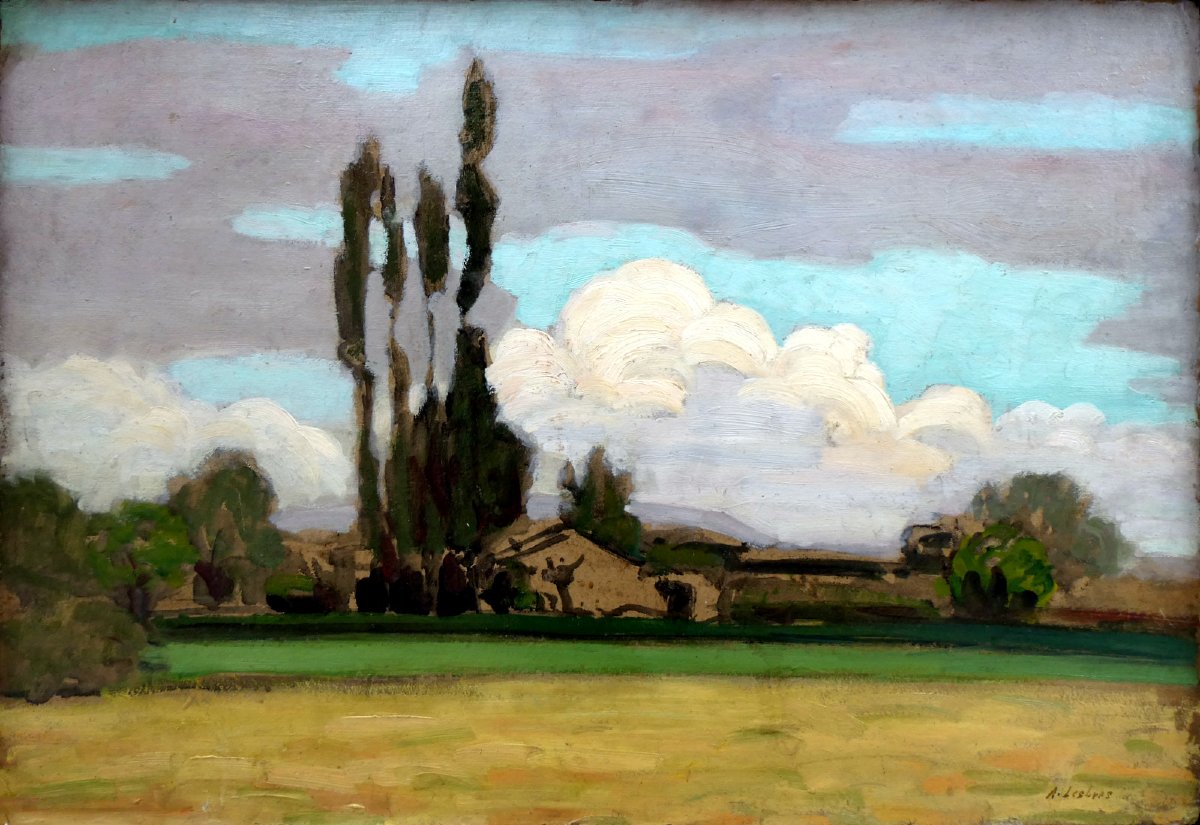
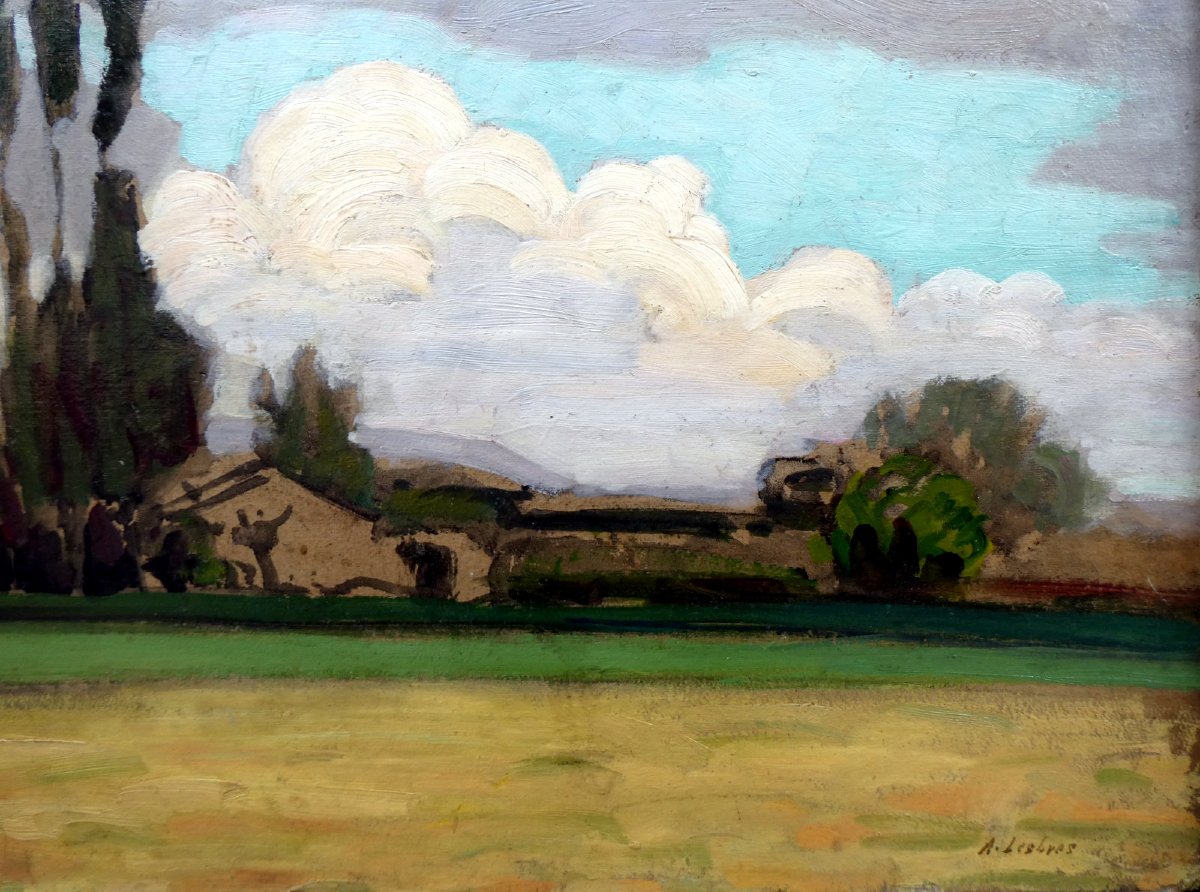
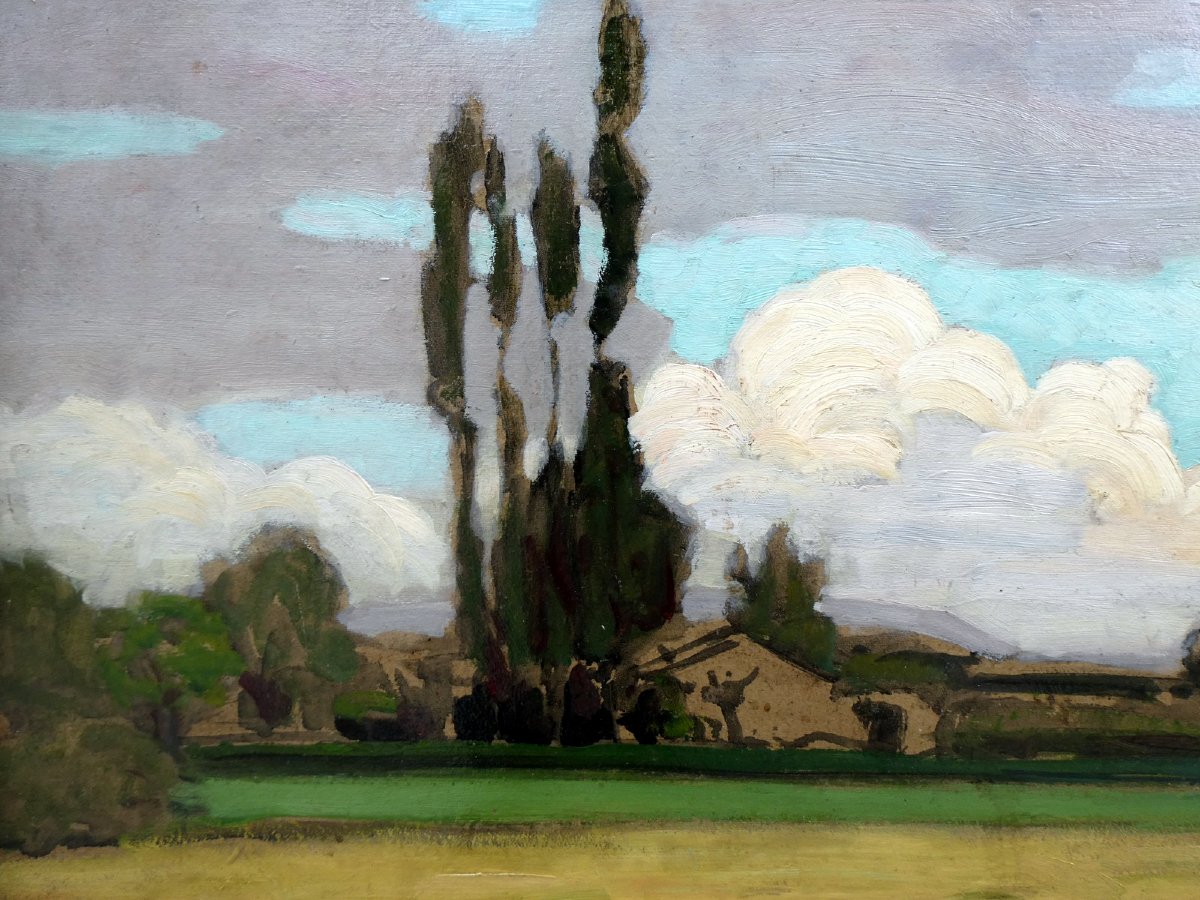
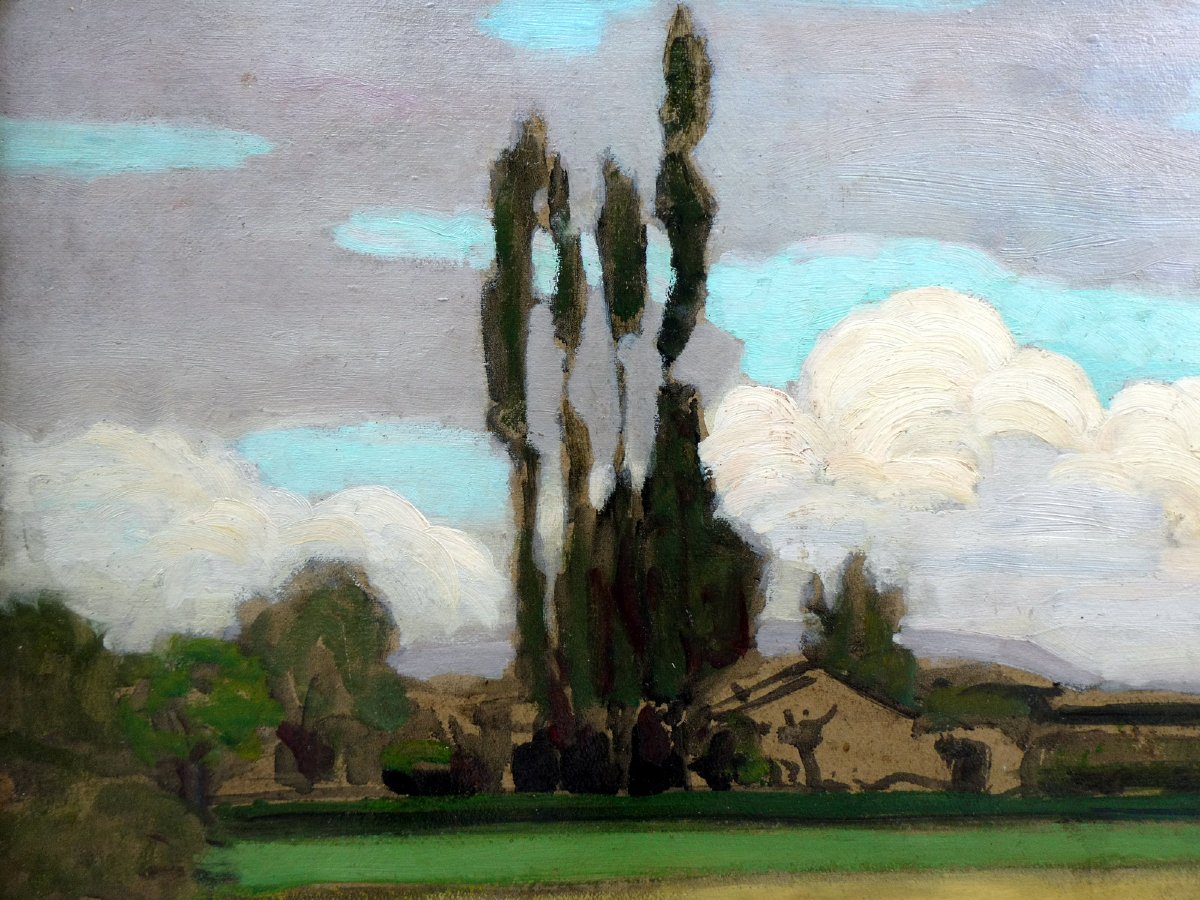
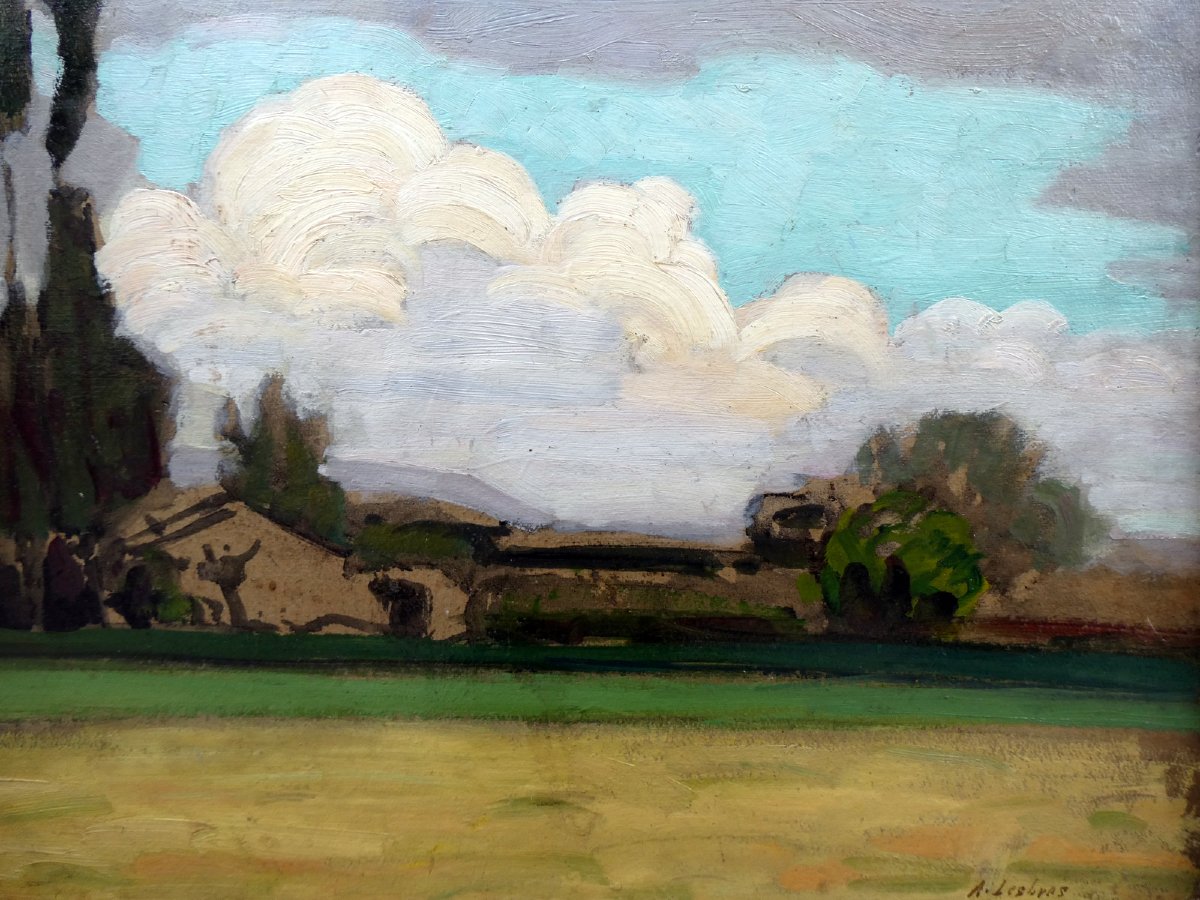
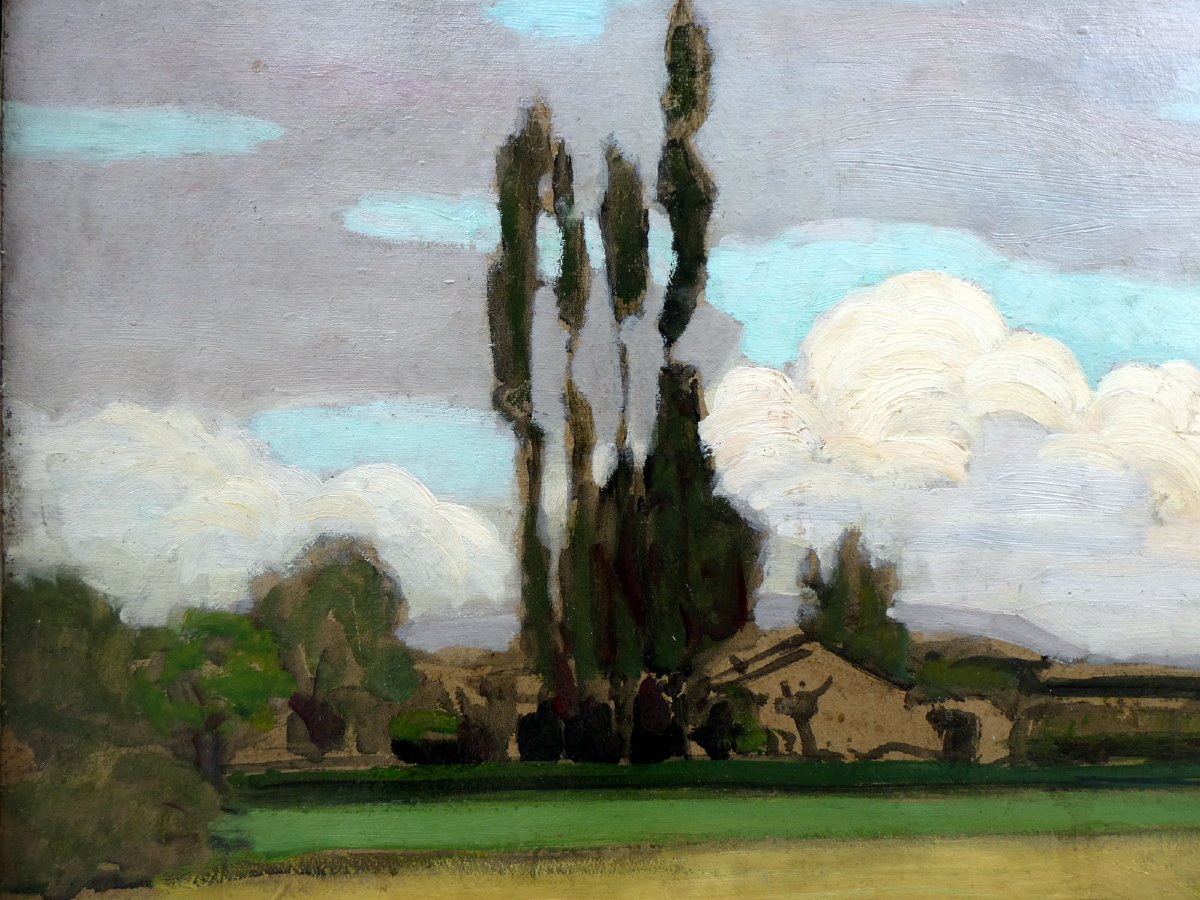
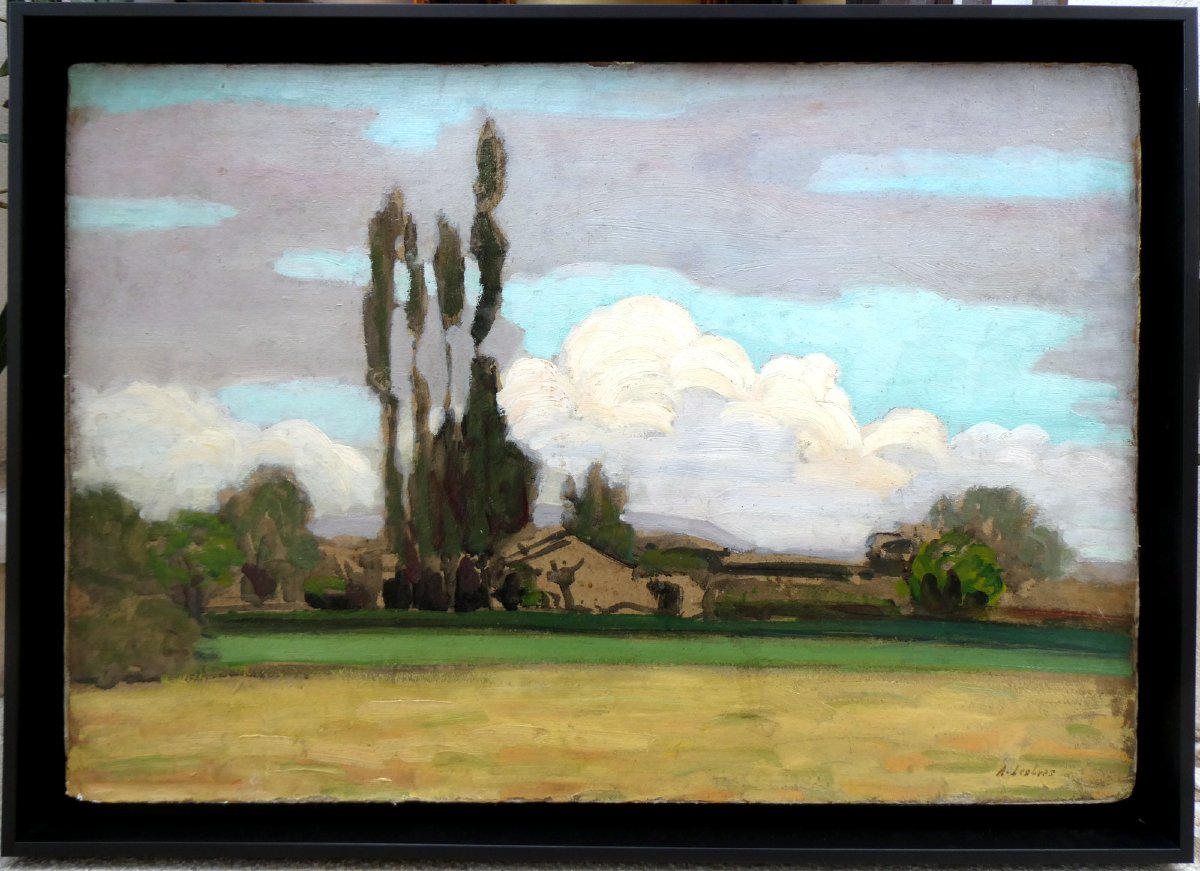
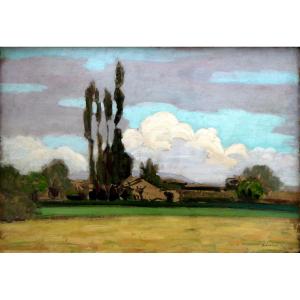
Surprisingly modern for its time (circa 1910), this work is characterized by its economy of means and an element of surprise, with a composition based on a simple and effective structure: four horizontal bands formed by a yellow field, a green field, a strip of unpainted cardboard suggesting a farmhouse and its outbuildings, and the sky.
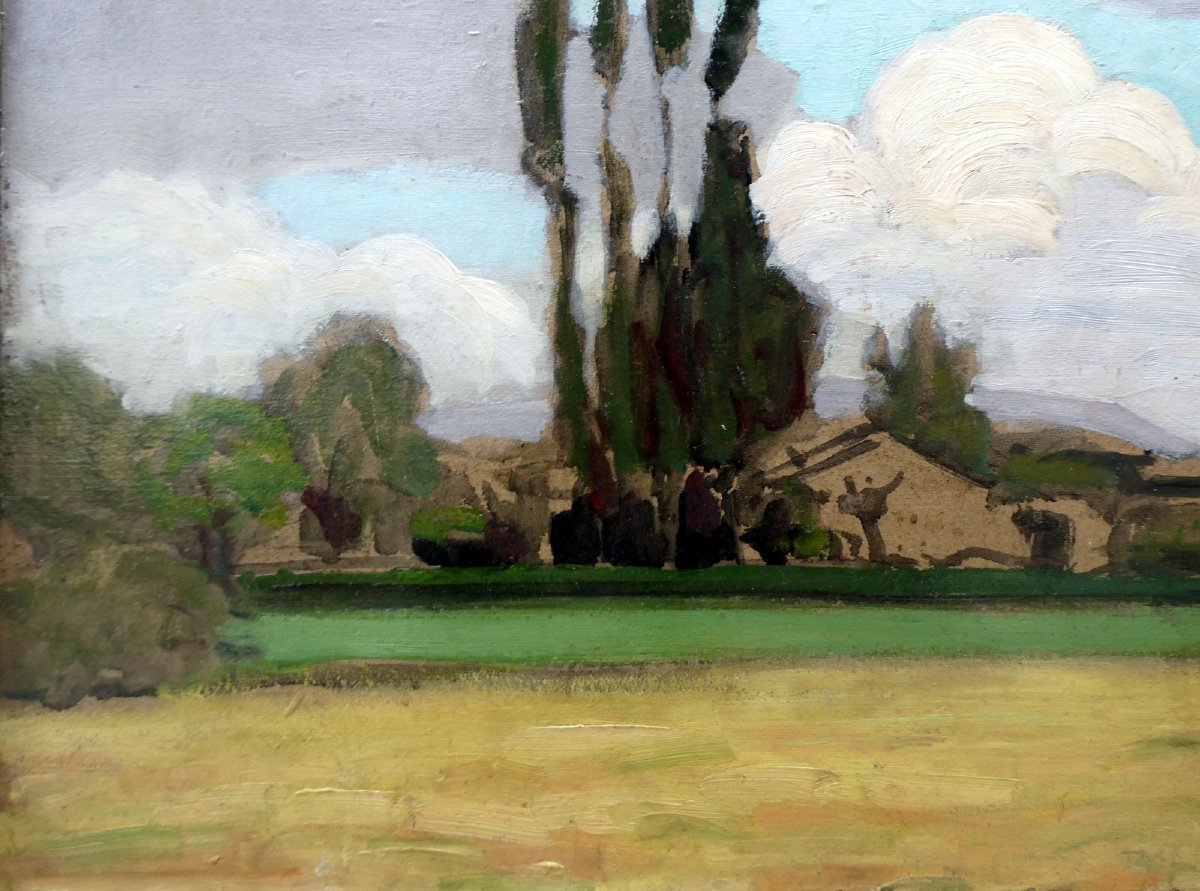
These horizontal lines are intersected vertically by the poplars, off-center to the left, which serve as a focal point in this composition, creating a dynamic asymmetry toward the left side of the work.
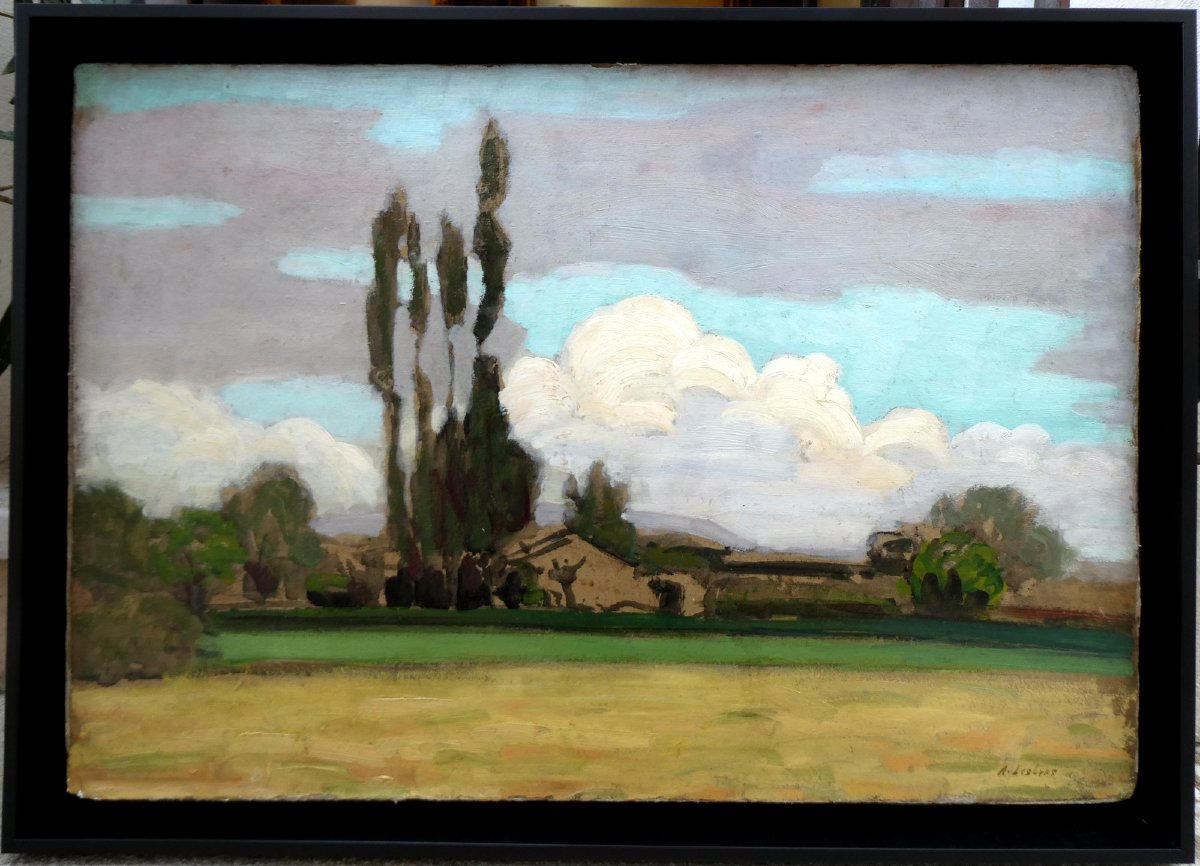
The work is painted in oil on cardboard and is presented in a modern black shadowbox frame measuring 58.5 cm by 81 cm, with the cardboard panel itself measuring 54 cm by 76 cm.
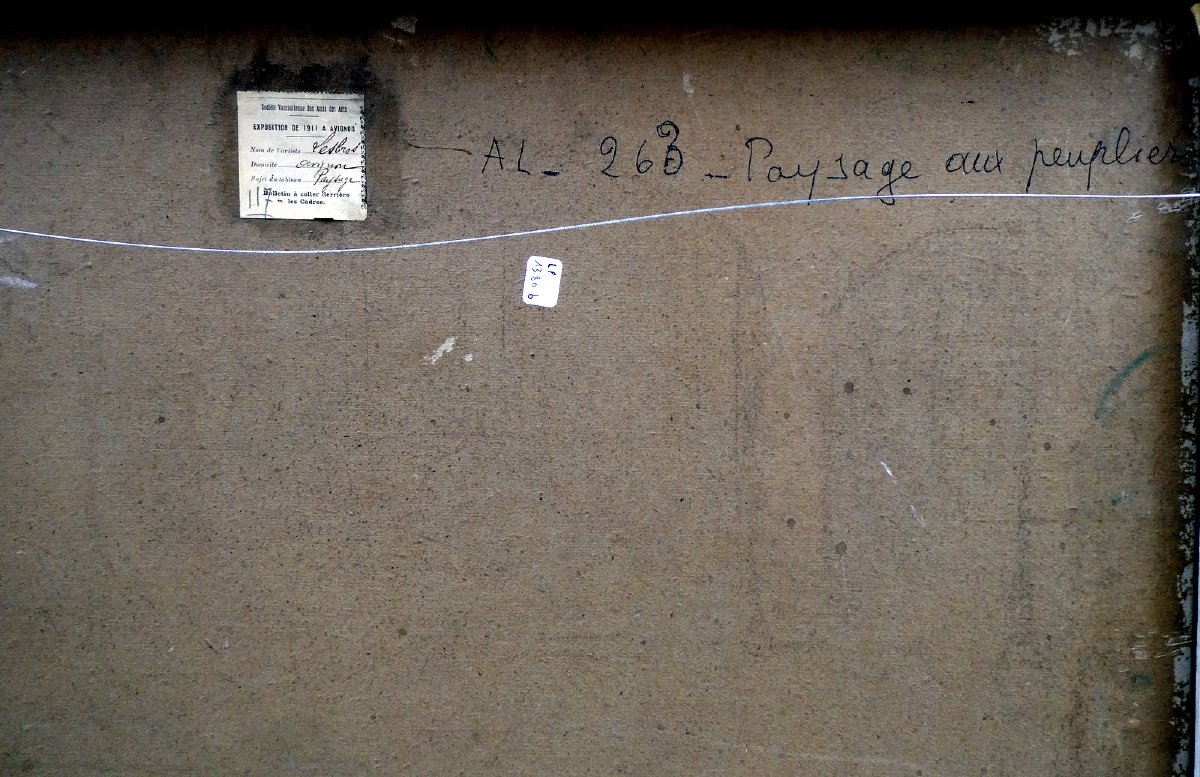
In good condition, it is signed in the lower right corner. On the back is an old exhibition label from the Société Vauclusienne des Amis des Arts in Avignon in 1911, along with the title: “Landscape with Poplars.”
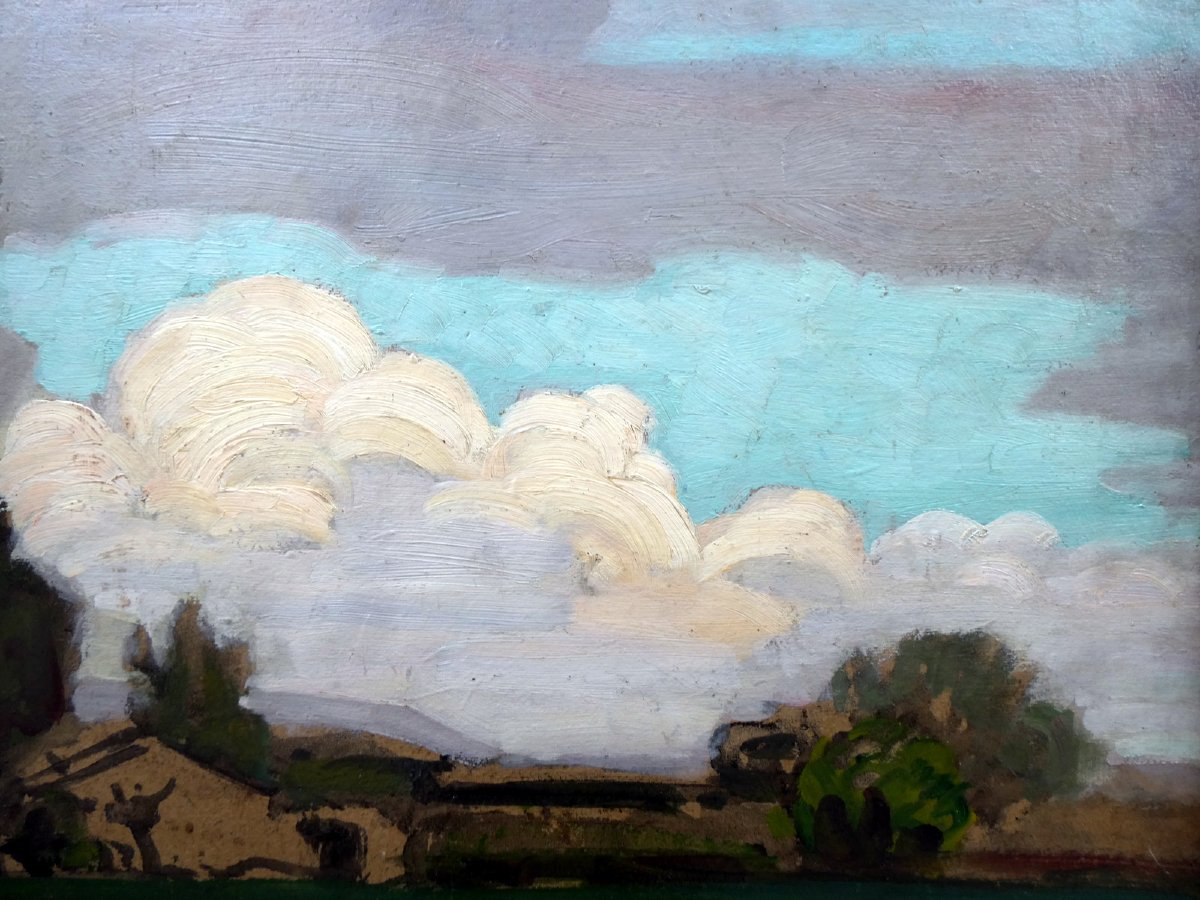
The sky, rendered with generous brushstrokes in broad swaths of grayish-mauve, turquoise blue, and creamy white for the clouds, contrasts with the unpainted areas of the cardboard support.
The large white cloud mass on the right, painted with thick, swirling brushstrokes, adds movement and almost rivals the trees, becoming nearly the main subject.
The brushwork is broad and synthetic. This work appears to belong to a period when he moved beyond the divisionism of his early years toward something more synthetic and expressive.
The son of landowners, he attended high school in Avignon. Although captivated by the charm of the surrounding countryside, he never participated in rural life. Realizing that painting would be his sole purpose, he anticipated his military service by choosing Montpellier (whose School of Fine Arts had been highly praised) as his garrison, hoping to avoid upsetting his parents, who did not share his enthusiasm for the arts. He naturally attended the School of Fine Arts in Montpellier and was then assigned to Mende, where he enrolled in the drawing school and gave lessons to his colonel's daughter. In 1896, he married the woman he had loved since the age of 15 and settled in Avignon, where his parents had bought him a glassmaking business. He established himself at number 41 Rue des Fourbisseurs, reserving a large studio for himself in the attic on the fourth floor. He enrolled at the Avignon School of Fine Arts, but, torn between his artistic aspirations and his business obligations, he could only attend Sunday classes. Quite spry, Pierre Grivolas continued to lead his students on plein air painting trips to Villeneuve and Les Angles, where Lesbros met Meyssonnier, Flour, Colombier, Belladen, Bergier, and the very young Hurard. He worked intelligently and tastefully to grow his business, while also participating in exhibitions in Avignon, and then at the Salon des Indépendants from 1908 onward. Although initially quite criticized by the Avignon press, Lesbros pursued his pictorial studies and worked tirelessly. Like all Avignon artists, he frequented the Riche Taverne almost daily, where, as an avant-garde seeker, he was something of a leader. Shortly before the First World War, Braque and Picasso, who had settled in Avignon, met with local painters and shared their ideas and research. It was around this time that Lesbros, becoming more aware of his artistic talent, began using stencils. While continuing to paint from nature, he turned his attention to decoration. He started with flowers, then moved on to landscapes, playing with color to create works suitable for modern furniture at prices accessible to a wider audience thanks to the availability of multiple copies. After the stencils, he temporarily abandoned color and embarked on an expressionist period (early 1930s). He admired Matisse and then moved towards Fauvism and colorful periods characterized by alternating white and black outlines. After a classical training, Lesbros, left to his own devices, developed his own theories and gained his own experience through reading art books, visiting museums, and maintaining close relationships with various groups of painters in southeastern France. Seeking to escape academicism, in 1912 he and Clément Brun were among the founders of the Group of Thirteen; a little later, he joined the New Group of Regional Artists (known as the Group of Sixteen, after the dissolution of the original members of the Thirteen). In the 1930s, with Chabaud and Chartier, he founded the Independent Painters of Avignon group, which gave ample space to young talent. From 1924 onward, he lived on Rue Barbacane and, with assistance in his glassmaking business, spent much of his time painting outdoors. After his first stay in Martigues in 1913, he was drawn to the vibrant colors of the small village of Roussillon. He returned to Martigues quite often, drawn there by his friends Hurard and Messonnier, but he was particularly fond of Les Angles and its "Bois Sacré" (Sacred Wood). Following in Grivolas's footsteps, he stayed at Mont Ventoux (Malaucène), then experienced the ruggedness of the Alpilles at Eygalières, and later, with Chabaud and Gontier, he explored the Montagnette. In his later years, he contented himself with the old streets and squares of Avignon, as well as the garden of his home. Lesbros exhibited regularly in Paris at the Salon des Indépendants from 1908 to 1920, at the Salon d’Automne from 1922 to 1924, and in Lyon at the Salon du Sud-Est from 1922 to 1933. He shunned the capital from 1929 onwards and exhibited only in the Southeast. He participated in virtually all the exhibitions of the Société Vauclusienne des Amis des Arts, the Groupe des Treize, the Groupe des Indépendants, and the Nouveau Groupe des Artistes Régionaux. He also exhibited in Geneva, Marseille, Saint-Étienne, Arles, and Nîmes. Lesbros's paintings are in the museums of Montpellier, Marseille, Arles, Aix-en-Provence, and the Musée Calvet in Avignon.
These horizontal lines are intersected vertically by the poplars, off-center to the left, which serve as a focal point in this composition, creating a dynamic asymmetry toward the left side of the work.
The work is painted in oil on cardboard and is presented in a modern black shadowbox frame measuring 58.5 cm by 81 cm, with the cardboard panel itself measuring 54 cm by 76 cm.
In good condition, it is signed in the lower right corner. On the back is an old exhibition label from the Société Vauclusienne des Amis des Arts in Avignon in 1911, along with the title: “Landscape with Poplars.”
The sky, rendered with generous brushstrokes in broad swaths of grayish-mauve, turquoise blue, and creamy white for the clouds, contrasts with the unpainted areas of the cardboard support.
The large white cloud mass on the right, painted with thick, swirling brushstrokes, adds movement and almost rivals the trees, becoming nearly the main subject.
The brushwork is broad and synthetic. This work appears to belong to a period when he moved beyond the divisionism of his early years toward something more synthetic and expressive.
The son of landowners, he attended high school in Avignon. Although captivated by the charm of the surrounding countryside, he never participated in rural life. Realizing that painting would be his sole purpose, he anticipated his military service by choosing Montpellier (whose School of Fine Arts had been highly praised) as his garrison, hoping to avoid upsetting his parents, who did not share his enthusiasm for the arts. He naturally attended the School of Fine Arts in Montpellier and was then assigned to Mende, where he enrolled in the drawing school and gave lessons to his colonel's daughter. In 1896, he married the woman he had loved since the age of 15 and settled in Avignon, where his parents had bought him a glassmaking business. He established himself at number 41 Rue des Fourbisseurs, reserving a large studio for himself in the attic on the fourth floor. He enrolled at the Avignon School of Fine Arts, but, torn between his artistic aspirations and his business obligations, he could only attend Sunday classes. Quite spry, Pierre Grivolas continued to lead his students on plein air painting trips to Villeneuve and Les Angles, where Lesbros met Meyssonnier, Flour, Colombier, Belladen, Bergier, and the very young Hurard. He worked intelligently and tastefully to grow his business, while also participating in exhibitions in Avignon, and then at the Salon des Indépendants from 1908 onward. Although initially quite criticized by the Avignon press, Lesbros pursued his pictorial studies and worked tirelessly. Like all Avignon artists, he frequented the Riche Taverne almost daily, where, as an avant-garde seeker, he was something of a leader. Shortly before the First World War, Braque and Picasso, who had settled in Avignon, met with local painters and shared their ideas and research. It was around this time that Lesbros, becoming more aware of his artistic talent, began using stencils. While continuing to paint from nature, he turned his attention to decoration. He started with flowers, then moved on to landscapes, playing with color to create works suitable for modern furniture at prices accessible to a wider audience thanks to the availability of multiple copies. After the stencils, he temporarily abandoned color and embarked on an expressionist period (early 1930s). He admired Matisse and then moved towards Fauvism and colorful periods characterized by alternating white and black outlines. After a classical training, Lesbros, left to his own devices, developed his own theories and gained his own experience through reading art books, visiting museums, and maintaining close relationships with various groups of painters in southeastern France. Seeking to escape academicism, in 1912 he and Clément Brun were among the founders of the Group of Thirteen; a little later, he joined the New Group of Regional Artists (known as the Group of Sixteen, after the dissolution of the original members of the Thirteen). In the 1930s, with Chabaud and Chartier, he founded the Independent Painters of Avignon group, which gave ample space to young talent. From 1924 onward, he lived on Rue Barbacane and, with assistance in his glassmaking business, spent much of his time painting outdoors. After his first stay in Martigues in 1913, he was drawn to the vibrant colors of the small village of Roussillon. He returned to Martigues quite often, drawn there by his friends Hurard and Messonnier, but he was particularly fond of Les Angles and its "Bois Sacré" (Sacred Wood). Following in Grivolas's footsteps, he stayed at Mont Ventoux (Malaucène), then experienced the ruggedness of the Alpilles at Eygalières, and later, with Chabaud and Gontier, he explored the Montagnette. In his later years, he contented himself with the old streets and squares of Avignon, as well as the garden of his home. Lesbros exhibited regularly in Paris at the Salon des Indépendants from 1908 to 1920, at the Salon d’Automne from 1922 to 1924, and in Lyon at the Salon du Sud-Est from 1922 to 1933. He shunned the capital from 1929 onwards and exhibited only in the Southeast. He participated in virtually all the exhibitions of the Société Vauclusienne des Amis des Arts, the Groupe des Treize, the Groupe des Indépendants, and the Nouveau Groupe des Artistes Régionaux. He also exhibited in Geneva, Marseille, Saint-Étienne, Arles, and Nîmes. Lesbros's paintings are in the museums of Montpellier, Marseille, Arles, Aix-en-Provence, and the Musée Calvet in Avignon.
2 300 €
Period: 20th century
Style: Other Style
Condition: Good condition
Material: Oil painting on cardboard
Length: 76 cm
Height: 54 cm
Reference (ID): 1827858
Availability: In stock
Print