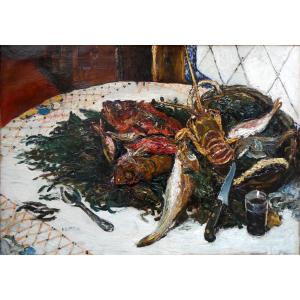


Marcel Leprin (1891–1933) Still Life With Fish From La Bouillabaisse
Artist: Marcel Leprin (1891-1933)
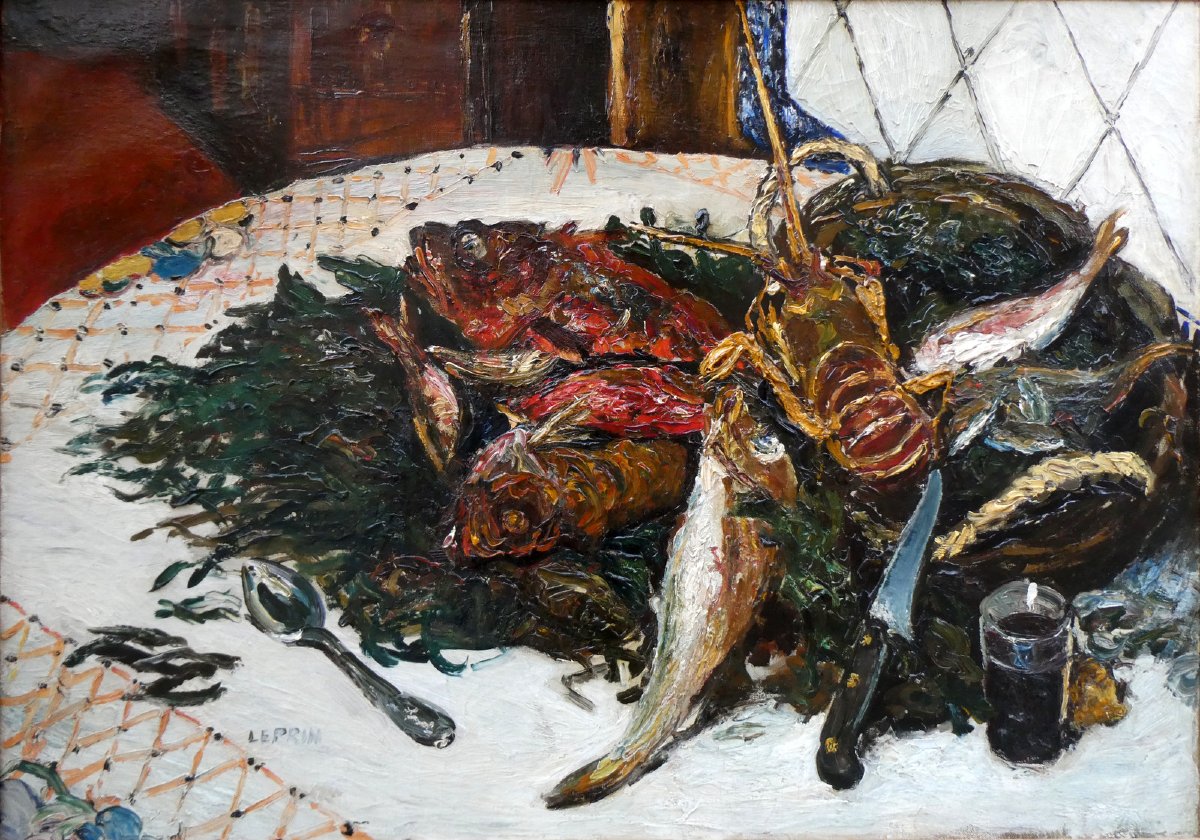
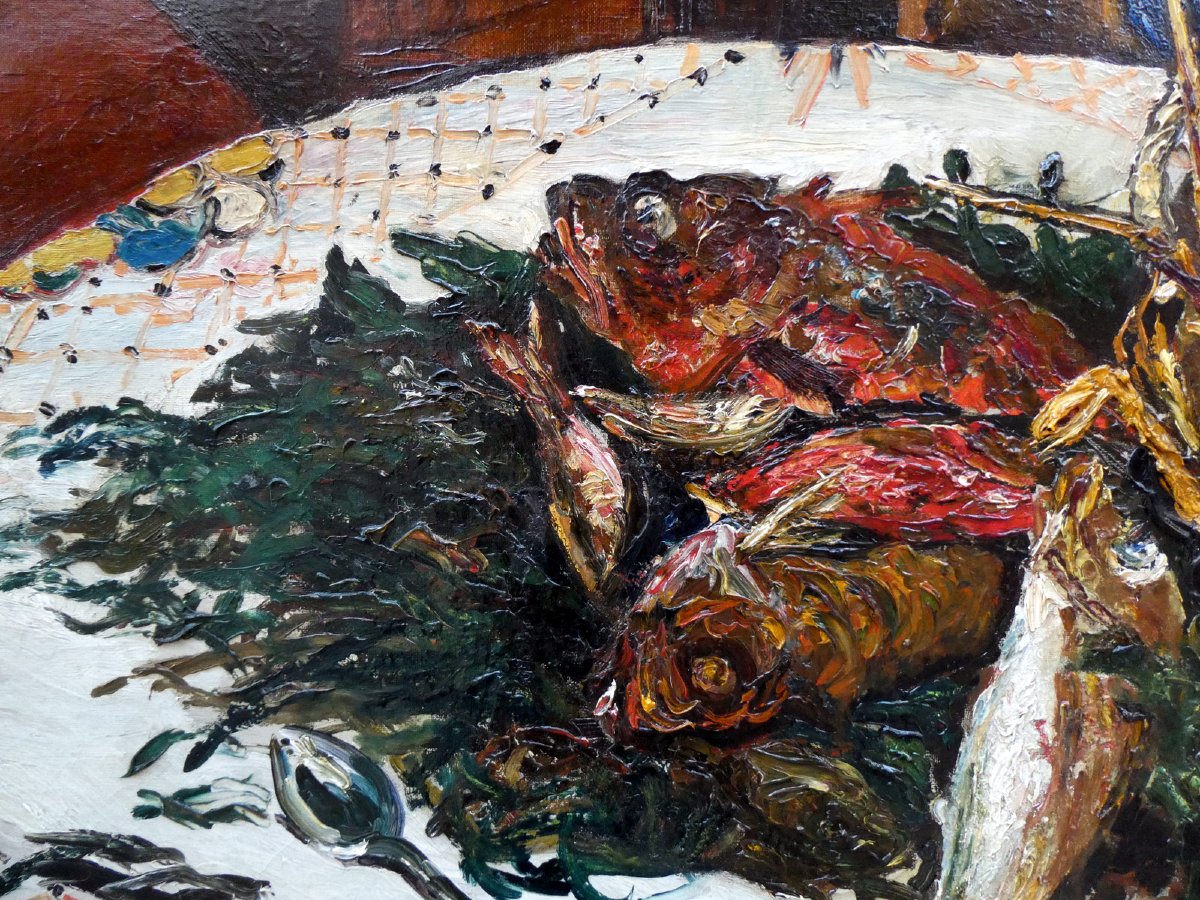
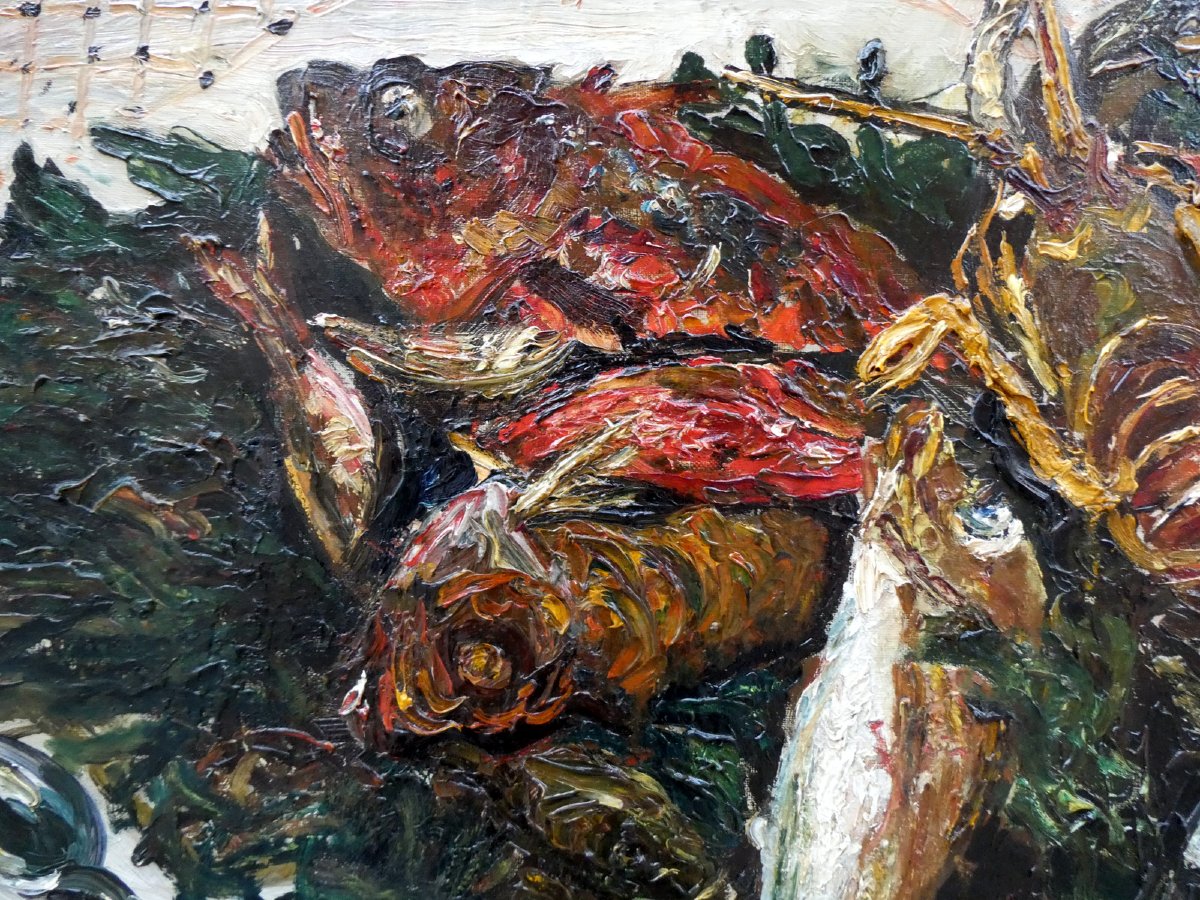
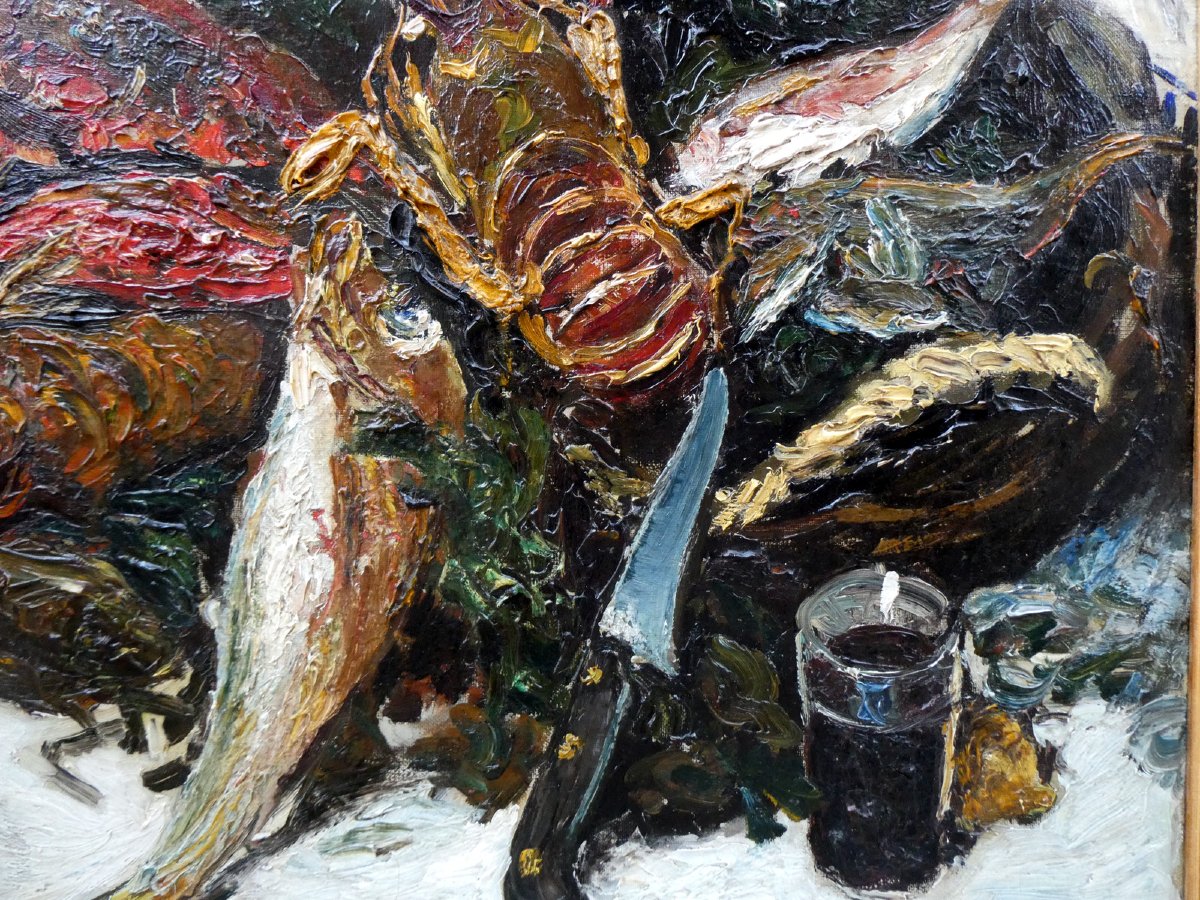
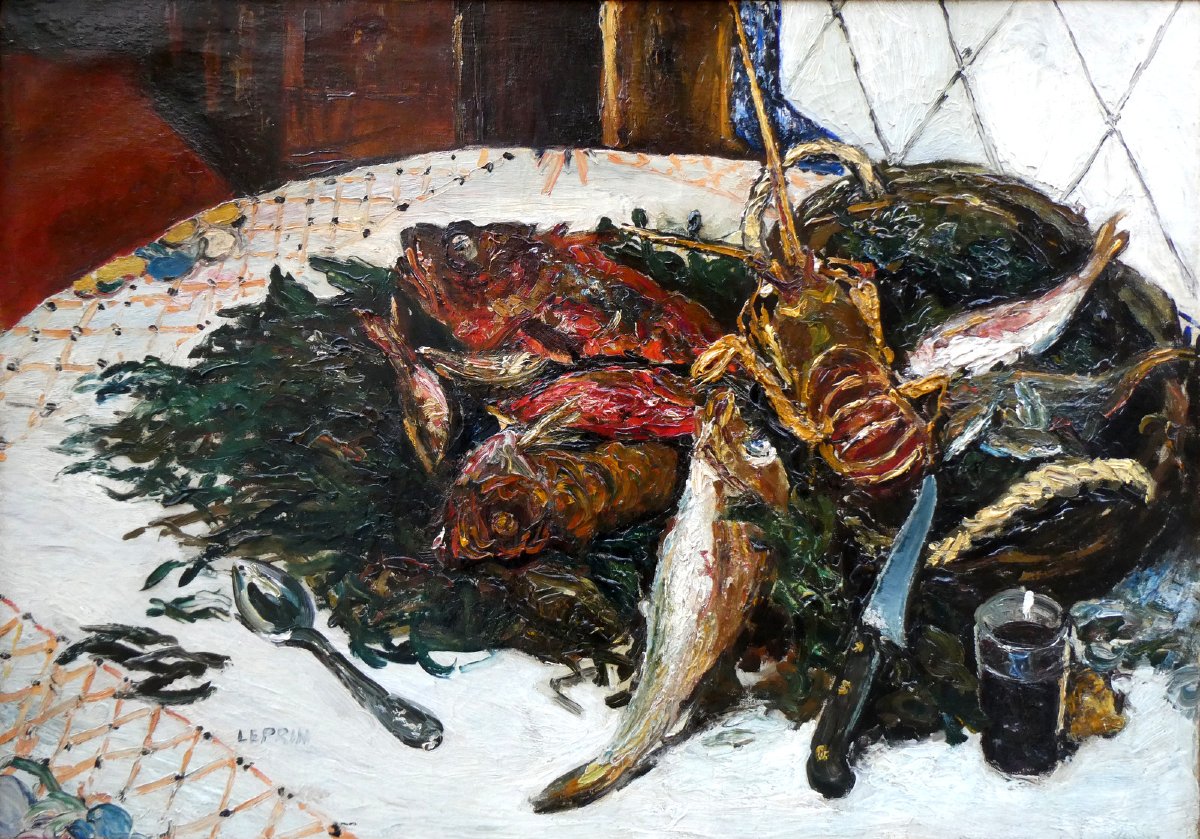
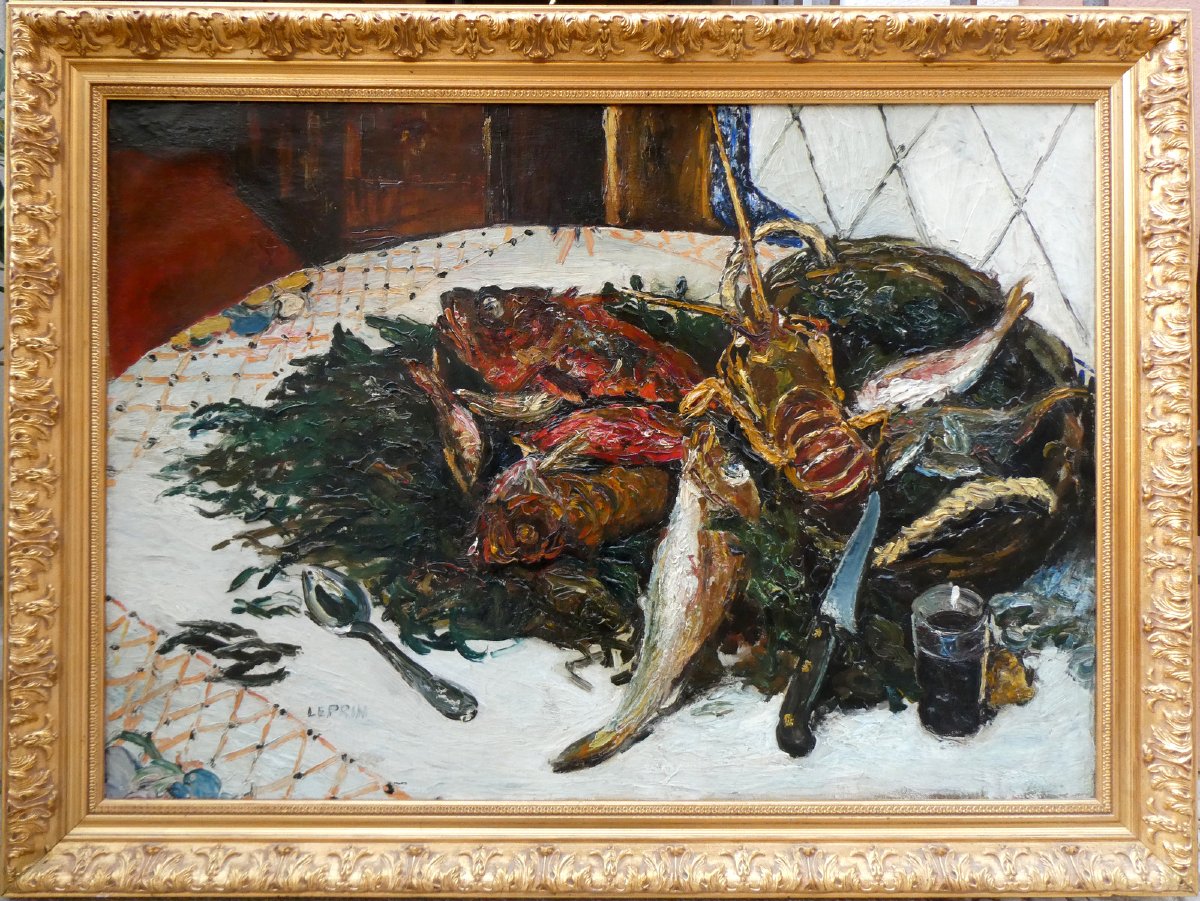
This versatile and talented artist, who died far too young and is knownprimarily for his Parisian and Montmartre landscapes (streets, squares, churches), presentshere a still life of fish typical of the Mediterranean: scorpionfish, red mullet gurnards, and lobster—which make up the bulk of the famous bouillabaisse, the renowned Mediterranean dish.
Arranged on dark seaweed in the background, on a table covered with a white tablecloth featuring a fishing net pattern—a veryobvious nod to the world of fishing in Marseille.
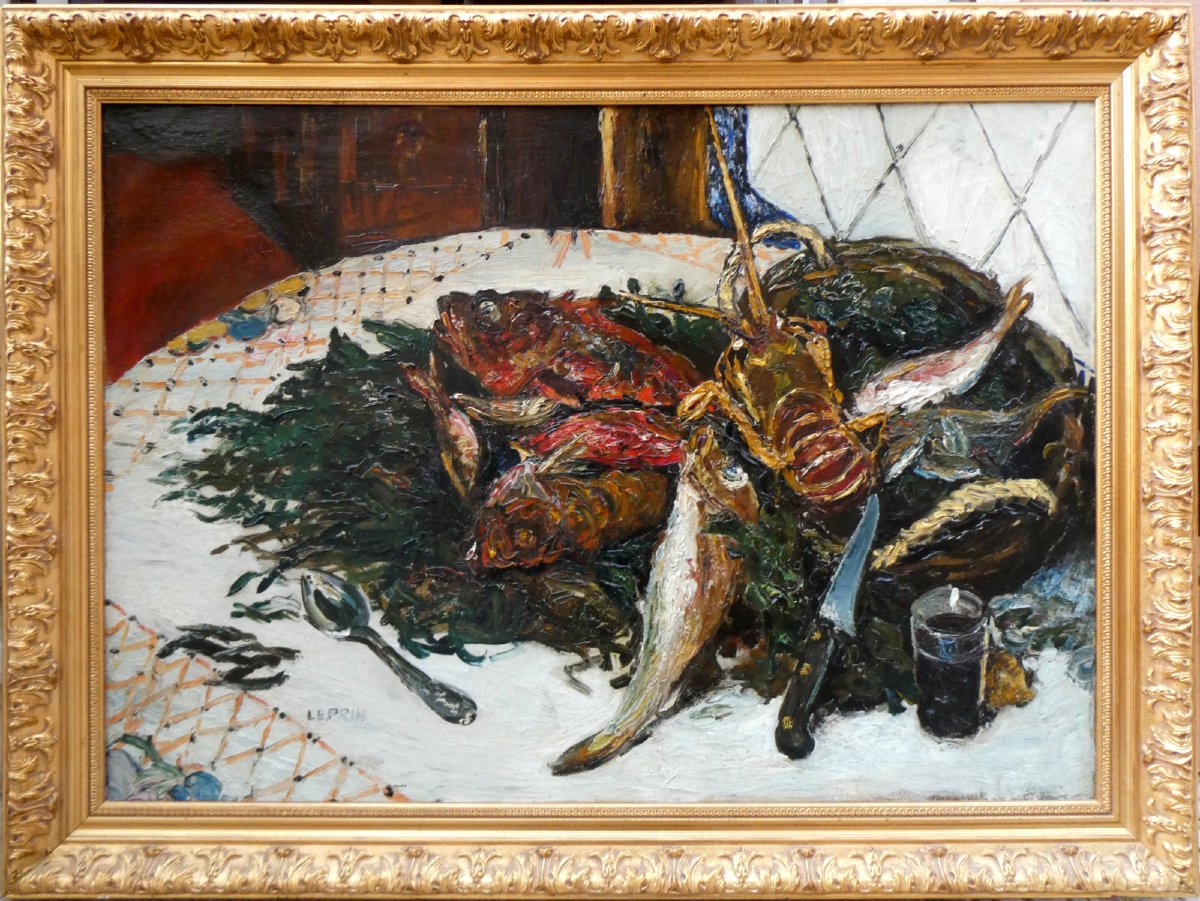
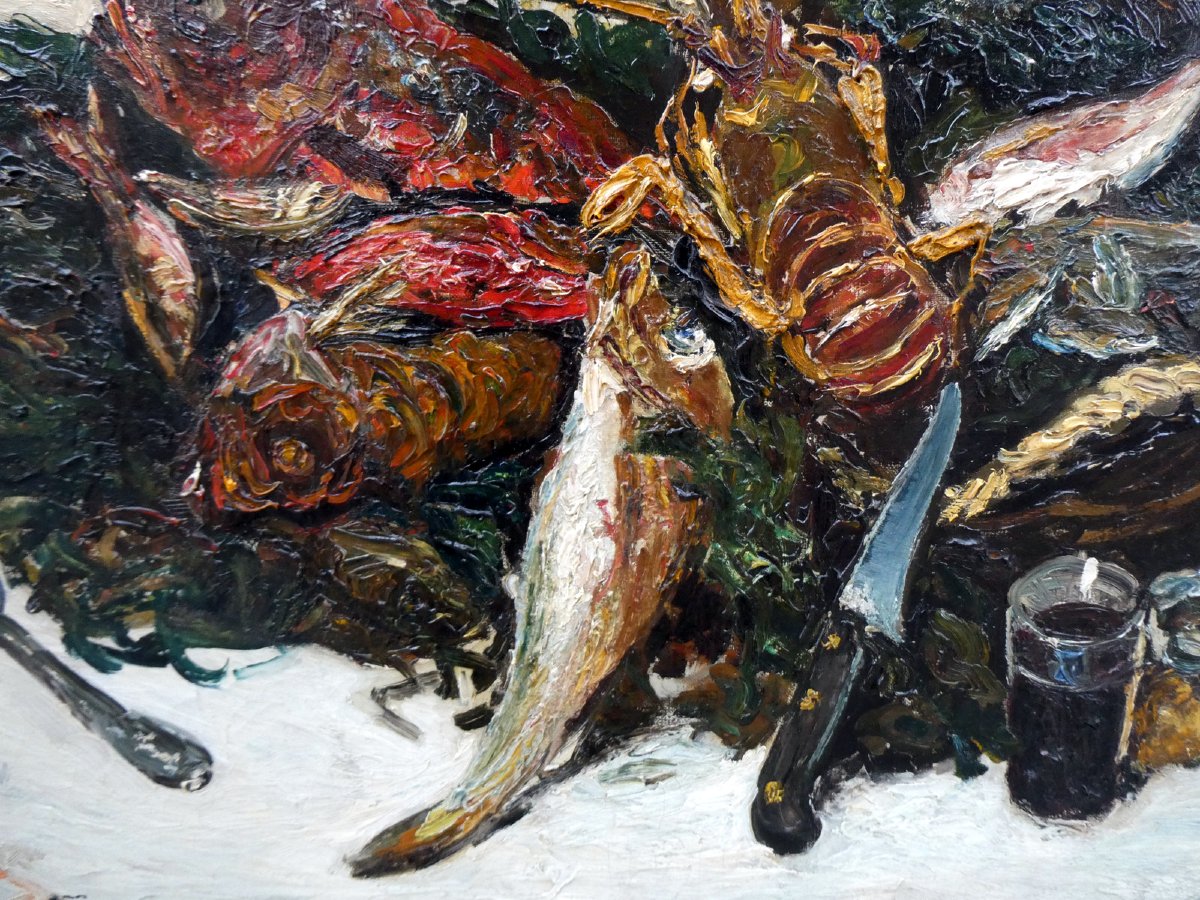
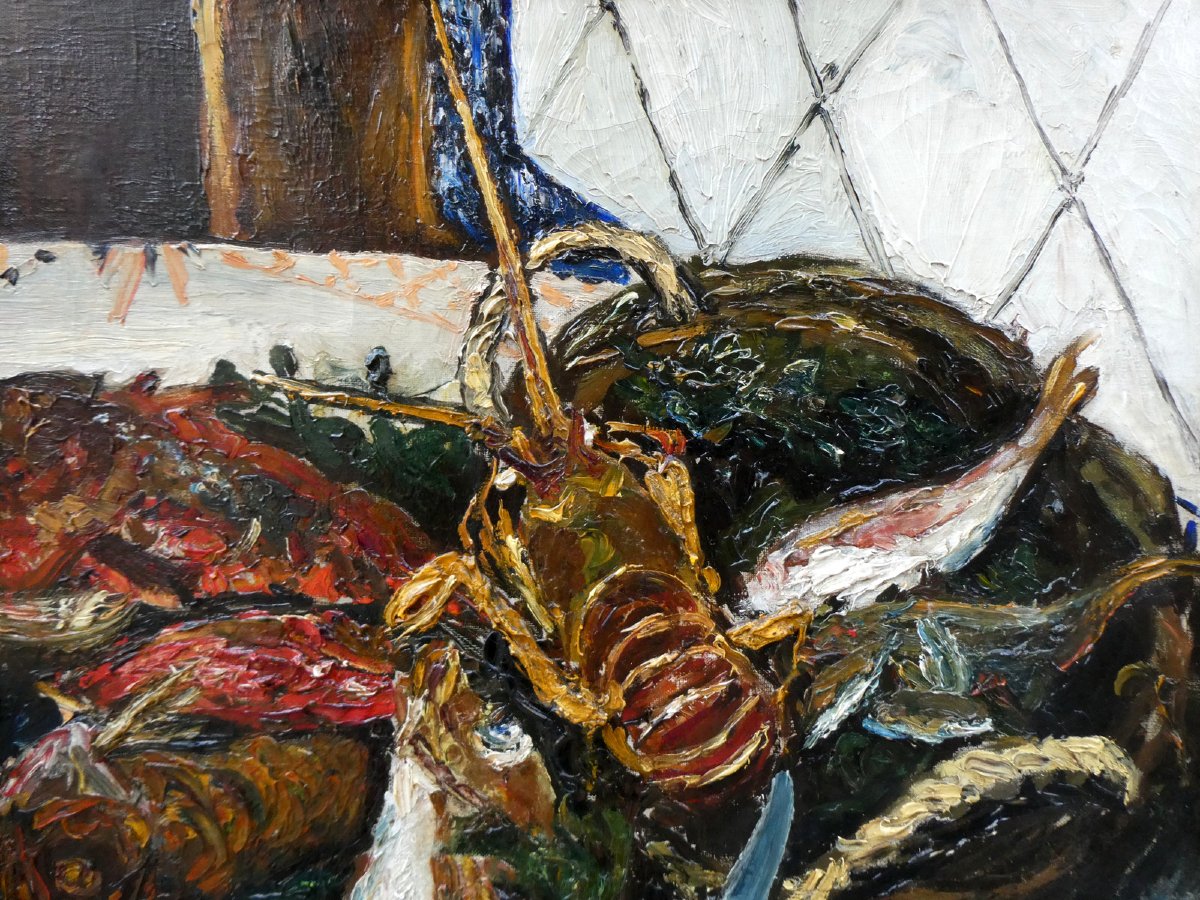
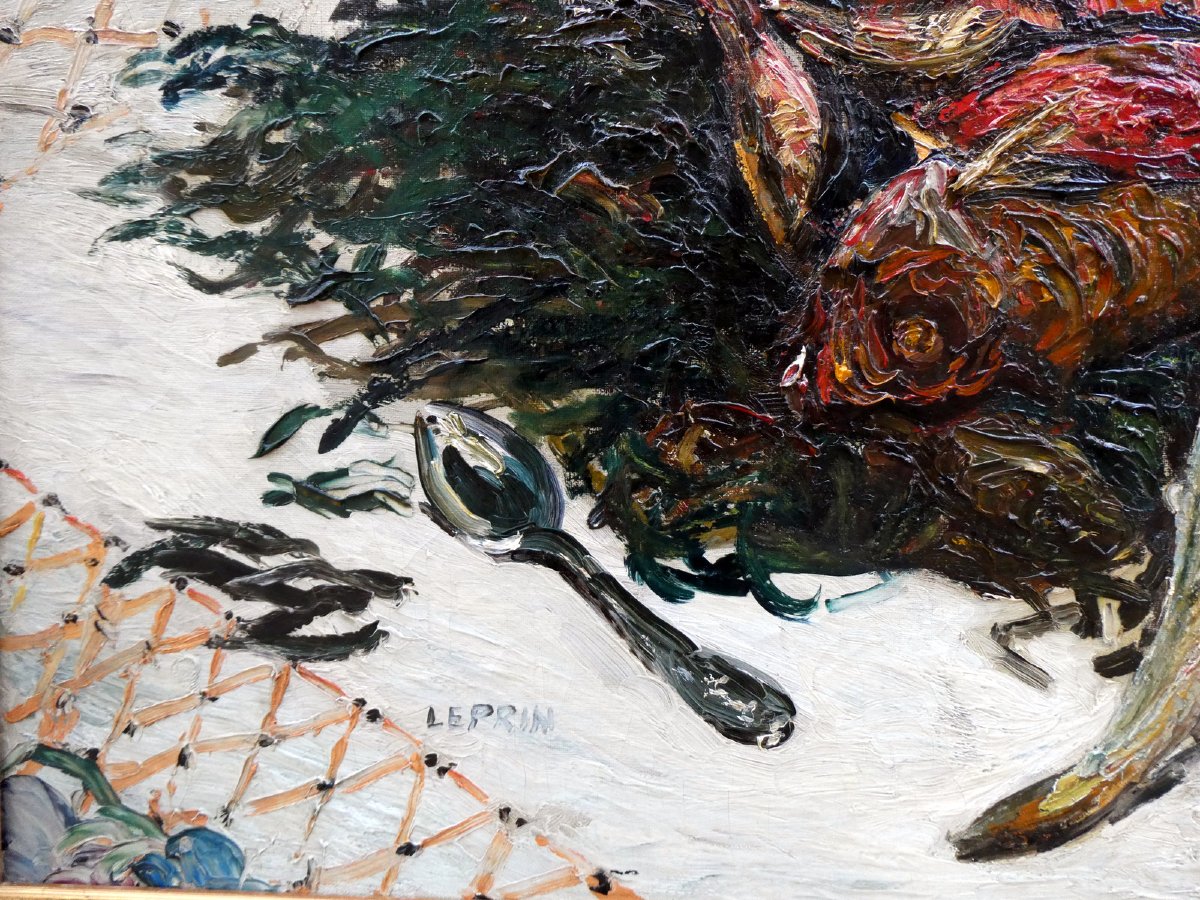
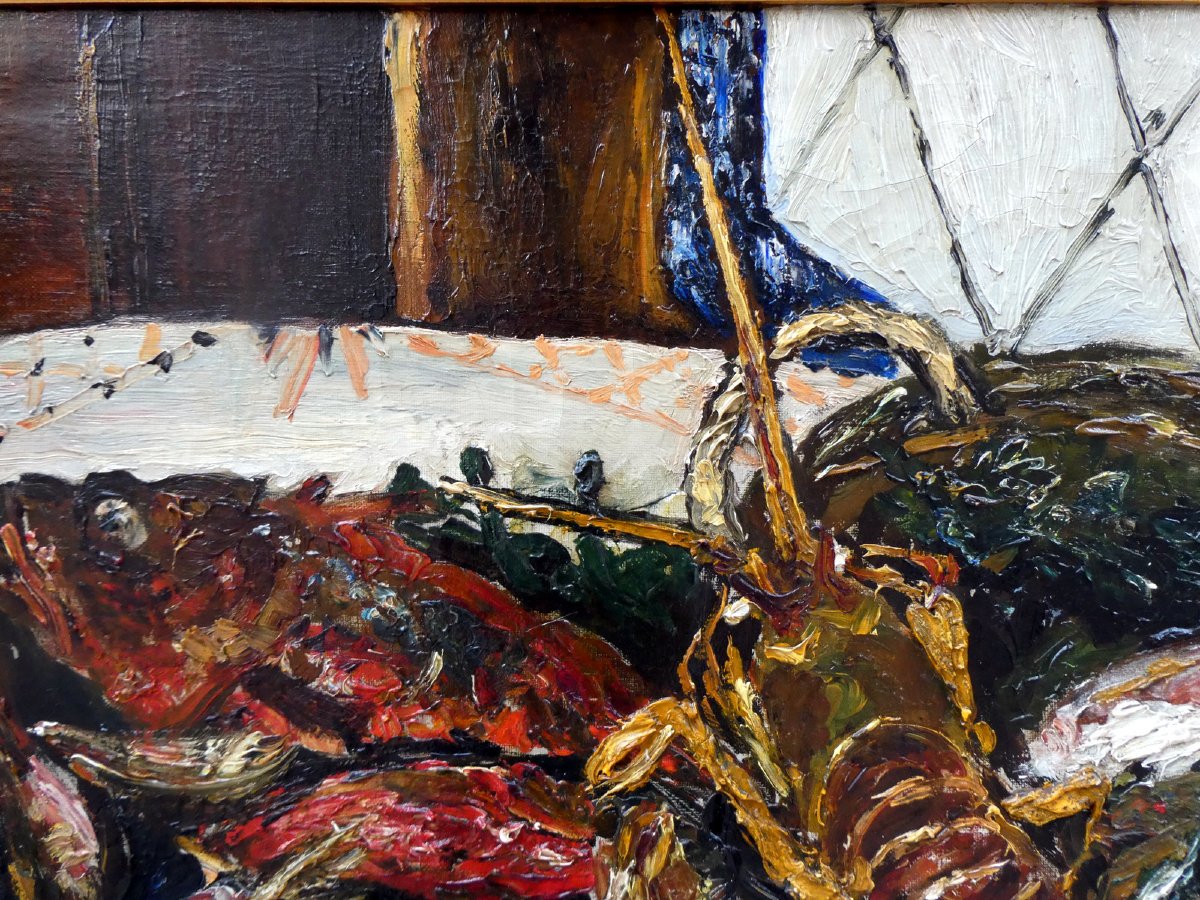
Painted in a thick medium, using a knife and brush, with almost sculptural impasto on the fish scalesand the lobster’s shell, everything is piled up in the center, with the spoon andknife placed diagonally in the foreground to anchor the depth, and the small dark glass that frames the scene on the right.
This grainy texture serves the subject well and perfectly captures the viscous and fleshy texture of the fish better than a smooth rendering would.
There’s a subtle nod to Soutine in this way of attacking the material with vigor, even though Leprin remains less distorting, closer to direct and realistic observation.
The vivid reds and oranges of the scorpionfish and red mullet stand out against the deep green-black of the seaweed, with the white background making these colors burst forth through contrast.
This oil-on-canvas painting is both effective and generous, reflects the sparkling Marseille-style of the Midi in this largely self-taught artist, who learned his craft on the job at the Old Port of Marseille—a style later tempered by his darker Montmartre period.
This imposing work is presented in a gilded frame measuring 82 cm by 108.5 cm, with the canvas alone measuring 65 cm by 92 cm.
It is signed in the lower left corner.
An orphan, Leprin had a difficult childhood in Marseille, left to his own devices and leading a bohemian life.
He was taken in by the Salesian Fathers of Don Bosco, who, noticing his talent, introduced him to drawing and lithography.
He began painting on the Old Port. At 22, he set his sights on a career in bullfighting in Barcelona, but had to give it up to fight in the First World War. At 30, in 1921, he moved to Paris and wandered around Montmartre, where he befriended artists he met in bistros, making a living selling drawings and pastels to tourists.
In 1924, he signed an exclusive contract with Henri Bureau, a framer in Montmartre, who offered to help him and further his career (it was at Henri Bureau's that he became friends with the painter Frank-Will).
In 1926, he embarked on a journey through the French countryside, painting numerous landscapes and views of towns and villages.
Despite the success of his two exhibitions at the Druet Gallery in Paris in 1928 and 1931, Marcel Leprin remained a solitary and depressed painter.
He succumbed to alcohol and drugs and died in 1933 at Tenon Hospital.
Dying prematurely at the age of 42, Marcel Leprin left behind approximately 700 canvases.
His work, influenced by the circumstances of his life, can be divided into three distinct periods, each with a different style reflecting his mental and material state: the Marseille period, characterized by large decorative murals; the Montmartre period, rather somber and commercial; and the period of his travels in the provinces, warmer and more creative.
He also distinguished himself with paintings of bullfights, portraits, still lifes, and landscapes, demonstrating mastery of line and delicate techniques such as pastel.
Leprin's paintings are primarily on display today at the National Museum of Modern Art and the Museum of Modern Art of the City of Paris, the Carnavalet Museum, the Montmartre Museum, and the Petit Palais Museum in Geneva.
Works in public collections:
Calais, Museum of Fine Arts: The Honfleur Basin, 1930, oil on canvas, 65 × 93 cm;
Chambéry, Museum of Fine Arts: House in the Countryside, oil on canvas, 34.8 × 48 cm;
Menton, Museum of Fine Arts: Village Street, oil on canvas, 54 × 46 cm; Vase of Flowers, 1923, oil on canvas, 73 × 60 cm; Rue Lepic, oil on canvas, 33 × 53 cm; Portrait of Charles Wakefield-Mori, oil on canvas, 65 × 54 cm;
Paris, Carnavalet Museum: The Moulin de la Galette, circa 1920, oil on canvas, 38.5 × 57.5 cm; The Church of Saint-Germain-de-Charonne, Place Saint-Blaise and the rue de Bagnolet, 59.6 × 80.4 cm
Museum of Modern Art: The Saint-Joseph Shelter, circa 1924, oil on canvas, 60 × 73 cm
Montmartre Museum: The Beautiful Innkeeper, 1924, oil on canvas, 116 x 90 cm
Exhibitions Retrospective of his works at the Salon d'Automne in 1933, of which he was a member in 1922.
Marcel Leprin and his friends, Paris, Galliera Museum, December 1964 - January 1965.
Retrospective Vestart Gallery, 1061 Madison, 628-0030 New York; 25 works. March 1970
Marcel Leprin Retrospective, Palais de la Méditerranée, Nice, March, April, May 1972.
Paris as seen by painters from Corot to Foujita,
Musée Carnavalet, 1978
Uzès Exhibition The History of Art, 19th and 20th centuries, Selected works, 1982
Arranged on dark seaweed in the background, on a table covered with a white tablecloth featuring a fishing net pattern—a veryobvious nod to the world of fishing in Marseille.
Painted in a thick medium, using a knife and brush, with almost sculptural impasto on the fish scalesand the lobster’s shell, everything is piled up in the center, with the spoon andknife placed diagonally in the foreground to anchor the depth, and the small dark glass that frames the scene on the right.
This grainy texture serves the subject well and perfectly captures the viscous and fleshy texture of the fish better than a smooth rendering would.
There’s a subtle nod to Soutine in this way of attacking the material with vigor, even though Leprin remains less distorting, closer to direct and realistic observation.
The vivid reds and oranges of the scorpionfish and red mullet stand out against the deep green-black of the seaweed, with the white background making these colors burst forth through contrast.
This oil-on-canvas painting is both effective and generous, reflects the sparkling Marseille-style of the Midi in this largely self-taught artist, who learned his craft on the job at the Old Port of Marseille—a style later tempered by his darker Montmartre period.
This imposing work is presented in a gilded frame measuring 82 cm by 108.5 cm, with the canvas alone measuring 65 cm by 92 cm.
It is signed in the lower left corner.
An orphan, Leprin had a difficult childhood in Marseille, left to his own devices and leading a bohemian life.
He was taken in by the Salesian Fathers of Don Bosco, who, noticing his talent, introduced him to drawing and lithography.
He began painting on the Old Port. At 22, he set his sights on a career in bullfighting in Barcelona, but had to give it up to fight in the First World War. At 30, in 1921, he moved to Paris and wandered around Montmartre, where he befriended artists he met in bistros, making a living selling drawings and pastels to tourists.
In 1924, he signed an exclusive contract with Henri Bureau, a framer in Montmartre, who offered to help him and further his career (it was at Henri Bureau's that he became friends with the painter Frank-Will).
In 1926, he embarked on a journey through the French countryside, painting numerous landscapes and views of towns and villages.
Despite the success of his two exhibitions at the Druet Gallery in Paris in 1928 and 1931, Marcel Leprin remained a solitary and depressed painter.
He succumbed to alcohol and drugs and died in 1933 at Tenon Hospital.
Dying prematurely at the age of 42, Marcel Leprin left behind approximately 700 canvases.
His work, influenced by the circumstances of his life, can be divided into three distinct periods, each with a different style reflecting his mental and material state: the Marseille period, characterized by large decorative murals; the Montmartre period, rather somber and commercial; and the period of his travels in the provinces, warmer and more creative.
He also distinguished himself with paintings of bullfights, portraits, still lifes, and landscapes, demonstrating mastery of line and delicate techniques such as pastel.
Leprin's paintings are primarily on display today at the National Museum of Modern Art and the Museum of Modern Art of the City of Paris, the Carnavalet Museum, the Montmartre Museum, and the Petit Palais Museum in Geneva.
Works in public collections:
Calais, Museum of Fine Arts: The Honfleur Basin, 1930, oil on canvas, 65 × 93 cm;
Chambéry, Museum of Fine Arts: House in the Countryside, oil on canvas, 34.8 × 48 cm;
Menton, Museum of Fine Arts: Village Street, oil on canvas, 54 × 46 cm; Vase of Flowers, 1923, oil on canvas, 73 × 60 cm; Rue Lepic, oil on canvas, 33 × 53 cm; Portrait of Charles Wakefield-Mori, oil on canvas, 65 × 54 cm;
Paris, Carnavalet Museum: The Moulin de la Galette, circa 1920, oil on canvas, 38.5 × 57.5 cm; The Church of Saint-Germain-de-Charonne, Place Saint-Blaise and the rue de Bagnolet, 59.6 × 80.4 cm
Museum of Modern Art: The Saint-Joseph Shelter, circa 1924, oil on canvas, 60 × 73 cm
Montmartre Museum: The Beautiful Innkeeper, 1924, oil on canvas, 116 x 90 cm
Exhibitions Retrospective of his works at the Salon d'Automne in 1933, of which he was a member in 1922.
Marcel Leprin and his friends, Paris, Galliera Museum, December 1964 - January 1965.
Retrospective Vestart Gallery, 1061 Madison, 628-0030 New York; 25 works. March 1970
Marcel Leprin Retrospective, Palais de la Méditerranée, Nice, March, April, May 1972.
Paris as seen by painters from Corot to Foujita,
Musée Carnavalet, 1978
Uzès Exhibition The History of Art, 19th and 20th centuries, Selected works, 1982
4 500 €
Period: 20th century
Style: Other Style
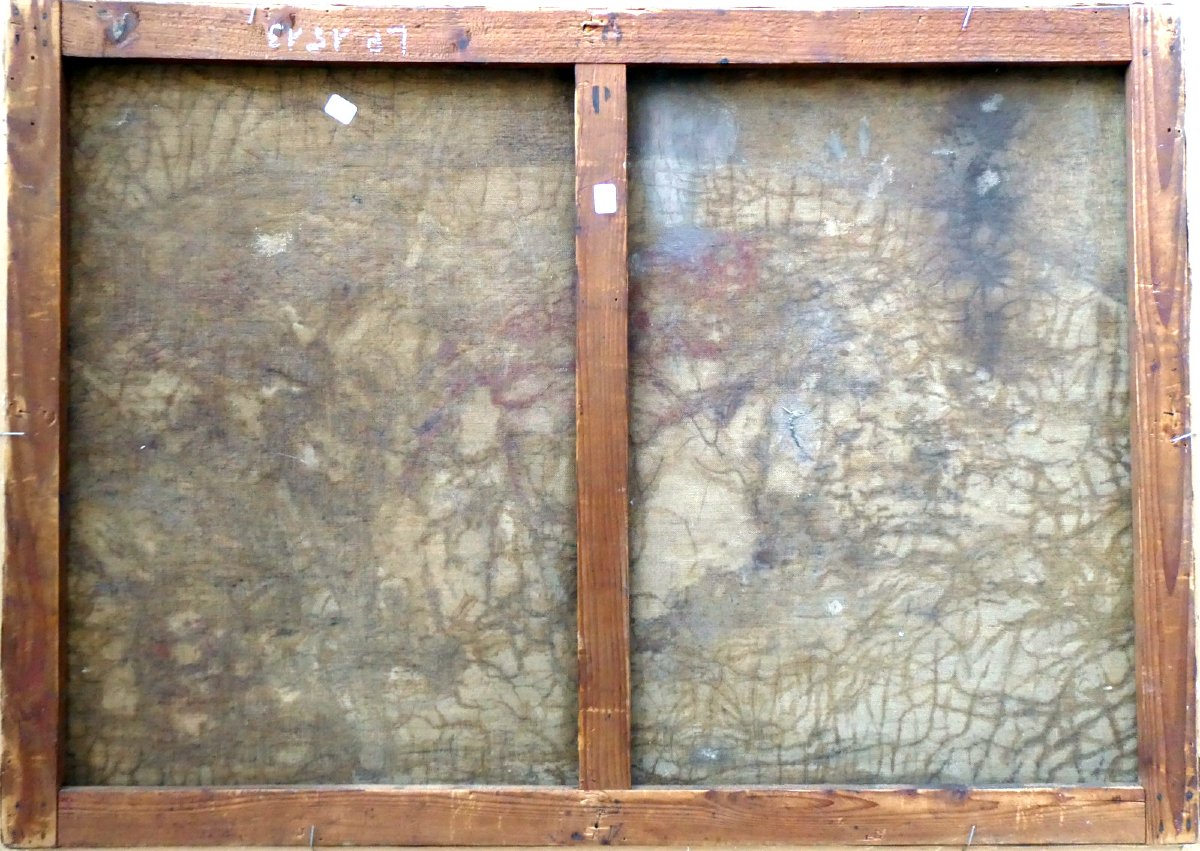
Condition: Fully restored in our whorkshop
Material: Oil painting
Length: 92 cm
Height: 65 cm
Reference (ID): 1808840
Availability: In stock
Print