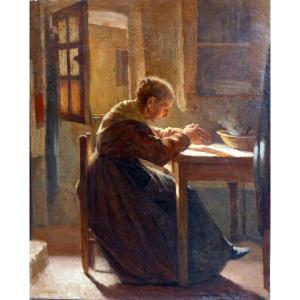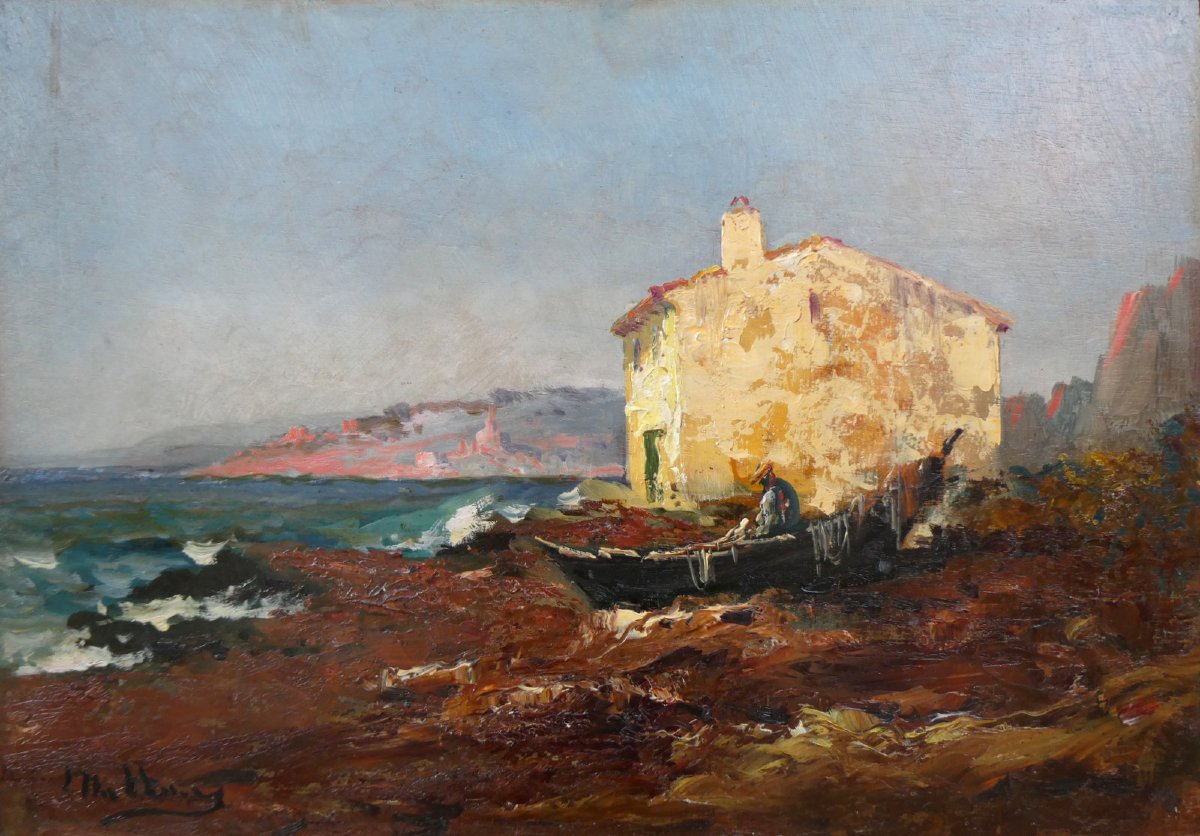
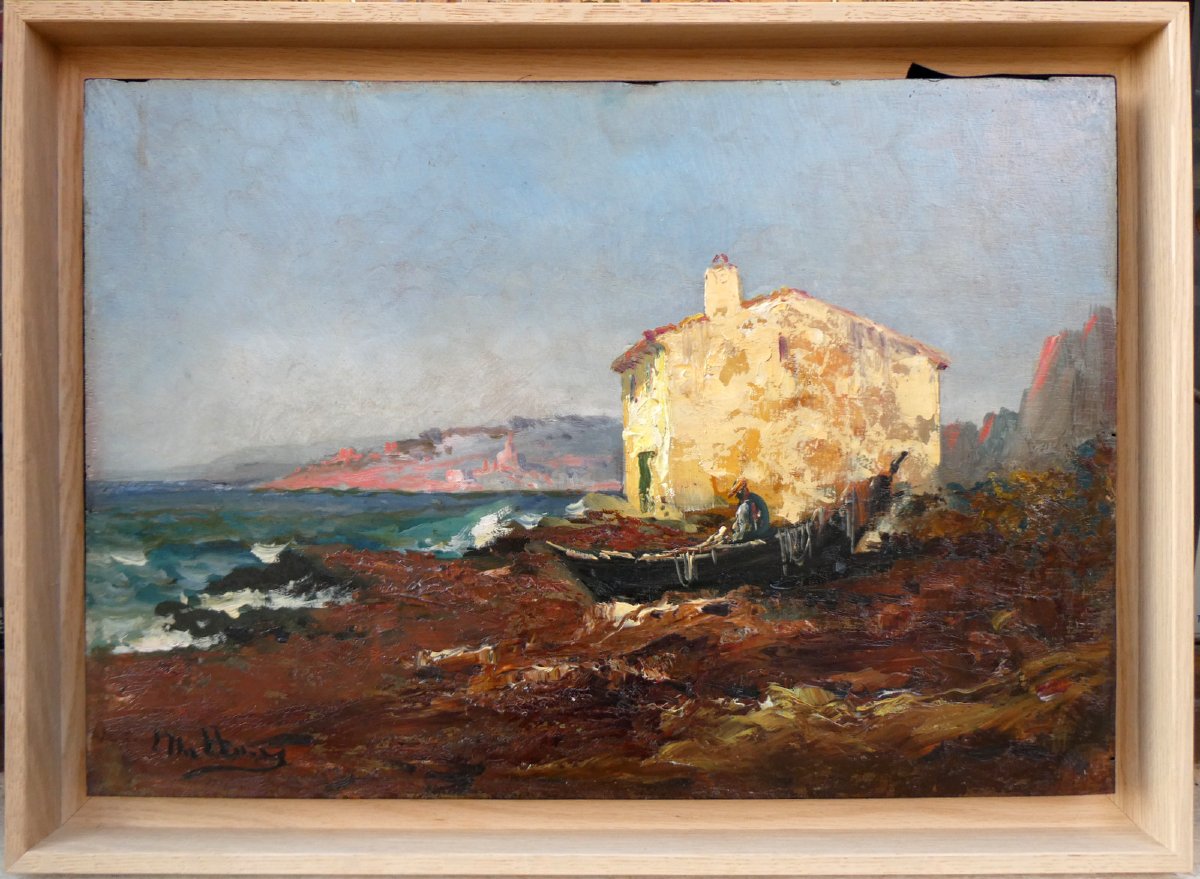
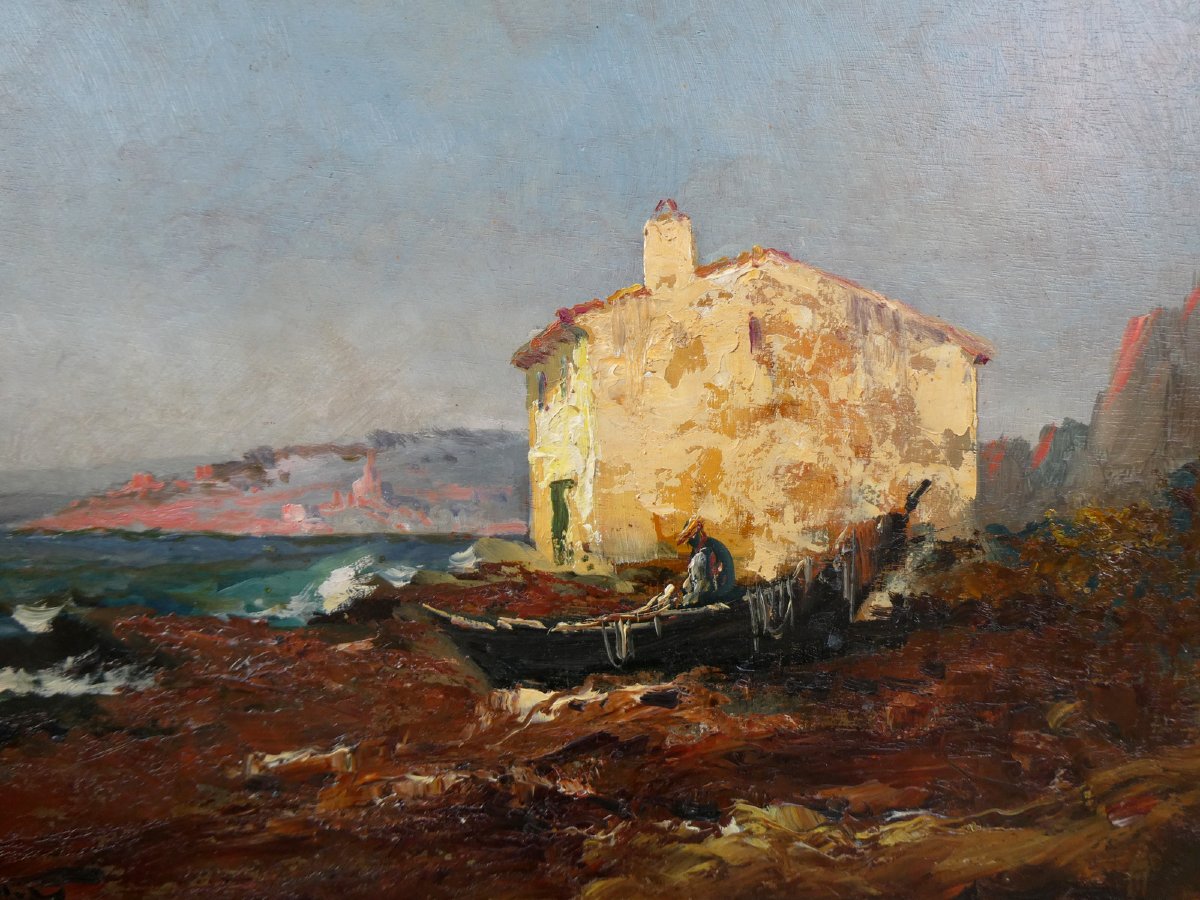
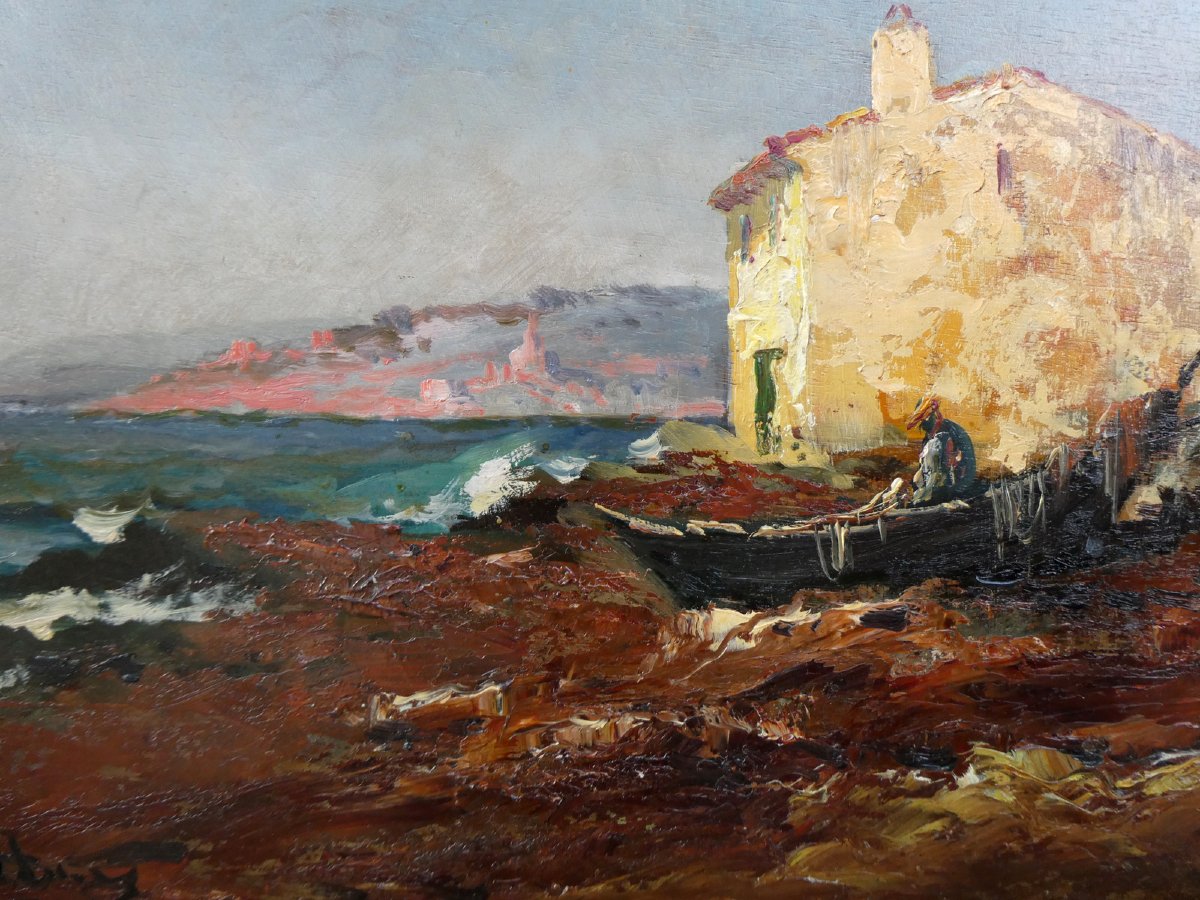
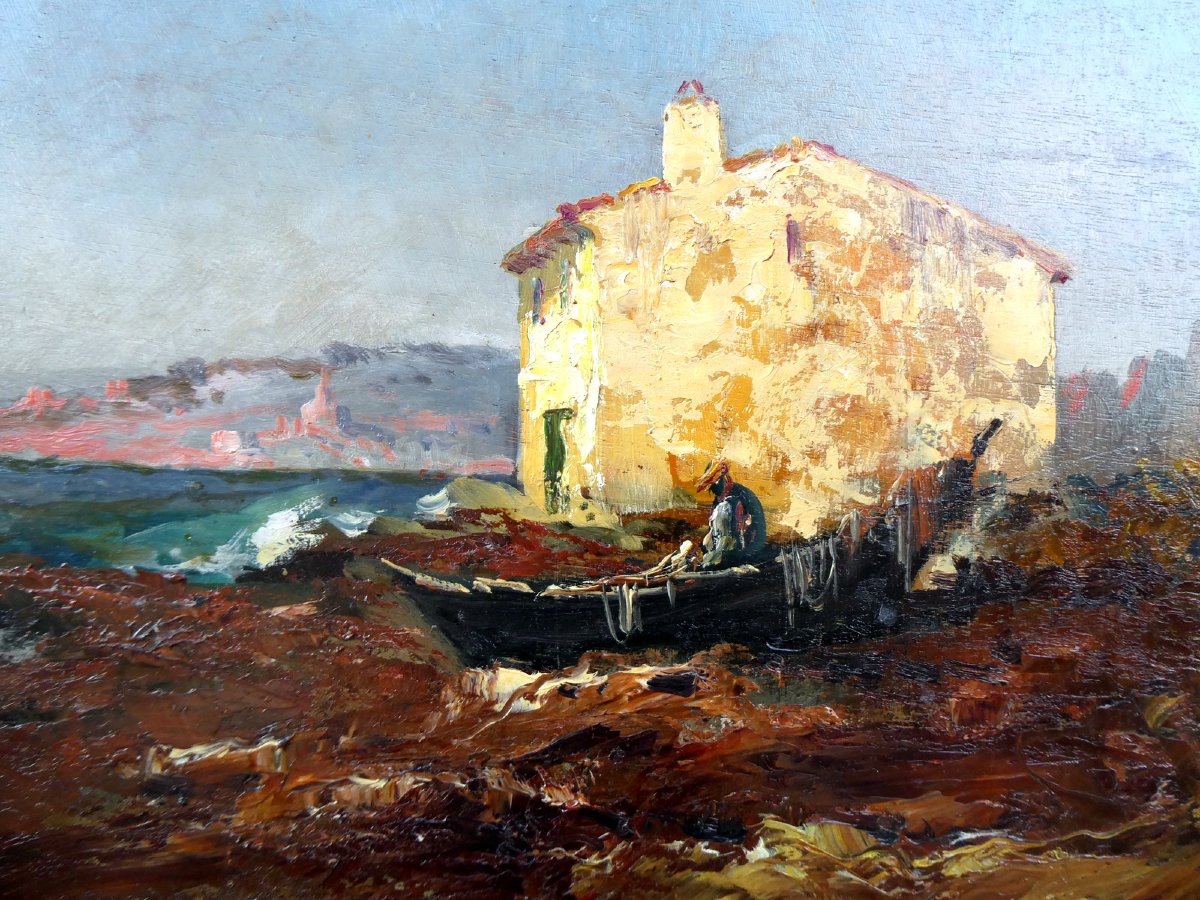
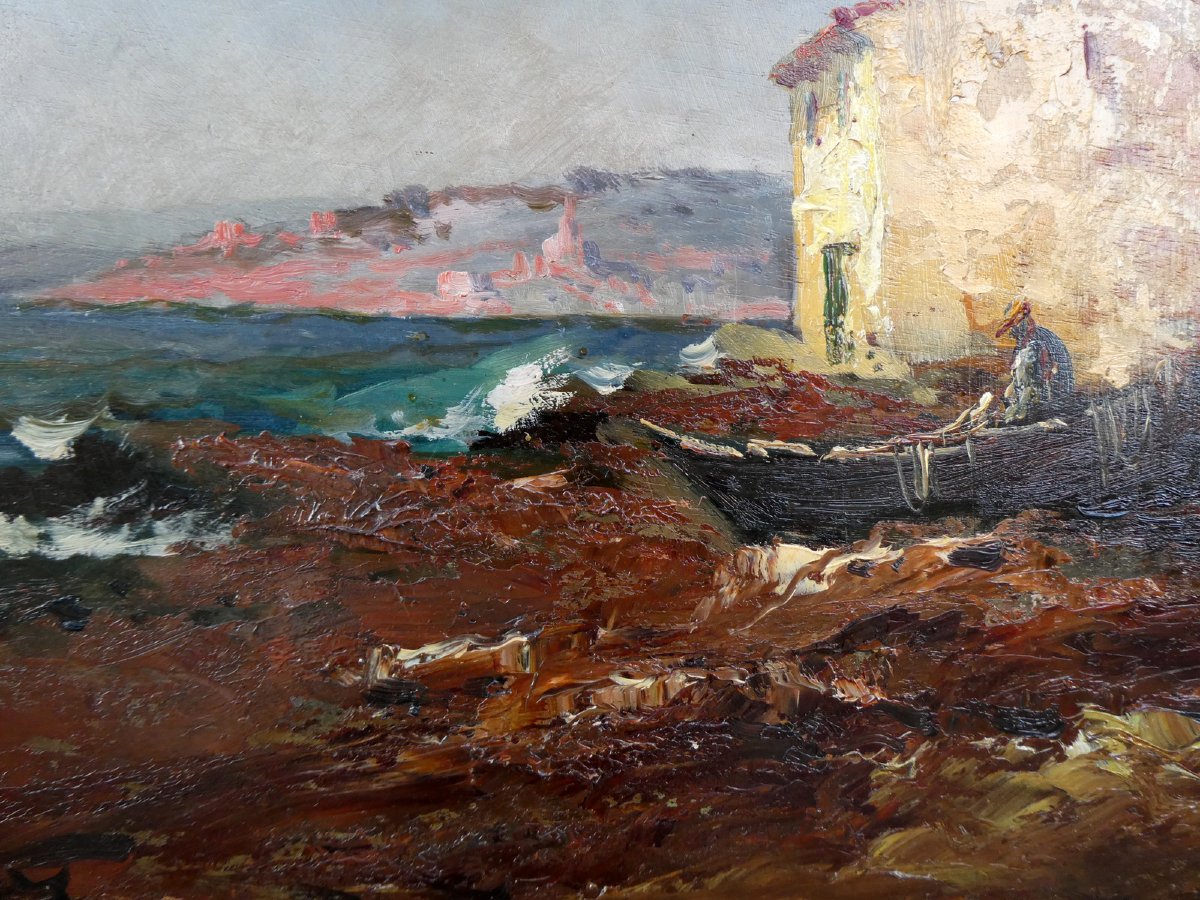
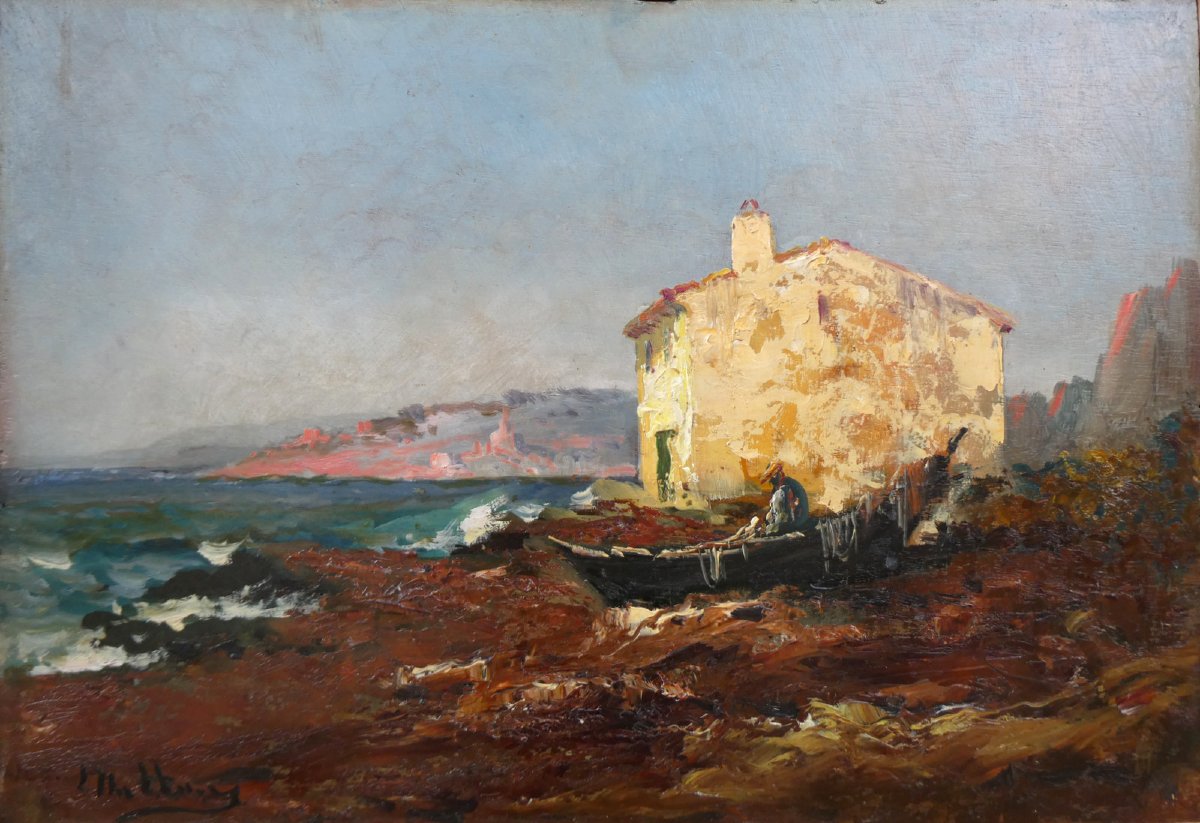


Louis Nattero (1870–1915) A Fisherman Mending His Nets On His Boat, Which Has Been Pulled Ashore
Artist: Louis Nattero (1870-1915)
There is something melancholic and timeless about this work by the painter Louis Nattéro.
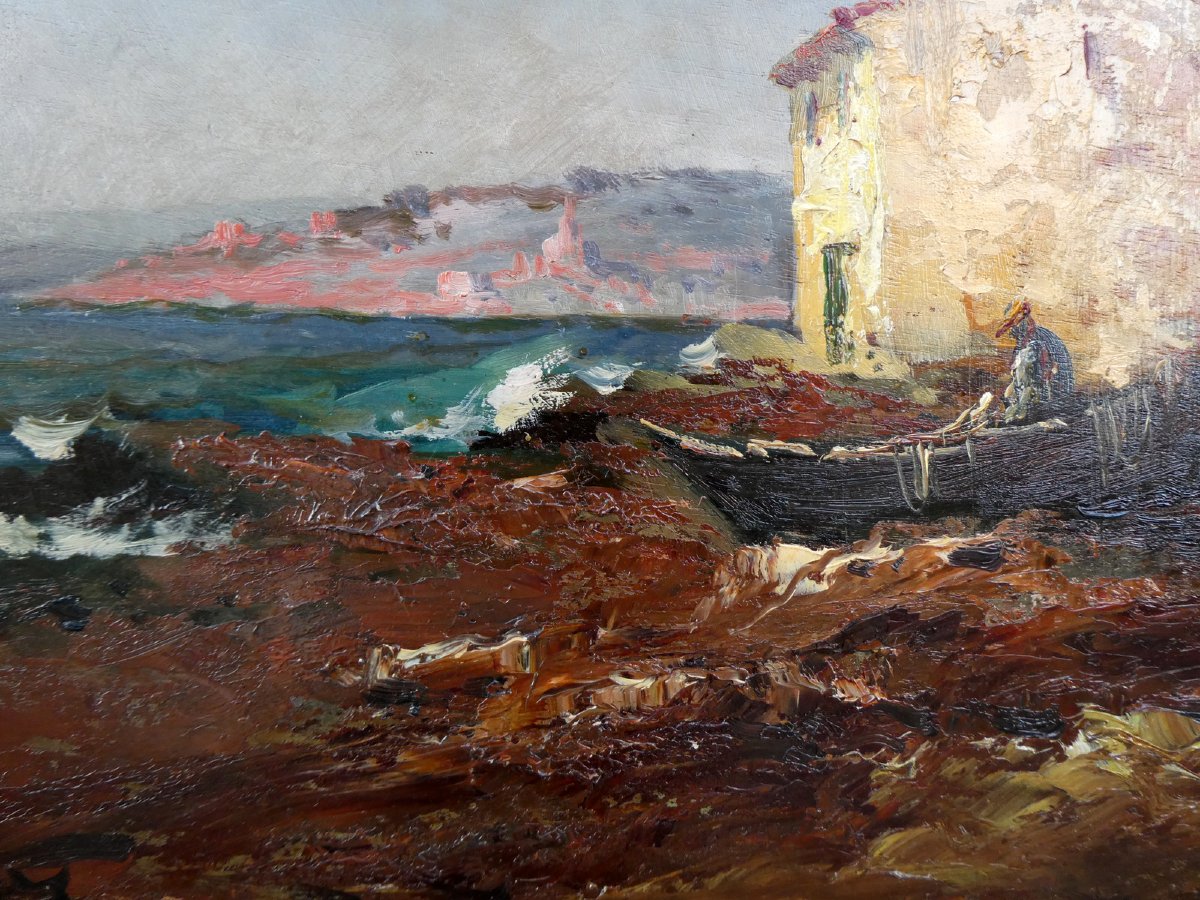
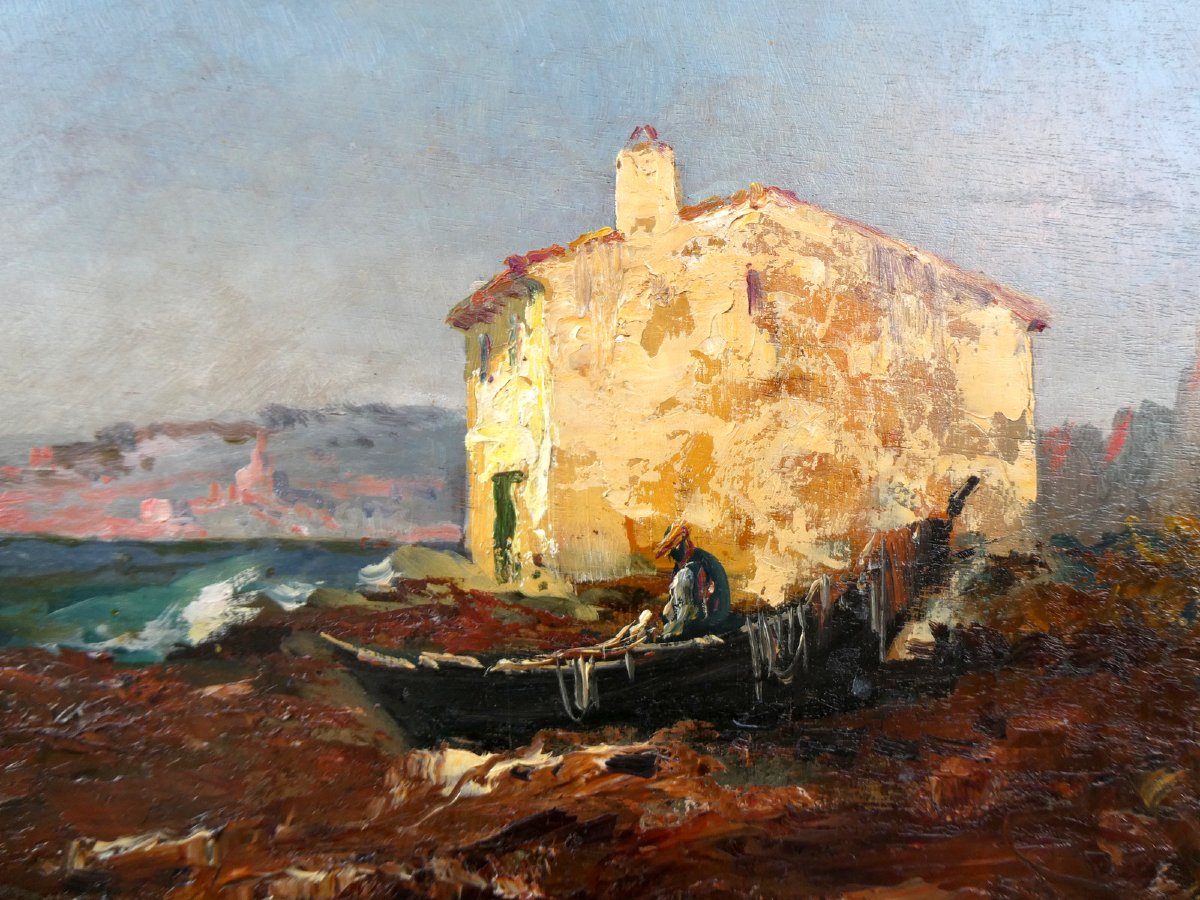
The choice of colors, the use of a thicker thick in certain areas, and the simplicity of the drawing and composition—asif the artist identified with this fisherman in his solitude as he faces the elements and sought to convey a solemn message, already fore shadowing the violent end that would behis own.
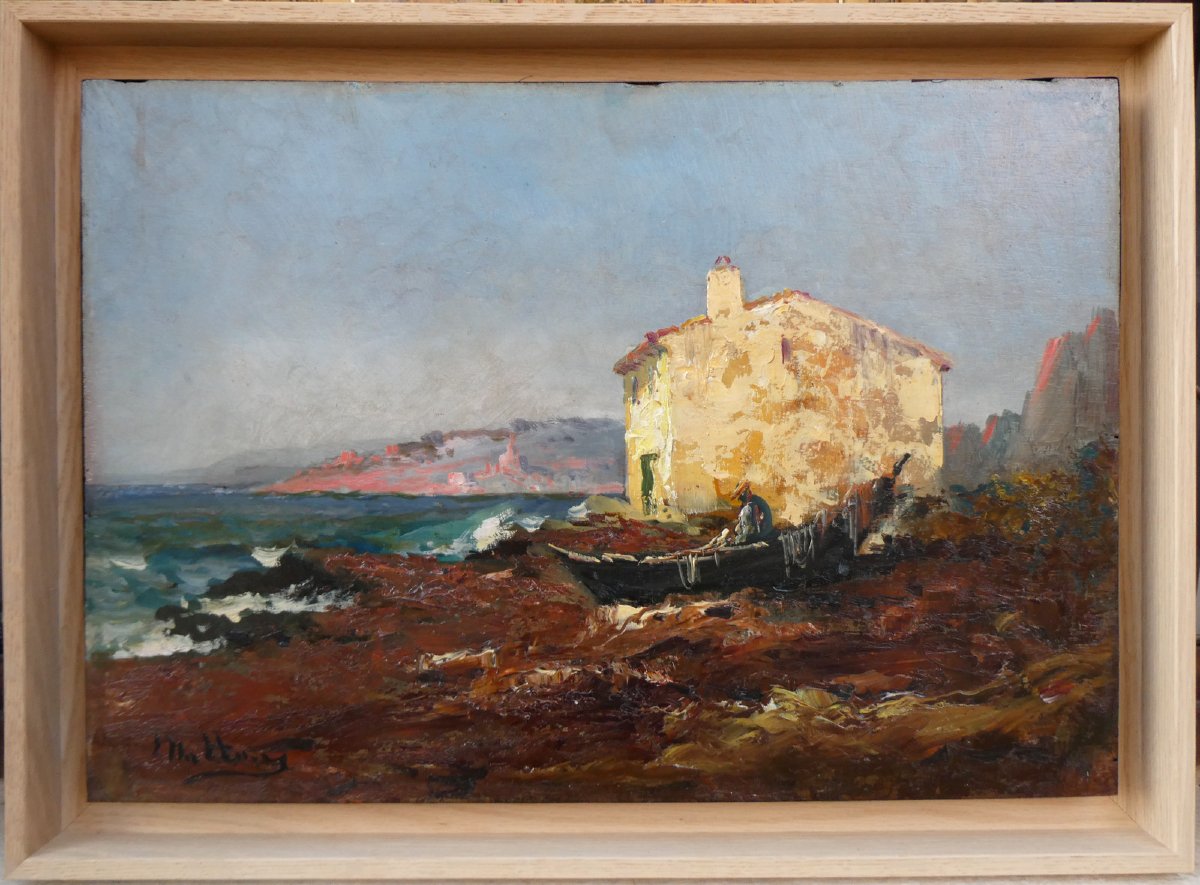
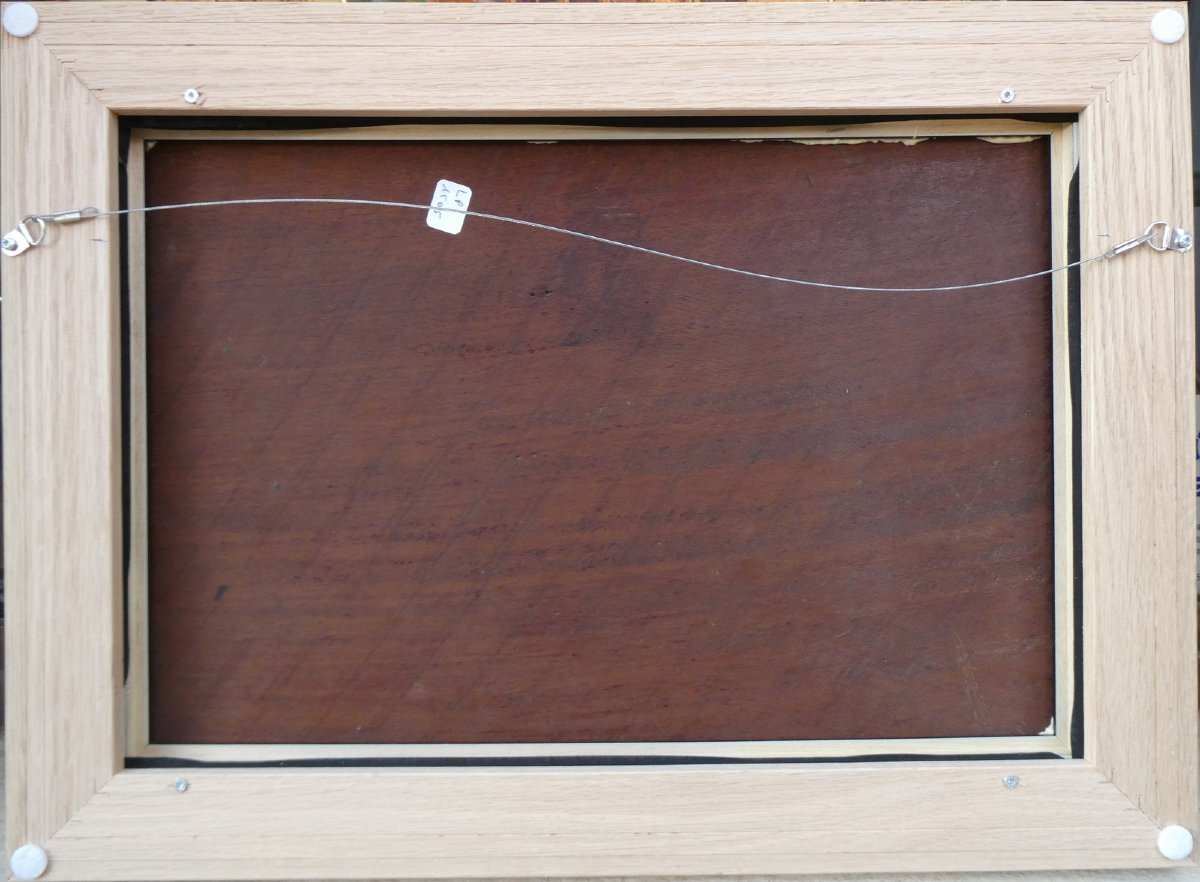
Painted in oil on a wooden panel, the work is presented in a modern, natural oak shadow box frame that measures 37 cm by 50.5 cm, with the painting itself measuring 31.5 cm by 45 cm.
It depicts a solitary fisherman in his flat-bottomed“bette marseillaise”-style boat, pulled ashore in front of the house.
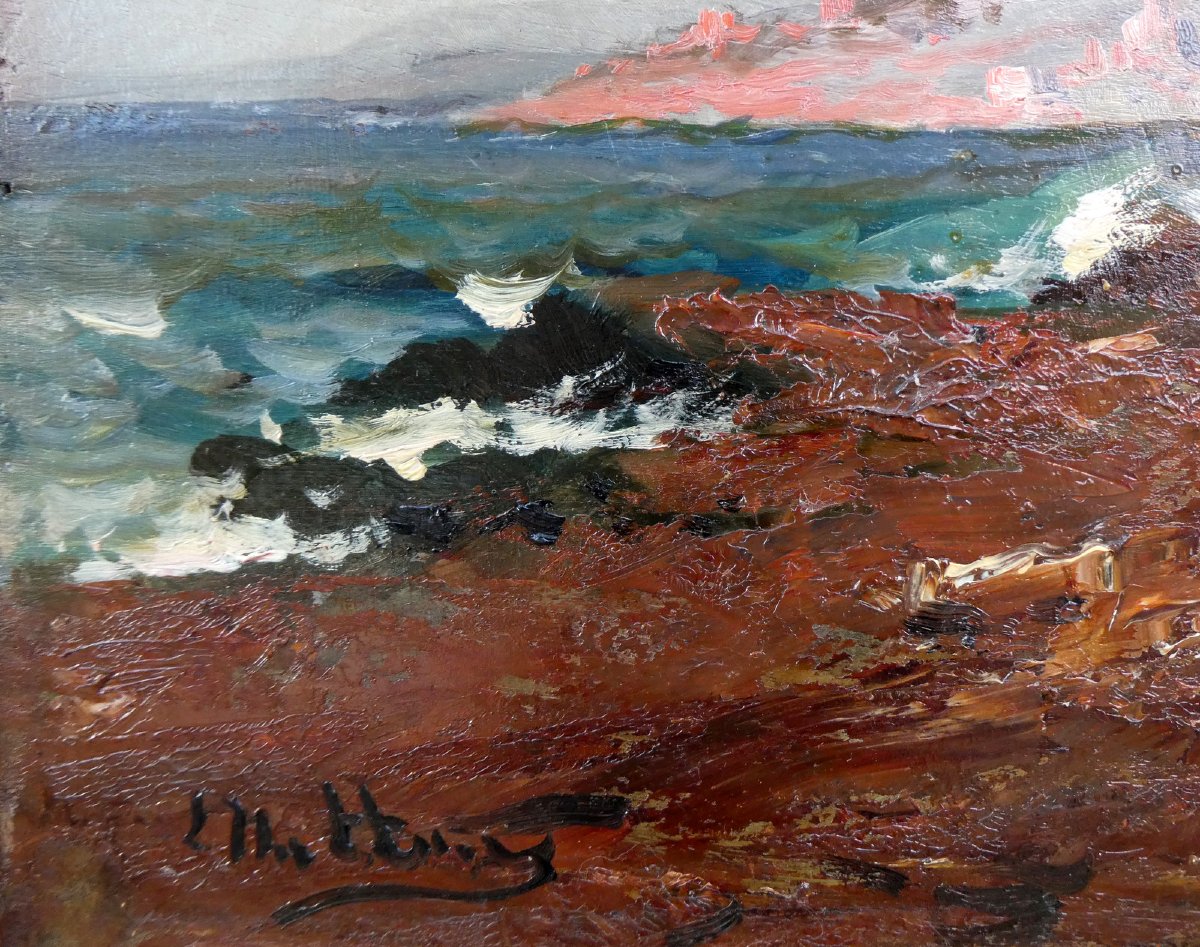
In good condition, it is signed in the lower left corner.
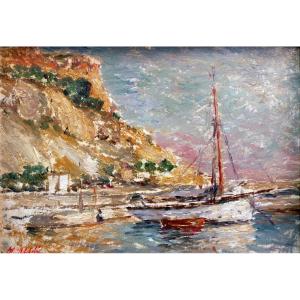
Louis Alexandre Marie Nattero was born on October 16, 1870in Marseille, 1 rue du Pharo, from the second marriage of Dominique Nattero toJeanne Joussaume.His parents quickly separatedin 1872 and, in 1880, Louis was placed in an orphanage.Passionate about drawing, he created his first works around the age of 11:portraits that he managed to sell in order to survive.After an unhappy childhood, he turned to painting.In 1891, in Toulon, he married Lucie Durbec with whom he had nine children. Hisson, Joseph Nattero, born in Marseille in 1904, followed in his father'sfootsteps and painted throughout his life.At the age of 26, from October 1896 to April 1897, thanks to a scholarship fromthe city of Toulon, he attended the École nationale supérieure des beaux-artsin Paris for a few months, where he was a student of Léon Bonnat.However, he suffered from lead poisoning and had to, with regret, stop hisstudies in Paris.He then returned to Toulon, then settled permanently in Marseille, hishometown, in 1904. He also stayed in Aix-en-Provence.His talent was quickly recognized and his paintings were very successful from1905. He participated in most of the salons in the Marseille and Toulon regionand worked tirelessly to feed his large family.In Toulon, he exhibited, among others, at the framer Lacqua (31 rue d'Alger)and at the Albano gallery (rue des Trois Dauphins). In 1902, he was present atthe Friends of the Arts exhibition in Toulon and won several prizes.In Marseille, his workshop is located on Boulevard de la Corderie and his worksregularly appear at the Vallet gallery, rue Paradis. He exhibited at theStudent Association show and at the Grand Cercle Républicain in 1905.In 1914, war broke out and three of his sons left for the front. His paintingno longer sells. A deep despair overcomes him.On November 10, 1915, at his home, 42 bd Joachim in Marseille, he ended hislife by shooting himself in front of his son Joseph.After a ceremony at the Bonneveine church, he was buried in the common grave atthe Mazargues cemetery. The day after his death, the Petit Marseillais launcheda collection to help his widow and children. In the Pointe Rouge district, theMarseille town hall gives its name to a roundabout.In 2004, the Musée du Vieux Toulon organized an exhibition: “Louis Nattero(1870-1915) – Victor Senchet (1879-1973), painters”.The seaFishing boatsLouis Nattero is above all a painter of the Mediterranean.It is for him the true subject of expression when he paints the poetry of atwilight, the sleeping waves of the coves, the fishermen hauling in their netsin an almost hushed calm. He is not the painter of tumult.In his work, the characters are rare, often distant: a sailor drinking from thefeast, a boat on the horizon, fishermen mending their nets, walkers on a quay.Like a photographer, he captures his subjects in everyday life and interpretsthem freely.Largely influenced by the Impressionists, Nattero makes light the essentialelement of his painting.“The vibrant note is in fact the goal that Nattero wants to achieve: for this,he is not afraid to sacrifice the precise line. It admirably gives theimpression of a teeming crowd on our sunny quays, in our picturesque oldstreets by skillfully applied impasto.”—Marseille Student, May 1905He knows perfectly the secret of pure colors and it is with precision that heplaces a touch of red on the cap of a fisherman or a touch of white on therebound of a wave. His palette evolves in shades of blue, mauve, pink, pearlynuances, warm ocher at dusk; the crashing waves changing from metallic emeraldto the lightest, milkiest green ash.He forgets the black.Works La Patache in the port of Toulon, oil on canvas, 46 ×61 cm, 1902-1905, Toulon Art Museum.
The choice of colors, the use of a thicker thick in certain areas, and the simplicity of the drawing and composition—asif the artist identified with this fisherman in his solitude as he faces the elements and sought to convey a solemn message, already fore shadowing the violent end that would behis own.
Painted in oil on a wooden panel, the work is presented in a modern, natural oak shadow box frame that measures 37 cm by 50.5 cm, with the painting itself measuring 31.5 cm by 45 cm.
It depicts a solitary fisherman in his flat-bottomed“bette marseillaise”-style boat, pulled ashore in front of the house.
In good condition, it is signed in the lower left corner.
Louis Alexandre Marie Nattero was born on October 16, 1870in Marseille, 1 rue du Pharo, from the second marriage of Dominique Nattero toJeanne Joussaume.His parents quickly separatedin 1872 and, in 1880, Louis was placed in an orphanage.Passionate about drawing, he created his first works around the age of 11:portraits that he managed to sell in order to survive.After an unhappy childhood, he turned to painting.In 1891, in Toulon, he married Lucie Durbec with whom he had nine children. Hisson, Joseph Nattero, born in Marseille in 1904, followed in his father'sfootsteps and painted throughout his life.At the age of 26, from October 1896 to April 1897, thanks to a scholarship fromthe city of Toulon, he attended the École nationale supérieure des beaux-artsin Paris for a few months, where he was a student of Léon Bonnat.However, he suffered from lead poisoning and had to, with regret, stop hisstudies in Paris.He then returned to Toulon, then settled permanently in Marseille, hishometown, in 1904. He also stayed in Aix-en-Provence.His talent was quickly recognized and his paintings were very successful from1905. He participated in most of the salons in the Marseille and Toulon regionand worked tirelessly to feed his large family.In Toulon, he exhibited, among others, at the framer Lacqua (31 rue d'Alger)and at the Albano gallery (rue des Trois Dauphins). In 1902, he was present atthe Friends of the Arts exhibition in Toulon and won several prizes.In Marseille, his workshop is located on Boulevard de la Corderie and his worksregularly appear at the Vallet gallery, rue Paradis. He exhibited at theStudent Association show and at the Grand Cercle Républicain in 1905.In 1914, war broke out and three of his sons left for the front. His paintingno longer sells. A deep despair overcomes him.On November 10, 1915, at his home, 42 bd Joachim in Marseille, he ended hislife by shooting himself in front of his son Joseph.After a ceremony at the Bonneveine church, he was buried in the common grave atthe Mazargues cemetery. The day after his death, the Petit Marseillais launcheda collection to help his widow and children. In the Pointe Rouge district, theMarseille town hall gives its name to a roundabout.In 2004, the Musée du Vieux Toulon organized an exhibition: “Louis Nattero(1870-1915) – Victor Senchet (1879-1973), painters”.The seaFishing boatsLouis Nattero is above all a painter of the Mediterranean.It is for him the true subject of expression when he paints the poetry of atwilight, the sleeping waves of the coves, the fishermen hauling in their netsin an almost hushed calm. He is not the painter of tumult.In his work, the characters are rare, often distant: a sailor drinking from thefeast, a boat on the horizon, fishermen mending their nets, walkers on a quay.Like a photographer, he captures his subjects in everyday life and interpretsthem freely.Largely influenced by the Impressionists, Nattero makes light the essentialelement of his painting.“The vibrant note is in fact the goal that Nattero wants to achieve: for this,he is not afraid to sacrifice the precise line. It admirably gives theimpression of a teeming crowd on our sunny quays, in our picturesque oldstreets by skillfully applied impasto.”—Marseille Student, May 1905He knows perfectly the secret of pure colors and it is with precision that heplaces a touch of red on the cap of a fisherman or a touch of white on therebound of a wave. His palette evolves in shades of blue, mauve, pink, pearlynuances, warm ocher at dusk; the crashing waves changing from metallic emeraldto the lightest, milkiest green ash.He forgets the black.Works La Patache in the port of Toulon, oil on canvas, 46 ×61 cm, 1902-1905, Toulon Art Museum.
1 400 €
Period: 19th century
Style: Other Style
Condition: Good condition
Material: Oil painting on wood
Length: 45 cm
Height: 31,5 cm
Reference (ID): 1804801
Availability: In stock
Print