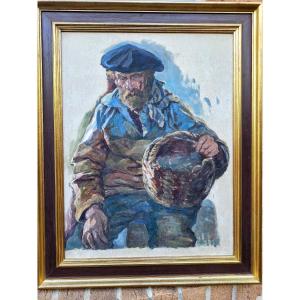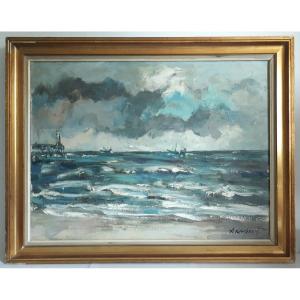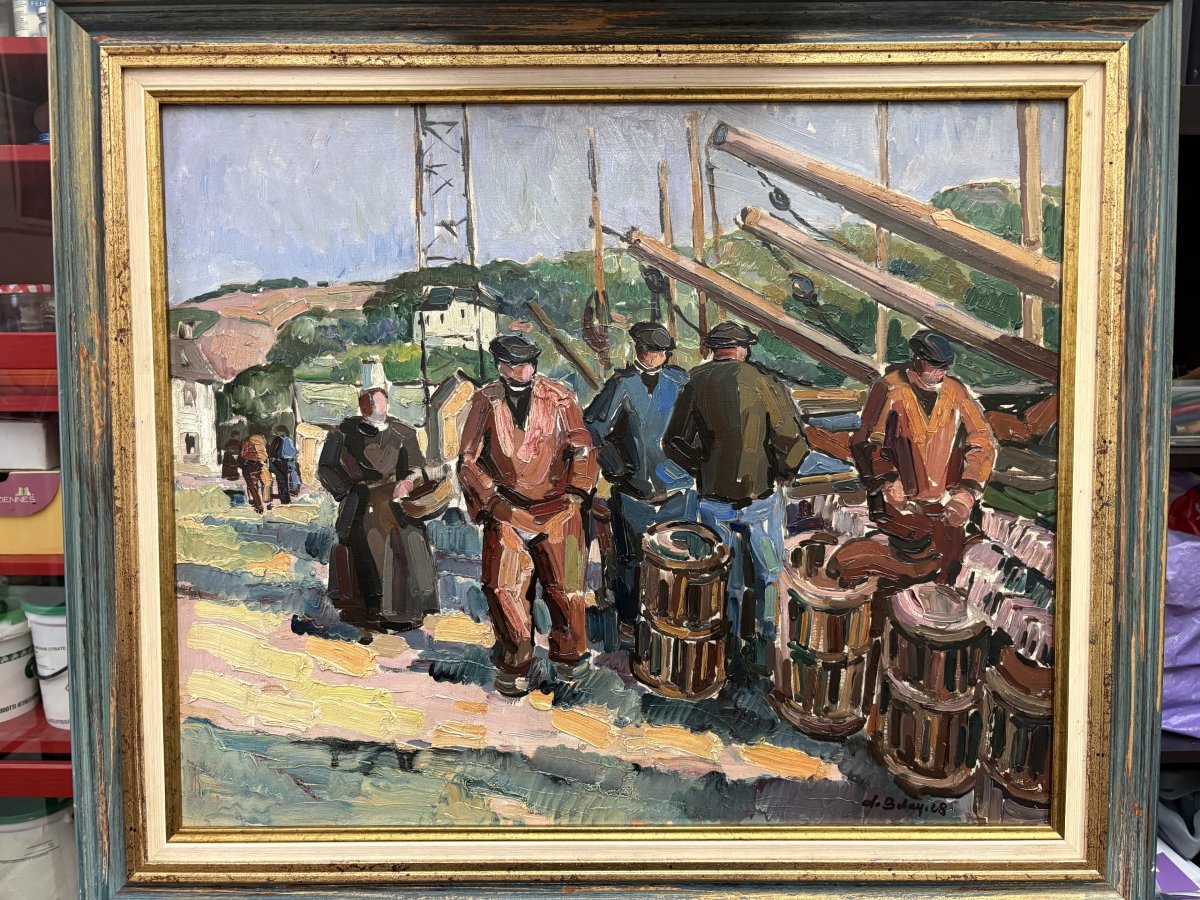
"pierre De Belay: Fishermen On The Audierne Pier," Brittany
Pierre Savigny de Belay or Pierre de Belay, born on December 12, 1890, on Rue des Boucheries in Quimper, France, died on June 30, 1947, in Ostend, Belgium, was a French painter
His real name was Eugène Pierre Savigny (or Pierre Savigny de Belay, named after one of his maternal ancestors), Pierre de Belay discovered his calling as a painter in 1900. His father, Azéma Savigny, a wine merchant and amateur artist who painted many landscapes of the banks of the Odet River or scenes of activity at the port of Quimper, and his mother, Carmelle Bodet, did not oppose their son’s ambitions. The only advice he accepted was that of his father. By 1903, Pierre Savigny de Belay was already painting numerous portraits of Quimper’s leading figures.
He was spotted by Max Jacob, a poet from Quimper and a close friend of the family. Even then, Max Jacob predicted that he would become a famous artist. He studied without a teacher, worked fifteen hours a day, sketched fishermen at the harbor, and recorded scenes from the daily lives of sailors. Max Jacob taught him to guide and control his nature, but not to disobey it. “Drawing,” he would repeat to him, “begins not with the copying of natural forms, but with the interpretation of those forms for the sake of creation. There is no creation where there is only slavish copying.”
Entrance to the Bateau-Lavoir, c. 1910
In 1905, Max Jacob and Pierre Savigny de Belay moved to Paris. They lived in Montmartre, at the Bateau-Lavoir, where Picasso’s studio, among others, was located. There, Pierre de Belay met numerous artists—Juan Gris, Appolinaire, Salmon, whom he painted—and immersed himself in a veritable whirlwind of ideas. Despite this effervescence, Pierre Savigny de Belay maintained his independence from the artistic movements of the time.
His real name was Eugène Pierre Savigny (or Pierre Savigny de Belay, named after one of his maternal ancestors), Pierre de Belay discovered his calling as a painter in 1900. His father, Azéma Savigny, a wine merchant and amateur artist who painted many landscapes of the banks of the Odet River or scenes of activity at the port of Quimper, and his mother, Carmelle Bodet, did not oppose their son’s ambitions. The only advice he accepted was that of his father. By 1903, Pierre Savigny de Belay was already painting numerous portraits of Quimper’s leading figures.
He was spotted by Max Jacob, a poet from Quimper and a close friend of the family. Even then, Max Jacob predicted that he would become a famous artist. He studied without a teacher, worked fifteen hours a day, sketched fishermen at the harbor, and recorded scenes from the daily lives of sailors. Max Jacob taught him to guide and control his nature, but not to disobey it. “Drawing,” he would repeat to him, “begins not with the copying of natural forms, but with the interpretation of those forms for the sake of creation. There is no creation where there is only slavish copying.”
Entrance to the Bateau-Lavoir, c. 1910
In 1905, Max Jacob and Pierre Savigny de Belay moved to Paris. They lived in Montmartre, at the Bateau-Lavoir, where Picasso’s studio, among others, was located. There, Pierre de Belay met numerous artists—Juan Gris, Appolinaire, Salmon, whom he painted—and immersed himself in a veritable whirlwind of ideas. Despite this effervescence, Pierre Savigny de Belay maintained his independence from the artistic movements of the time.
6 400 €
Period: 20th century
Style: Modern Art
Condition: Perfect condition
Material: Oil painting on cardboard
Length: 50
Width: 60
Reference (ID): 1827248
Availability: In stock
Print