


Strasbourg, 1763, Besenval-von Roll Coat Of Arms, Sprinkling Spoon, Sugar Spoon, Johann Pick
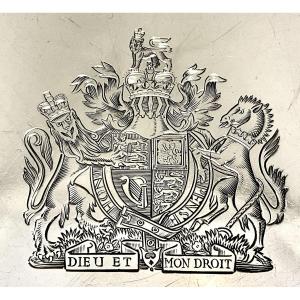
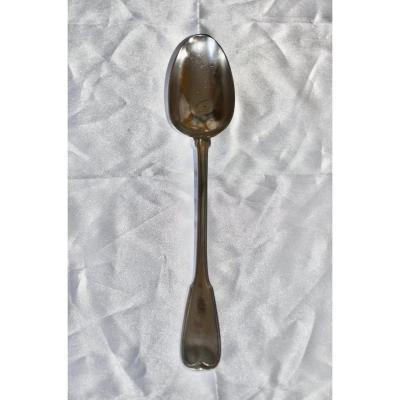
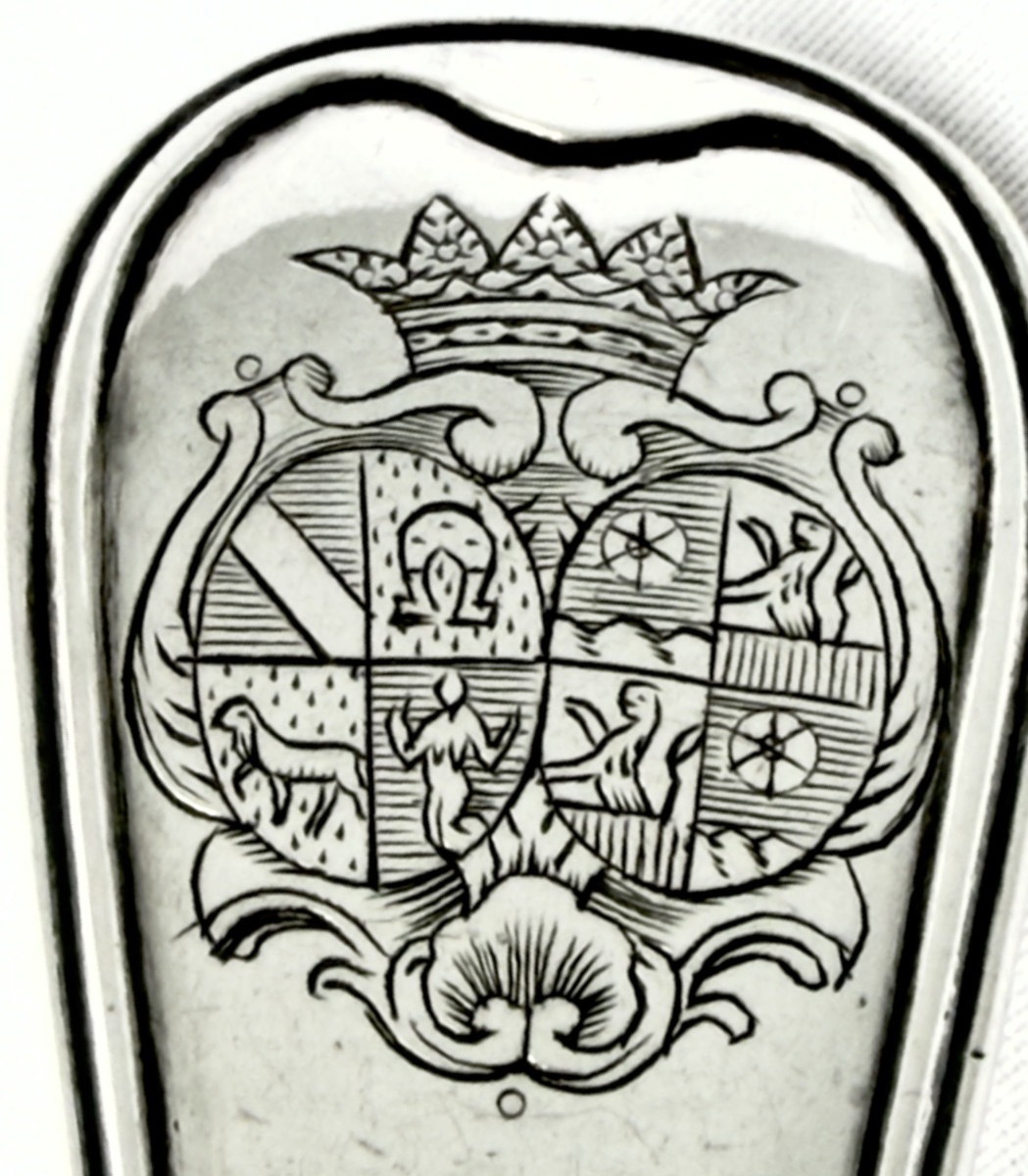
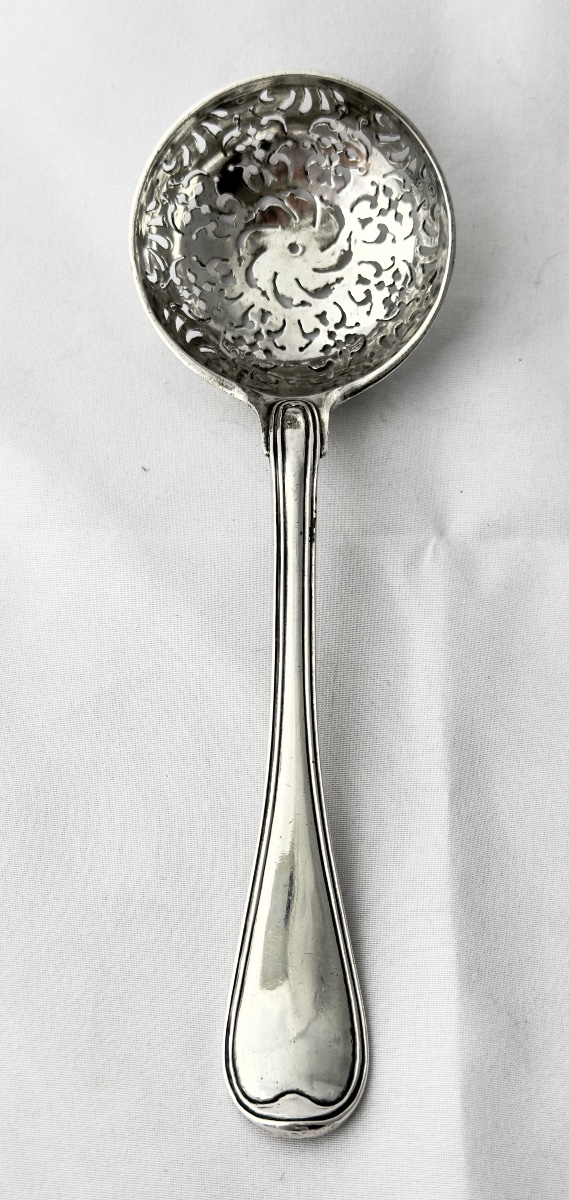
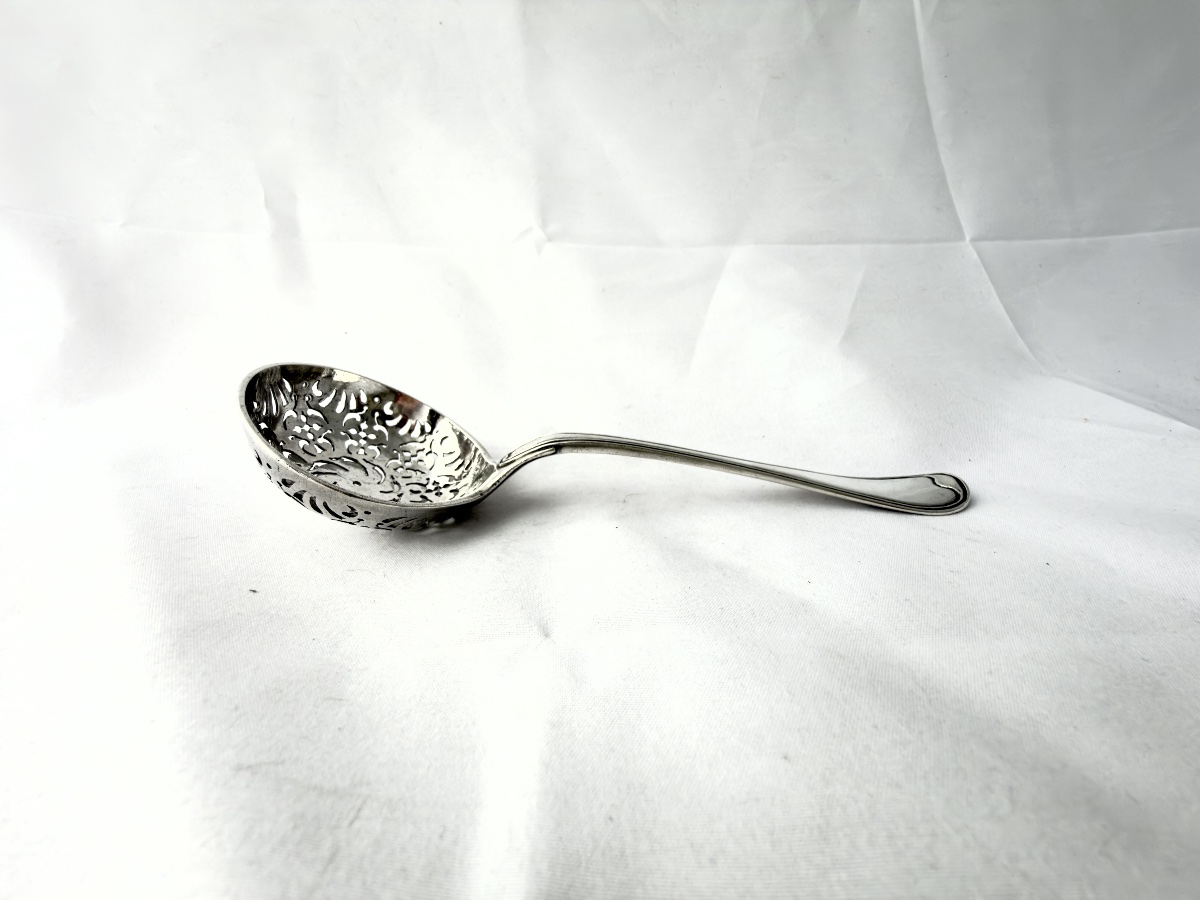
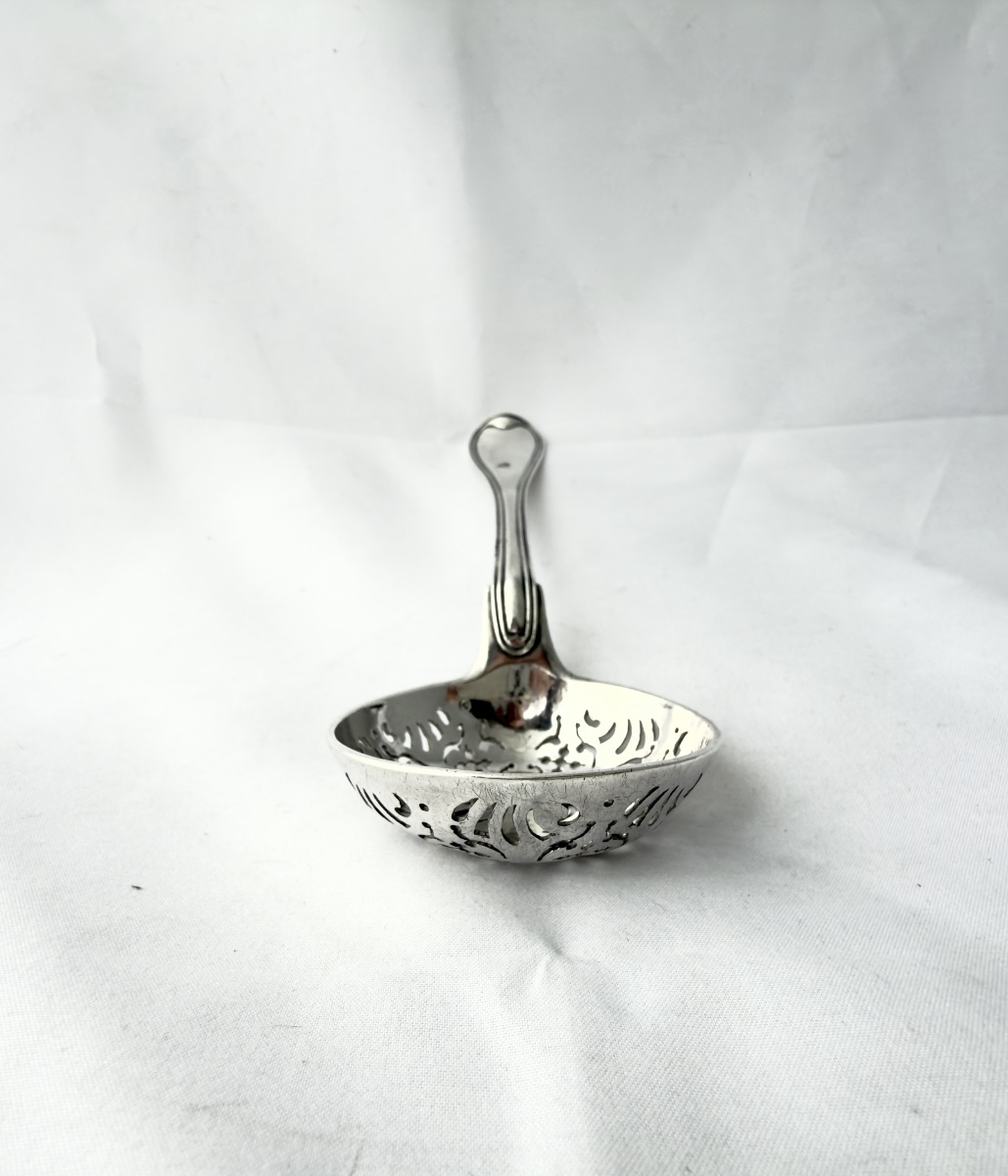
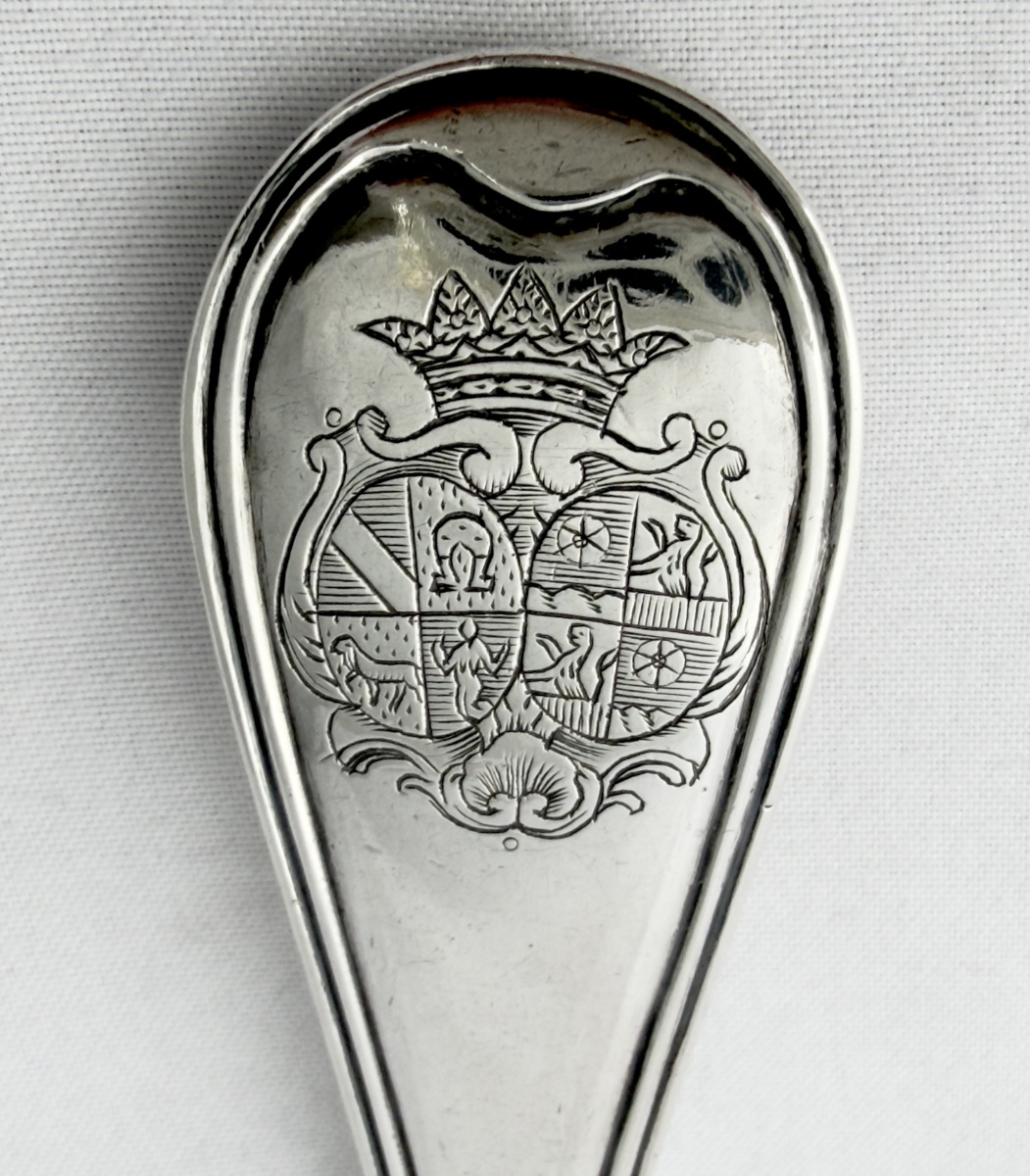
Rare solid-silver sugar sifter spoon bearing the alliance arms of the Besenval and von Roll von Emmenholz families.
Strasbourg, 1763.
Silversmith: Johann Pick.
Silver of the exceptional standard of 11 deniers 12 grains, equivalent to approximately 958 fineness.
Length: 20 cm – diameter of the bowl: 7 cm.
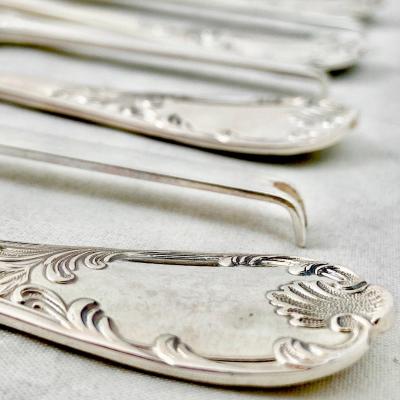
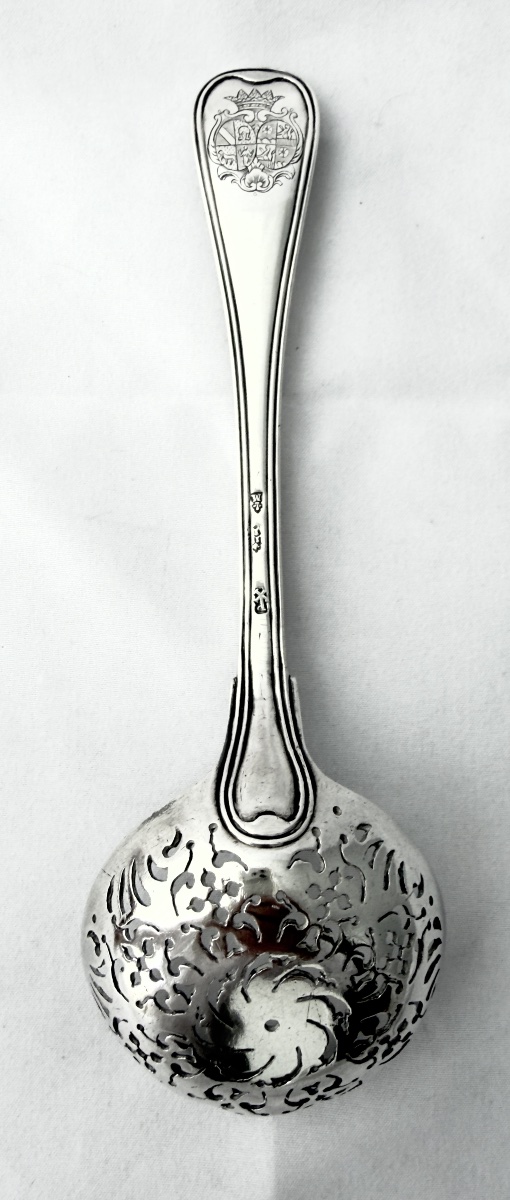
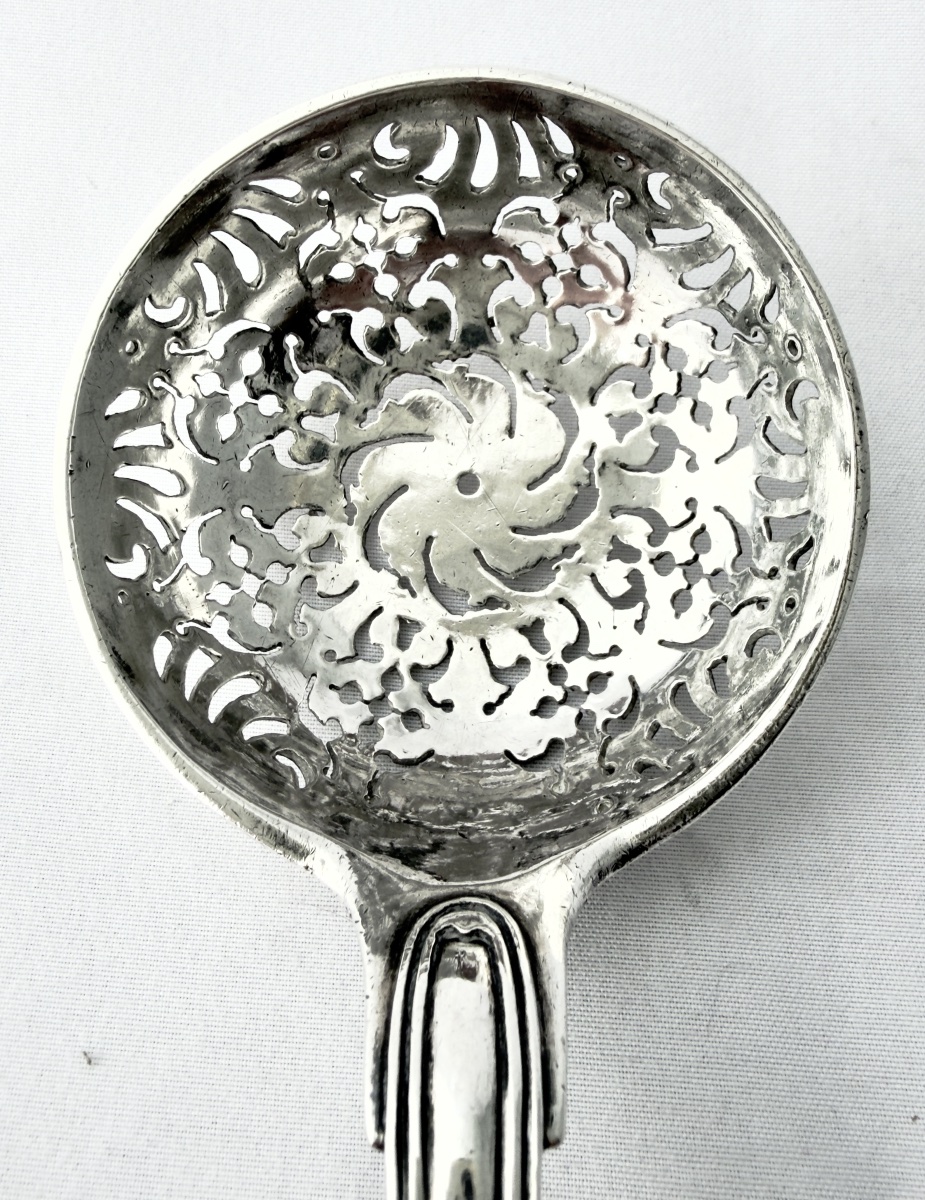
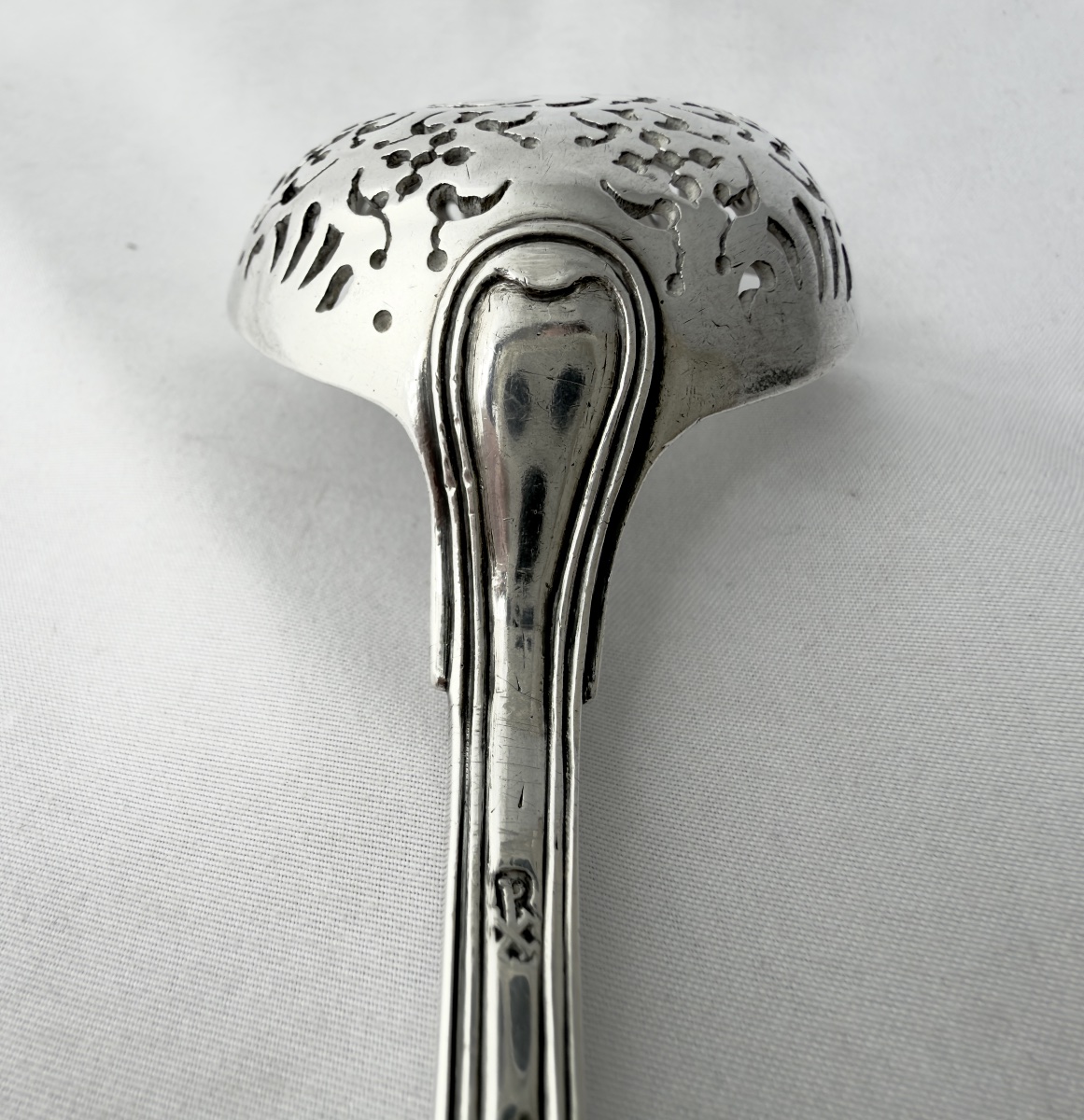
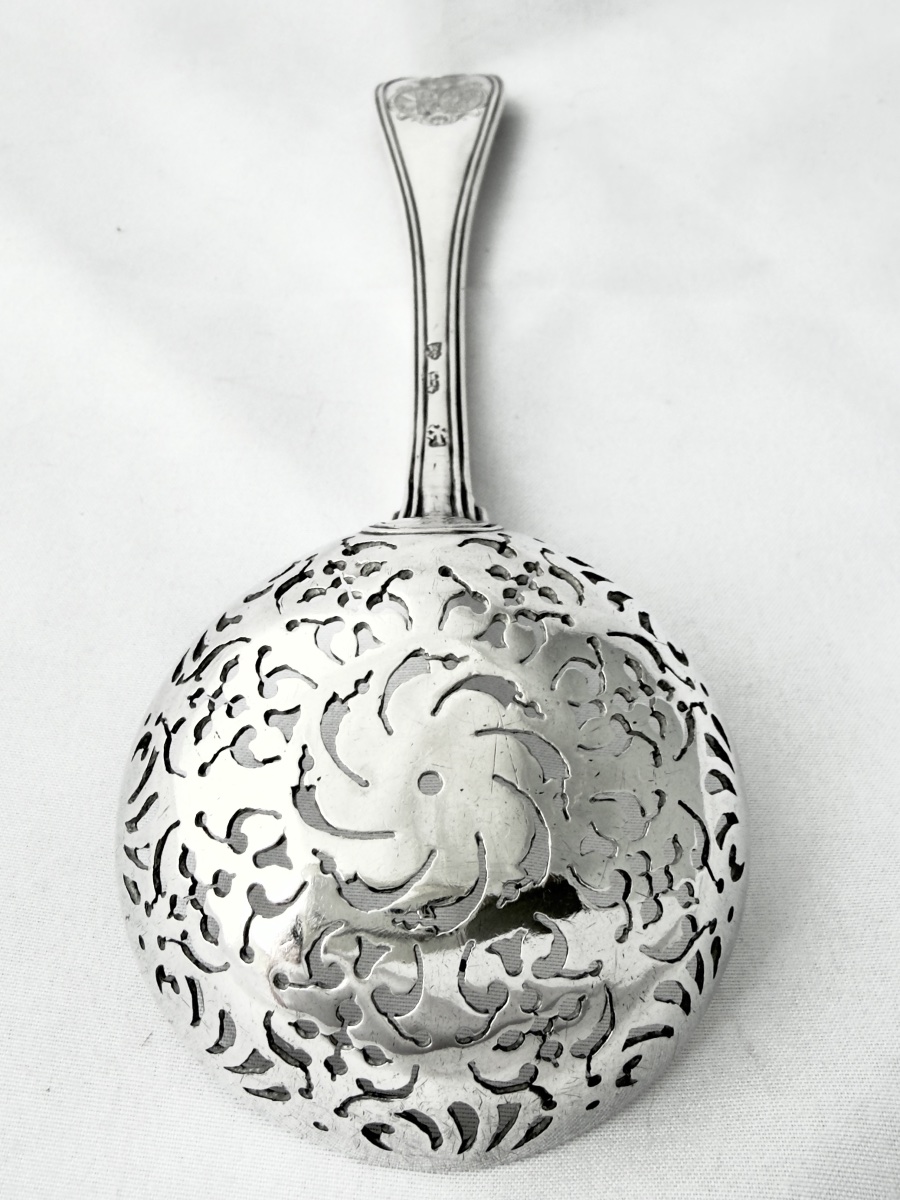
This rare solid-silver sugar sifter spoon has a large circular, fully pierced bowl designed to scoop and evenly sprinkle powdered sugar. A moulded thread runs along the entire length of the handle to the terminal, which is engraved with the alliance arms of its original owners.[1]
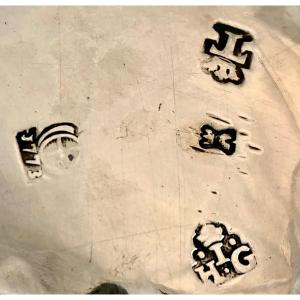
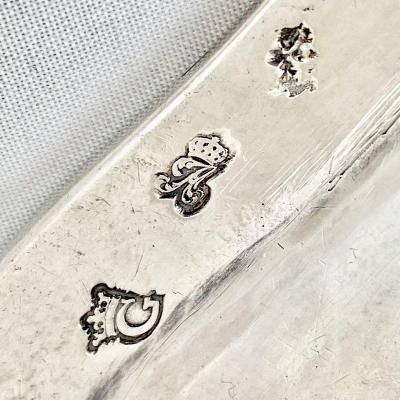
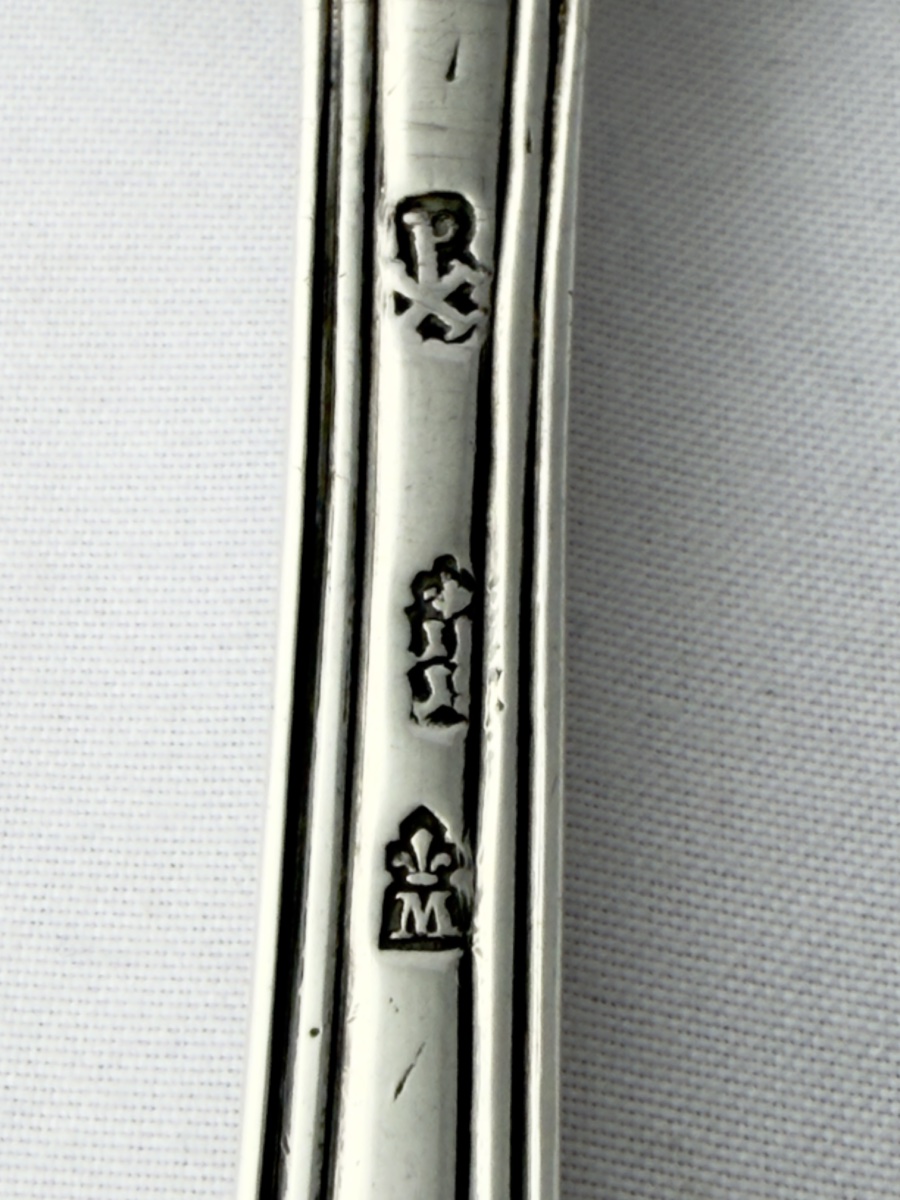
The handle bears a particularly interesting set of hallmarks. These comprise the Strasbourg town mark, the date letter M corresponding to 1763, and the maker’s mark of the silversmith Johann Pick: a P above two intertwined capital letters I.[1][2]
The spoon also bears the standard mark for 11 deniers 12 grains, represented by the numbers 11 and 12 beneath a fleur-de-lis. This corresponds to approximately 958 parts per thousand of fine silver, the statutory French standard and considerably higher than the 13-loth standard — 812.5 parts per thousand — generally used by Strasbourg silversmiths.[1][2] The choice of this higher and more costly standard, unusual in Strasbourg, underlines the prestigious nature of the commission.
The spoon’s principal historical interest, however, lies in the alliance arms engraved at the time of its manufacture. They are those of Jean-Pierre-Joseph de Besenval and Marie-Josèphe von Roll von Emmenholz, who married in 1759, four years before the spoon was made.[1][3]
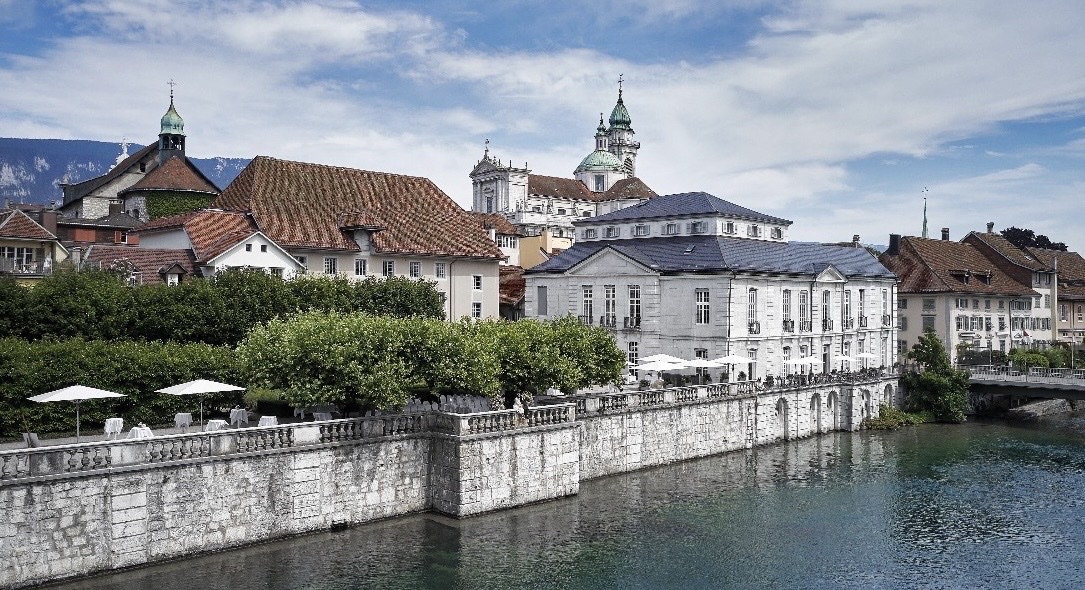
This marriage united two of the wealthiest and most influential Catholic patrician families of Solothurn, Switzerland. The Besenval and von Roll families held important political offices, owned extensive estates and maintained privileged relations with the French monarchy.[3][4]
The Besenvals of Brunnstatt derived a considerable part of their power from the salt trade and from military service in France. The family owned the Alsatian lordships of Brunnstatt, Riedisheim and Didenheim, as well as Waldegg Castle, near Solothurn, Switzerland, built between 1682 and 1686 as their country residence.[3][5] They also commissioned the Palais Besenval in Solothurn, Switzerland, constructed between 1703 and 1706 following the French model of a private mansion entre cour et jardin.[3]
The Besenval family’s connections with France were particularly close. Under the system of military capitulations concluded with the Swiss cantons, Swiss regiments served in the French royal army and were maintained by the King of France. A Swiss regiment was even known as the Besenval Regiment from 1729 to 1739, after its colonel-proprietor Jean-Victor de Besenval.[3][6]
A close relative of the couple, the celebrated Pierre-Victor de Besenval de Brunnstatt (1721–1791), pursued a distinguished career in the service of the French monarchy. Having entered the Swiss Guards at a very young age, he became a Lieutenant-General in the King’s armies, Inspector-General of the Swiss and Grisons troops and, finally, Commander-in-Chief of the troops and garrisons stationed within the kingdom.[5] Under Louis XVI, he became one of Queen Marie-Antoinette’s intimates and advisers.[5][6]
In 1767, Pierre-Victor de Besenval acquired a magnificent private mansion on the Rue de Grenelle in Paris, which he commissioned the architect Alexandre-Théodore Brongniart to remodel in order to house his important art collection.[6] Still known as the Hôtel de Besenval, the building has housed the Swiss Embassy in France since 1938.[6] This Parisian residence belonged to Pierre-Victor de Besenval and not directly to the couple whose arms appear on the spoon.
Marie-Josèphe belonged to the von Roll von Emmenholz branch, one of the most powerful families of the Catholic patriciate of Solothurn, Switzerland. She was the daughter of Franz-Viktor-Augustin von Roll von Emmenholz (1700–1773) and Johanna-Margaretha-Viktoria de Besenval (1704–1793); through her mother, she was therefore herself descended from the Besenval family.[4][7]
Her father had served in France before holding the principal political offices of Solothurn, Switzerland. He was successively a member of the Grand Council, interpreter to the French embassy, treasurer, banneret and, from 1759 until his death in 1773, chief magistrate or avoyer of Solothurn, Switzerland.[7] The Historical Dictionary of Switzerland describes him as possessing by far the largest fortune in Solothurn, Switzerland, and as the leader of the French party in the city.[7]
In 1749, Franz-Viktor-Augustin von Roll acquired the lordship and castle of Hilfikon, in what is now the Swiss canton of Aargau. He had the castle chapel rebuilt and richly decorated; its Rococo interior notably contains a representation of the Holy Sepulchre in Jerusalem.[7]
The marriage of 1759 therefore represented more than the union of two great fortunes: it renewed an existing family alliance, since Marie-Josèphe was already related to the Besenvals through her mother. Dated 1763, decorated with the couple’s arms and made in silver of an exceptional standard for Strasbourg, this spoon may originally have formed part of an important table service commissioned a few years after their marriage.[1][3]
The sugar sifter spoon in the eighteenth century
The sugar sifter spoon, also simply called a “sugar spoon”, appeared in France around 1735–1740, at a time when an increasing number of specialised utensils were being created for the refined service of the table.[8]
At the beginning of the eighteenth century, sugar remained a precious commodity consumed mainly in aristocratic and wealthy bourgeois households. It was sold in the form of hard, compact sugar loaves that had to be broken, crushed and sometimes sifted to obtain a more or less finely powdered sugar.[8][9]
Before the appearance of the sugar spoon, powdered sugar was commonly dispensed from a closed sugar caster whose upper section was pierced with small holes. The development of open sugar bowls, or bowls fitted with a notched cover, encouraged the introduction of a separate and more convenient utensil: the sugar sifter spoon.[8]
It was used to sprinkle sugar over fresh fruit, compotes, creams, fritters and other desserts, but could also accompany the serving of tea, coffee or chocolate.[8] The pierced bowl therefore fulfilled a practical purpose while offering the silversmith an opportunity to display remarkable decorative virtuosity.
References
[1] Direct examination of the spoon: dimensions, decoration, hallmarks and engraved coats of arms.
[2] Hans Haug, Jacques Fischer and Louis Hesselbarth, Le siècle d’or de l’orfèvrerie de Strasbourg, exhibition catalogue, Galerie Jacques Kugel, Paris, 1964, 107 pp.
Bibliographical record
[3] Gabrielle Claerr Stamm, De Soleure à Paris : la saga de la famille de Besenval, seigneurs de Brunstatt, Riedisheim et Didenheim, Société d’histoire du Sundgau, 2015.
[4] Philippe Rogger and André Holenstein, “The Besenval Family: Constants and Changes in Its Entrepreneurial Strategies”, in Officers, Entrepreneurs, Career Migrants and Diplomats: Military Entrepreneurs in the Early Modern World, Brill, 2024.
View the publication
[5] Marco Schnyder, “Besenval de Brunnstatt, Pierre-Victor”, Historical Dictionary of Switzerland.
View the entry
[6] Andreas Affolter, “The Passions of Monsieur de Besenval”, Swiss National Museum, 2021; Jean-Pierre Samoyault, L’Hôtel de Besenval – Ambassade de Suisse en France, Paris, 2017.
Swiss National Museum article
[7] Erich Meyer, “Roll von Emmenholz, Franz Viktor Augustin”, Historical Dictionary of Switzerland, 2012.
View the entry
[8] Bilgi Kenber, Françoise Baudequin, Nicolas Marischael, Paul Micio and Philippe Palasi, Les cuillers à sucre dans l’orfèvrerie française du XVIIIe siècle, Paris, Somogy, 2003, 256 pp.
Bibliographical record of the Château de Fontainebleau
[9] Noël Deerr, The History of Sugar, London, Chapman & Hall, 1949–1950, 2 vols.
Period: 18th century
Style: Louis 15th - Transition
Condition: Excellent condition
Material: Sterling silver
Length: 20 cm
Diameter: 7 cm
Reference (ID): 1820157
Availability: In stock