




A Follower Of Jan Van Der Straet, Known As Giovanni Stradano (1523–1605), Giulio Cesare
A follower of Jan van der Straet, known as Giovanni Stradano (Bruges, 1523 – Florence, 1605)
Julius Caesar
Oil on canvas, 103 x 83 – with frame, 127 x 108 cm
Reference publication: A. Baroni Vannucci, Jan van der Straet, known as Giovanni Stradaro: flandrus pictor et inventor, Jandi Sapi, 1997, p. 416
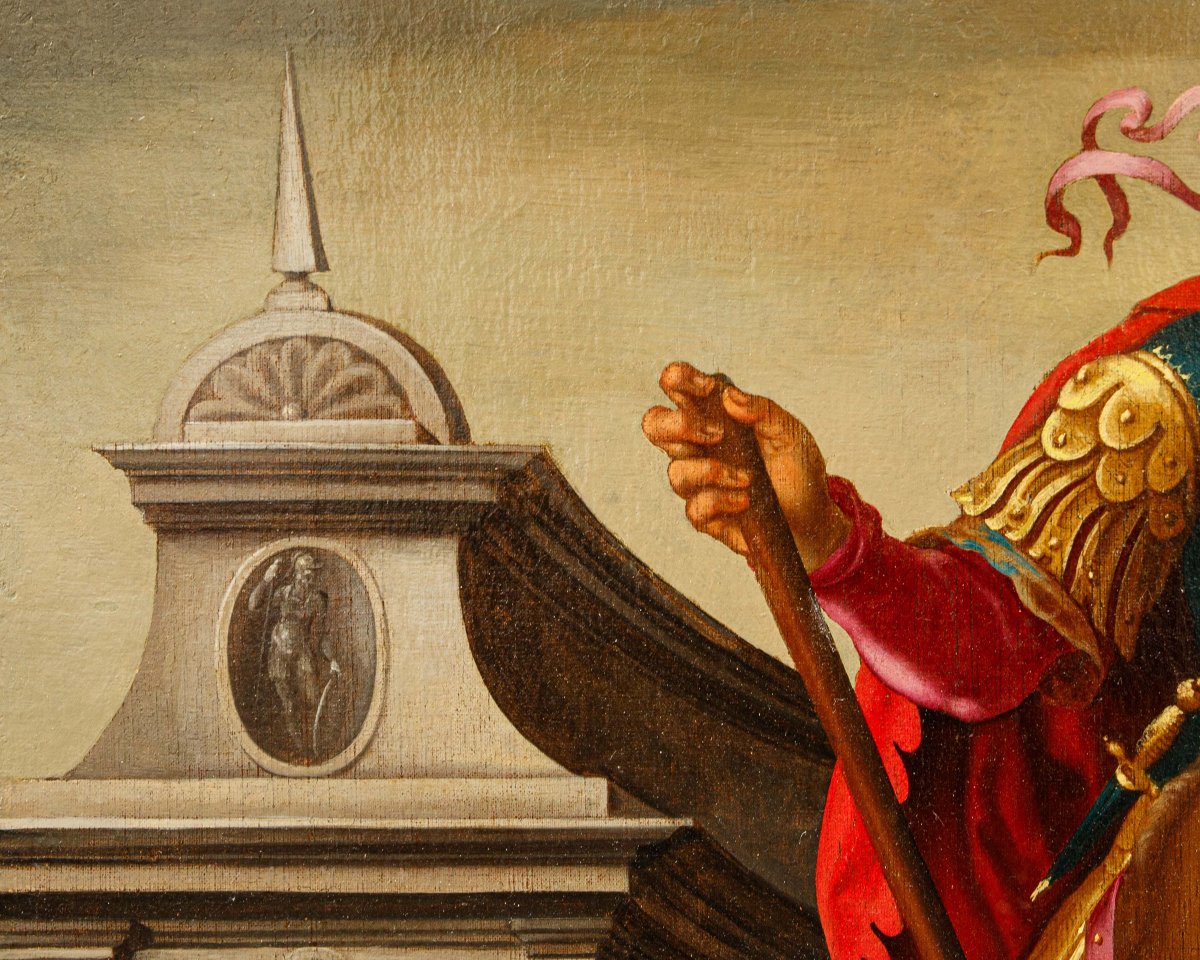
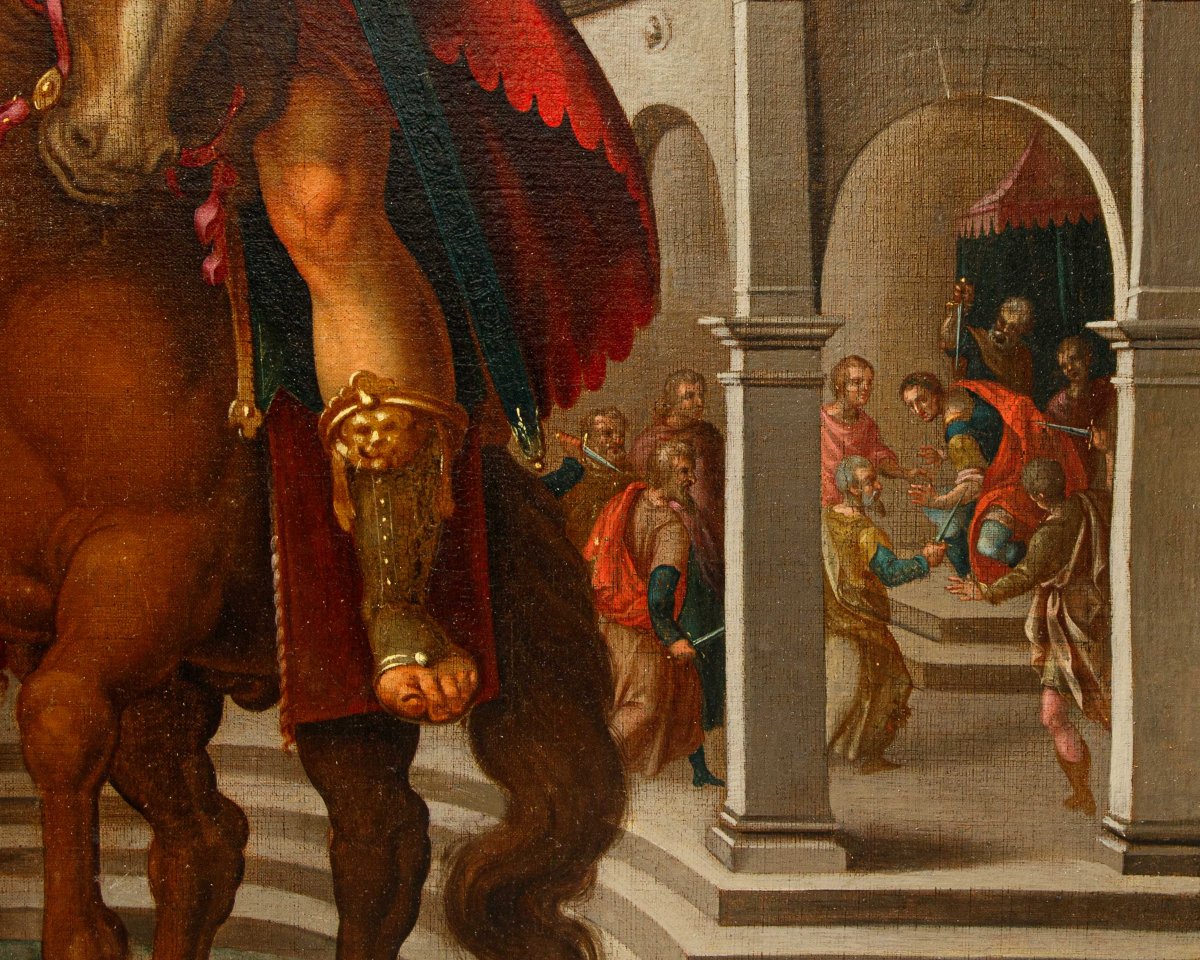
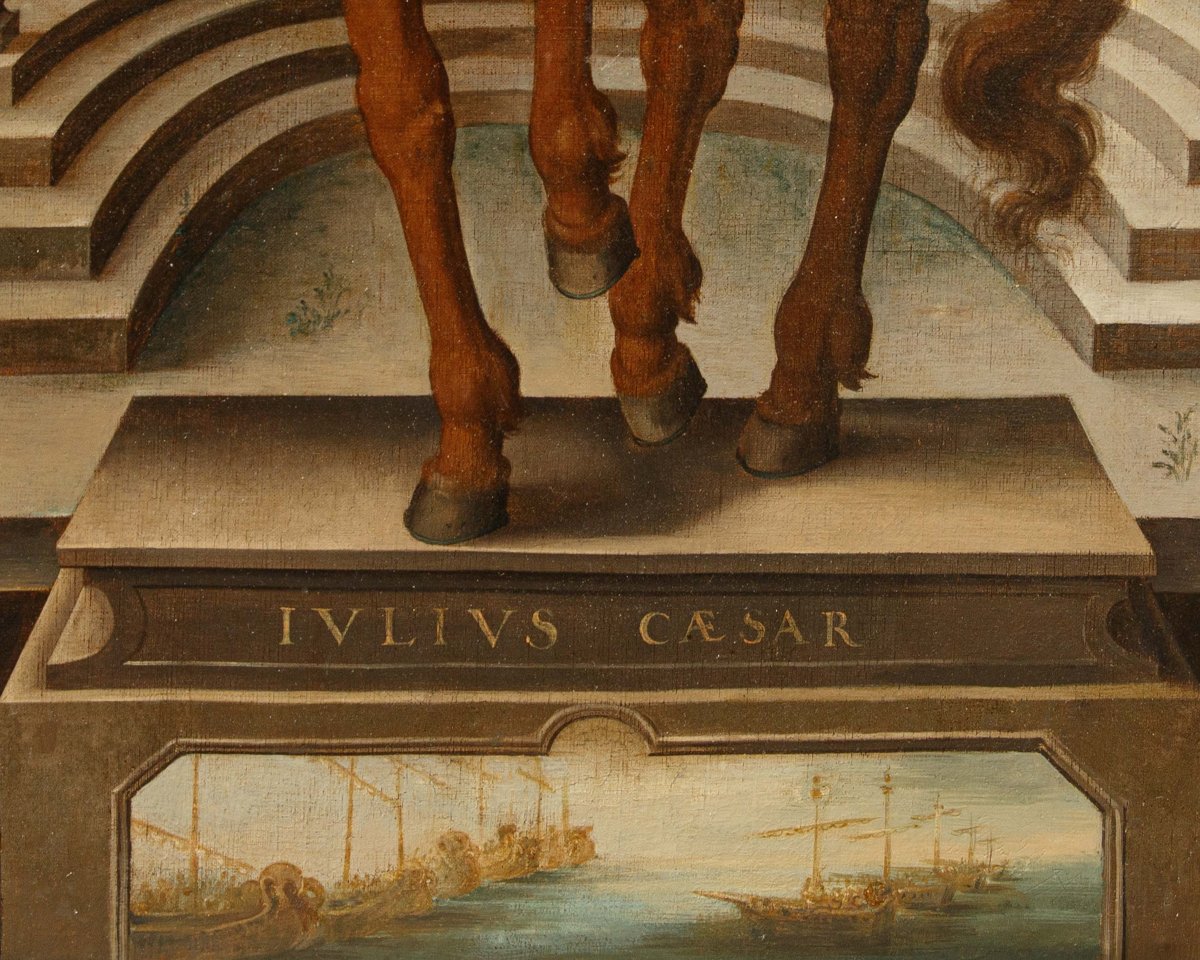
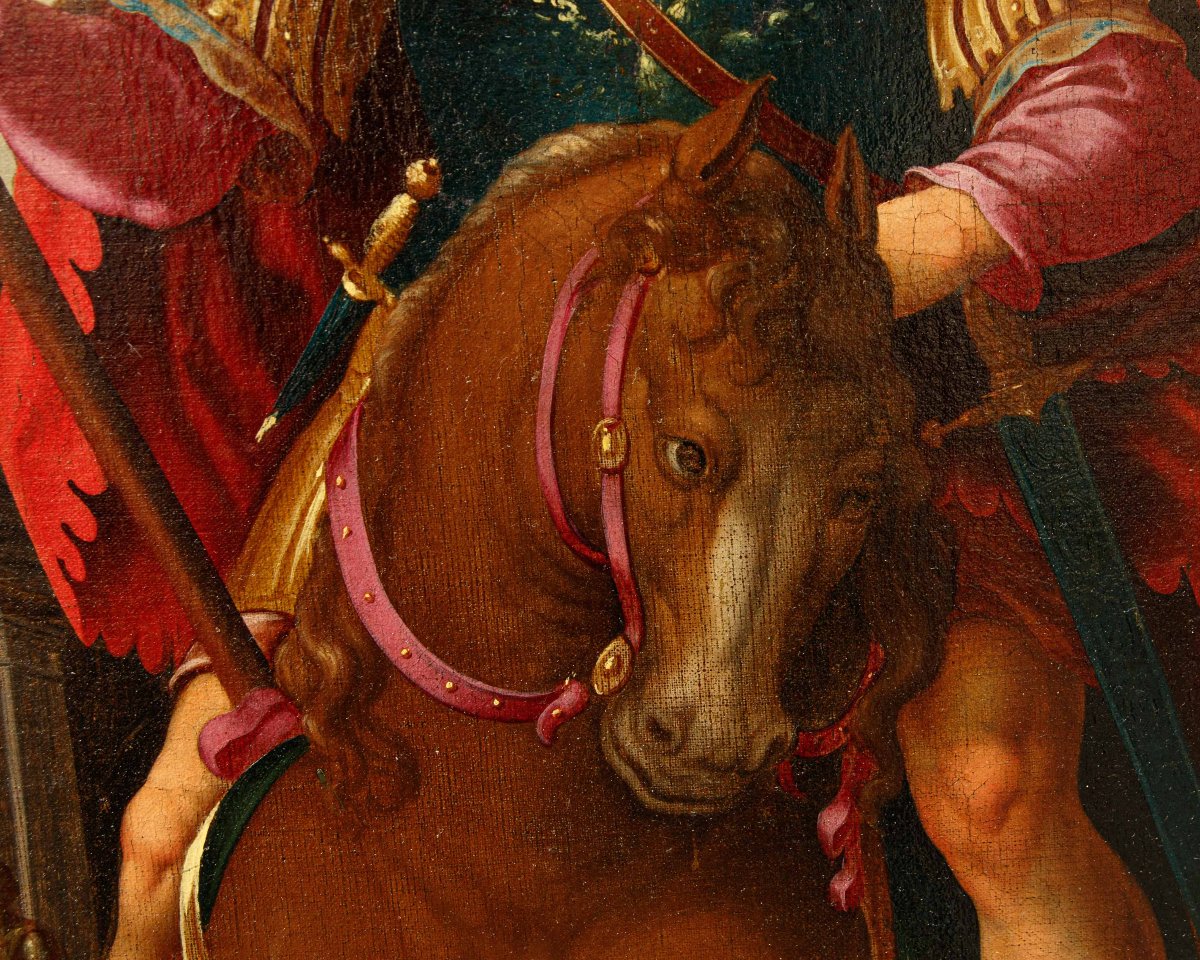
The painting depicts Julius Caesar on horseback, captured in a moment of solemn advance toward the viewer, wrapped in a bright red cloak billowing behind his shoulders and clad in ancient-style armor embellished with golden details. The commander holds a scepter in his right hand, while the chestnut-colored horse strides proudly across a marble pedestal engraved with the emperor’s name. Behind the figure unfolds a classical architectural setting, with portals and loggias filled with soldiers in armor and small figures engaged in various activities, in a play of perspective that lends depth to the composition and evokes the urban backdrops characteristic of Flemish-Florentine painting from the second half of the 16th century.
The work is attributed to Jan van der Straet, known as Giovanni Stradano, a Flemish painter who became a naturalized Italian citizen. His original composition—which today remains unidentified, whether as a drawing or a painting— was translated into an engraving by Adriaen Collaert and published by Philips Galle in the late 1580s, as part of a series titled *Imperatorum Romanorum* dedicated to twelve Roman emperors on horseback, including, in addition to Caesar, the figures of Augustus, Tiberius, Caligula, Claudius, Nero, Galba, Otho, Vitellius, Vespasian, Titus, and Domitian. Each ruler was portrayed according to a consistent scheme, raised on a stone pedestal decorated with narrative bas-reliefs and set against backdrops enlivened by classical architecture, figures in arms, and bird’s-eye-view landscapes, a compositional scheme that this painting—the work of a follower of Stradano active between the late sixteenth and early seventeenth centuries—faithfully reproduces for Julius Caesar alone.
Stradano, born Jan van der Straet in Antwerp, trained in his father’s workshop and then under Pieter Aertsen, joining the Guild of Saint Luke in 1545. Beginning in 1550, he undertook a series of journeys that took him to Lyon, Venice, and finally to Florence, where he entered the service of Grand Duke Cosimo I and joined the circle of Giorgio Vasari, for whom he first created cartoons for tapestries and later collaborated on the decoration of the Studiolo of Francesco I. In Rome, he worked with Francesco Salviati on the decorations of the Vatican’s Belvedere, while in Florence he painted altarpieces and took part in the decoration of numerous rooms in the Palazzo Vecchio, including the apartments of Eleonora di Toledo. Over the course of his career, he drew over 130 cartoons for tapestries—an extraordinarily prolific body of graphic work that went hand in hand with a production of drawings intended specifically for print. It was, in fact, primarily through engraving that his creations spread widely throughout Europe: publications such as the one dedicated to emperors on horseback, edited by publishers like Philips Galle and engraved by masters such as Adriaen Collaert, allowed his iconography to circulate well beyond the borders of Florence, inspiring painted replicas such as this one—a testament to the enduring prestige achieved by Stradano’s style between the late sixteenth and early seventeenth centuries.
Period: 17th century
Style: Other Style
Condition: Good condition
Material: Oil painting
Width: 83
Height: 103
Reference (ID): 1819563
Availability: In stock