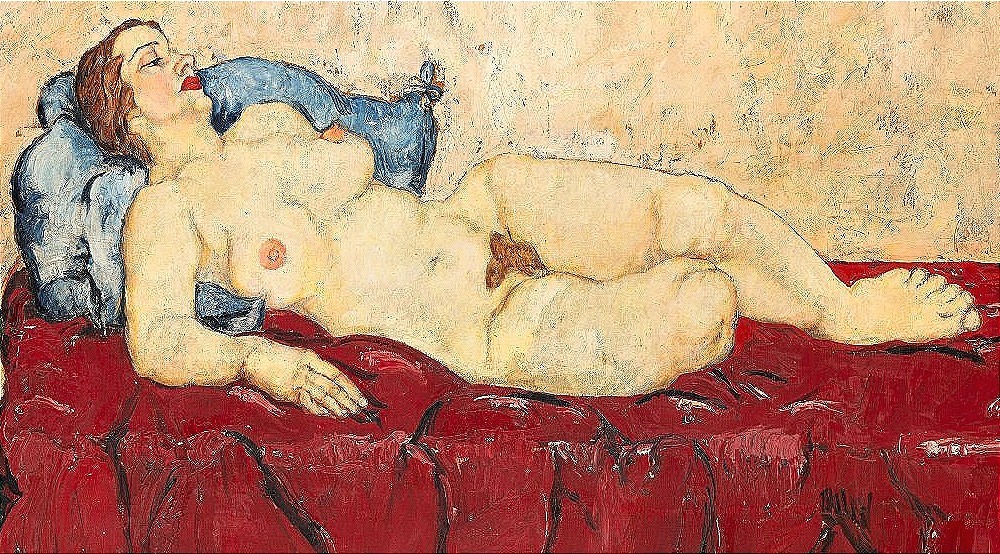




Nude Of Wally Neuzil On A Red Sofa.oil On Canvas, 70 X 100 Cm,austrian Expressionist, 1915
Artist: Egon Schiele
This oil painting on canvas depicting Wally Neuzil nude on a red sofa is a previously unknown work, attributed to a great painter of exceptional pictorial power. Created at the very beginning of the 20th century by a Central European artist of undeniable energy and character, it immediately evokes the vibrant world of Egon Schiele, without, however, revealing its characteristic harshness. The work exudes the profound resignation of the model, while the strength of the brushstrokes blends with a sense of emptiness and a deep, unsettling sadness. We believe that the painter captures the epilogue of a relationship, manifested by the final throes of passion, now a reflection of abysmal despair. We know that Wally, Egon Schiele's model and lover, responded to his insistent requests in his last letters to the painter in 1915. He longed to see her again, but, being a free man, she knew that she was his first wife, his queen. After Egon's marriage to Edith, Wally's passion faded. He would never have accepted being relegated to the background. It can be assumed that Egon, now married to Edith, persuaded his muse, his lifelong lover, to pose one last time for a nude. Wally, lying on the sofa, her body abandoned, desolate and bitter in the face of the confirmation of the death of a great love, is depicted nude. The painting conveys the misery of a relationship that had become profoundly sad and definitively over. The painter immortalizes Wally's painful moments, capturing their profound human dimension in the expression of this devastated and humiliated woman. This painting, strictly private in nature, was not intended to be seen, and the painter could never have signed or dated the evidence of his betrayal of Edith. This is why it is the only one not signed or dated by the artist. The pictorial quality of the painting depicting Wally on the red sofa is such that it cannot be attributed to any other Expressionist painter. The intensity of the scene marks the end of a love affair: likely the last encounter between the model Wally Neuzil and the painter Egon Schiele. The painting was presented to Professor Leopold approximately 25 years ago, through a reputable Belgian art dealer, in the form of a photograph for authentication. Professor Leopold showed great interest in acquiring the work, which was not for sale at the time, and declined to provide a written appraisal, retaining the photograph. The work had originally been acquired by its owner in Rome some 30 years earlier; it came from the sale of an Austrian woman whose grandmother had been a dancer at the Viennese theater. (The work is accompanied by a certificate of free export)
For a work of such importance, it is now possible—thanks to the most advanced and meticulous laboratory techniques—to establish its attribution to a specific artist with absolute certainty. Pigments, brushstrokes, varnishes, the painting support, X-rays, reflectography, and precise dating of the canvas and stretcher: all these elements allow for a precise attribution. Yet, if one asks the artist's recognized expert to make an attribution, they will rarely rely on scientific evidence. This may seem illogical, even absurd, but many "experts" wish to arrogate to themselves the right to make the final call *super partes*—standing above the fray—without regard for the findings of cutting-edge technical and scientific research. In practice, their certification—obtained without any concrete proof—takes precedence over technical and scientific tests, even though the latter are indispensable and irrefutable. That is (unfortunately) how the system works. If an exceptional, previously unknown, and undocumented masterpiece emerges from an old collection, the established criteria for attributing the artist's work are ignored. Publications already exist that catalogue the artist's *œuvre*—listing all known masterpieces, often in texts written by the expert themselves, alongside details of past exhibitions and the museums or private collections holding the known works. Presenting a new masterpiece serves no one's interests—neither the museums' nor even the wealthy collectors'. The fewer known works there are, the higher the value of the already authenticated paintings remains. When weighed against art history, a love of art, knowledge, and the artist's legacy, this stands as one of the most absurd follies embedded in the realm of art—true art. Years upon years will pass before the lost masterpiece finds a scholar—prepared and knowledgeable—whose heart is bound to the memory of the artist. Only then, perhaps, will the masterpiece be studied, understood, and admired.
In memory of Egon Schiele.
51 €
Period: 20th century
Style: Modern Art
Condition: Perfect condition
Material: Oil painting
Width: 100 cm
Height: 70 cm
Reference (ID): 1816430
Availability: In stock
Print