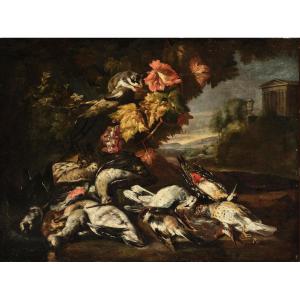


Still Life With A Guinea Pig And Hunting Trophies, Attributed To Castelli, 17th Century
Artist: Attribué à Giovanni Paolo Castelli, Dit Spadino
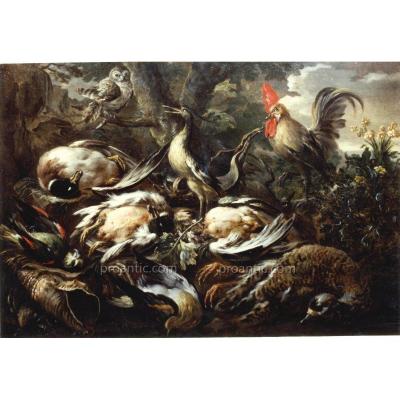
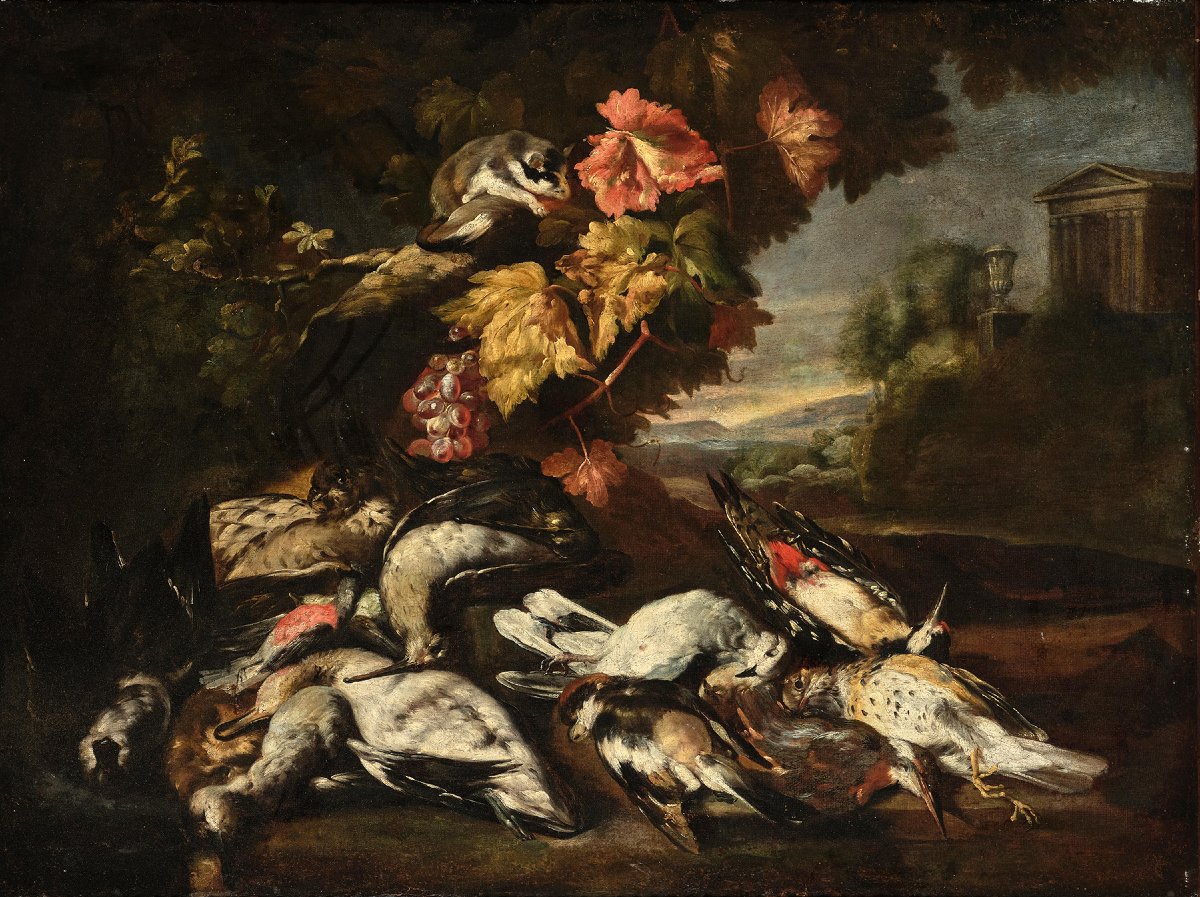
STILL LIFE WITH A GUINEA PIG AND GAME BIRDS
Attributed to GIOVANNI PAOLO CASTELLI, known as SPADINO
Rome, 1659 – circa 1730
Oil on canvas
Canvas dimensions: 74.5 × 98.5 cm / 29.3 × 38.8 in
Unframed
The second half of the 17th century was a period of extraordinary growth for still life in Rome and brought profound transformations to the genre. The traditional repertoire of the Roman school, in which compositions of flowers and fruit played a central role, gradually expanded. New subjects emerged, notably depictions of game and hunting trophies, which until then had been primarily associated with Northern European painting and were relatively rare in the Roman tradition.
The German painter Franz Werner von Tamm, who worked in Rome from approximately 1685 to 1695, played an important role in this evolution. His work exerted a considerable influence on an entire generation of still-life painters active in the city. Tamm reinterpreted the northern tradition of hunting still lifes, combining precise observation of animals, birds, and plants with the decorative splendor of the Roman Baroque. The presence of dead game also lent these sumptuous compositions a subtle element of vanity—a reminder of the fragility of life concealed within an image of abundance.
This still life eloquently illustrates how Giovanni Paolo Castelli, known as Spadino—one of the most remarkable Italian representatives of the genre—assimilated and then transformed Tamm’s pictorial language.
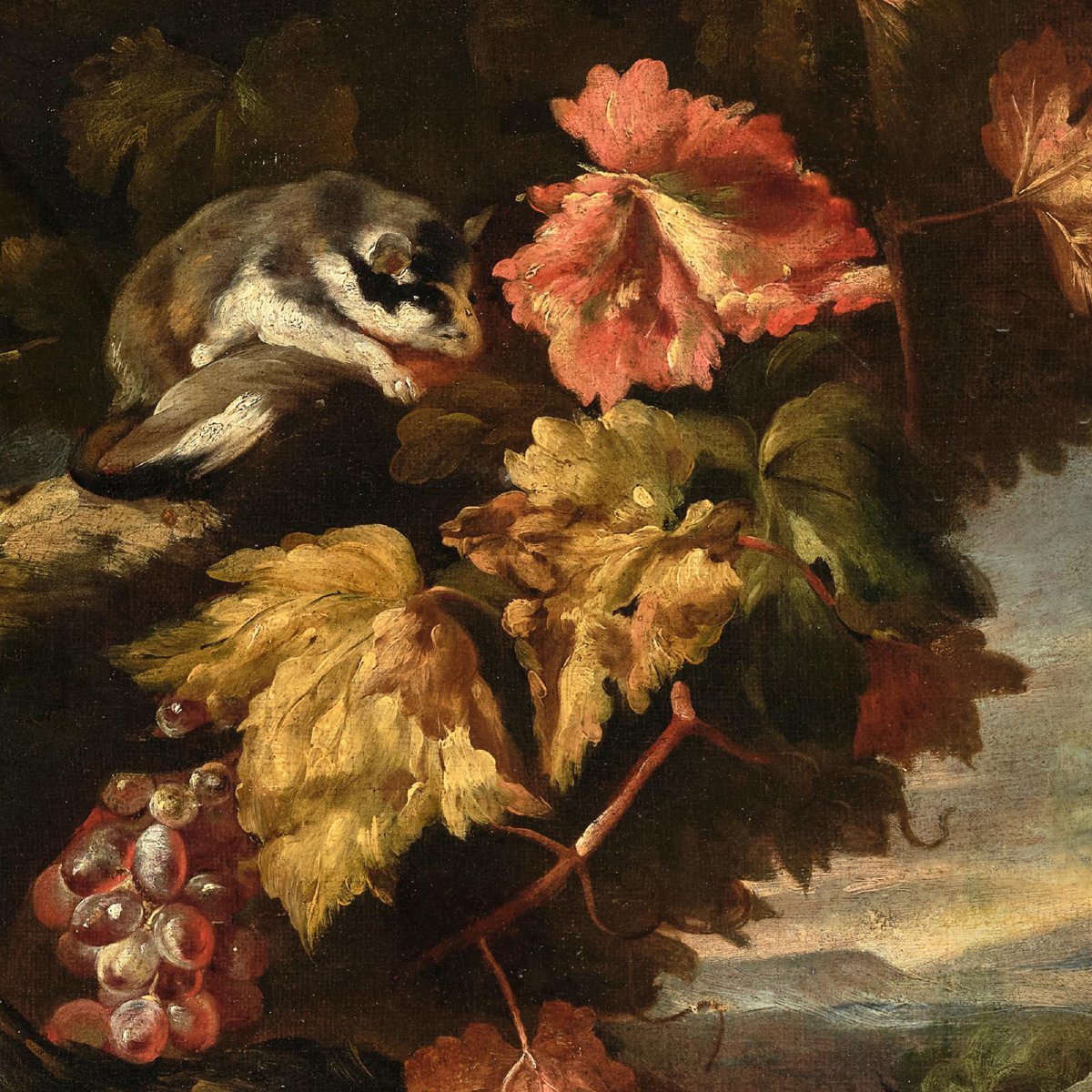
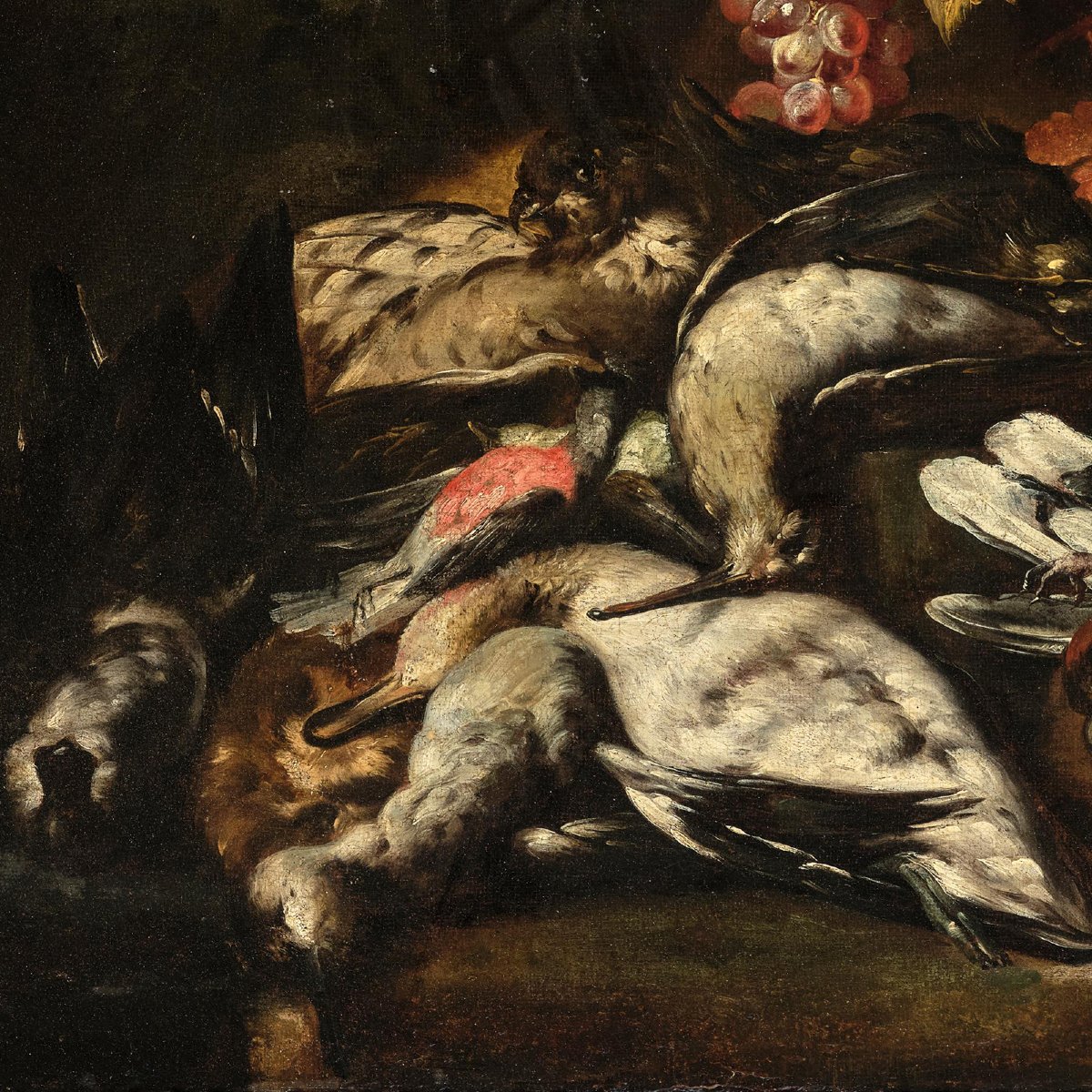
Castelli adopts several motifs particularly favored by his northern colleague. Above the cascade of game, he places a live guinea pig—an exotic animal that appears repeatedly in Tamm’s work. Its small, alert figure enters into an expressive dialogue with the motionless bodies of the birds, accentuating the tension between life and death.
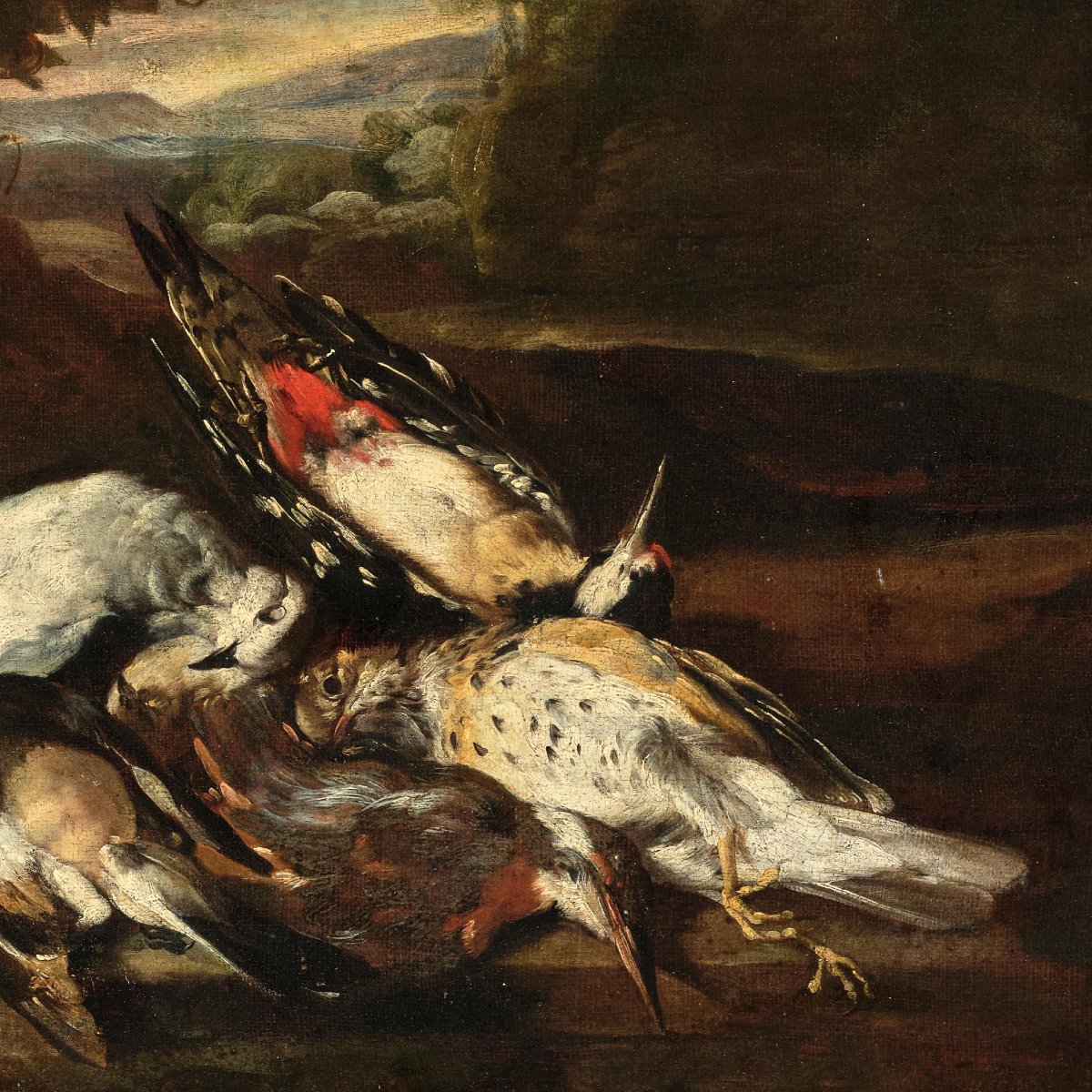
Castelli, however, profoundly alters the character of the depiction. In Tamm’s work, hunting trophies generally retain a restrained and ceremonial intimacy, appearing almost as precious objects gathered within a closed composition. Here, by contrast, the still life becomes an integral part of a vast landscape. The space opens up toward a luminous sky and an ancient temple, while the accumulation of game, bunches of grapes, and autumn vine leaves takes on an almost theatrical grandeur.
In Castelli’s hands, the northern tradition of the hunting still life is thus transformed into a spectacle imbued with a profoundly Italian sense of space, light, and Baroque theatricality.
A closely related version of this composition, slightly smaller and measuring 67 × 89 cm, was previously presented by the Antichità Castelbarco gallery with an attribution to Giovanni Paolo Castelli. The very close replication of the composition attests to the success of this subject and suggests its circulation within the painter’s studio or his immediate circle.
Attributed to GIOVANNI PAOLO CASTELLI, known as SPADINO
Rome, 1659 – circa 1730
Oil on canvas
Canvas dimensions: 74.5 × 98.5 cm / 29.3 × 38.8 in
Unframed
The second half of the 17th century was a period of extraordinary growth for still life in Rome and brought profound transformations to the genre. The traditional repertoire of the Roman school, in which compositions of flowers and fruit played a central role, gradually expanded. New subjects emerged, notably depictions of game and hunting trophies, which until then had been primarily associated with Northern European painting and were relatively rare in the Roman tradition.
The German painter Franz Werner von Tamm, who worked in Rome from approximately 1685 to 1695, played an important role in this evolution. His work exerted a considerable influence on an entire generation of still-life painters active in the city. Tamm reinterpreted the northern tradition of hunting still lifes, combining precise observation of animals, birds, and plants with the decorative splendor of the Roman Baroque. The presence of dead game also lent these sumptuous compositions a subtle element of vanity—a reminder of the fragility of life concealed within an image of abundance.
This still life eloquently illustrates how Giovanni Paolo Castelli, known as Spadino—one of the most remarkable Italian representatives of the genre—assimilated and then transformed Tamm’s pictorial language.
Castelli adopts several motifs particularly favored by his northern colleague. Above the cascade of game, he places a live guinea pig—an exotic animal that appears repeatedly in Tamm’s work. Its small, alert figure enters into an expressive dialogue with the motionless bodies of the birds, accentuating the tension between life and death.
Castelli, however, profoundly alters the character of the depiction. In Tamm’s work, hunting trophies generally retain a restrained and ceremonial intimacy, appearing almost as precious objects gathered within a closed composition. Here, by contrast, the still life becomes an integral part of a vast landscape. The space opens up toward a luminous sky and an ancient temple, while the accumulation of game, bunches of grapes, and autumn vine leaves takes on an almost theatrical grandeur.
In Castelli’s hands, the northern tradition of the hunting still life is thus transformed into a spectacle imbued with a profoundly Italian sense of space, light, and Baroque theatricality.
A closely related version of this composition, slightly smaller and measuring 67 × 89 cm, was previously presented by the Antichità Castelbarco gallery with an attribution to Giovanni Paolo Castelli. The very close replication of the composition attests to the success of this subject and suggests its circulation within the painter’s studio or his immediate circle.
8 000 €
Period: 17th century
Style: Louis 14th, Regency
Condition: Good condition
Material: Oil painting
Length: 98.5 cm
Height: 74.5 cm
Reference (ID): 1816172
Availability: In stock
Print