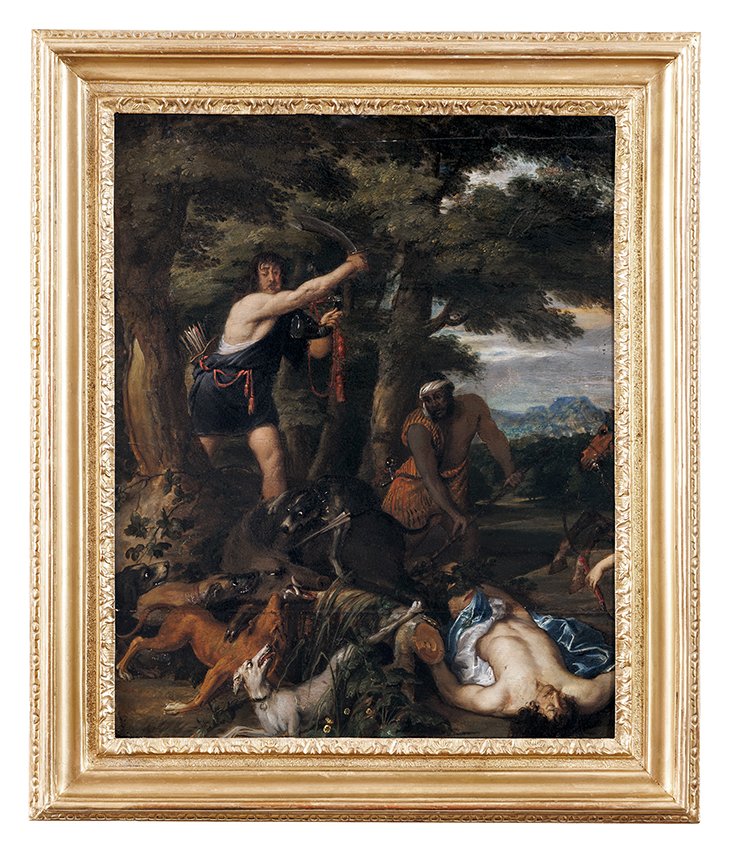


Bosschaert Attr. – Argonaut Ancaeus In The Hunt For The Calydonian Boar
Artist: Thomas Willeboirts Bosschaert, Attr. To
THOMAS WILLEBOIRTS BOSSCHAERT, attr. to
Bergen op Zoom 1613 – 1654 Antwerpen
THE HUNT FOR THE CALEDONIAN WILD BOAR
Oil on panel
56.5 × 44.5 cm / 22.2 × 17.5 inches
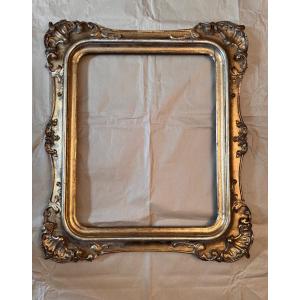
with frame: 73 × 63 cm / 28.7 × 24.8 inches
PROVENANCE
Paris, private collection
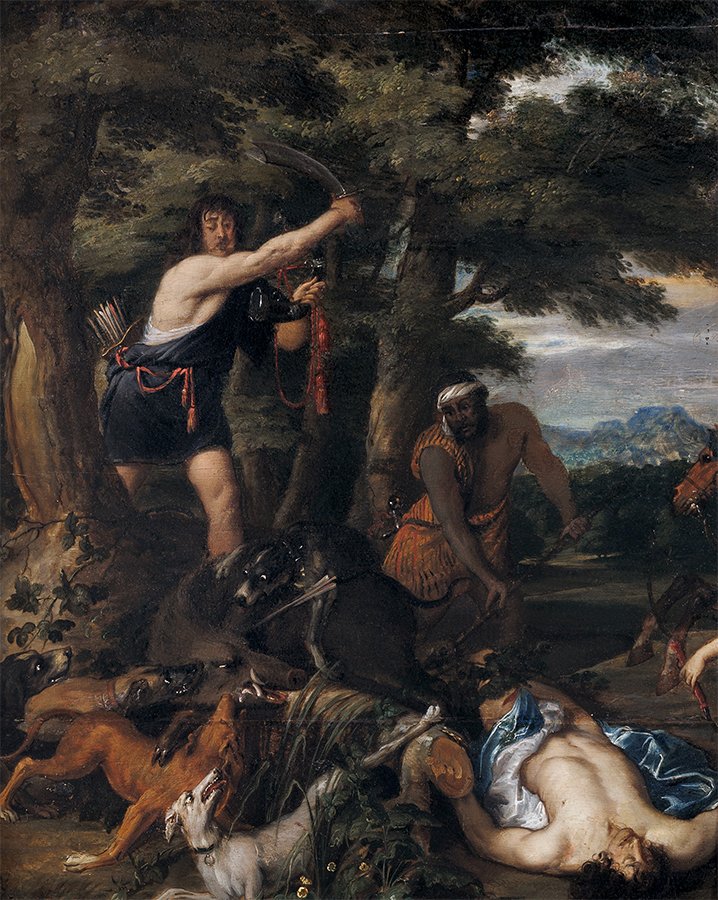
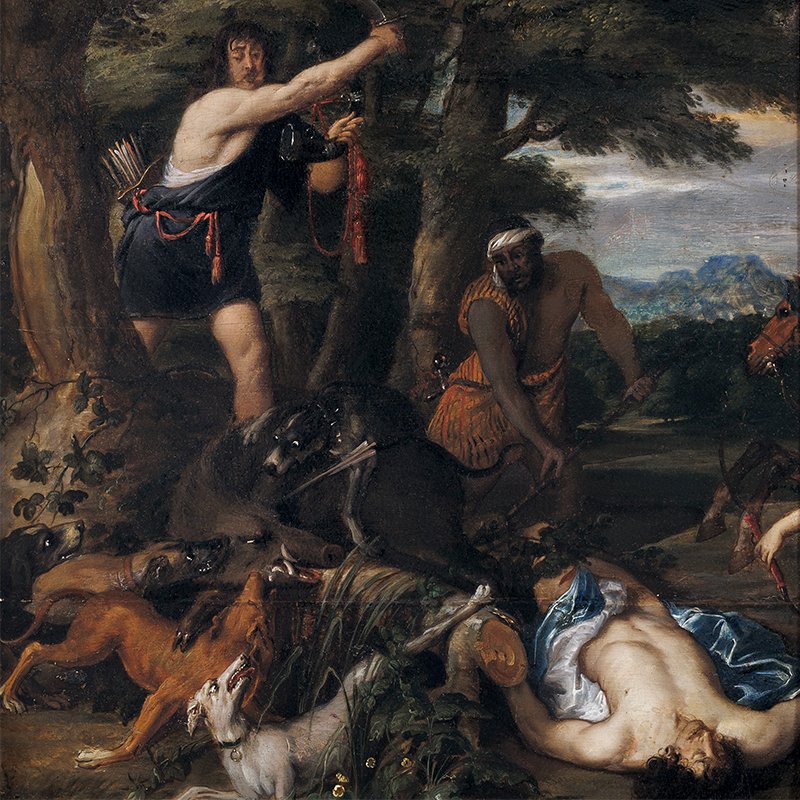
Few episodes from ancient mythology are as rarely represented in painting as the beginning of the legendary Calydonian boar hunt — the dramatic moment of the death of the Argonaut Ancaeus. This painting is particularly fascinating because the narrative remains unusually legible, allowing the protagonists of the myth to be identified with remarkable precision.
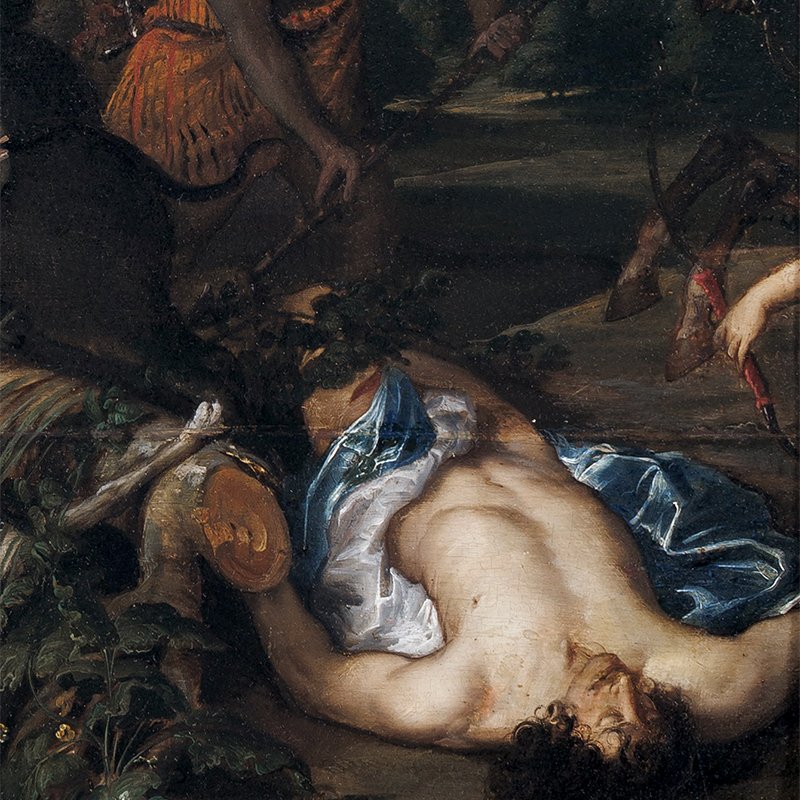
At the lower right lies the mortally wounded Ancaeus, struck down after attacking the monstrous boar with overconfidence. His beautifully modelled body, treated with an elegance strongly reminiscent of Anthony van Dyck, becomes one of the emotional centres of the composition. At the very moment of his fall, Atalanta — the only female participant in the hunt — wounds the beast with her arrow. Significantly, during restoration, a female hand emerged on the right side of the composition, likely belonging to Atalanta, further clarifying the narrative structure of the scene.
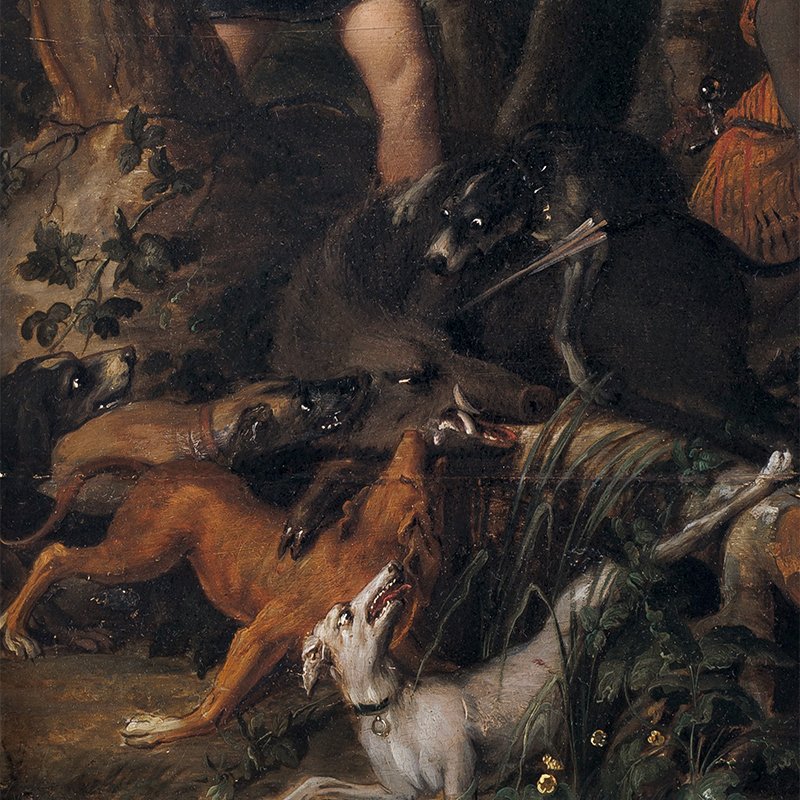
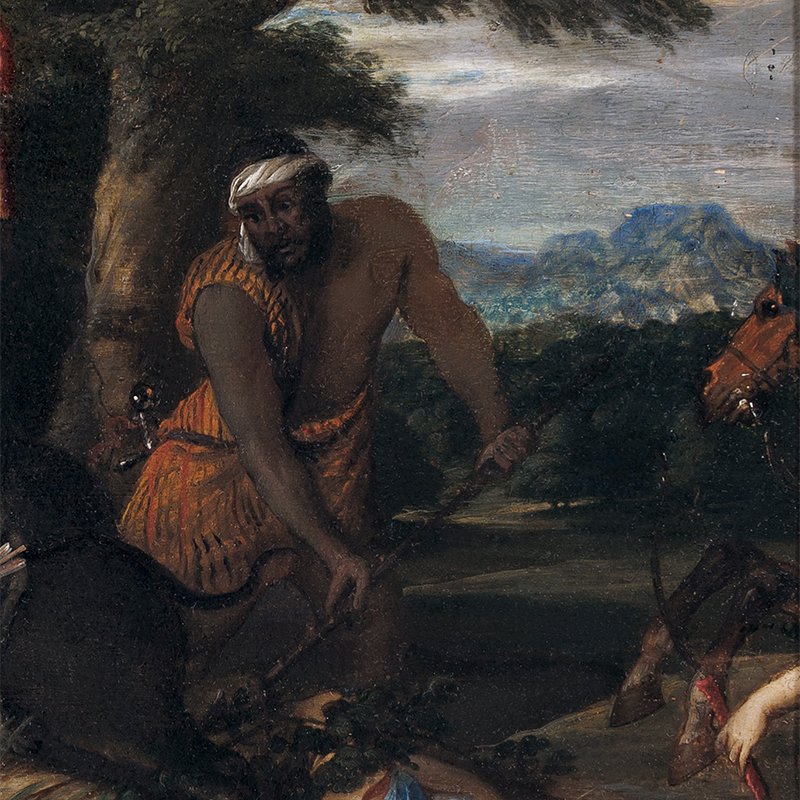
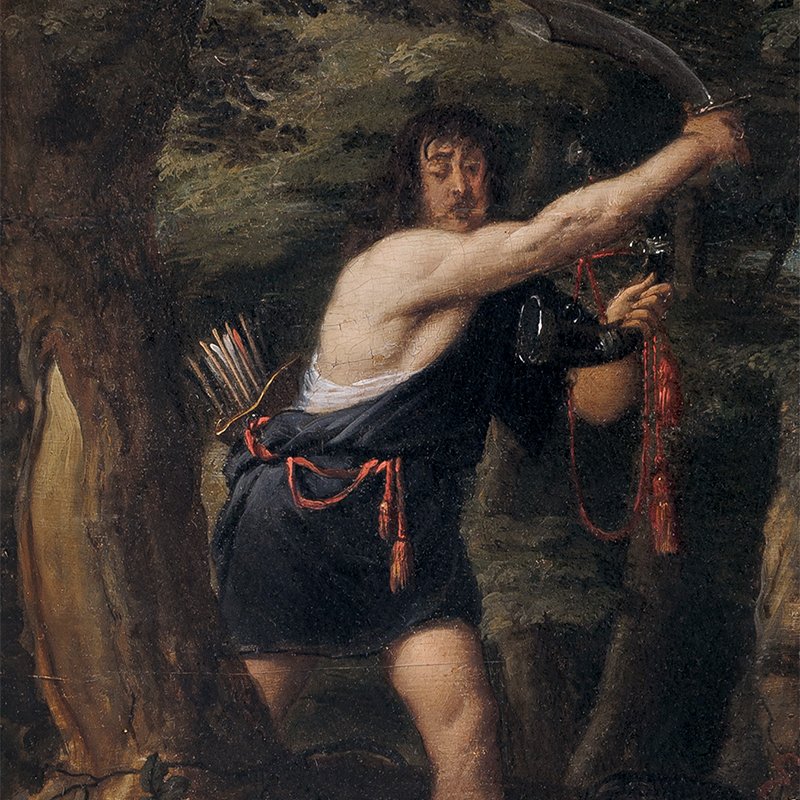
The boar itself still bears the arrow lodged in its body, while the central hunter, traditionally identified as Meleager, prepares the decisive strike. Another figure, equipped with a hunting horn and sword, may plausibly represent Theseus. Such iconographic clarity is uncommon in representations of the Calydonian hunt, which are often reduced to generalized hunting scenes rather than carefully narrated mythological episodes.
The painting can confidently be associated with Thomas Willeboirts Bosschaert, one of the most refined Flemish painters active in Antwerp during the first half of the seventeenth century. Born in Bergen op Zoom in 1613 and later active in Antwerp, Bosschaert trained under Gerard Seghers and developed a pictorial language that combined the richness of Flemish Baroque with a notable elegance and sensitivity.
An important turning point in Bosschaert’s artistic development was his encounter with the work of Anthony van Dyck. His palette became softer and more luminous, while his figures acquired greater refinement and nobility. This influence is especially evident in the treatment of the dying Ancaeus, whose graceful anatomy and aristocratic beauty recall the poetic elegance found in Van Dyck’s mythological and religious compositions.
Bergen op Zoom 1613 – 1654 Antwerpen
THE HUNT FOR THE CALEDONIAN WILD BOAR
Oil on panel
56.5 × 44.5 cm / 22.2 × 17.5 inches
with frame: 73 × 63 cm / 28.7 × 24.8 inches
PROVENANCE
Paris, private collection
Few episodes from ancient mythology are as rarely represented in painting as the beginning of the legendary Calydonian boar hunt — the dramatic moment of the death of the Argonaut Ancaeus. This painting is particularly fascinating because the narrative remains unusually legible, allowing the protagonists of the myth to be identified with remarkable precision.
At the lower right lies the mortally wounded Ancaeus, struck down after attacking the monstrous boar with overconfidence. His beautifully modelled body, treated with an elegance strongly reminiscent of Anthony van Dyck, becomes one of the emotional centres of the composition. At the very moment of his fall, Atalanta — the only female participant in the hunt — wounds the beast with her arrow. Significantly, during restoration, a female hand emerged on the right side of the composition, likely belonging to Atalanta, further clarifying the narrative structure of the scene.
The boar itself still bears the arrow lodged in its body, while the central hunter, traditionally identified as Meleager, prepares the decisive strike. Another figure, equipped with a hunting horn and sword, may plausibly represent Theseus. Such iconographic clarity is uncommon in representations of the Calydonian hunt, which are often reduced to generalized hunting scenes rather than carefully narrated mythological episodes.
The painting can confidently be associated with Thomas Willeboirts Bosschaert, one of the most refined Flemish painters active in Antwerp during the first half of the seventeenth century. Born in Bergen op Zoom in 1613 and later active in Antwerp, Bosschaert trained under Gerard Seghers and developed a pictorial language that combined the richness of Flemish Baroque with a notable elegance and sensitivity.
An important turning point in Bosschaert’s artistic development was his encounter with the work of Anthony van Dyck. His palette became softer and more luminous, while his figures acquired greater refinement and nobility. This influence is especially evident in the treatment of the dying Ancaeus, whose graceful anatomy and aristocratic beauty recall the poetic elegance found in Van Dyck’s mythological and religious compositions.
7 900 €
Period: 17th century
Style: Renaissance, Louis 13th
Condition: Good condition
Material: Oil painting on wood
Length: 44,5 cm
Height: 56,5 cm
Reference (ID): 1769344
Availability: In stock
Print