

Nicolas Henry De Gray (1822–1909)—*the Offering*, Or *the Lady Of The Manor’s Favor*, Ca. 1870
Nicolas HENRY de GRAY (1822–1909) – *A Gracious Alms, or The Chatelaine’s Favor* – Circa 1870.
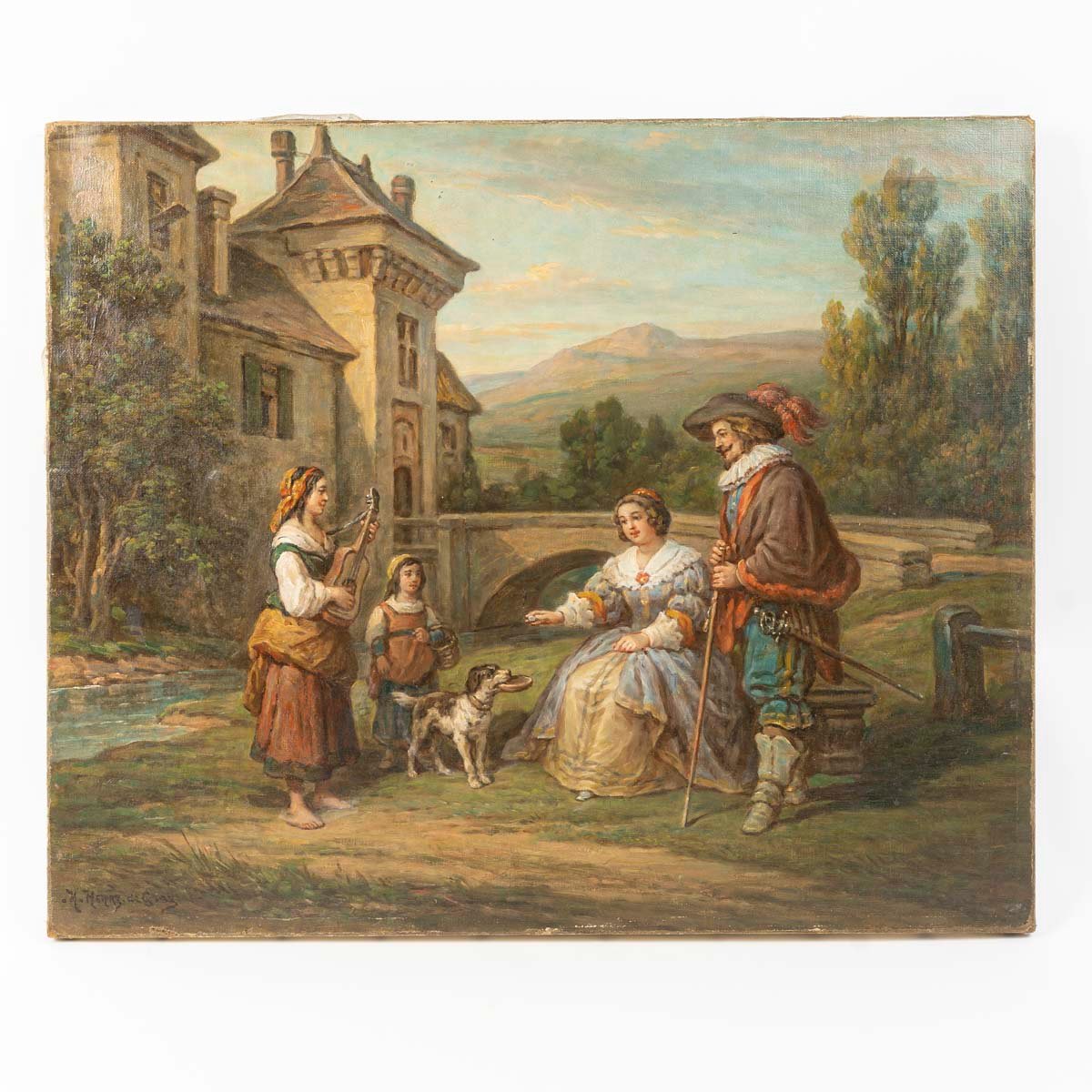
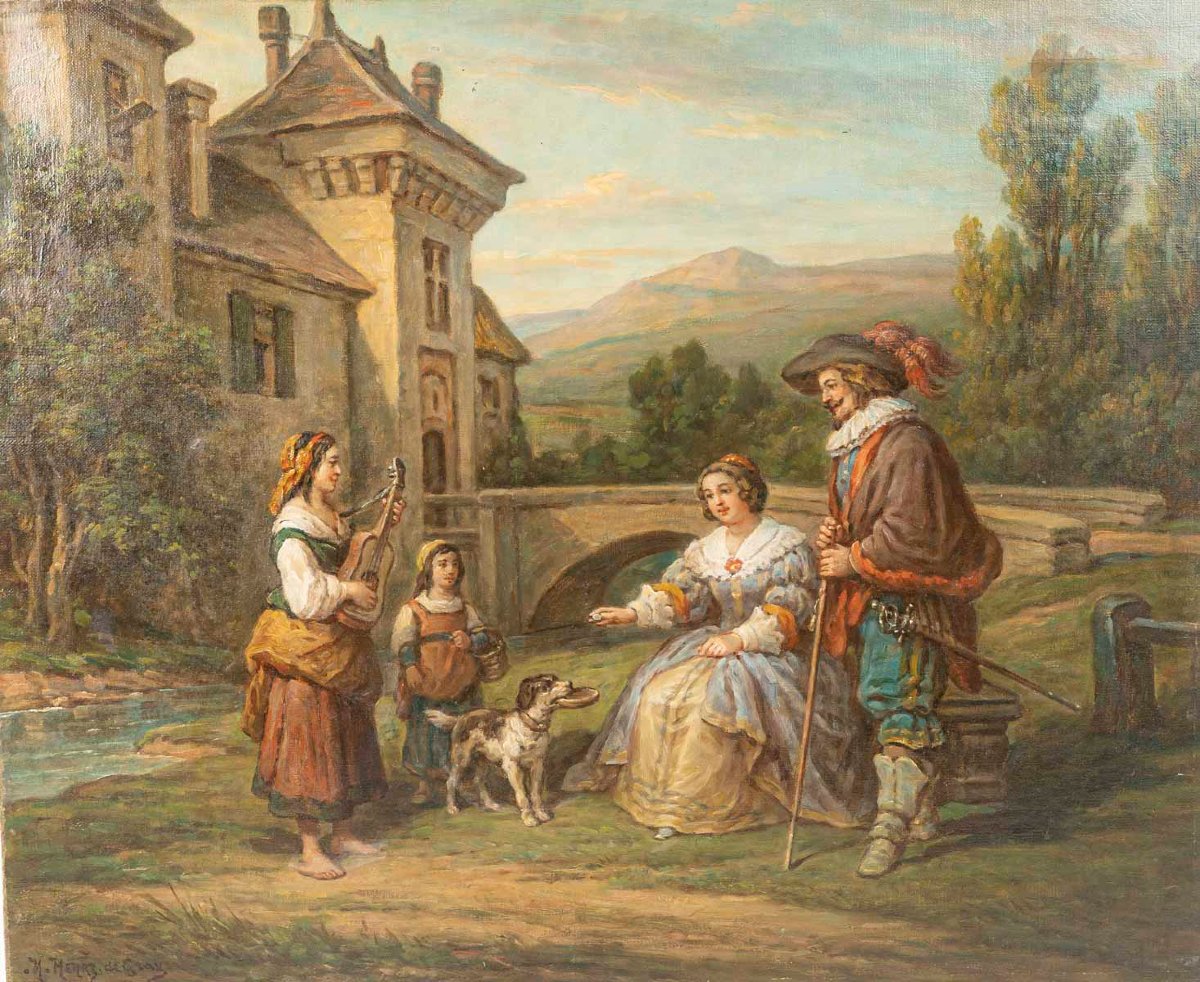
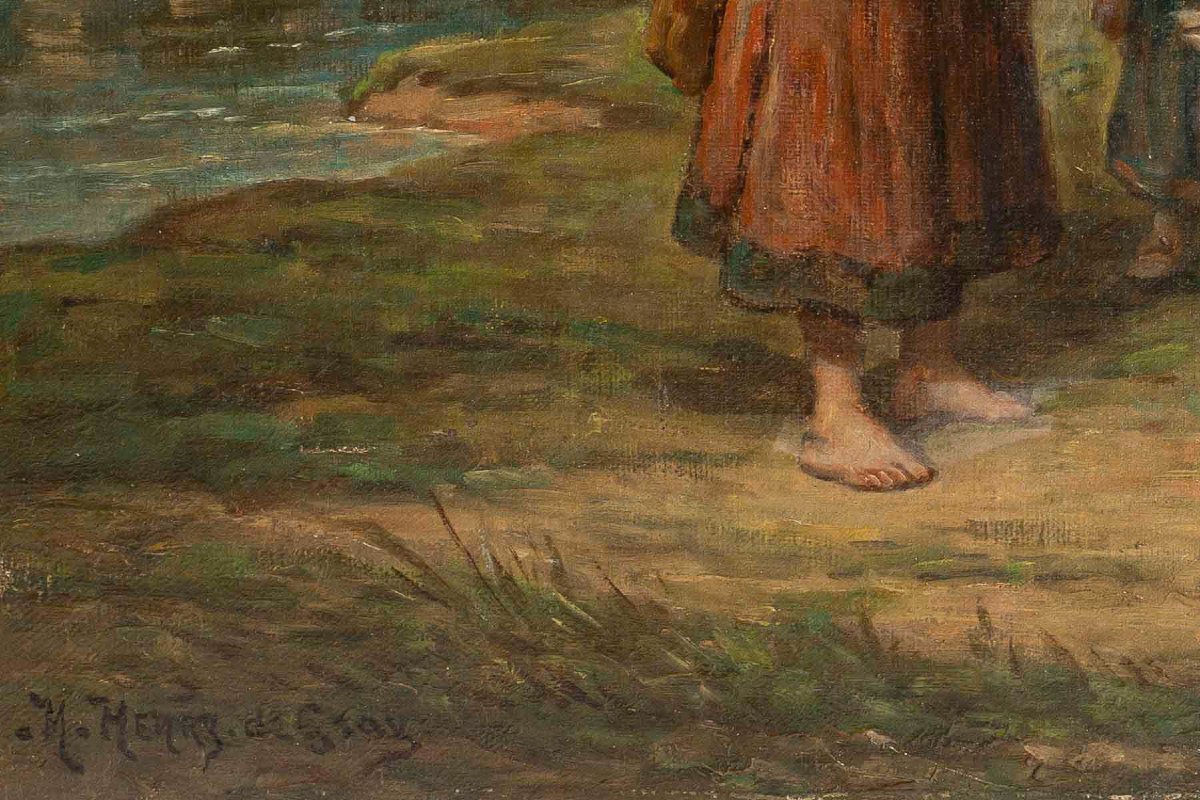
Oil on canvas, signed lower left: "N. HENRY. de Gray." Undated.
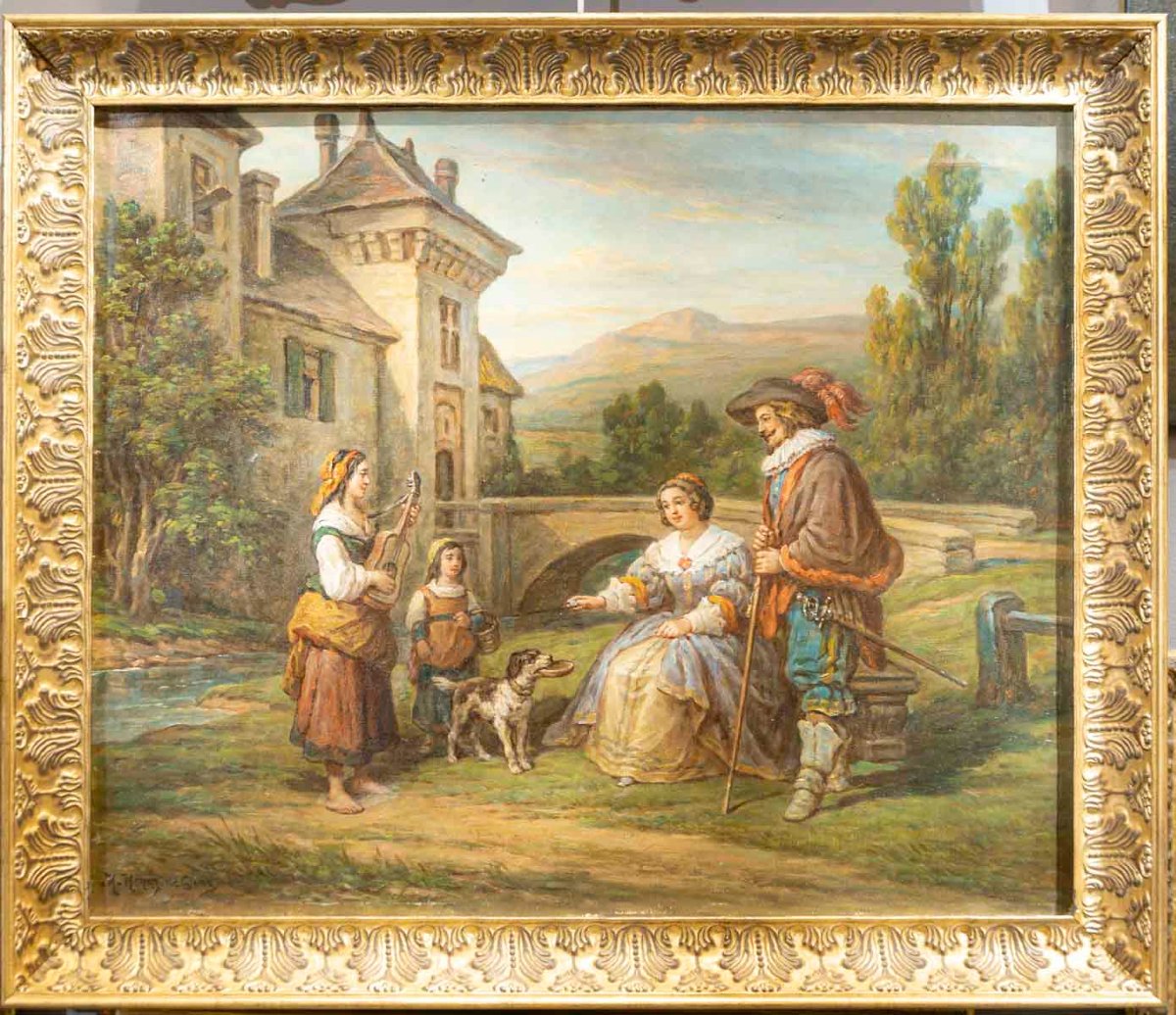
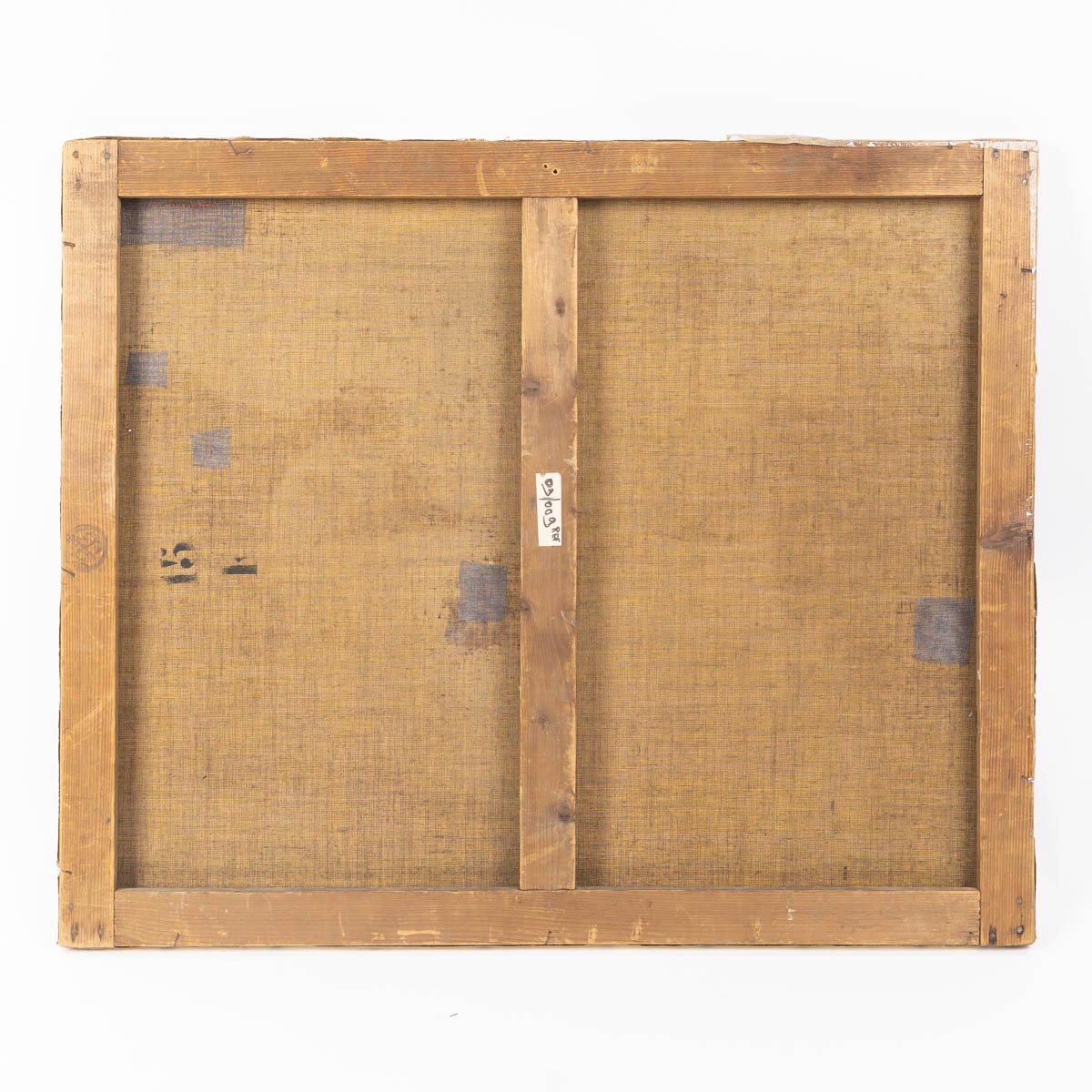
Presented in a (non-original) molded and gilded wood frame featuring stylized acanthus palmette motifs.
French School of painting, second half of the 19th century.
-------------------------
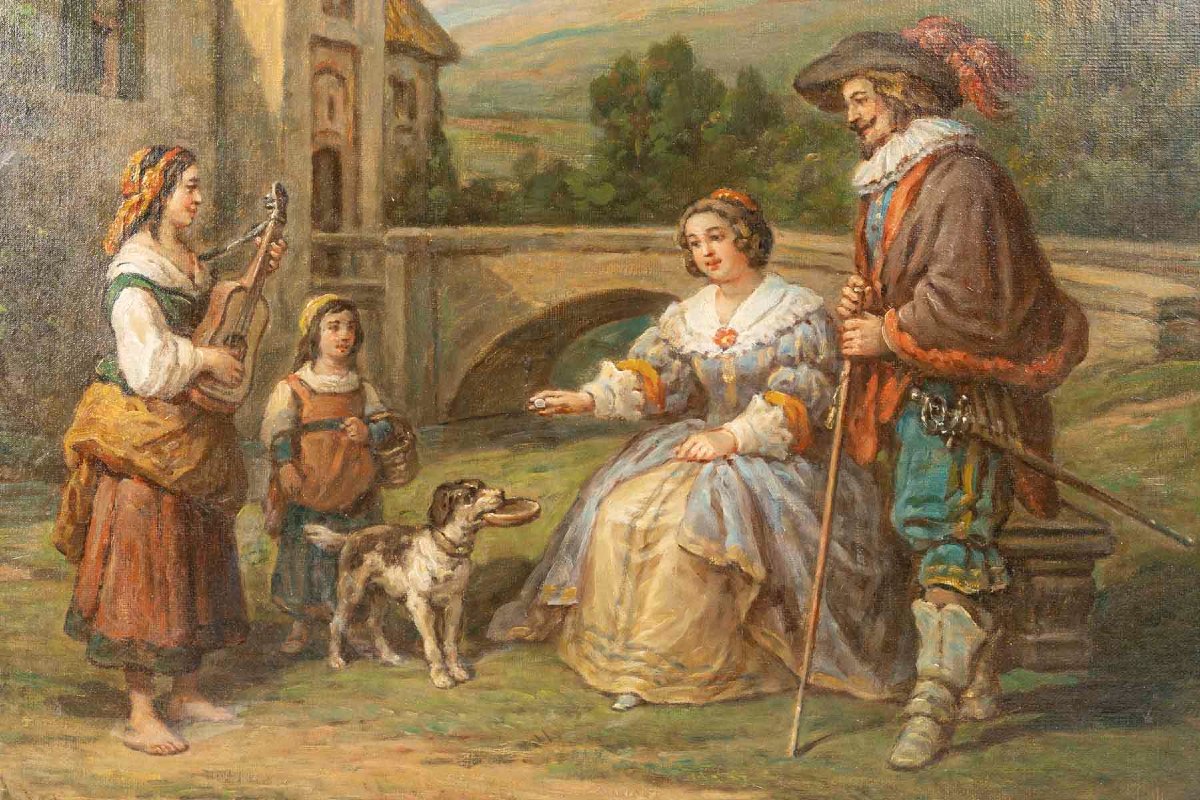
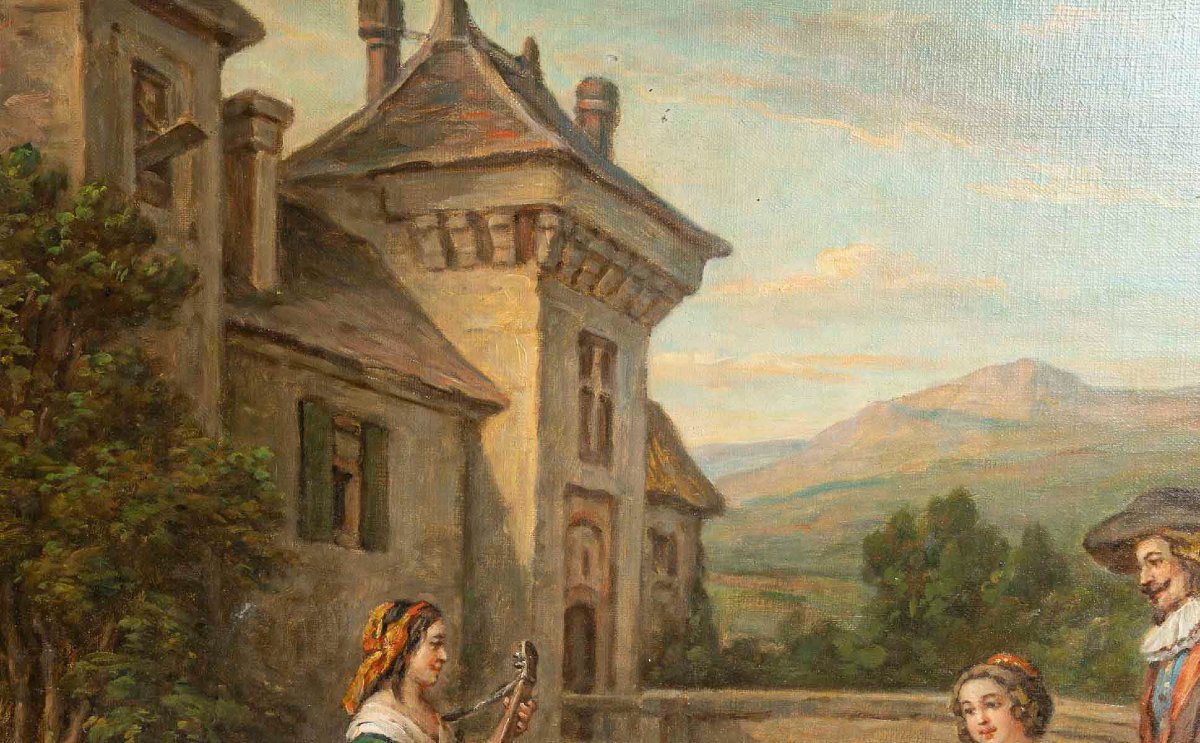
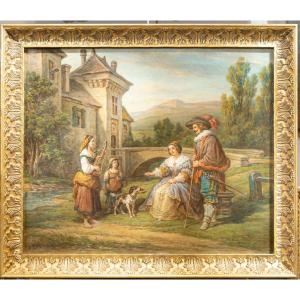
Featuring an elaborate composition, this pleasing anecdotal genre painting depicts two elegant figures of refined bearing—dressed in the noble attire of the Louis XIII era (short jacket with ruff, trimmed *rhingrave* breeches, doublet, soft boots with spurs, felt hat with ostrich plumes, sword / gown with boned bodice and puffed sleeves, lace cuffs and collar adorned with a *bout-en-train* and small velvet roll)—situated near the grounds of a country manor belonging to a chatelaine. Standing in a three-quarter pose, his hands resting on a tall cane with a ribboned pommel, a courteous gentleman stands beside a charming, coquettish young woman seated on an ancient stone bench. Captured in an obliging attitude, he appears to accept the benevolent alms (a small silver coin) that she—looking touched, with flushed cheeks and a faint smile—extends with a graceful gesture toward the humble bowl held in the jaws of a spirited little dog, the faithful companion of two Bohemian women. Coarsely dressed (cotton chemise, wool bodice and apron, gathered skirts) and wearing headscarves, the women are depicted barefoot; one of them—a young girl—holds... One figure cradles a wicker basket filled with berries, while the other—the mother—plucks the strings of a small guitar slung across her body; together, they form a picturesque counterpoint to the decorous couple. In the background—set against dense stands of trees, wooded clumps with foliage bathed in soft light, and rolling hills silhouetted against an azure sky tinged with silvery-gold hues—a lush landscape provides a verdant setting for this affable, deliberately staged scene.
Meticulously painted, this canvas—enhanced by a palette that blends a warm range of ochre-browns and greens with the harmonious brilliance of vivid tones—reveals the artistic qualities of Nicolas Henry de Gray. He was a painter recognized in his time for his "attractive and charming genre scenes," characterized by skillful, polished composition; an "intelligent arrangement" of figures with "tight draftsmanship" displaying "varied poses and well-studied expressions"; and "imagination, finesse, and poetic use of color."
Possessing a delightful historical whimsy, this engaging composition—its subject linked to the theme of *galant* pastimes set in the past—combines a deliciously old-fashioned charm with an impromptu quality. This latter element, introduced through the figures of the *Bohémiennes* (Gypsy women)—figures prized and sought after in the 19th century for their "picturesque" appeal—lends the work a palpable freshness and spontaneity.
Much like *La Déclaration* and *Les Amants Surpris* (works recorded on the art market)—which share similar subjects, compositions, motifs, and dimensions—our painting belongs squarely within the extensive body of work produced by "painters of great finesse, delicacy, harmony, and wit" who were masters of the genre scene, such as Ernest Meissonier (1815–1891), Emile Plassan (1807–1903), and Victor Chavet. (1822–1906) or Adrien Moreau (1843–1906)—artists who delighted, much to the dismay of art lovers of the Second Empire and Third Republic, in reviving and revisiting, in a lighthearted vein, the pastimes and courtly gallantries of earlier centuries.
Nicolas Henry de Gray (Gray, Haute-Saône, 1822 – Neuilly-sur-Seine, 1909): an unassuming painter.
A native of the charming town of Gray (Haute-Saône), Nicolas Henry—known as "de Gray"—did not enjoy the honors and privileges associated with an official career, unlike his peers such as Ernest Meissonier (1815–1891), who was also a student of the history painter Léon Cogniet (1794–1880) at the École des Beaux-Arts in Paris. In his *Mémorial de l'Art et des Artistes de mon temps* (1876–1878), Théophile Véron (1820–1890)—an astute art critic—sheds light on the work of this "serious and conscientious" painter while recounting the reason for his career struggles in these terms: "Here is a talented painter who failed to find favor under the Empire. One day, while he was working at Trianon, the Emperor spoke to him; whether he was insufficiently obsequious or not servile enough in his reply, the fact remains that he fell into disfavor and was consistently rejected throughout the Empire era. Here is what happened: M. Henry de Gray conducted himself with the dignity of an artist who respects himself, and this honorable attitude displeased the Caesar, who preferred lackeys. General Fleury and Mme de la Moskowa recommended this independent artist to M. de Nieuwerkerke; yet, ever since, the worthy de Gray has struggled to gain recognition despite his genuine talent—for as early as 1843, he had presented *Druidic Sacrifice*, a work that M. Thiers, then a government minister, deigned to notice. Accepted at the Salon des Artistes Français until 1848, all his paintings were appreciated by both the public and connoisseurs—right up until that fateful encounter at Trianon. Nevertheless, in 1865–1866, *The Sirens* (or *A Vision*)—No. 1030—was accepted but suffered from poor placement. Under the direction of M. Ch. Blanc, M. de Gray was fortunate enough to have two further works accepted—*Market Day in Finistère (near Quimper)* and *The Village of Saint-Nicolas* (1876)—two fine, thoroughly studied paintings... yet the Bonapartist faction returned to power..." He is being sacrificed once again. "We know of other victims of this regime, whose power reigns openly. But let Mr. de Gray take heart and help us denounce this dangerous enemy, whose baleful influence infects not only politics but also the harmless realm of art." *
Despite these repeated consignments to obscurity, Henry de Groux pursued a quiet artistic career between 1857 and 1895. Occasionally exhibited at annual provincial Salons (Lyon, Rouen, Marseille)—frequented by both local enthusiasts and Parisians (such as at the Salon des Artistes Indépendants)—his canvases, which revealed his "fine talent," were praised for their meticulous composition, "finish," and "accuracy," all enhanced by a "delicate use of color." Among the works discussed in the press of the time, one notes—in addition to genre scenes of a historical or anecdotal nature (*Market Day on the Poulg-David Heath*, 1857; *The Thanksgiving Pilgrimage*, 1858; *Fair Day in Carhaix*, 1888; *The Sharecroppers*, 1861)—landscapes (*View from Tournus, Saône-et-Loire*, 1872; *The Seine at Vernon, Eure*, 1888; *Vaucouleurs Valley at Montchauvet, near Septeuil*, 1891) and "delightful compositions" with allegorical themes (*Round of Love, or Idyll*, 1864; *The Four Seasons, The Four Ages*, 1866; *Reverie*, 1886; *Alone...*, 1895). A particularly singular work is his "pleasant and charming painting" titled *The Demons of the Sea* (1878), depicting "two figures in medieval costume who might be taken for Faust or Manfred..." ...sailing in a "picturesque boat," "assailed during their excursion by a swarm of seductive demons—Sirens, Naiads, or Undines—emerging from the sea (...), frolicking on the waves in the most lascivious poses to tempt and seduce the travelers"; exhibited at La Galerie Contemporaine (Paris), it was included in the *Catalogue Général des reproductions (...) d'après les chefs-d'oeuvres de la Peinture dans les musées, les galeries, les collections particulières* [General Catalogue of reproductions (...) of painting masterpieces in museums, galleries, and private collections] published by Adolphe Braun & Co. (1880, p. 284).
Nicolas HENRY de GRAY: recognized during his lifetime by Salon critics and admired by connoisseurs, he is an unjustly overlooked painter whose body of work represents a significant milestone among the talented "Petits Maîtres" (minor masters) characteristic of French painting in the second half of the 19th century.
* Fleury Emile, Félix (1815–1889), general and diplomat, Senator under the Second Empire; Mme Eglé de La Moskowa (1862–1890), Duchess of Persigny, close to Empress Eugénie; Nieuwerkerke (Count Émilien de, 1811–1898), Superintendent of Fine Arts for the Emperor's Household (1855), Superintendent of Imperial Museums (1870), responsible for official commissions and the organization of the annual Salon des Artistes Français; Thiers, Adolphe (1797–1877), Minister of the Interior (1834–1848); Blanc, Charles (1813–1882).
Bibliography: Bénézit, Emmanuel, *Dictionnaire critique des peintres, sculpteurs, graveurs...*, Paris: 1999, Vol. […], p. 402; - Bellier de la Chavignerie, Émile, *Dictionnaire général des Artistes de l'École Française*, 1882–1885, Vol. I, p. 691; - Véron, Théophile, *Dictionnaire Véron, ou Mémorial de l'art et des artistes de mon temps*, years 1876 (pp. 169–170), 1877 (p. 436), and 1878 (p. 269); *Livrets du Salon des Artistes Français*, 1857–1872, 1878; - Société des Artistes Indépendants: catalogues, exhibitions, and retrospectives, 1886–1887 and 1888.
---------------------------------
Materials: Oil on canvas; gilded wood frame.
Dimensions: With frame: H: 64 cm x W: 75 cm; Without frame: H: 54 cm x W: 65 cm.
Very good condition. Original canvas restored (cleaned and revarnished).
Oil on canvas, signed lower left: "N. HENRY. de Gray." Undated.
Presented in a (non-original) molded and gilded wood frame featuring stylized acanthus palmette motifs.
French School of painting, second half of the 19th century.
-------------------------
Featuring an elaborate composition, this pleasing anecdotal genre painting depicts two elegant figures of refined bearing—dressed in the noble attire of the Louis XIII era (short jacket with ruff, trimmed *rhingrave* breeches, doublet, soft boots with spurs, felt hat with ostrich plumes, sword / gown with boned bodice and puffed sleeves, lace cuffs and collar adorned with a *bout-en-train* and small velvet roll)—situated near the grounds of a country manor belonging to a chatelaine. Standing in a three-quarter pose, his hands resting on a tall cane with a ribboned pommel, a courteous gentleman stands beside a charming, coquettish young woman seated on an ancient stone bench. Captured in an obliging attitude, he appears to accept the benevolent alms (a small silver coin) that she—looking touched, with flushed cheeks and a faint smile—extends with a graceful gesture toward the humble bowl held in the jaws of a spirited little dog, the faithful companion of two Bohemian women. Coarsely dressed (cotton chemise, wool bodice and apron, gathered skirts) and wearing headscarves, the women are depicted barefoot; one of them—a young girl—holds... One figure cradles a wicker basket filled with berries, while the other—the mother—plucks the strings of a small guitar slung across her body; together, they form a picturesque counterpoint to the decorous couple. In the background—set against dense stands of trees, wooded clumps with foliage bathed in soft light, and rolling hills silhouetted against an azure sky tinged with silvery-gold hues—a lush landscape provides a verdant setting for this affable, deliberately staged scene.
Meticulously painted, this canvas—enhanced by a palette that blends a warm range of ochre-browns and greens with the harmonious brilliance of vivid tones—reveals the artistic qualities of Nicolas Henry de Gray. He was a painter recognized in his time for his "attractive and charming genre scenes," characterized by skillful, polished composition; an "intelligent arrangement" of figures with "tight draftsmanship" displaying "varied poses and well-studied expressions"; and "imagination, finesse, and poetic use of color."
Possessing a delightful historical whimsy, this engaging composition—its subject linked to the theme of *galant* pastimes set in the past—combines a deliciously old-fashioned charm with an impromptu quality. This latter element, introduced through the figures of the *Bohémiennes* (Gypsy women)—figures prized and sought after in the 19th century for their "picturesque" appeal—lends the work a palpable freshness and spontaneity.
Much like *La Déclaration* and *Les Amants Surpris* (works recorded on the art market)—which share similar subjects, compositions, motifs, and dimensions—our painting belongs squarely within the extensive body of work produced by "painters of great finesse, delicacy, harmony, and wit" who were masters of the genre scene, such as Ernest Meissonier (1815–1891), Emile Plassan (1807–1903), and Victor Chavet. (1822–1906) or Adrien Moreau (1843–1906)—artists who delighted, much to the dismay of art lovers of the Second Empire and Third Republic, in reviving and revisiting, in a lighthearted vein, the pastimes and courtly gallantries of earlier centuries.
Nicolas Henry de Gray (Gray, Haute-Saône, 1822 – Neuilly-sur-Seine, 1909): an unassuming painter.
A native of the charming town of Gray (Haute-Saône), Nicolas Henry—known as "de Gray"—did not enjoy the honors and privileges associated with an official career, unlike his peers such as Ernest Meissonier (1815–1891), who was also a student of the history painter Léon Cogniet (1794–1880) at the École des Beaux-Arts in Paris. In his *Mémorial de l'Art et des Artistes de mon temps* (1876–1878), Théophile Véron (1820–1890)—an astute art critic—sheds light on the work of this "serious and conscientious" painter while recounting the reason for his career struggles in these terms: "Here is a talented painter who failed to find favor under the Empire. One day, while he was working at Trianon, the Emperor spoke to him; whether he was insufficiently obsequious or not servile enough in his reply, the fact remains that he fell into disfavor and was consistently rejected throughout the Empire era. Here is what happened: M. Henry de Gray conducted himself with the dignity of an artist who respects himself, and this honorable attitude displeased the Caesar, who preferred lackeys. General Fleury and Mme de la Moskowa recommended this independent artist to M. de Nieuwerkerke; yet, ever since, the worthy de Gray has struggled to gain recognition despite his genuine talent—for as early as 1843, he had presented *Druidic Sacrifice*, a work that M. Thiers, then a government minister, deigned to notice. Accepted at the Salon des Artistes Français until 1848, all his paintings were appreciated by both the public and connoisseurs—right up until that fateful encounter at Trianon. Nevertheless, in 1865–1866, *The Sirens* (or *A Vision*)—No. 1030—was accepted but suffered from poor placement. Under the direction of M. Ch. Blanc, M. de Gray was fortunate enough to have two further works accepted—*Market Day in Finistère (near Quimper)* and *The Village of Saint-Nicolas* (1876)—two fine, thoroughly studied paintings... yet the Bonapartist faction returned to power..." He is being sacrificed once again. "We know of other victims of this regime, whose power reigns openly. But let Mr. de Gray take heart and help us denounce this dangerous enemy, whose baleful influence infects not only politics but also the harmless realm of art." *
Despite these repeated consignments to obscurity, Henry de Groux pursued a quiet artistic career between 1857 and 1895. Occasionally exhibited at annual provincial Salons (Lyon, Rouen, Marseille)—frequented by both local enthusiasts and Parisians (such as at the Salon des Artistes Indépendants)—his canvases, which revealed his "fine talent," were praised for their meticulous composition, "finish," and "accuracy," all enhanced by a "delicate use of color." Among the works discussed in the press of the time, one notes—in addition to genre scenes of a historical or anecdotal nature (*Market Day on the Poulg-David Heath*, 1857; *The Thanksgiving Pilgrimage*, 1858; *Fair Day in Carhaix*, 1888; *The Sharecroppers*, 1861)—landscapes (*View from Tournus, Saône-et-Loire*, 1872; *The Seine at Vernon, Eure*, 1888; *Vaucouleurs Valley at Montchauvet, near Septeuil*, 1891) and "delightful compositions" with allegorical themes (*Round of Love, or Idyll*, 1864; *The Four Seasons, The Four Ages*, 1866; *Reverie*, 1886; *Alone...*, 1895). A particularly singular work is his "pleasant and charming painting" titled *The Demons of the Sea* (1878), depicting "two figures in medieval costume who might be taken for Faust or Manfred..." ...sailing in a "picturesque boat," "assailed during their excursion by a swarm of seductive demons—Sirens, Naiads, or Undines—emerging from the sea (...), frolicking on the waves in the most lascivious poses to tempt and seduce the travelers"; exhibited at La Galerie Contemporaine (Paris), it was included in the *Catalogue Général des reproductions (...) d'après les chefs-d'oeuvres de la Peinture dans les musées, les galeries, les collections particulières* [General Catalogue of reproductions (...) of painting masterpieces in museums, galleries, and private collections] published by Adolphe Braun & Co. (1880, p. 284).
Nicolas HENRY de GRAY: recognized during his lifetime by Salon critics and admired by connoisseurs, he is an unjustly overlooked painter whose body of work represents a significant milestone among the talented "Petits Maîtres" (minor masters) characteristic of French painting in the second half of the 19th century.
* Fleury Emile, Félix (1815–1889), general and diplomat, Senator under the Second Empire; Mme Eglé de La Moskowa (1862–1890), Duchess of Persigny, close to Empress Eugénie; Nieuwerkerke (Count Émilien de, 1811–1898), Superintendent of Fine Arts for the Emperor's Household (1855), Superintendent of Imperial Museums (1870), responsible for official commissions and the organization of the annual Salon des Artistes Français; Thiers, Adolphe (1797–1877), Minister of the Interior (1834–1848); Blanc, Charles (1813–1882).
Bibliography: Bénézit, Emmanuel, *Dictionnaire critique des peintres, sculpteurs, graveurs...*, Paris: 1999, Vol. […], p. 402; - Bellier de la Chavignerie, Émile, *Dictionnaire général des Artistes de l'École Française*, 1882–1885, Vol. I, p. 691; - Véron, Théophile, *Dictionnaire Véron, ou Mémorial de l'art et des artistes de mon temps*, years 1876 (pp. 169–170), 1877 (p. 436), and 1878 (p. 269); *Livrets du Salon des Artistes Français*, 1857–1872, 1878; - Société des Artistes Indépendants: catalogues, exhibitions, and retrospectives, 1886–1887 and 1888.
---------------------------------
Materials: Oil on canvas; gilded wood frame.
Dimensions: With frame: H: 64 cm x W: 75 cm; Without frame: H: 54 cm x W: 65 cm.
Very good condition. Original canvas restored (cleaned and revarnished).
1 800 €
Period: 19th century
Style: Napoleon 3rd
Condition: Excellent condition
Material: Oil painting
Length: 75 cm
Height: 64 cm
Reference (ID): 1814823
Availability: In stock
Print