THIS OBJECT WAS SOLD
Large Tapestry-style Painting Depicting A Dance Scene In A Park, Circa 1880–1910.
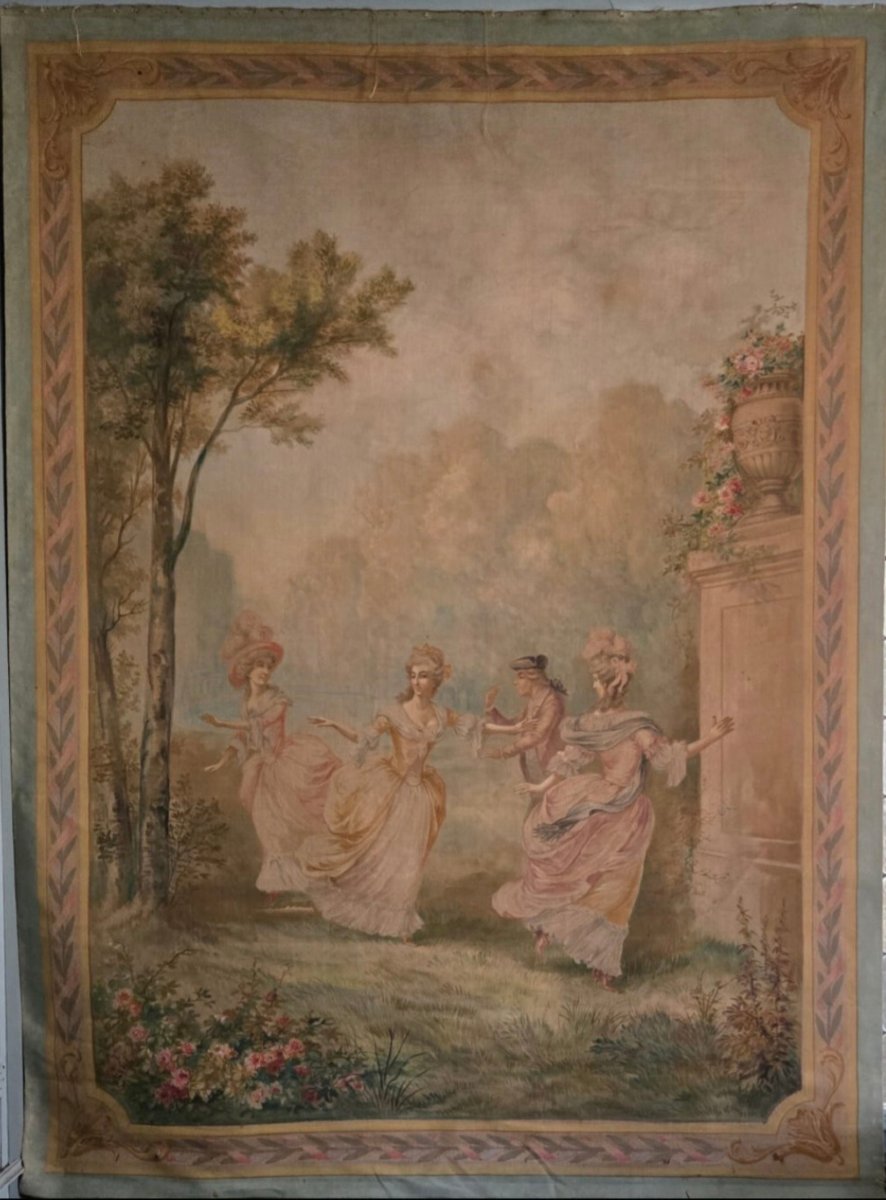
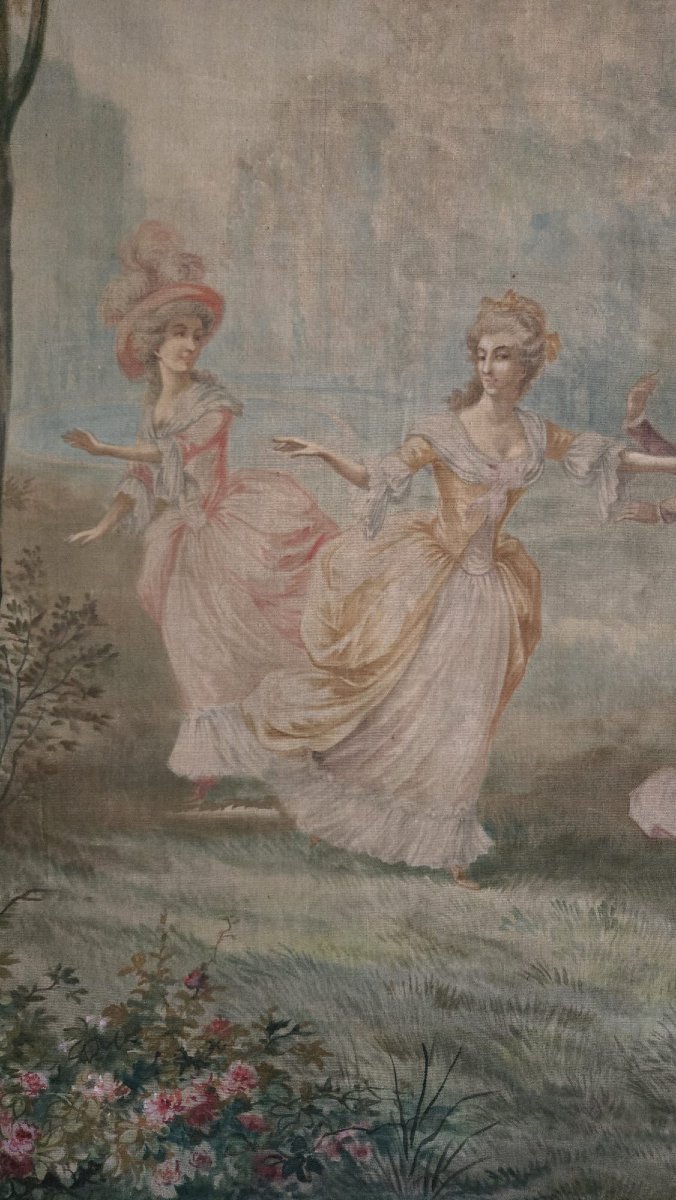
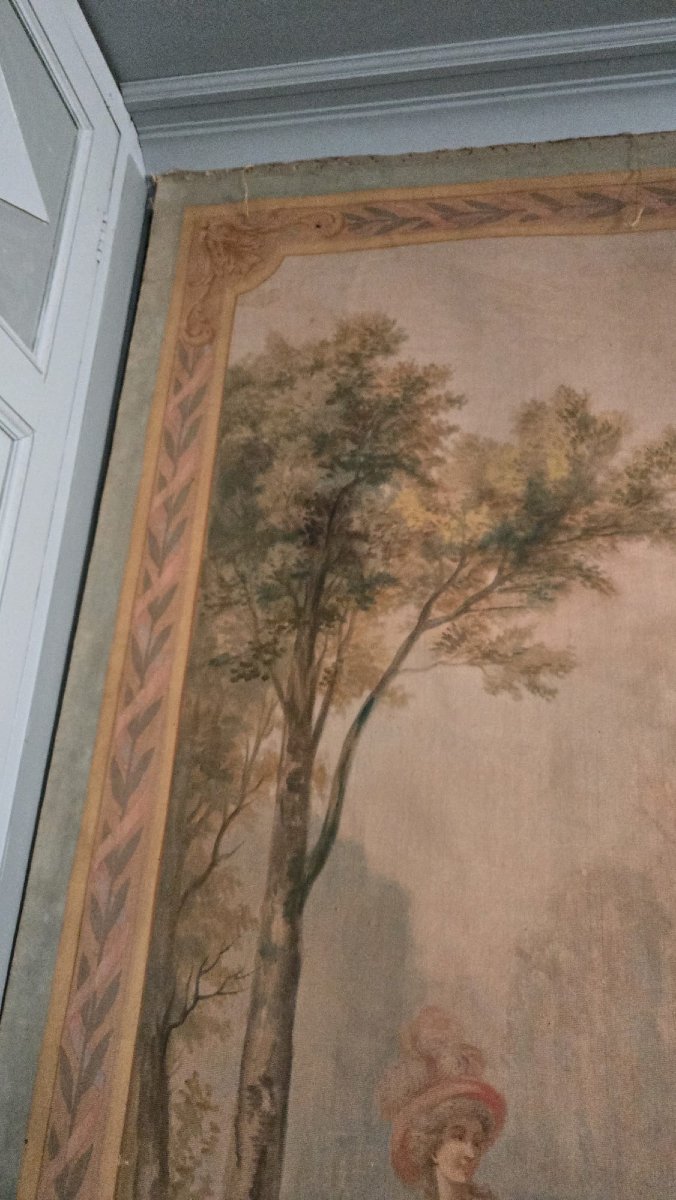
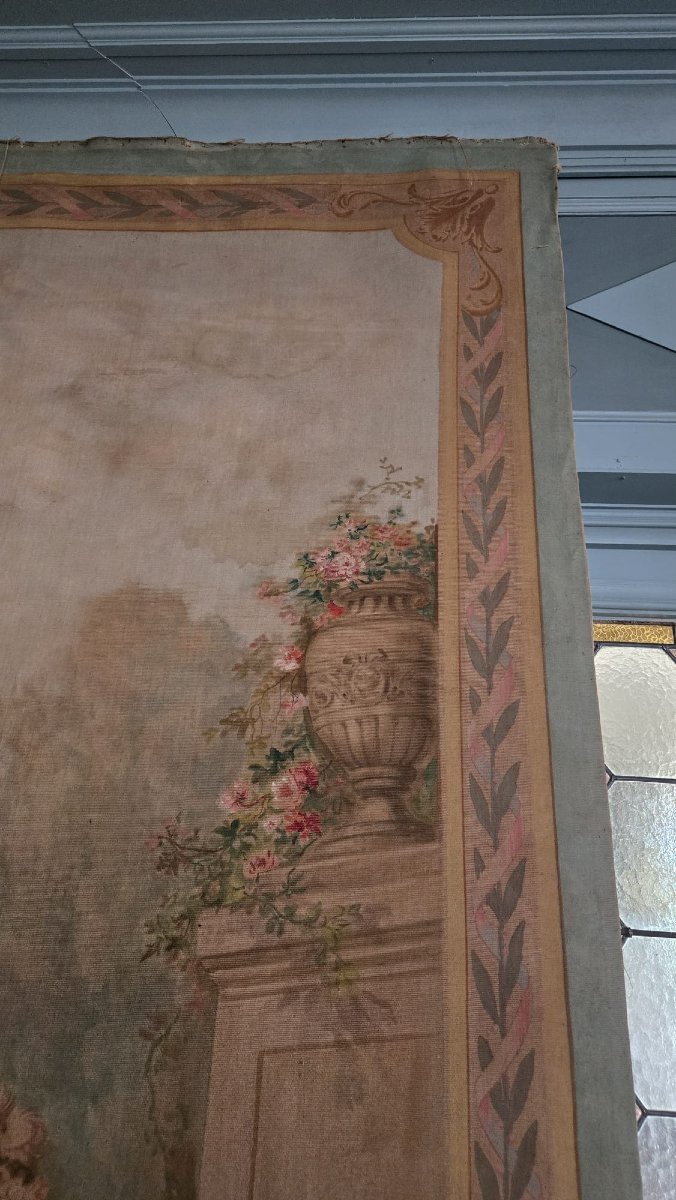
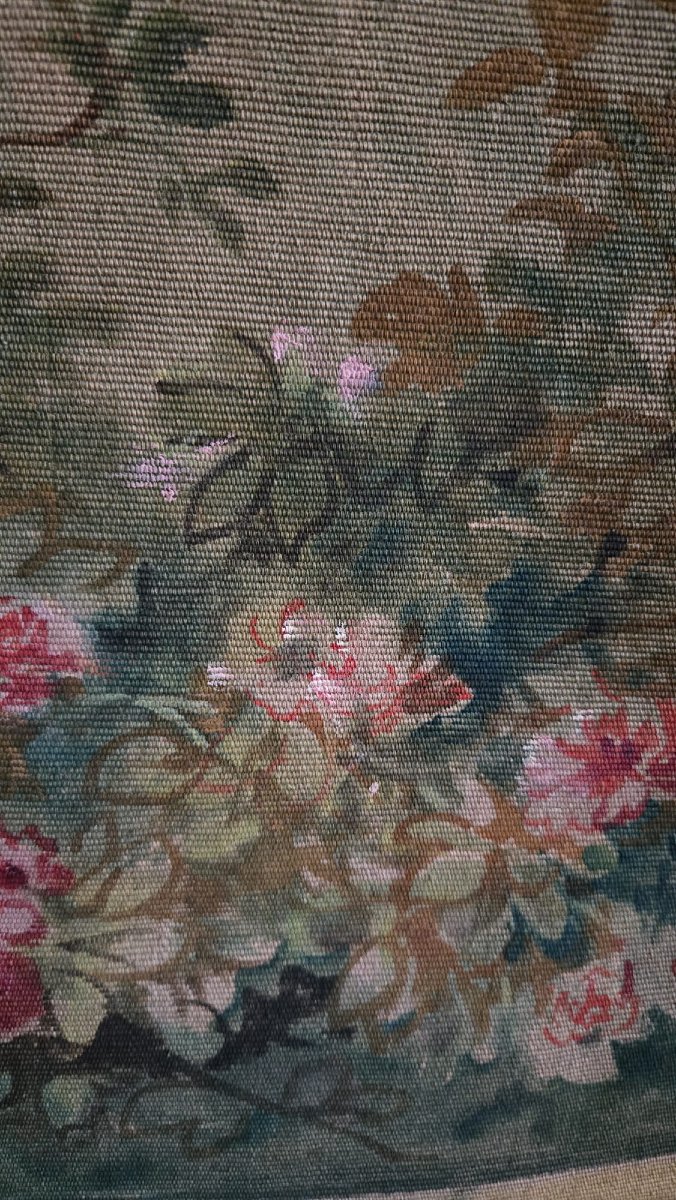
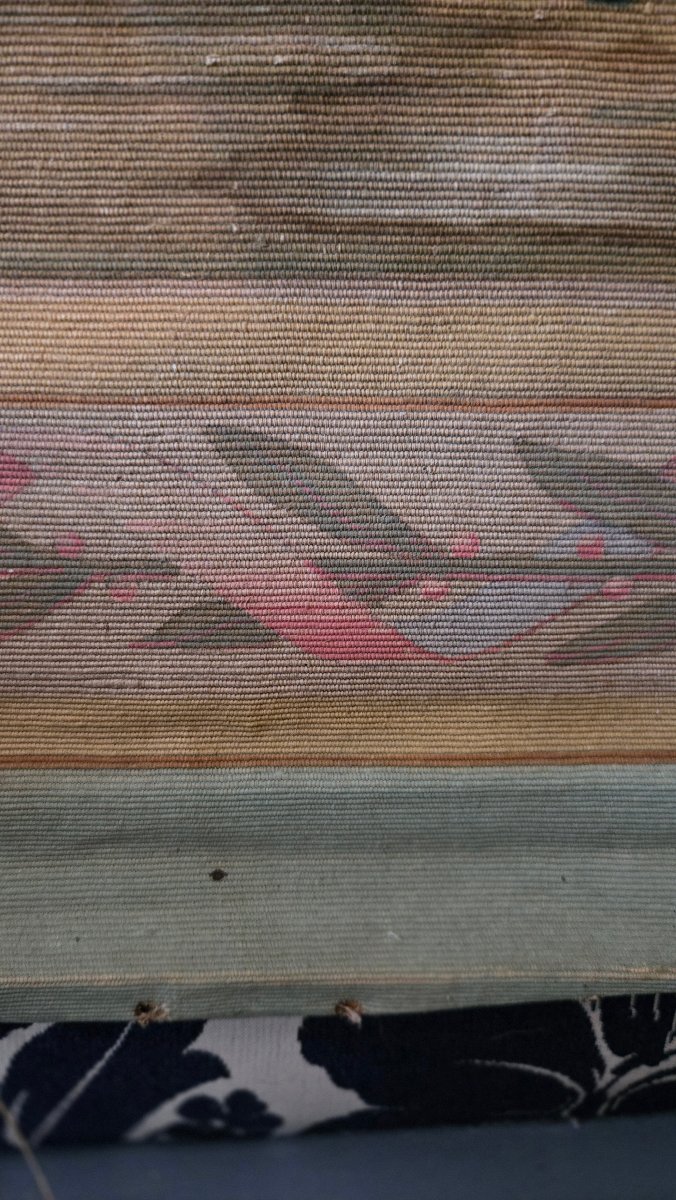
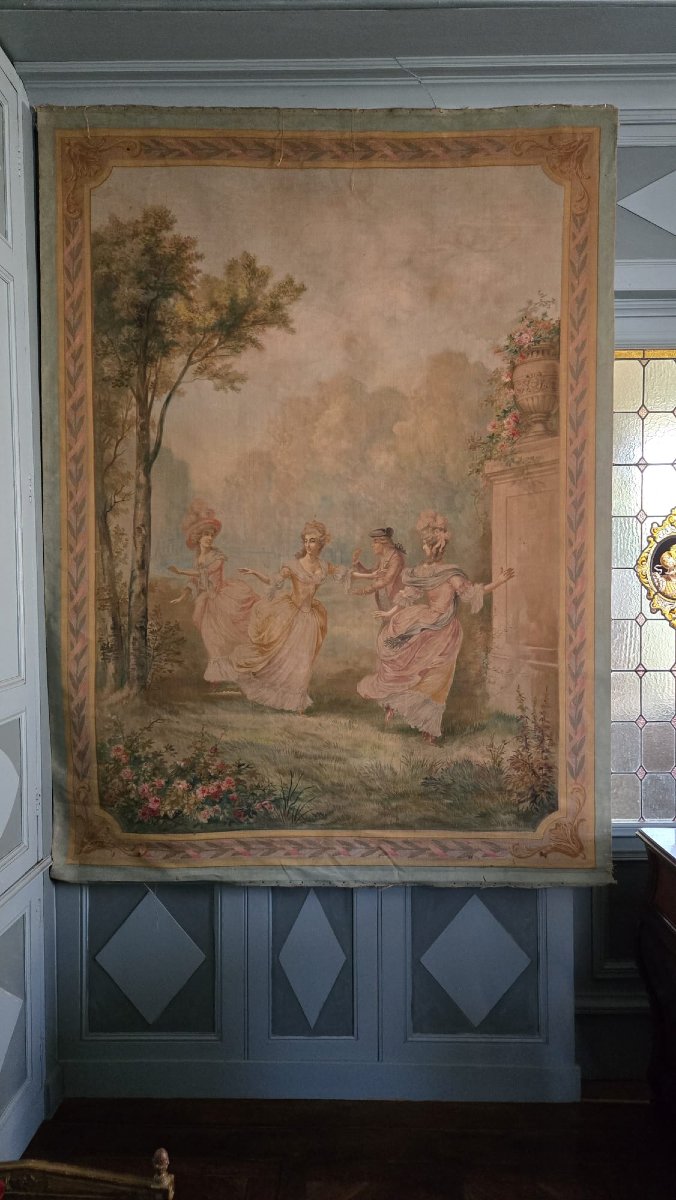


A large decorative tapestry depicting a scene of dancing and entertainment in a park, loosely inspired by the repertoire of 18th-century galant festivities.
At the center of the composition, four figures dressed in 18th-century fashion move in a light-hearted round dance. Three young women in flowing, colorful dresses accompany a young man; the figures’ gestures and the movement of the fabrics lend the scene a particularly lively quality.
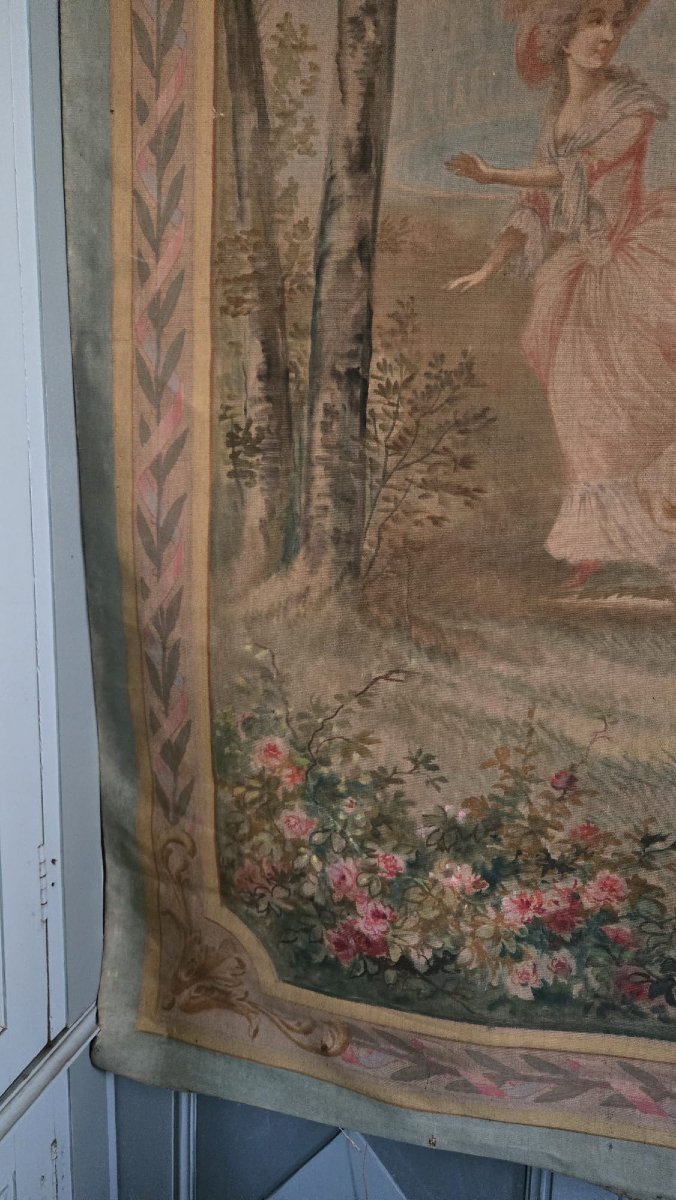
The group is set in a vast, tree-lined garden, opening onto a landscape rendered in soft, misty tones. On the right, a garden structure is topped by a large stone vase overflowing with flowers, while the foreground is enlivened by rosebeds and carefully detailed vegetation.
The composition thus draws on the vocabulary of courtly festivities and aristocratic entertainments popularized in the 18th century by Watteau, Lancret, Pater, and their followers, reinterpreted here in the decorative style of the late 19th century.
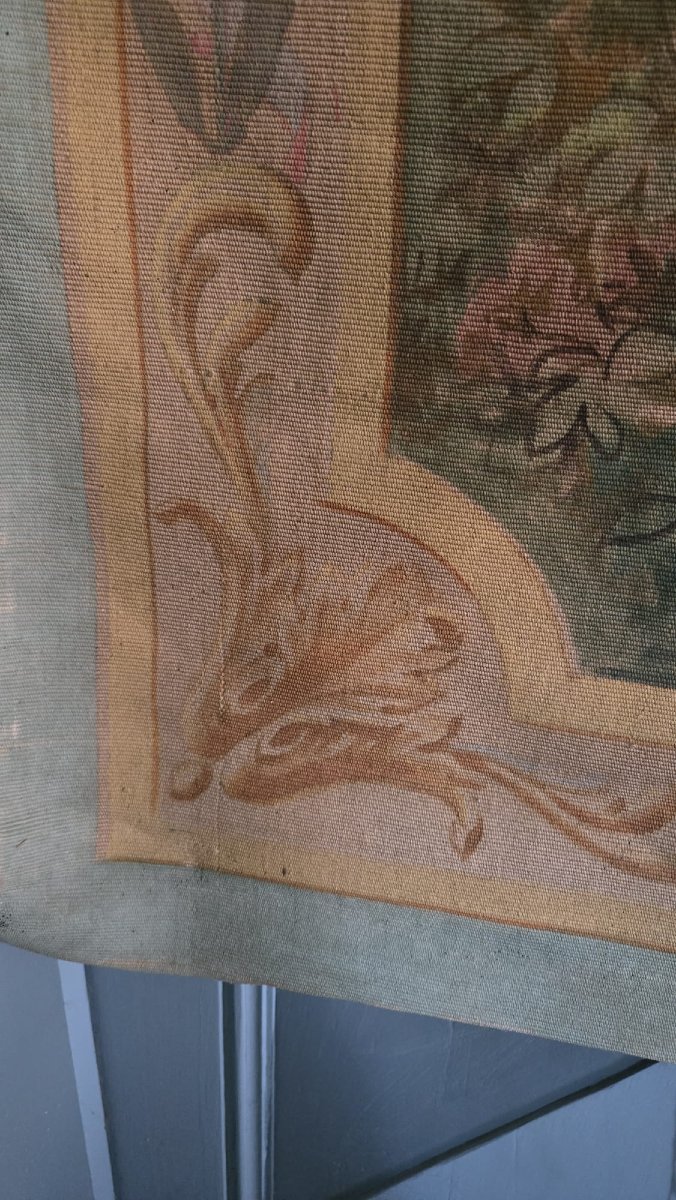
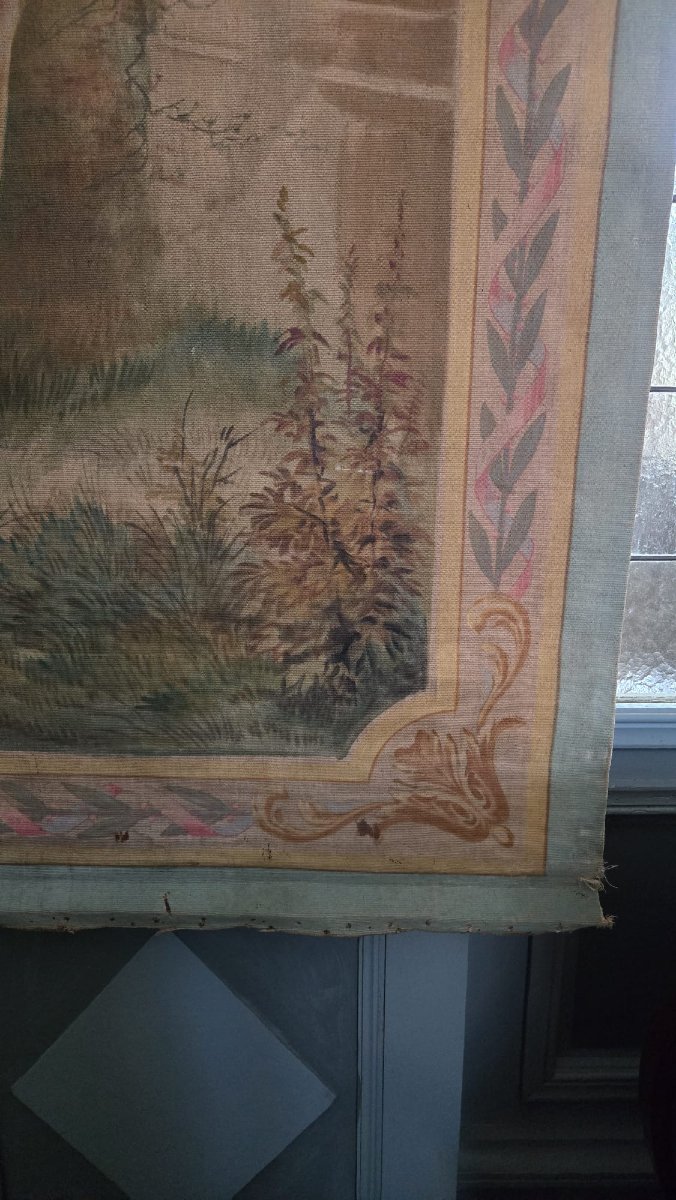
The entire design is surrounded by a wide border painted on the same fabric, adorned with a frieze of gray-green lanceolate leaves intertwined with a pink ribbon, finished at the corners with foliage motifs and framed by a broad celadon-green field.
A unique technique: tapestry painting
The design is not woven but painted directly onto a coarse-weave fabric, whose particularly pronounced weave remains deliberately visible beneath the colors. This texture of the fabric contributes to the desired effect: from a distance, the work takes on the appearance of a tapestry, while a closer examination reveals the painterly work.
This technique underwent significant development in the last third of the 19th century. As early as the 1860s, the Binant company in Paris began marketing canvases specially adapted for decorative painting and for imitating tapestries. The process was later described by Julien Godon, particularly for using paint to reproduce the appearance of tapestries from Flanders, the Gobelins, Beauvais, or Aubusson. At the 1900 Paris World’s Fair, this type of work constituted a recognized category known as “hand-painted tapestries,” created on coarse-weave fabrics. Similar works are also documented in Belgium during the same period.
There are no markings linking our textile to the Binant company or to a specific workshop; these elements therefore constitute technical and historical parallels that allow us to place the work within the context of this decorative production, which was then in vogue.
The reverse sides and the old folds along the edges are particularly interesting: they retain numerous regular marks from tacks corresponding to a former mounting that was stretched and nailed in place. Combined with the work’s monumental size and its border—designed to serve as a frame—this arrangement very likely indicates that it was intended as a panel in a decorative ensemble, probably integrated into wood paneling.
This painting is part of a set of three panels from the same provenance, executed using the same technique and featuring an identical border. The other two compositions are offered separately.
Original condition, with patina, discoloration, small stains, and isolated signs of wear consistent with its age, as well as traces of the original mounting. Some deterioration and fragility are visible at the edges. A beautiful harmony of pastel tones that have now naturally mellowed.
Dimensions: H. 230 × W. 170 cm.
At the center of the composition, four figures dressed in 18th-century fashion move in a light-hearted round dance. Three young women in flowing, colorful dresses accompany a young man; the figures’ gestures and the movement of the fabrics lend the scene a particularly lively quality.
The group is set in a vast, tree-lined garden, opening onto a landscape rendered in soft, misty tones. On the right, a garden structure is topped by a large stone vase overflowing with flowers, while the foreground is enlivened by rosebeds and carefully detailed vegetation.
The composition thus draws on the vocabulary of courtly festivities and aristocratic entertainments popularized in the 18th century by Watteau, Lancret, Pater, and their followers, reinterpreted here in the decorative style of the late 19th century.
The entire design is surrounded by a wide border painted on the same fabric, adorned with a frieze of gray-green lanceolate leaves intertwined with a pink ribbon, finished at the corners with foliage motifs and framed by a broad celadon-green field.
A unique technique: tapestry painting
The design is not woven but painted directly onto a coarse-weave fabric, whose particularly pronounced weave remains deliberately visible beneath the colors. This texture of the fabric contributes to the desired effect: from a distance, the work takes on the appearance of a tapestry, while a closer examination reveals the painterly work.
This technique underwent significant development in the last third of the 19th century. As early as the 1860s, the Binant company in Paris began marketing canvases specially adapted for decorative painting and for imitating tapestries. The process was later described by Julien Godon, particularly for using paint to reproduce the appearance of tapestries from Flanders, the Gobelins, Beauvais, or Aubusson. At the 1900 Paris World’s Fair, this type of work constituted a recognized category known as “hand-painted tapestries,” created on coarse-weave fabrics. Similar works are also documented in Belgium during the same period.
There are no markings linking our textile to the Binant company or to a specific workshop; these elements therefore constitute technical and historical parallels that allow us to place the work within the context of this decorative production, which was then in vogue.
The reverse sides and the old folds along the edges are particularly interesting: they retain numerous regular marks from tacks corresponding to a former mounting that was stretched and nailed in place. Combined with the work’s monumental size and its border—designed to serve as a frame—this arrangement very likely indicates that it was intended as a panel in a decorative ensemble, probably integrated into wood paneling.
This painting is part of a set of three panels from the same provenance, executed using the same technique and featuring an identical border. The other two compositions are offered separately.
Original condition, with patina, discoloration, small stains, and isolated signs of wear consistent with its age, as well as traces of the original mounting. Some deterioration and fragility are visible at the edges. A beautiful harmony of pastel tones that have now naturally mellowed.
Dimensions: H. 230 × W. 170 cm.
Explore similar pieces and discover your ideal find:
tapestries