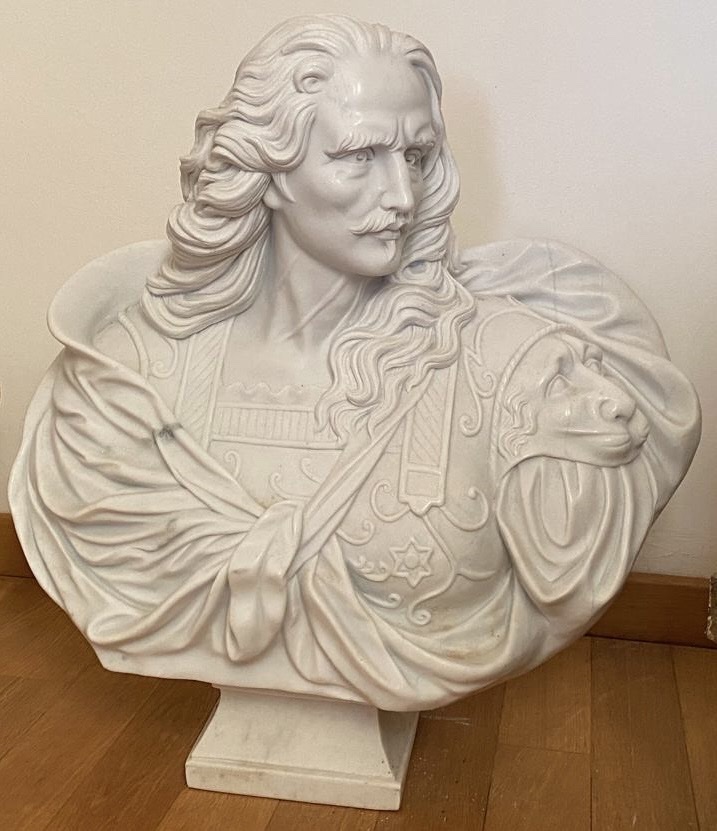
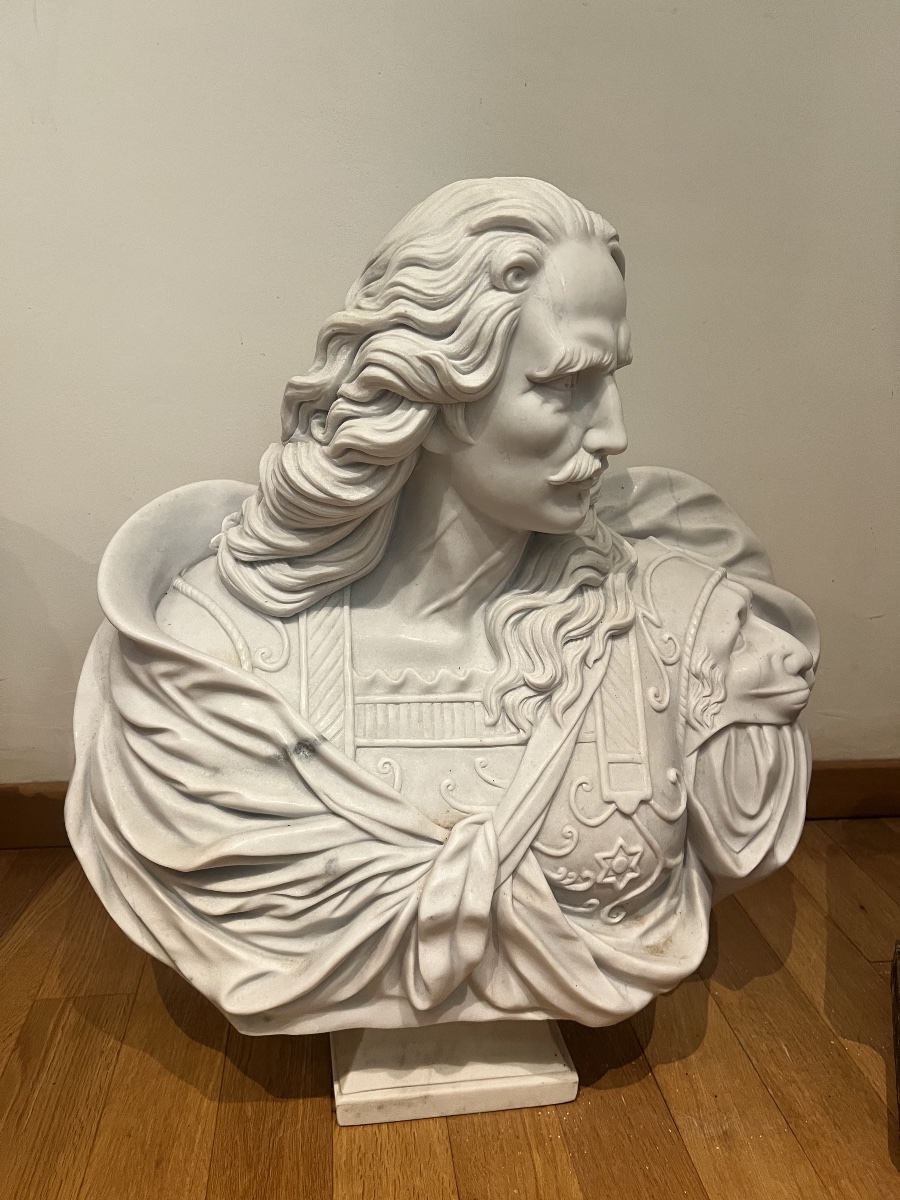
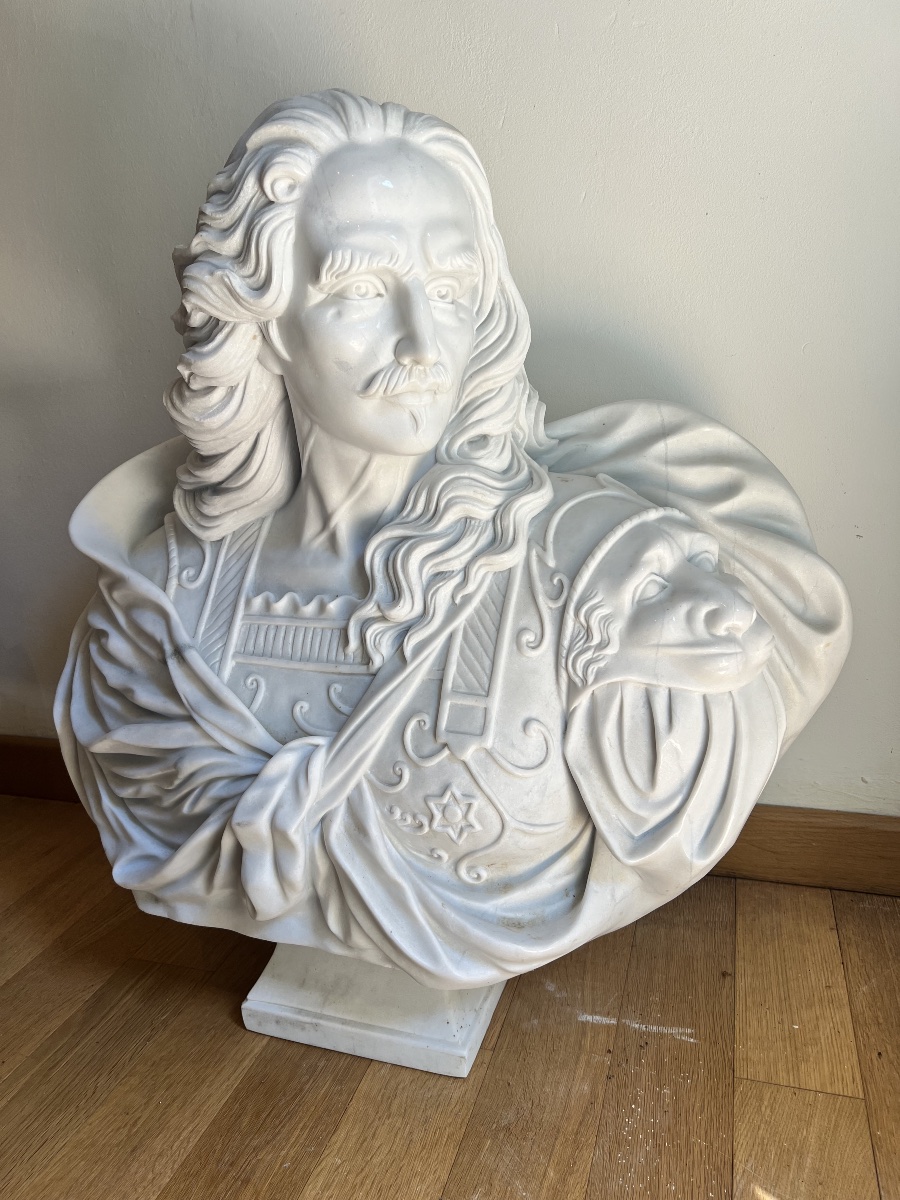
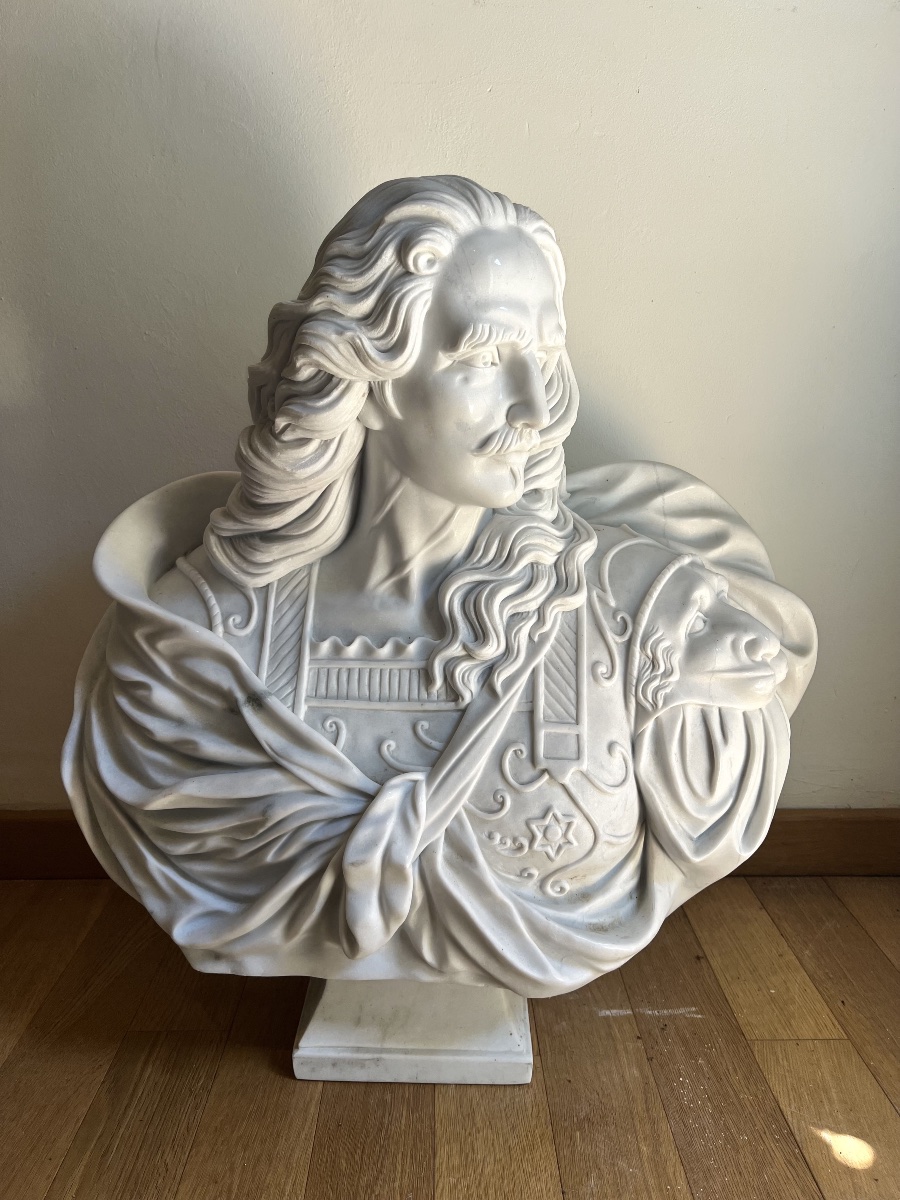
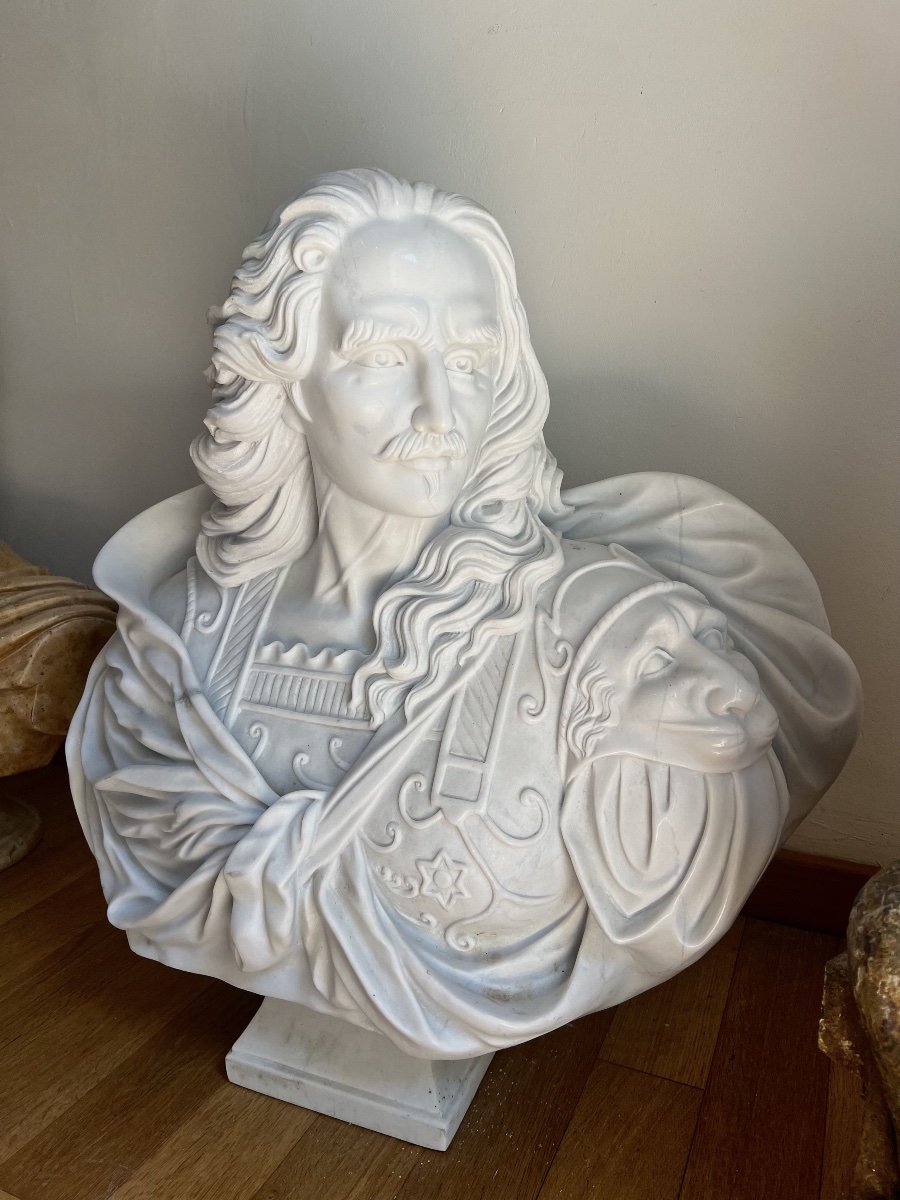
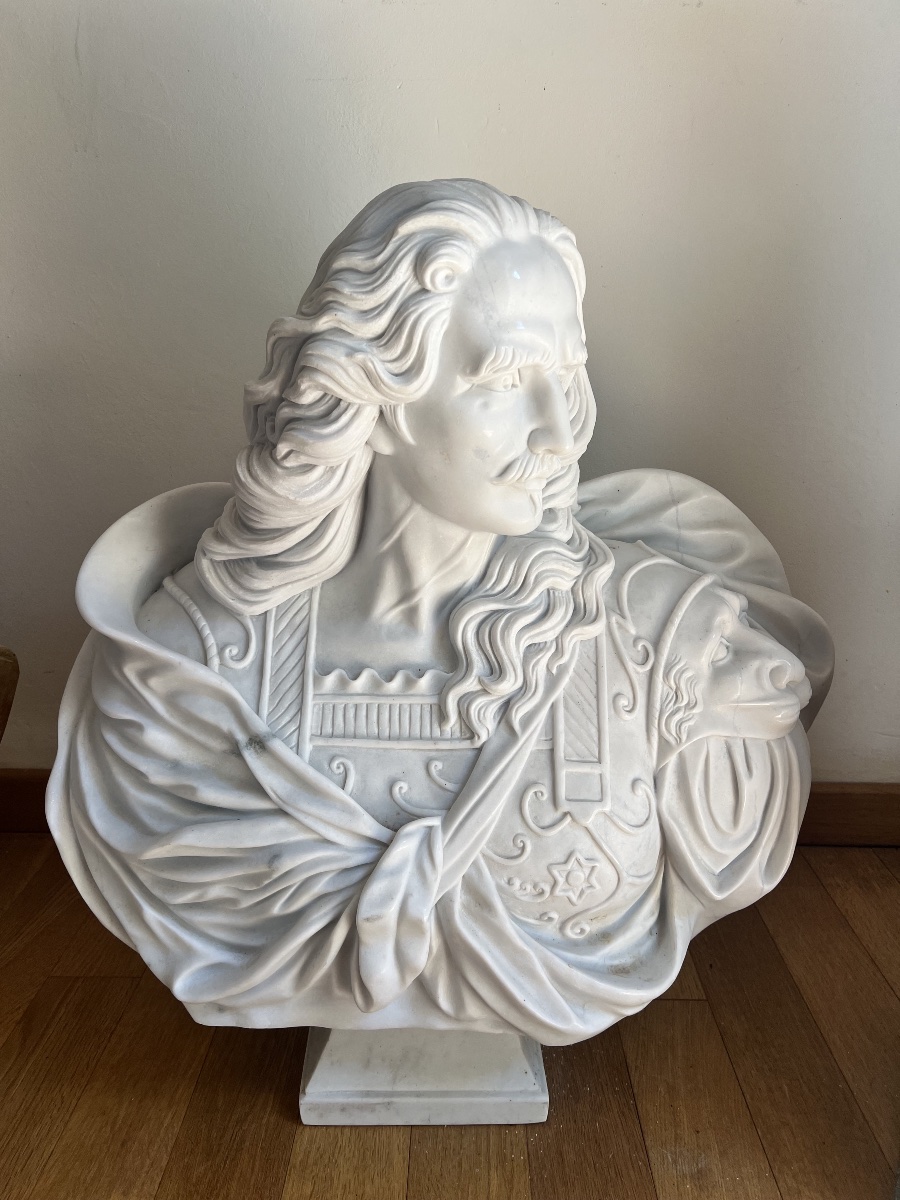


Large Bust Of Turenne In Carrara Marble – 20th Century
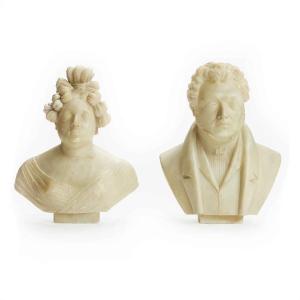
A magnificent and significant Carrara marble bust depicting Marshal de Turenne (1611–1675), one of the greatest military figures in French history.
Henri de La Tour d’Auvergne, Viscount of Turenne, was appointed Marshal of France in 1643 and became one of the most illustrious military leaders of the 17th century. He distinguished himself notably during the Thirty Years’ War and later in the wars waged during the reign of Louis XIV. His reputation as a strategist and his numerous victories earned him a prominent place in French military history. He was elevated to the rank of Marshal General of the King’s Camps and Armies in 1660.
This portrait is a true work of sculpture, particularly evident in the rendering of the face, hair, mustache, and various elements of the costume. The sculptor paid special attention to detail and form, giving the portrait remarkable presence and depth.
The quality of the Carrara marble—its beautiful whiteness and fine grain—particularly highlights the carving work and the subtleties of the modeling. The details of the costume and the face are rendered with great precision, giving the piece as a whole a particularly elegant appearance.
Created in the 20th century in a classical style, this significant sculpture follows in the tradition of portraits of historical figures and great French military leaders.
With its imposing dimensions—72 cm high and 75 cm wide—the sculpture has a striking decorative presence. It will naturally find its place in a distinctive home, a library, a living room, or alongside a collection of sculptures and objets d’art.
From the Thirty Years’ War to the War of Devolution, including the Fronde, Marshal de Turenne distinguished himself on numerous 17th-century battlefields. Alongside the great Condé and Vauban, the Viscount of Turenne contributed significantly to France’s military successes during the “Grand Siècle.” Without his invaluable marshals, the reign of Louis XIV would likely not have been so resplendent. Among these military leaders, Turenne is considered the most talented, distinguishing himself notably at the Battle of the Dunes and the Battle of Nördlingen.Born in Sedan in 1611 to Henri I de La Tour d’Auvergne, Duke of Bouillon, and Élisabeth de Nassau, of Dutch origin, Henri de Turenne was raised under the influence of his mother’s Reformed faith. He began his military career at the age of fifteen under the guidance of his uncles Maurice and Henri de Nassau, two princes of Orange who led the Dutch rebellion against Spain.
In 1630, Louis XIII called him into his service. France’s involvement in the Thirty Years’ War under Richelieu quickly allowed him to distinguish himself in the Rhineland under the command of Cardinal de La Valette. Appointed field marshal in 1635, he was wounded at Saverne and contributed in 1638 to the victory at Brisach, won by Bernard of Saxe-Weimar over the Imperial forces. In 1640, he was in Piedmont, where he captured Turin and Moncalvo.
These successes earned him the title of lieutenant general in 1642. After the capture of Trino in 1643, Turenne was awarded the marshal’s baton at the age of 32. In 1644, having been placed in command of the German army, he defeated the Bavarians at Donaueschingen, then at Freiburg. But he was taken by surprise and defeated at Marienthal by Mercy the following year. He took his revenge shortly thereafter alongside the Duke of Enghien at Nördlingen. In 1647, the intervention of the Swedes enabled him to invade Bavaria once again and force the Elector to agree to an armistice. Since the Bavarians failed to honor the terms of the armistice, the French resumed hostilities. Turenne’s victory over the Imperial forces at Sommershausen opened the way to Munich.
Period: 20th century
Style: Other Style
Condition: Excellent condition
Material: Marble
Width: 75
Height: 72
Depth: 38
Reference (ID): 1812653
Availability: In stock